Indiana households get raw milk through herdshares. No Indiana statute creates or authorises them, and none prohibits them either, and the state has not moved against farms operating share agreements, so the arrangement has run steadily for years. Understanding what Indiana does and does not regulate is the key to finding supply here.
Is raw milk legal in Indiana?
Direct sale for human consumption is not permitted. Indiana Code 15-18-1-21(a) provides that a person may not offer, display for sale, sell, deliver, or possess with intent to sell or deliver milk or milk products for human consumption unless every particle has been thoroughly pasteurized by board-approved equipment. The framework is administered by the Indiana State Board of Animal Health (BOAH) under 345 IAC Article 8, Rule 2 and Indiana Code 15-18-1.
Two routes exist alongside that prohibition, and both are in active use.
Route one: herdshares
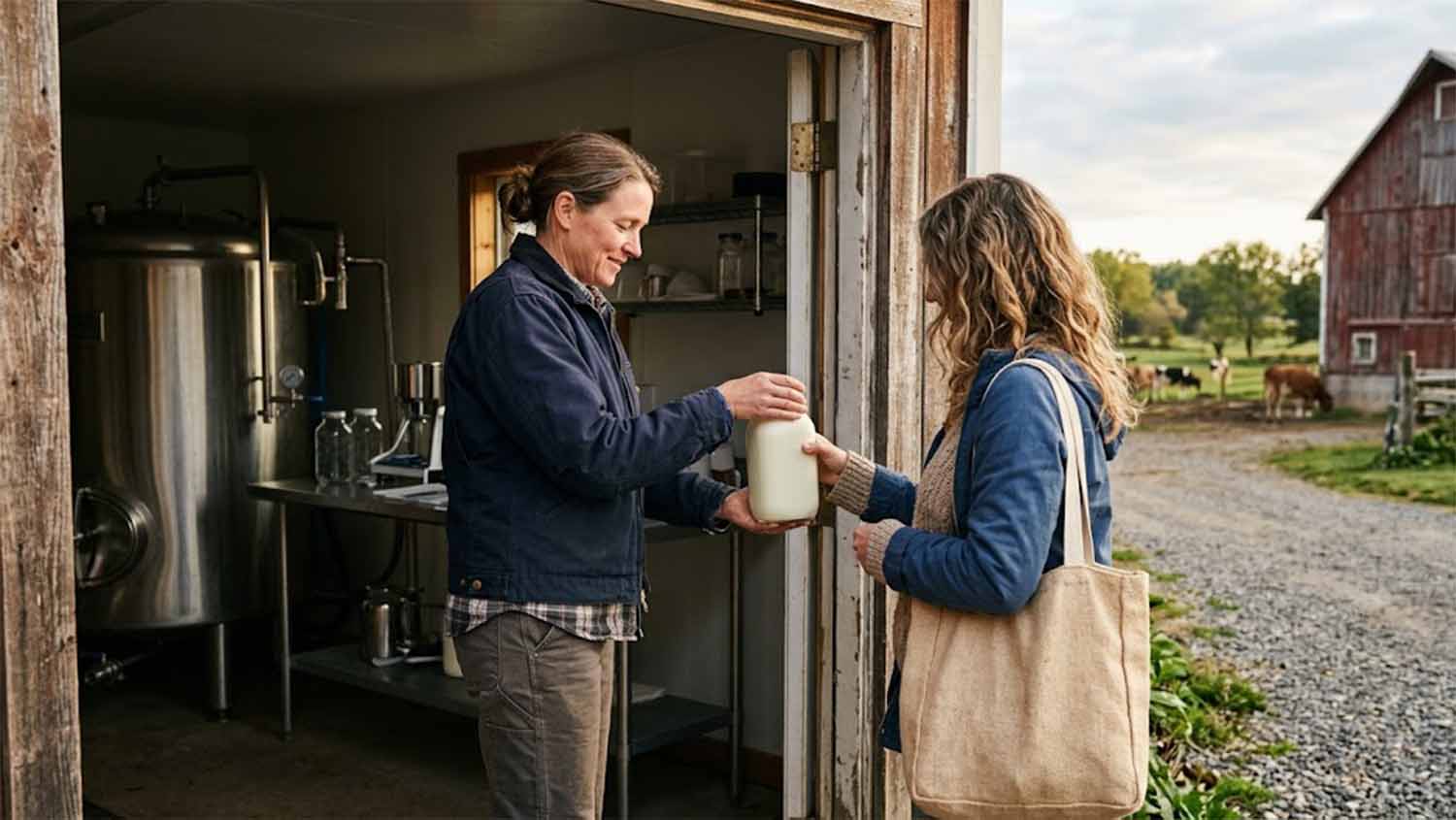
There is no law on herdshares in Indiana. The state is aware they exist and has taken no action to stop them, and a settled community of farms runs share agreements under which members own the animal and receive its milk as owners rather than purchasers. Because nothing in Indiana Code addresses the arrangement, there is no registration, no state list, and no application. You contract with a farm directly.
Be aware that some sources cite a specific Indiana Code section as authorising herdshares. No such provision exists in Title 15, and treating a herdshare as statutorily protected would be a mistake. It operates in a space the legislature has not addressed.
Route two: raw pet milk
Raw milk sold for pet consumption is separately lawful in Indiana, and a number of producers supply that market. Product is labelled as not intended for human consumption. This is a real and openly operating channel, and it is why you will see Indiana farms advertising pet milk where they cannot advertise raw drinking milk.
Advertising, and why farms are quiet
This is worth understanding before you start looking, because it shapes how you find supply. BOAH issued a food safety advisory on 9 March 2026 asking producers to remove references to "raw milk" from all advertising platforms, including social media, websites, yard signage, farmers market stalls and farm stores, unless the advertising clearly indicates the product is not intended for human consumption.
The practical consequence is that Indiana producers say very little publicly, or present themselves as pet milk suppliers. Searching online for "raw milk" plus an Indiana town will return much less than the same search in Pennsylvania or Arizona. That is a function of advertising rules, not of scarce supply.
How to find a herdshare in Indiana
Word of mouth and local networks carry more weight here than anywhere in the surrounding region. Productive routes include food cooperatives and buying clubs, Weston A. Price Foundation chapter contacts, homesteading and natural parenting groups, farmers market conversations with vegetable and egg growers who often know local dairies, and health food shops whose staff know the community.
Geographically, the northern counties around Elkhart, LaGrange and Adams have Indiana's largest Amish settlements and a corresponding density of small dairies. Central and southern farming counties serve Indianapolis, Fort Wayne, Bloomington, and the Louisville and Cincinnati fringes. Daviess County in the southwest has another substantial Amish community.
Crossing state lines
Indiana sits next to states with meaningfully different rules, which is useful if you are near a border. Michigan to the north recognises herdshares by written policy and permits cream and butter to shareholders. Illinois to the west allows permitted on-farm sales outright, so no share agreement is needed. Ohio to the east relies on herdshares. Kentucky to the south has its own framework. Federal law at 21 CFR 1240.61 restricts interstate commerce in raw milk, though the FDA has stated it has never taken and does not intend to take enforcement action against an individual transporting raw milk across a state line solely for personal consumption.
What is changing
Reform bills recur in the Indiana legislature, and the national trend is toward expanded access, with more than 40 pro raw milk bills introduced across 18 states in the current session. Indiana's large Amish farming population and strong agricultural base give any licensed framework a ready supply of producers. For the federal framework, see the United States raw milk laws overview.