Missouri has one of the most accommodating farm-direct frameworks in the country, and the detail that makes it unusual is this: a producer needs no permit at all to sell raw milk and raw cream at the farm or to deliver it to you. A permit is optional, and taking one unlocks farmers market sales on top.
Is raw milk legal in Missouri?
Yes, through a two-tier structure that is worth understanding because it determines where you can meet a producer.
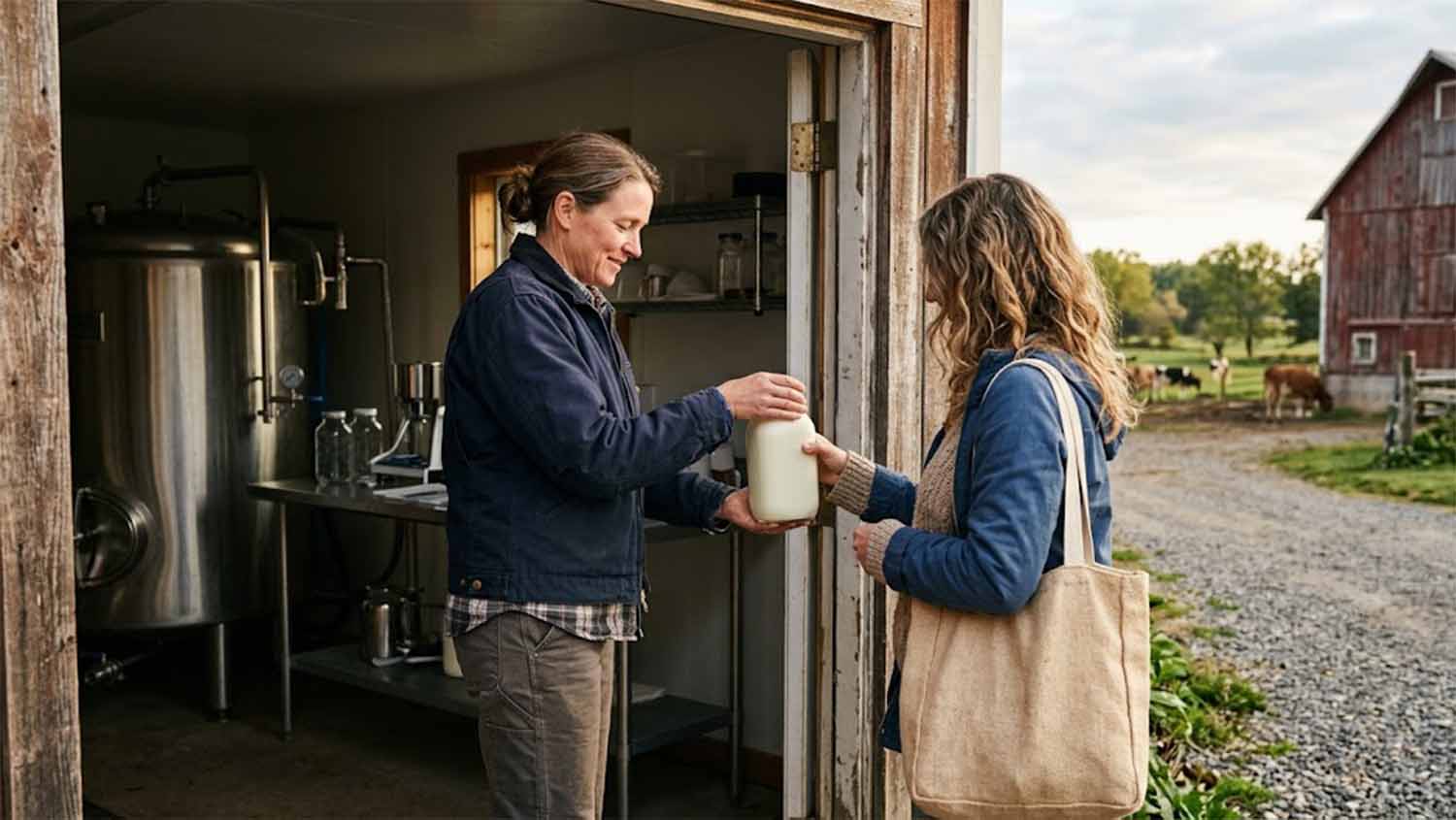
Without a permit, a Missouri producer may sell raw milk and raw cream on the farm, and may deliver direct to the consumer. Delivery without any permit requirement is rare among US states and is the single most useful feature of Missouri law for buyers.
With a permit from the Missouri Milk Board, a producer may additionally sell at farmers markets and other direct-to-consumer venues. Permitted producers meet herd health, testing, sanitation and labelling requirements. The framework sits in Missouri Revised Statutes chapter 196 with associated regulations at 9 CSR 90-25.
Retail store sales are not part of either tier, so you will not find raw milk on a Missouri grocery shelf.
Why the two-tier structure matters
It lowers the barrier at both ends. A small family dairy can begin selling at the gate and running a delivery route without navigating any permit process, which means Missouri has more small producers than a licensing-only state would. A producer wanting a market stall then steps up to a permit voluntarily. For buyers this means the market includes both very small unpermitted operations and more established permitted dairies, and you can choose accordingly.
What you can buy
Raw milk and raw cream are both expressly covered, which not every state allows and which matters if you want to make butter or want cream for its own sake. Cow milk predominates; goat dairies operate across the Ozarks and are a good option if you are seeking goat milk.
Aged raw milk cheese is separately legal throughout Missouri under the federal 60 day rule, with no permit or arrangement needed on the buyer's side.
How to find a producer
Farmers markets are the most visible route wherever producers hold permits, and Missouri has an active market culture. Delivery is widely used around Kansas City, St Louis, Springfield and Columbia, and many small dairies run weekly routes into nearby towns, so buyers often do not need to travel at all.
Farms operate across the Ozarks, central Missouri, the northern counties and the southwest around Springfield. Missouri has substantial Amish and Mennonite communities, including around Jamesport in Daviess County and Seymour in Webster County, with traditional dairying. Food cooperatives, farmers market conversations, buying clubs and local food directories are all productive, and because sale is lawful, producers can advertise and be approached openly.
Crossing state lines
Missouri is generally the most permissive option in its region, so the traffic tends to run inward. Kansas to the west allows on-farm sales with no permit and, since 2019, unrestricted advertising, but no delivery, so Kansas City buyers may find Missouri delivery routes more convenient. Iowa to the north permits licensed farm-direct sales and delivery. Arkansas to the south expanded substantially in 2025 to cover farmers markets, natural food stores and delivery with no volume cap, and is well worth knowing about if you are in southern Missouri. Illinois, Kentucky, Tennessee, Oklahoma and Nebraska complete the border. Federal law at 21 CFR 1240.61 restricts interstate commerce in raw milk, though the FDA has stated it has never taken and does not intend to take enforcement action against an individual transporting raw milk across a state line solely for personal consumption. For the federal framework, see the United States raw milk laws overview.