Does Raw Milk Contain Lactase?
A widely repeated claim holds that raw milk contains lactase, the enzyme that digests milk sugar, which is why lactose-intolerant people can drink it without trouble. It appears in wellness content, advocacy forums, and word-of-mouth testimonials from people who believe lactase in raw milk explains their newfound access to the world of (successfully digesting) dairy. This is inaccurate.
Origin and Function of Lactase
Lactase (technically classified as beta-galactosidase, EC 3.2.1.108) is an enzyme that cleaves the disaccharide lactose into two component monosaccharides: glucose and galactose. Those simpler sugars are then absorbed through the intestinal wall into the bloodstream. Without sufficient lactase activity in the small intestine, lactose passes undigested into the colon, where gut bacteria ferment it and produce the gas, bloating, and discomfort associated with lactose intolerance.
Lactase is produced in the brush border of the small intestine, specifically in the microvilli lining the jejunum. It is a product of the intestinal epithelium, not of the mammary gland. The cow’s udder does not synthesize or secrete lactase. This is not a contested point in dairy science. The FDA’s review of indigenous milk enzymes states directly: “There is no indigenous lactase in milk” (U.S. FDA, Raw Milk Misconceptions and the Danger of Raw Milk Consumption). The extensive catalog of enzymes present in bovine milk includes lipases, plasmin, lactoperoxidase, lysozyme, and alkaline phosphatase, but lactase is absent because the mammary gland simply doesn’t produce it. For a full overview of the enzymes that are present in raw milk, see the list of enzymes found in unpasteurized raw milk.
Why Trace Lactase Activity Can Still Appear in Bottled Raw Milk
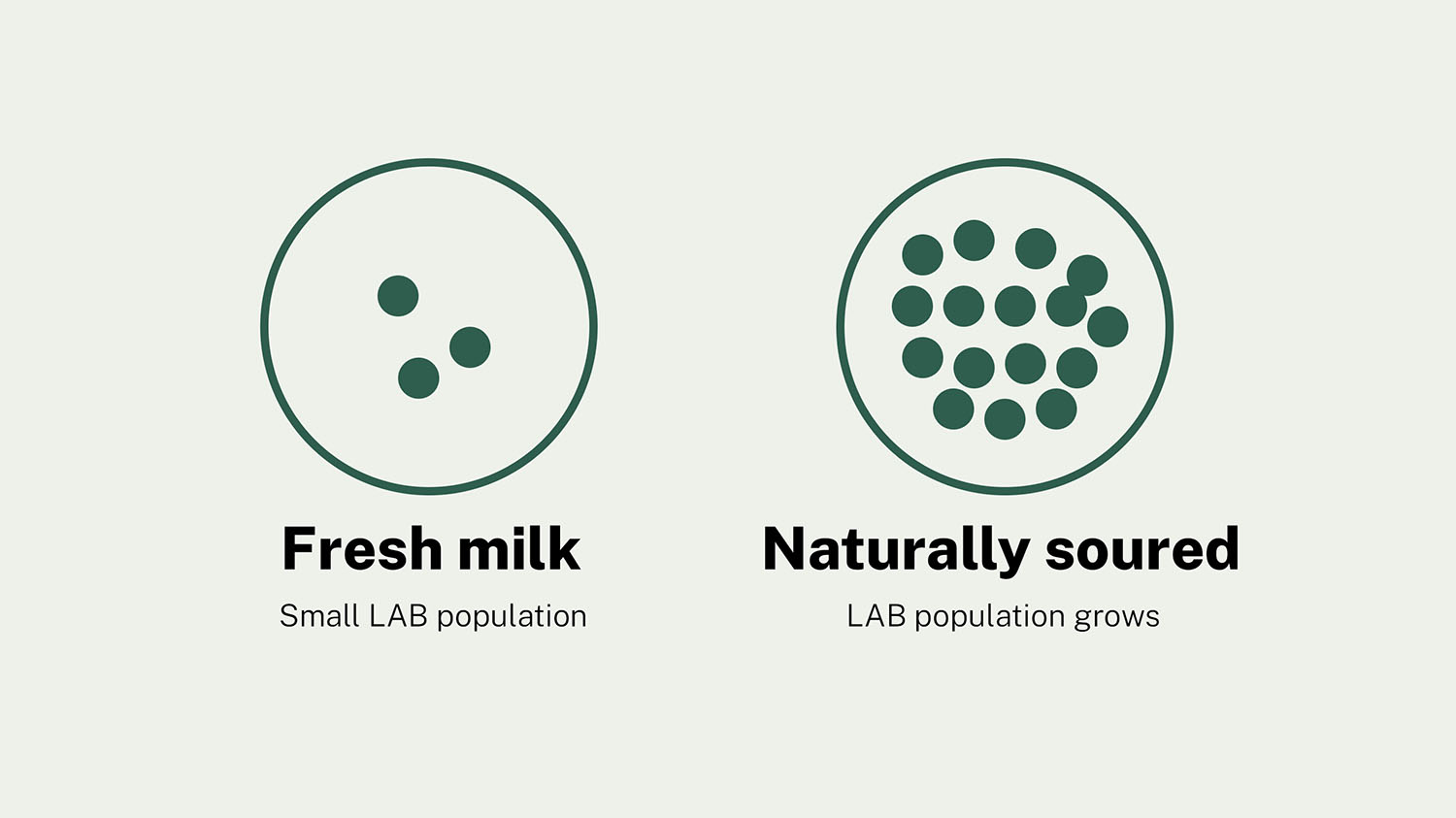
While no lactase is produced by the mammary gland, milk doesn’t remain sterile for long after leaving the udder. A 2013 review in FEMS Microbiology Reviews (Quigley et al.) notes that milk in a healthy udder is thought to be sterile, but it becomes colonized almost immediately by microorganisms from the teat apex, milking equipment, air, bedding, feed, and the surrounding farm environment. That incoming microbial community includes lactic acid bacteria (LAB) such as Lactobacillus, Leuconostoc, and Enterococcus, and certain LAB strains are well-documented producers of beta-galactosidase. This is the enzyme they use internally to metabolize lactose as an energy source, and it begins accumulating in the milk as a byproduct of that activity.
As bacteria in the milk begin metabolizing lactose, they express beta-galactosidase intracellularly. As bacterial cells eventually lyse, some of that enzyme releases into the surrounding milk. The longer raw milk sits at warmer temperatures, the more bacterial growth occurs and the more microbial lactase accumulates. Taken to completion, this process produces kefir, cultured buttermilk, and other fermented dairy products with significant, purposeful beta-galactosidase concentrations.
Refrigeration slows this process substantially. A 2020 study in Microbiome (Xiong et al.) analyzed over 2,000 retail milk samples and found that refrigerated raw milk microbiota remained stable and was frequently dominated not by LAB but by Pseudomonadaceae, Gram-negative psychrotrophic bacteria that don’t produce beta-galactosidase. LAB populations were present at limited levels in retail raw milk stored at 4°C.
Fresh, properly refrigerated raw milk therefore contains trace beta-galactosidase as a byproduct of minor bacterial activity, not as a native milk enzyme. The cow contributes nothing to that trace amount. Pasteurization kills the bacteria responsible and destroys any microbial enzyme they have produced, which is why lactase activity is lower in pasteurized milk, but the amounts in fresh raw milk were already far too small to be physiologically relevant.
Lactic Acid Bacteria, Raw Milk Cheese, and the Limits of Starter Culture
The lactic acid bacteria responsible for that trace microbial lactase in fresh raw milk are the same organisms at the center of what makes raw milk cheese distinct from anything made with pasteurized milk. Research published in Food Control(Masoud et al., 2012) establishes that raw milk cheeses develop more diverse and intense flavor than pasteurized milk cheeses, with that complexity linked directly to the earlier and more extensive development of the raw milk microflora and to differences in proteolysis patterns it drives during ripening. Pasteurization eliminates that community, and no combination of added starter cultures fully recreates it.
Beyond artisan preference, this relationship is built into regulatory frameworks for some of the world’s most recognized cheeses. A 2023 study in Frontiers in Microbiology documented how natural whey and raw milk cultures, produced by selectively enriching the indigenous microbiota of raw milk itself, are required by the standards of identity for several European protected designation of origin (PDO) cheeses because a strict relationship is recognized between their use, the territory of production, and the character of the finished cheese. This is the dairy equivalent of terroir in winemaking: the microbial community in the milk reflects the specific farm environment it came from, and that community shapes flavor in ways that can’t be standardized or reconstructed from freeze-dried starter culture.
The non-starter LAB (NSLAB) that originate from the farm and dairy environment, entering raw milk as natural contaminants in very low concentrations, are the organisms that become dominant during aging and drive much of what distinguishes a well-made aged raw milk cheese. A review in FEMS Microbiology Reviews warns that industry trends toward standardization of inocula and ripening conditions risk losing the empirically derived biodiversity that defines traditional regional cheeses. Those organisms survive the physical and chemical stresses of cheesemaking precisely because they evolved in that environment, an adaptation that no added culture can replicate.
Does Trace Lactase in Raw Milk Reduce Lactose Intolerance?
A randomized controlled pilot study published in the Annals of Family Medicine (Gardner et al., 2014, Stanford University) enrolled 16 adults with confirmed lactose malabsorption and put them through an 8-day escalating-dose protocol comparing raw milk, pasteurized milk, and soy milk. Lead author Dr. Christopher Gardner noted the result showed “no hint of any benefit” from raw milk relative to pasteurized milk for lactose malabsorption or intolerance symptoms. The microbial beta-galactosidase present in raw milk was insufficient to affect measurable lactose digestion outcomes.
Kefir and other fermented raw dairy products work because LAB have been given time and conditions to multiply to high concentrations and produce substantial quantities of lactase, enough to pre-digest a meaningful portion of the lactose before consumption and to deliver live bacteria with active enzyme into the gut. Fresh raw milk, refrigerated for consumer sale, is nowhere near that stage of fermentation.
Widespread Reports of Improvement Deserve a Better Explanation
Reports from people who switched from conventional pasteurized milk to raw milk and found their digestive symptoms resolved are widespread and have accumulated across raw milk communities for decades. The question isn’t whether the experience is real; for many people it clearly is. The question is what’s actually causing it.
Lactase is not the explanation. Multiple variables change simultaneously when someone makes this switch. Raw milk sold directly from farms is almost always whole fat. Many people who develop symptoms labeled as “lactose intolerance” were drinking ultra-pasteurized, low-fat, or skim milk, products processed at higher temperatures, stripped of fat, and often consumed without a meal. The protein composition also changes: conventional dairy herds are predominantly A1 cattle, while many raw milk farms, particularly smaller and heritage operations, work with A2 breeds or mixed herds. A1 and A2 beta-casein proteins are processed differently during digestion, and some research suggests A1-derived peptides may contribute to gastrointestinal discomfort independent of lactose. These threads warrant their own treatment, but they offer more scientifically plausible mechanisms than lactase.
What isn’t in dispute is the significance of the outcome, whatever its cause. Finding a dairy product that the body tolerates opens up an entire category of food, including cheese, butter, cream, and kefir, that was previously off the table. That is a meaningful quality-of-life change, and it’s worth understanding accurately rather than attributing it to a mechanism that doesn’t hold up to scrutiny.
Dairy Products with Documented Benefit for Lactose Intolerance
The dairy products that demonstrably reduce lactose intolerance symptoms are those where fermentation has produced substantial beta-galactosidase activity. Fermented raw dairy products like kefir and aged raw milk cheese occupy this territory, with the fermentation process doing the work rather than the raw status of the milk itself.
Commercially produced lactose-free milk achieves the same end through industrial means: beta-galactosidase, typically derived from Kluyveromyces lactis yeast, is added to pre-hydrolyze the lactose before packaging. A 2011 study in the Journal of Dairy Science (Horner et al.) confirmed that this enzymatic hydrolysis process works equally well in raw and pasteurized milk at refrigerated temperatures, underscoring that the milk matrix itself has no bearing on beta-galactosidase function. The enzyme must be present in sufficient quantity from whatever source, and fresh raw milk simply doesn’t provide it.
On a broader nutritional point, research has consistently shown milk to be an exceptionally hydrating beverage, significantly more effective than water, sports drinks, orange juice, and other common options, partly due to its electrolyte content and slower gastric emptying. For more on that, see milk hydrates better than water, sports drinks, orange juice, and more.
Conclusions
Raw milk does not contain lactase as a native enzyme. The mammary gland produces none. Trace beta-galactosidase activity in bottled raw milk is microbial in origin, a byproduct of the natural bacterial community that colonizes milk after collection, and is present in amounts too small to affect lactose digestion. Attributing lactose tolerance to lactase in raw milk is not supported by the biology or by controlled clinical evidence.
Widespread reports of improved dairy tolerance after switching to raw milk are real and worth investigating. But the mechanism, wherever the research eventually lands, is not lactase. The enzyme that unlocks lactose for human digestion is made in the gut, not in the bottle.