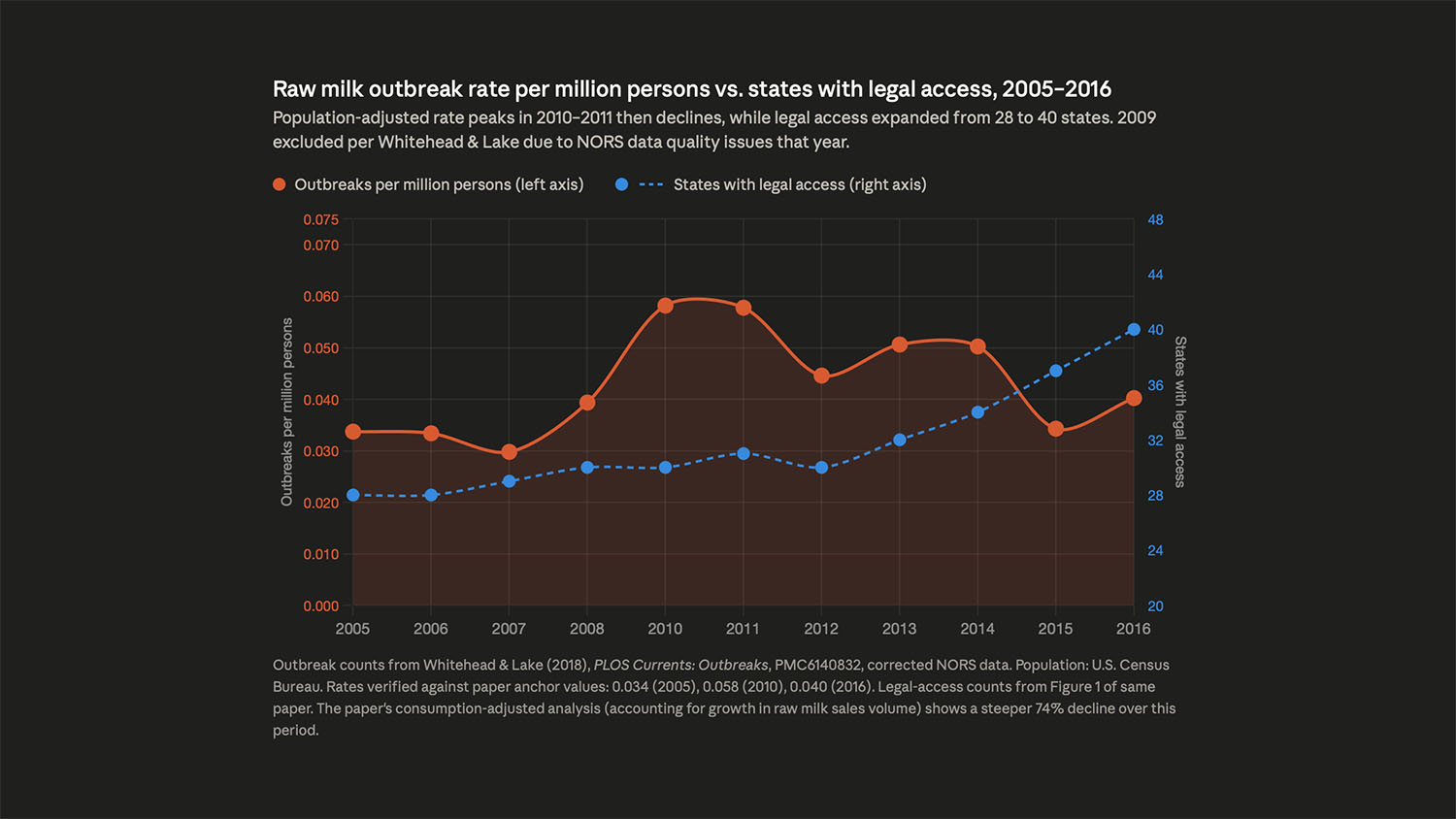
Raw Milk Legalization and Foodborne Illness: Outbreaks Have Not Kept Pace With Access
A recurring argument against legalizing raw milk is that states allowing sales have more outbreaks. The studies behind that claim are real, and their counts are accurate. What they did not measure is how many people in each state drink raw milk. Studies that do account for consumption find the outbreak rate falling as legal access expanded.
The studies behind the claim
Three studies published in CDC venues form the basis of the argument:
| Study | Period | Finding |
|---|---|---|
| Langer et al. 2012, Emerging Infectious Diseases | 1993 to 2006 | States where raw milk sale was legal had more than twice the outbreak rate of states where it was prohibited |
| Mungai et al. 2015, Emerging Infectious Diseases | 2007 to 2012 | Outbreaks linked to nonpasteurized milk increased; further legalization projected to bring more |
| Koski et al. 2022, Epidemiology and Infection | 1998 to 2018 | States allowing sales had 3.2 times as many outbreaks as states prohibiting them; retail states had 3.6 times as many as farm-only states |
Koski et al. is the most recent and is the study the American Academy of Pediatrics cites in its 2026 policy statement calling for a nationwide ban. From 2013 to 2018 it counted 75 raw milk outbreaks with 675 illnesses, and found that 58 of 74 single-state outbreaks (78%) occurred in states where sale was expressly allowed.
What the counts leave out
All three studies compare outbreak counts between states grouped by legal status. People drink far more raw milk in states where it is legal and sold in stores, so those states would be expected to record more outbreaks even if each glass carried the same risk. A count comparison cannot distinguish “legal access makes raw milk more dangerous” from “legal access means more people drink it.”
Koski et al. acknowledge this directly. The authors write that their comparisons “did not control for true population at risk (i.e., those who drink unpasteurised milk) within each jurisdiction because this information is not collected through NORS,” and that accounting for the number of consumers “could help assess if the observed rates of illness are influenced by the size of the exposed populations and not merely the legal status of the states in which they reside.”
The same paper also found that the average size of outbreaks did not increase over time, even as the number of outbreaks rose.
What consumption-adjusted data shows
Whitehead and Lake 2018, published in PLOS Currents: Outbreaks, reanalyzed CDC outbreak data from 2005 to 2016 with consumption taken into account. Because no national consumption data exists, the authors used the number of licensed raw milk dairies as a proxy. Across nine states with available records, licensed dairies rose from 76 to 347 over the period, an increase of 357%.
Raw milk outbreaks rose from 10 a year in 2005 and 2006 to a peak of 18 in 2010 and 2011, then fell: 14 in 2012, 16 in 2013 and 2014, 11 in 2015 and 13 in 2016. (2009 was excluded because of documented data quality problems in that year’s records.) Scaled to population alone, the outbreak rate in 2016 was 19% higher than in 2005, but 30% lower than its 2010 peak. Scaled to the growth in licensed dairies, the outbreak rate fell by 74% between 2005 and 2016. The correlation between the number of states with legal access and the consumption-scaled outbreak rate was strongly negative (r = -0.83).
Licensed dairy counts are an imperfect stand-in for consumption, and the authors describe the result as suggestive. But it is the only published analysis to attempt the adjustment the count-based studies left out, and Koski et al. identify that same adjustment as needed.
The 2024 Stephenson study
Stephenson, Coleman and Azzolina 2024, published in the Journal of Epidemiology and Global Health, analyzed CDC outbreak data from all transmission sources for 2005 to 2020. For raw milk, after adjusting for multistate outbreaks, it counted 162 outbreaks, 1,696 illnesses, 170 hospitalizations and two deaths over 16 years. The authors note that both deaths involved patients with pre-existing underlying disease. Pasteurized fluid milk was linked to four deaths over the same period.
The study tested whether outbreak rates rose after a state changed its legal status, using the eight states with enough data before and after the change: Kentucky, Maryland, Michigan, Montana, North Dakota, Tennessee, West Virginia and Wyoming. It found no evidence that legalization increased outbreak rates. The authors note that with only 16 outbreaks across those eight states over 16 years, the test had limited statistical power, so they also pooled the data by legal status. Across all foods, the authors found that fatal foodborne disease in the period “was dominated by fruits, vegetables, peanut butter, and pasteurized dairy,” and concluded that the evidence “conflicts with assumptions of zero risk for pasteurized milk and increasing trends in the burden of illness for raw milk.”
The role of on-farm safety programs
Whitehead and Lake point to on-farm food safety training as a possible reason for the decline. Starting in 2010, the Farm-to-Consumer Legal Defense Fund published training materials and the Raw Milk Institute began developing a HACCP-based (hazard analysis and critical control points) food safety program for raw milk dairies.
Pennsylvania illustrates the pattern. Raw milk outbreaks occurred there every year from 2006 to 2014, then none in 2015 or 2016, then one in 2017. In 2014, the owner of the state’s largest raw milk farm completed Raw Milk Institute training and listing. That farm had been linked to outbreaks in 2012 and 2013, including one responsible for 148 of the 258 raw milk illnesses reported nationwide in 2012 (57%). No outbreaks were linked to it in the years that followed. The authors are careful to note this is a correlation, not proof of cause. They compare it to meat processing, where the introduction of HACCP systems in 1997 was followed by a 42% decline in E. coli-related illnesses over seven years.
Summary
Outbreak counts by period and the per-dairy trend are summarized in raw milk statistics.
Studies finding more raw milk outbreaks in legal states counted outbreaks without accounting for how many people drink raw milk, a limitation the most recent of them acknowledges in its own text. The one study that adjusted for consumption found the outbreak rate falling by about three-quarters as legal access expanded, and a 2024 before-and-after analysis of eight states found no increase following legalization. Large outbreaks still occur, and legal status alone does not determine safety. The evidence points to production practices, testing and training, which licensed and legal markets make possible, as the variables that matter most.