Ice Cream and Diabetes Risk: What Harvard’s Long-Term Data Found
For decades, a counterintuitive signal kept appearing in the data. Researchers ran every test they had. It held.
Across multiple Harvard cohort studies spanning several decades, the same unexpected association kept appearing: people who ate ice cream regularly showed lower rates of type 2 diabetes and cardiovascular disease than those who didn’t. It wasn’t a fluke in one dataset. It replicated. And the researchers who found it — careful, credentialed scientists at one of the world’s most respected public health institutions — genuinely could not explain it.
The Harvard Studies: What They Actually Found
The story begins in 1986, when Harvard researchers began enrolling tens of thousands of health professionals in a series of long-term dietary tracking studies: the Nurses’ Health Study, the Nurses’ Health Study II, and the Health Professionals Follow-Up Study (HPFS). Together, these cohorts would eventually track the diets and health outcomes of roughly 190,000 people over the course of several decades — among the most detailed and well-regarded observational datasets in nutritional epidemiology.
The first signal appeared in an early paper on dairy and type 2 diabetes based on the HPFS data covering men from 1986 to 1998. The primary findings focused on low-fat dairy, but in Table 5 was something the authors didn’t foreground: men who reported consuming ice cream two or more times per week showed a statistically significant reduction in diabetes risk.
Mark Pereira, then an assistant professor at Harvard Medical School, also encountered the signal in a cohort study tracking over 5,000 adults beginning in 1985. His team found that dairy-based desserts — mostly ice cream — were associated with a 2.5 times greater risk reduction for insulin-resistance syndrome than milk or cheese. Ice cream consumers also showed roughly 12% lower likelihood of cardiovascular disease compared to non-consumers. Pereira told The Atlantic decades later: “We analyzed the hell out of the data. I still to this day don’t have an answer for it.”
The finding resurfaced again in a 2014 paper examining dairy and diabetes across twelve years of tracking data. The published conclusion emphasized yogurt as the standout dairy food, but co-author Dariush Mozaffarian, then dean of policy at Tufts University’s nutrition school, later acknowledged: “The conclusions weren’t exactly accurately written. Ice cream was associated.” Nutrition scientist Kevin Klatt at UC Berkeley noted that the ice cream finding was actually more consistent across cohorts than the yogurt finding that received more attention.
The Ardisson Korat Dissertation (2018)
The most thorough treatment of this paradox came in 2018, when doctoral candidate Andres Ardisson Korat defended his dissertation, Dairy Products and Cardiometabolic Health Outcomes, at the Harvard T.H. Chan School of Public Health. Drawing on all three major cohorts — NHS, NHS II, and HPFS — his work examined the relationship between dairy fat intake and both type 2 diabetes and cardiovascular disease risk.
Among his findings: for diabetic patients, consuming approximately half a cup of ice cream per day was associated with a meaningfully lower risk of cardiovascular problems. The dissertation committee, chaired by Frank Hu, pushed Ardisson Korat to keep digging — to find the confound, the computational error, the statistical artifact that would make the result disappear. He ran every test available to him. The signal held.
As Ardisson Korat wrote in his dissertation: “There are few plausible biological explanations for these results.” One observer at his defense, quoted anonymously in The Atlantic, described it this way: his team “had done, like, every type of analysis — they had thrown every possible test at this finding to try and make it go away. And there was nothing they could do to make it go away.”
This research was later published in a peer-reviewed paper by Drouin-Chartier et al. in the American Journal of Clinical Nutrition, 2019 — examining changes in dairy product consumption and T2D risk across the three cohorts.
Important caveat: These are observational associations, not proof of causation. Reverse causation (healthy people feeling free to indulge moderately), residual confounding from other lifestyle factors, and the “healthy user” bias that plagues dietary epidemiology all remain plausible explanations. No randomized controlled trials have confirmed that eating ice cream reduces diabetes or CVD risk. The finding is genuine and robust — but its interpretation requires appropriate humility.
So What Might Explain It? Enter MFGM
The most scientifically interesting hypothesis for why traditional, cream-based ice cream might have an unexpected metabolic profile involves a largely overlooked component of dairy fat: the Milk Fat Globule Membrane, or MFGM.
In raw milk and minimally processed full-fat dairy, every fat droplet is encased in a thin but biochemically complex trilayer membrane — a phospholipid-protein “skin” that protects the fat globule from oxidation and coalescence. This membrane is the MFGM.
It is composed of a remarkable array of bioactive compounds, including sphingomyelin, phosphatidylserine, phosphatidylcholine, gangliosides, and glycoproteins such as mucin-1, lactadherin, and butyrophilin. These aren’t inert structural molecules — they have measurable biological effects in humans.
What the research shows:
A 2021 review in the Journal of Dairy Science titled “Milk fat globule membrane — A possible panacea for neurodevelopment, infections, cardiometabolic diseases, and frailty” (Raza, Herzig, Leppäluoto) summarized human intervention data showing that MFGM supplementation reduced postprandial LDL cholesterol, total cholesterol, triglycerides, and insulin compared to control conditions. It also increased IL-10, a key anti-inflammatory cytokine — suggesting that MFGM can blunt the unhealthy downstream effects of saturated fat consumption.
Research published in Springer Nature’s Food Science and Biotechnology (2025) confirmed that dietary sphingolipids from MFGM reduce intestinal lipid absorption, improve hepatic lipid metabolism, and modulate cholesterol transport. The ceramide/sphingosine-1-phosphate ratio appears to be a meaningful determinant of effects on insulin resistance and atherosclerosis.
A registered clinical trial (NCT03860584) is underway specifically testing whether MFGM-enriched dairy reduces gut permeability, endotoxemia, and glycemic markers in adults with metabolic syndrome. The underlying hypothesis: MFGM seals the gut barrier, preventing bacterial endotoxins from leaking into circulation and triggering the TLR4/NFκB inflammatory cascade that drives insulin resistance. Preclinical studies support this mechanism.
Why Ice Cream, and Not Butter?
This is the critical distinction — and the one that matters most for understanding where raw milk ice cream fits.
Butter is made by churning cream, a mechanical process that disrupts and largely destroys the MFGM. The fat globules rupture, the membrane is lost, and what remains is largely triglycerides — without the phospholipid-rich layer that appears to modulate how the body responds to saturated fat.
Heavy cream, and especially ice cream made from it, largely preserves the intact fat globule structure — including the MFGM. This is likely why ice cream behaves differently than butter in the epidemiological data, even though both are high-fat dairy products.
It also helps explain why the Harvard cohort finding is specific to ice cream and yogurt rather than dairy fat as a whole. These are both minimally processed dairy formats in which the original fat globule architecture remains relatively intact. Butter and cream cheese show no comparable protective signal in the data.
The more ultra-processed the dairy product — the more the fat has been homogenized, fractionated, or recombined using plant oils and emulsifiers — the less likely it is to retain meaningful MFGM content. Most commercial “frozen dairy desserts” don’t meet the FDA standard of identity for ice cream and use vegetable fats in place of cream. They’re not the same food.
Raw Milk Ice Cream: The Real Thing
If MFGM is part of what makes traditional cream-based ice cream biologically distinctive, then raw milk ice cream represents the most intact version of that food.
Raw cream from pasture-raised cows contains the full, undisturbed fat globule structure — MFGM completely preserved, no homogenization, no high-heat processing that can alter phospholipid profiles. When made into ice cream without further industrial processing, that structural integrity carries through to the final product.
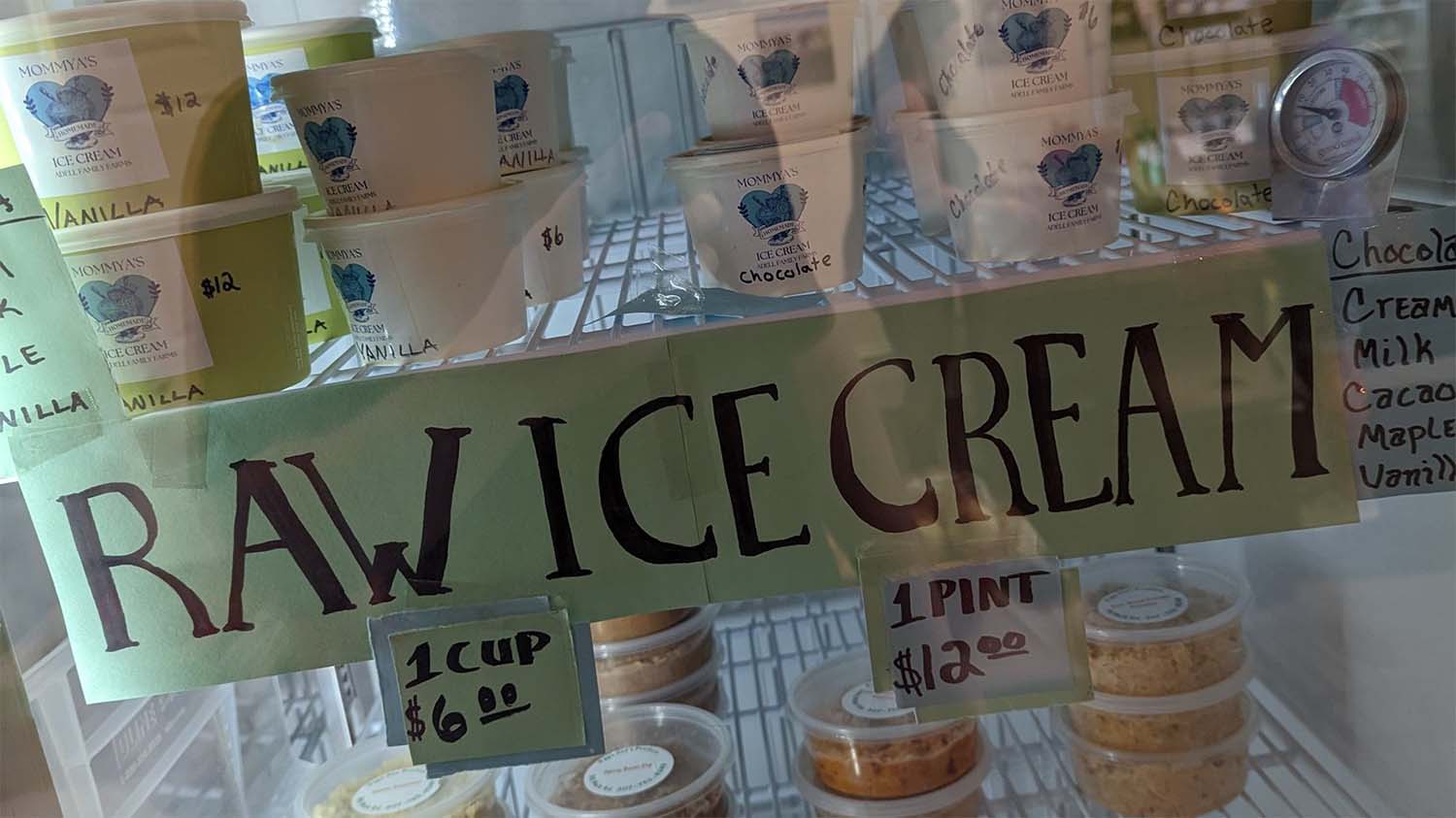
This isn’t a small artisanal novelty. Raw milk ice cream is made across the United States by small creameries, farms, and dairy operations that have returned to independent food production. Some states allow direct-to-consumer sale; others require purchase at the farm. The regulations vary, but the product exists — and if you know where to look, it’s findable. Learn more about state-by-state raw milk laws.
Find raw milk ice cream near you → GetRawMilk.com/icecream
The Bigger Picture
The ice cream finding is, in many ways, a good illustration of how nutrition science actually works. A counterintuitive result appears in the data. Researchers treat it with appropriate skepticism, run additional analyses, look for confounders, and — when it survives scrutiny — eventually publish it with appropriately hedged conclusions. That’s not suppression; that’s rigor.
What makes this case unusual is that the finding has now replicated across multiple independent cohorts over multiple decades, and a plausible biological mechanism — MFGM — has since emerged from a separate body of research. The two threads haven’t been formally connected in a clinical trial. But the mechanistic research on milk fat globule membrane — its effects on gut barrier function, postprandial inflammation, cholesterol metabolism, and insulin sensitivity — provides a biologically coherent framework for why a traditional cream-based dairy product might behave differently than expected.
What the data suggests, at minimum, is that fat matrix matters. Not all saturated fat is the same. Not all dairy is the same. And the most traditional, least processed version of a full-fat dairy product may retain compounds that industrial processing removes.
The Harvard researchers couldn’t explain the ice cream finding. The MFGM literature may be pointing toward why.