Interstate Milk Freedom Act of 2026: Congress Moves to End Federal Ban on Raw Milk Interstate Commerce
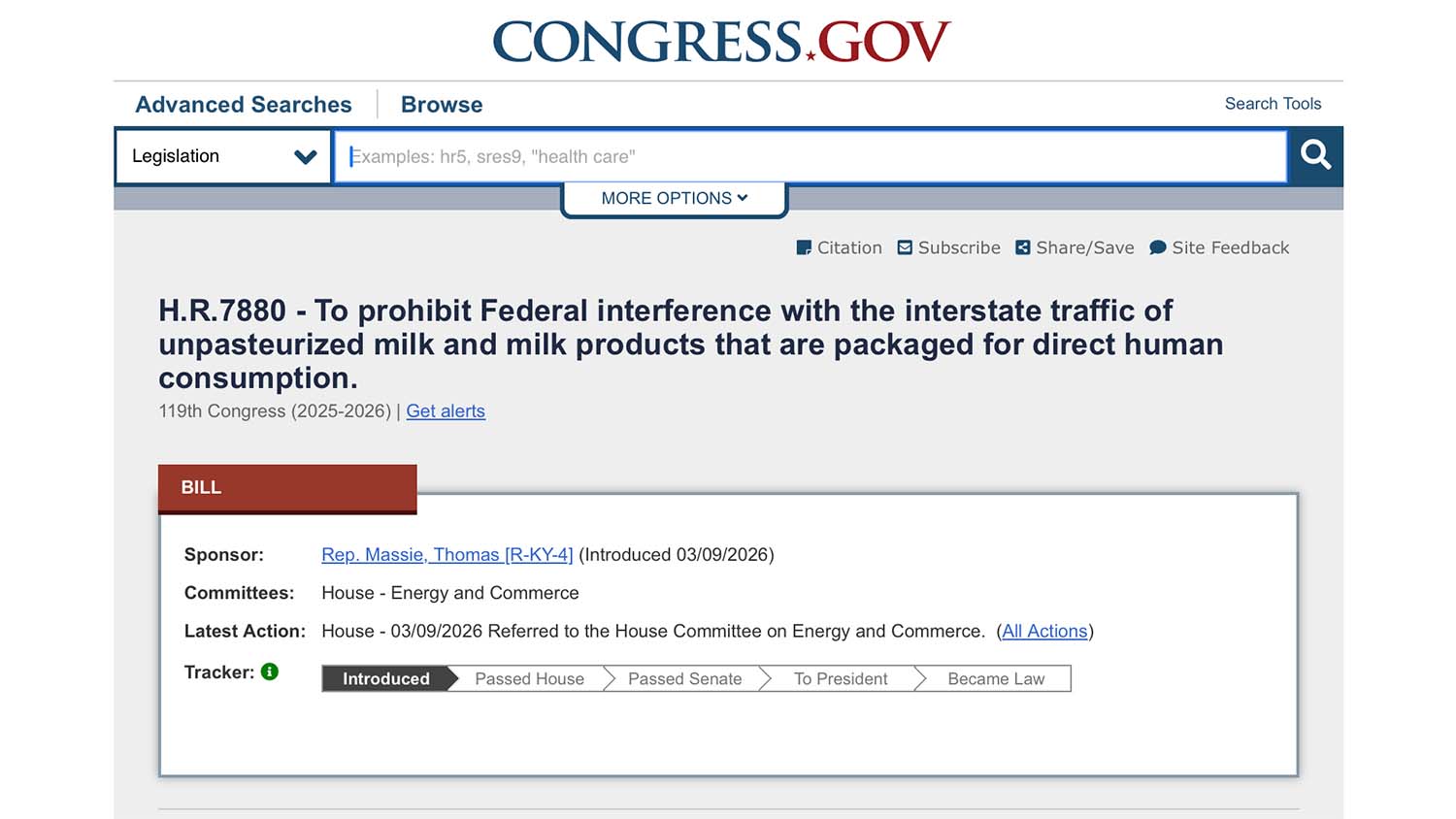
Rep. Thomas Massie (R-KY) and Rep. Chellie Pingree (D-ME) introduced H.R. 7880 on March 10, 2026 – the latest and most politically significant push yet to lift the FDA’s decades-old prohibition on transporting raw milk across state lines.
On March 10, 2026, Representative Thomas Massie (R-KY) introduced H.R. 7880, the Interstate Milk Freedom Act of 2026, in the 119th Congress. The bill would prohibit any federal department, agency, or court from interfering with the interstate transport of unpasteurized milk and milk products that are packaged for direct human consumption – stripping the FDA of the regulatory authority it has used since 1987 to effectively ban raw milk from crossing state lines.
Crucially, the bill carries genuine bipartisan weight. Representative Chellie Pingree (D-ME-1) is the co-lead sponsor, making this a left-right coalition bill in an era when those are increasingly rare. Pingree, a working farmer herself who raises grass-fed beef, chickens, and vegetables on an island off the coast of Maine, has co-led this legislation through multiple congressional sessions and brings the food sovereignty argument from a progressive food-systems perspective that extends far beyond the usual libertarian framing.
What H.R. 7880 Actually Does
The bill’s operative language is direct. It bars any federal action – administrative, civil, or criminal – that would prohibit, interfere with, regulate, or restrict the interstate traffic of raw milk or raw milk products, provided four conditions are met:
- The state of origin permits the distribution of unpasteurized milk for direct human consumption – whether through retail sale, direct farm-to-consumer sales, or cowshare arrangements.
- The milk is produced, packaged, and transported in compliance with the laws of that state of origin, including all labeling, warning, and packaging requirements.
- The destination state also permits the distribution of unpasteurized milk for direct human consumption.
- The federal restriction being challenged is based solely on the milk being unpasteurized – not on any independent health violation.
The bill explicitly includes a no preemption clause: nothing in the Act overrides any state law. States that ban raw milk sales remain free to do so. The legislation solely addresses the question of what the federal government may do to stop commerce between two states that have each independently legalized the product.
A Bipartisan Alliance With Real Staying Power
The Interstate Milk Freedom Act is not new – Massie has introduced versions of this legislation in 2014, 2015, 2019, 2021, and 2024, and it was previously offered as an amendment to the 2018 Farm Bill. What distinguishes H.R. 7880 is the strength and ideological range of its co-sponsors at introduction.
Original cosponsors include:
- Rep. Chellie Pingree (D-ME) – co-lead
- Rep. Lauren Boebert (R-CO)
- Rep. Warren Davidson (R-OH)
- Rep. Glenn Grothman (R-WI)
- Rep. Clay Higgins (R-LA)
- Rep. Nancy Mace (R-SC)
- Rep. Scott Perry (R-PA)
- Rep. Chip Roy (R-TX)
- Rep. Lloyd Smucker (R-PA)
Pingree’s continued co-leadership is the story within the story. While the bill attracts predominantly Republican support, Pingree has stood with this legislation for years precisely because the case for raw milk access is not ideologically owned by one party. Her district in coastal Maine includes small-scale farmers and food-conscious consumers who value direct relationships with local producers – a constituency that overlaps with progressive food movement priorities around local agriculture, food transparency, and farm viability.
“So many people across the country want to make sure their food is fresh and local – including fruits, vegetables, and even their milk,” Pingree said in the official press release. “Raw milk is currently the only food banned for interstate commerce – an onerous regulation that hurts small farmers for selling milk straight from their cows to the consumer.”
The Legal Backstory: How the FDA Ban Happened Without an Act of Congress
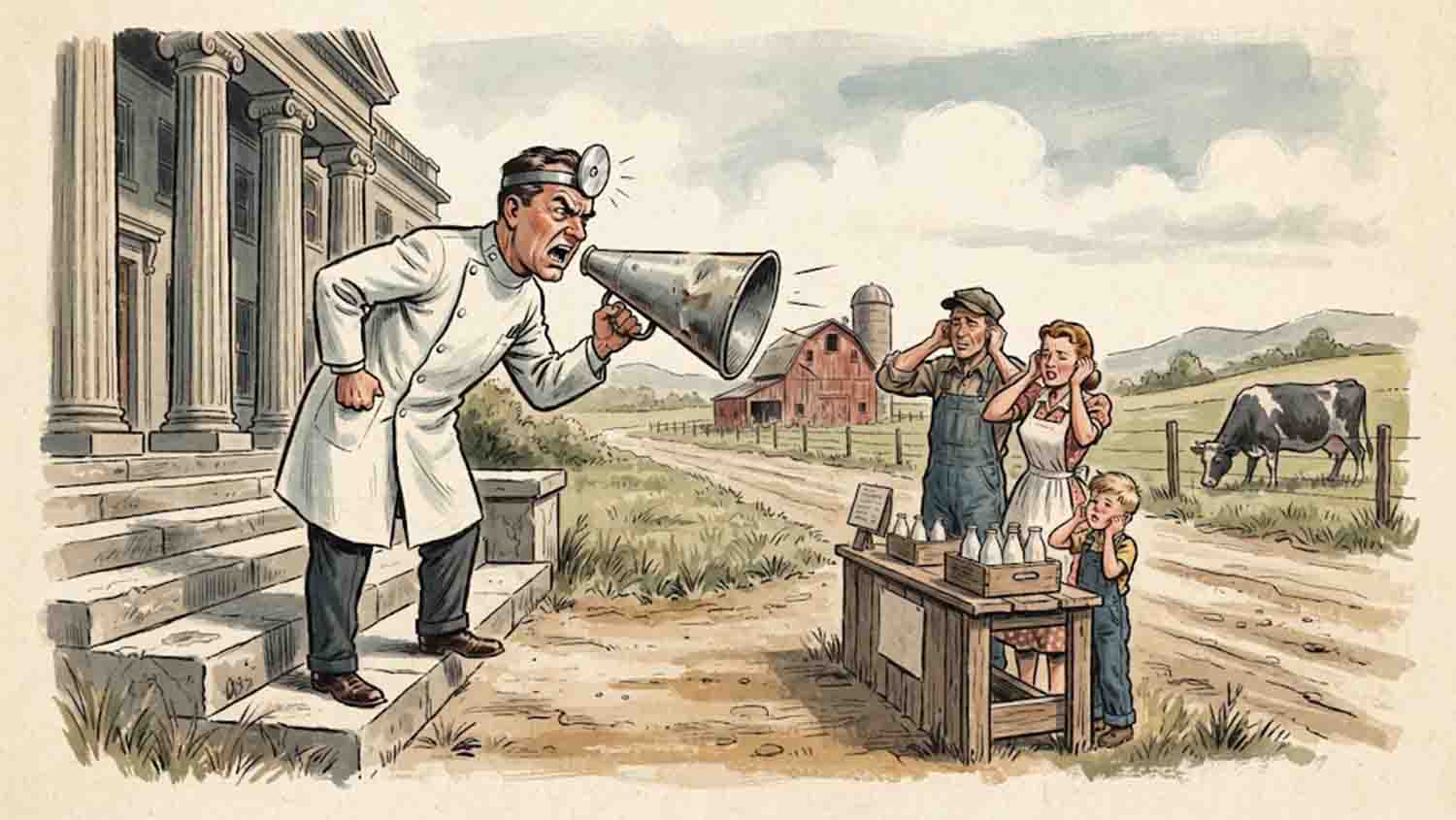
One of the most important and least-understood facts about raw milk regulation is this: Congress has never passed a law banning raw milk interstate commerce. The prohibition exists entirely through FDA regulatory action.
In 1987, the FDA issued a regulation banning the interstate sale of raw milk following a lawsuit decided in 1986. The agency used its authority under the Federal Food, Drug, and Cosmetic Act and the Public Health Service Act to treat unpasteurized milk as inherently adulterated when sold across state lines – a determination made without a direct congressional mandate.
H.R. 7880 addresses this directly. Its operative clause is written to override the FDA’s current regulatory framework, citing both 21 U.S.C. 301 et seq. (the FDCA) and 42 U.S.C. 264 (the Public Health Service Act) and declaring that federal action under either statute cannot be used to restrict qualifying raw milk interstate commerce.
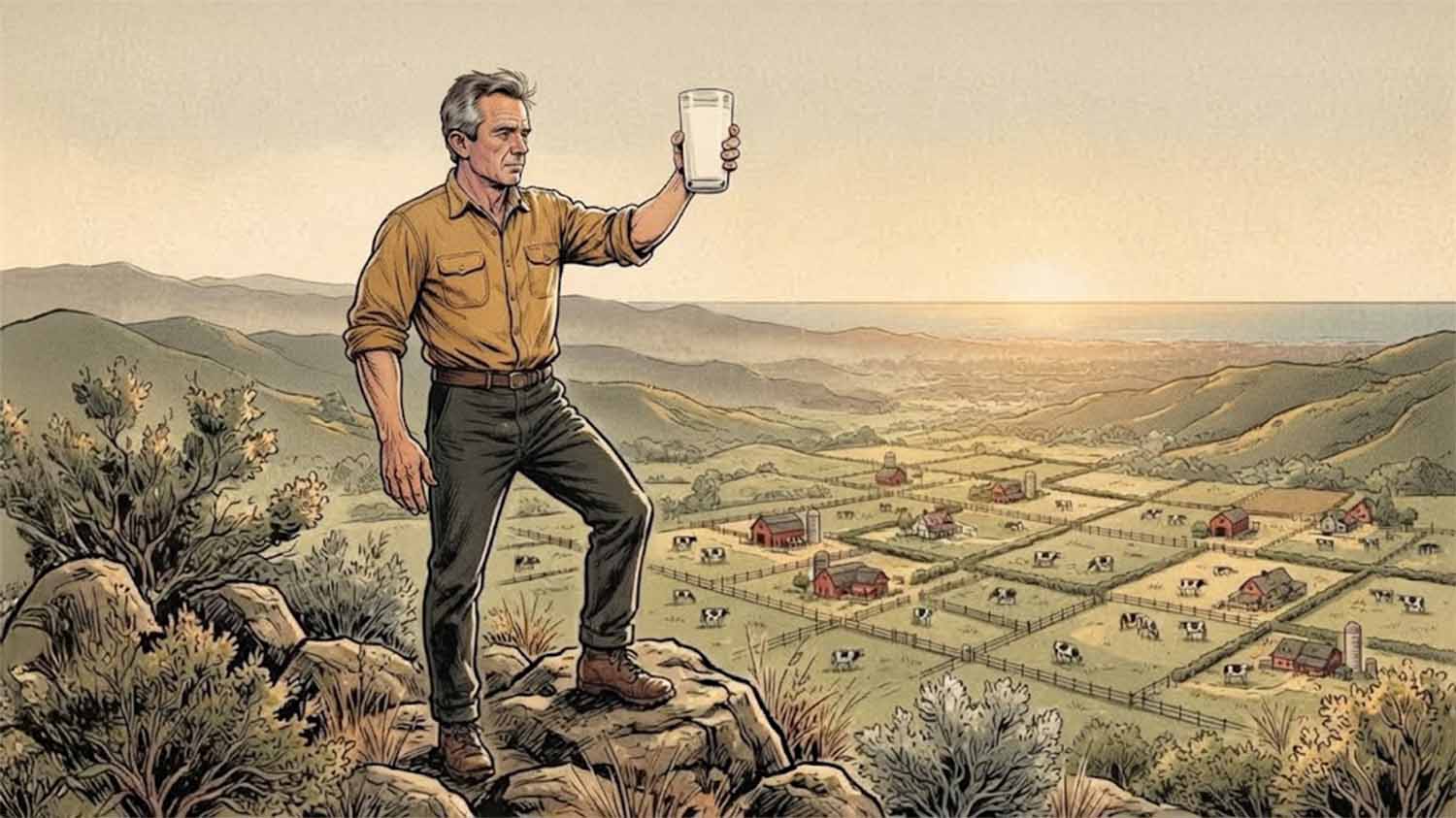
“Executive branch agencies, such as the Food and Drug Administration (FDA), do not and should not have the power to shut down trade between peaceful farmers and willing consumers,” said Rep. Massie. “It is Congress’s job to legislate. The Interstate Milk Freedom Act would make it easier for families to buy the milk of their choice by reversing the criminalization of specific dairy farmers.”
How the Bill Defines Key Terms
The bill includes a carefully constructed definitions section with practical implications for farmers, consumers, and cowshare participants:
Cowshare – An undivided ownership interest in a milk-producing animal (cow, goat, sheep, water buffalo, or a herd of such animals), created by a written contractual relationship between a consumer and a farmer. The contract must include a legal bill of sale for the consumer’s interest in the animal, and a boarding contract under which the consumer boards the animal with the farmer for care and milking. Under a valid cowshare, the consumer is entitled to receive a share of milk from the animal.
Milk – The lacteal secretion, practically free from colostrum, obtained from the milking of one or more healthy animals.
Milk product – Any food product made from milk, explicitly including low-fat milk, skim milk, cream, half and half, dry milk, nonfat milk, dry cream, condensed or concentrated milk products, cultured or acidified milk products, kefir, eggnog, yogurt, butter, cheese, whey, and other frozen dairy desserts.
Packaged for direct human consumption – Packaged for the final consumer and intended for human consumption. This definition specifically excludes products packaged for additional processing (including pasteurization) before human consumption – meaning the bill only protects finished, consumer-ready products, not raw milk inputs for industrial dairy operations.
Pasteurized / Unpasteurized – The bill defines pasteurization by reference to the time-temperature tables in 21 C.F.R. § 1240.61, the current FDA standard. “Unpasteurized” is defined simply as not pasteurized.
Why This Bill Matters for Farmers and Consumers
Under existing federal law, a farmer in Pennsylvania – where retail raw milk sales are legal – cannot legally ship raw milk to a customer in New Hampshire, where raw milk is also legal. The FDA’s interstate prohibition creates an invisible wall between otherwise willing sellers and buyers, regardless of what their respective state legislatures have decided.
The practical effects fall hardest on small farms. Because raw milk must be sold locally, producers cannot access regional markets even when neighboring states have explicitly chosen to permit the product. The inability to ship interstate also limits cowshare arrangements for consumers who move or travel across state lines.
H.R. 7880 would not force any state to allow raw milk. It would not override state labeling or safety requirements. It would simply prevent the federal government from criminalizing commerce that two states have each independently decided to allow – restoring the basic interstate commerce framework to reflect what state legislatures have actually enacted.
The Real Opposition: Industrial Dairy, Not a Party
The political obstacle facing H.R. 7880 is not cleanly partisan – and understanding that is key to understanding why this bill has been introduced seven times without passing.
The organized opposition has consistently come from two Washington trade associations representing industrial-scale dairy: the National Milk Producers Federation (NMPF) and the International Dairy Foods Association (IDFA). NMPF represents large dairy cooperatives that collectively produce the majority of the U.S. milk supply. IDFA represents dairy processors and manufacturers, including multinational corporations, and claims an overall economic footprint exceeding $200 billion. Both organizations have the lobbying infrastructure and congressional relationships to move votes at scale – on both sides of the aisle.
The clearest demonstration of that power came during the 2018 Farm Bill debate. When Massie offered the Interstate Milk Freedom Act as an amendment, NMPF and IDFA sent a joint letter to both Speaker Paul Ryan (R-WI) and Minority Leader Nancy Pelosi (D-CA), simultaneously lobbying Republican and Democratic leadership to defeat it. The effort worked: the Massie amendment failed by a vote of 331 against to 79 in favor – a lopsided defeat that reflected the reach of industrial dairy across the full House, not just one party.
The coalition that assembled against the 2018 amendment extended beyond NMPF and IDFA. Additional letters of opposition came from the Safe Food Coalition – a consortium including the Center for Science in the Public Interest, the Consumer Federation of America, the National Consumers League, STOP Foodborne Illness, and The Pew Charitable Trusts – as well as the National Conference on Interstate Milk Shipments, 53 dairy cooperatives, and state dairy associations.
NMPF and IDFA have not yet issued a statement specifically addressing H.R. 7880 – the bill was introduced today. But their position on every prior version of this legislation has been unambiguous. In a 2019 letter opposing a standalone version of the bill, NMPF and IDFA argued it would greatly increase the production and consumption of what they characterized as a known health hazard. The organizations have mounted similar campaigns at the state level across dozens of states for years, making clear this is a standing institutional priority, not a reactive one.
What this means practically is that the bill’s path in the 119th Congress runs directly through the same industrial dairy lobbying apparatus that has defeated it before – one that has historically been just as effective with Democrats as with Republicans. The bipartisan co-lead structure of H.R. 7880 is partly a direct response to that reality.
Opposition to lifting the interstate ban is also not limited to industrial dairy. A separate debate exists within the raw milk community itself. Some advocates and small farmers quietly favor the interstate ban as a form of protectionism – reasoning that restricting consumers to local sources keeps existing raw milk farms viable and insulated from competition with large national brands that would emerge if interstate shipping were opened up. That tension is real, and it complicates the assumption that every raw milk farmer is pushing for this bill.
Legislative Outlook
The bill has been referred to committee in the 119th Congress. As with prior sessions, passage faces an uncertain path – the FDA’s food safety prerogatives have traditionally commanded deference from the House Energy and Commerce Committee, where milk legislation typically lands.
However, the political environment has shifted. With increased attention to regulatory overreach, food sovereignty, and the costs of federal agency authority under the current Congress, H.R. 7880 enters a more receptive climate than many of its predecessors. The bipartisan co-lead structure also gives the bill political cover that single-party legislation cannot provide.
You can track the bill’s progress directly on Congress.gov, where cosponsor additions, committee referrals, and any floor action will be recorded.
What You Can Do
Consumers and farmers who support the right to engage in commerce across state lines without federal interference can contact their Member of Congress and request a cosponsor commitment on H.R. 7880. Representative contact information is available at house.gov/representatives/find-your-representative.
The full text of the Interstate Milk Freedom Act of 2026 is available on Rep. Massie’s official website.