Utah HB283 Raw Milk Bill: Tighter Regulations and Elevated Penalties
Stricter compliance requirements, enhanced testing standards, and increased penalties may soon come to Utah raw milk producers.
Proposed Changes to State Raw Milk Regulations and Enforcement
The Utah Legislature is considering House Bill 283, which proposes amendments to the state’s raw milk regulations. Sponsored by Republican Representative Mike Kohler, the bill adds operational requirements for raw milk producers and enforcement mechanisms for health violations.
Rep. Kohler has extensive prior involvement with Utah’s dairy industry as a lobbyist and in leadership roles with dairy organizations. His family’s farm, owned by his brother, sold raw milk for some time before pivoting to pasteurized non-homogenized milk.
Background: Recent Health Testing Issues
In January 2026, Ballerina Farm, a dairy operation in the Kamas Valley, paused raw milk sales following health inspections. Testing samples from May and June 2025 identified elevated coliform bacteria levels, including E. coli, in bottled raw milk produced by the operation, according to records from the Utah Department of Agriculture and Food.
The farm had begun selling raw milk at its Kamas location in 2025. Following the test results, the operation suspended raw milk sales and transitioned to selling pasteurized milk products. The company has indicated plans to construct a separate facility designed for raw milk production in the future.
Proposed Bill Provisions
HB0283 includes provisions that modify raw milk regulatory requirements and penalties. According to Kohler, the bill intends to streamline certain operational requirements for producers while increasing consequences for producers that fail health testing. Proposed penalties include fines and permit suspensions for repeated violations.
Specific Changes
HB0283 makes the following changes to Utah Code Title 4, Chapter 3:
Registration Requirements
The bill establishes a new registration system replacing the current permit system. Producers and markets must register with the Department of Agriculture and Food, providing:
- Intended method of sale (direct-to-consumer, through markets, or both)
- Declaration of intent to comply with regulations
- Examples of compliant signage and labeling
- Species of lactating animals
- Recall plan
- Type of raw milk products to be produced or sold
Registration is valid for the calendar year and must be renewed by December 31 annually.
Operational Requirements
Producers must:
- Obtain regular services from a licensed veterinarian and maintain veterinary care records including “routine herd health checks; disease screening; treatment documentation; and withdrawal period verification”
- Cool raw milk “to 41 degrees Fahrenheit or below within two hours of milking and maintain the raw milk or a raw milk product at or below 41 degrees Fahrenheit at all times”
- Use “a separate enclosed facility for animal housing; milking; and processing and packaging”
- Maintain premises that include “a sanitary toilet and handwashing station; a wastewater disposal system approved by the applicable state or local agency; and a proper cleaning, sanitizing, and storage area for equipment or packaging”
- Retain samples “of at least four ounces from each batch for nine days”
- Retain records “for a minimum of two years” including “animal health and treatment records” and “test results and corrective actions”
Bacterial and Pathogen Standards
Raw milk and raw milk products “may not contain:
- drug residues
- aerobic bacteria that exceeds 20,000 colony forming units per milliliter
- a coliform count that exceeds 10 colony forming units per milliliter
- detectable levels of listeria, salmonella, campylobacter, or shiga toxin-producing e. coli”
Producers must “report positive pathogen or drug residue findings to the department within two business days of receipt of a test.”
Labeling and Signage
Producers and markets must:
- Post signage stating: “THIS PRODUCT IS RAW MILK OR MADE WITH RAW MILK”
- Label containers with “RAW MILK” or “RAW MILK PRODUCT” in letters “at least 1/4 inch high”
- Include warning: “Raw milk, no matter how carefully produced, may be unsafe.”
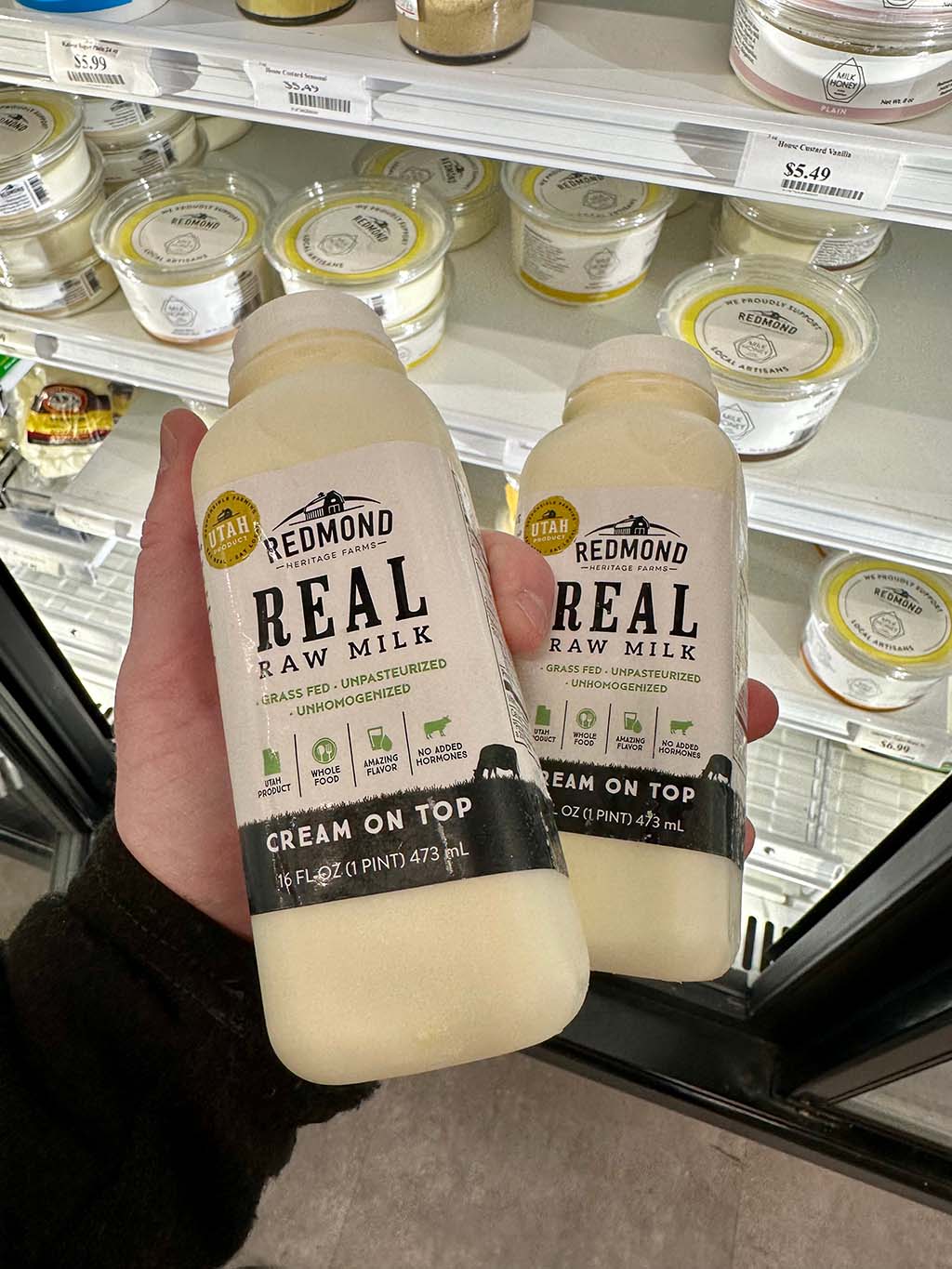
- Use “a black cap for fluid raw milk”
- Include net volume, production and consume-by date, registration number, producer name and address, animal source, ingredient list, and allergen statement
Testing and Outbreak Response
The department “may collect and test a sample of raw milk or a raw milk product during an inspection if there is suspicion of adulteration; or anytime there is a suspicion that the producer or market is linked to a foodborne illness outbreak.”
Upon discovering a likely foodborne illness outbreak, the department “shall issue a cease and desist order” and “within two working days of issuing a cease and desist order, the department shall collect a sample of raw milk or a raw milk product for whole genome sequencing.”
The department “shall share with the producer or market whole genome sequencing results within 15 working days from the day the sample is taken.”
Penalties for Non-Compliance
For adulterated or misbranded raw milk (12-month period):
- First violation: “administrative fine of not more than $2,000”
- Second violation: “administrative fine of not more than $5,000”
- Third or subsequent violation: “administrative fine of not more than $10,000 and the suspension of operations by the producer or market under this part for not more than one year”
For foodborne illness outbreaks (12-month period):
- First proof: “cease and desist order of 14 days”
- Second proof or new case: “cease and desist order of 14 days and an administrative fine of $2,000”
- Third proof or new case: “cease and desist order of 14 days and an administrative fine of $5,000”
- Fourth or subsequent proof: “administrative fine of $10,000 and the suspension of operations by the producer or market under this part for one year”
For selling without registration: Same penalties as adulterated or misbranded products.
Other Changes
The bill:
- Prohibits sale of raw milk through food service establishments or under the Home Consumption and Homemade Food Act
- Prohibits use of the Department of Agriculture and Food’s name or logo in marketing materials
- Prohibits describing raw milk as “grade A”
- Requires markets to purchase only from registered producers and store raw milk separately from pasteurized products
- Repeals Section 4-3-503 (previous raw milk sales regulations)
Effective Date
The bill would take effect on May 6, 2026.
Current Regulatory Framework
Utah law permits raw milk sales for human consumption when produced on-farm or through producer-owned retail locations. Under the state’s Raw Milk for Retail program, milk that fails health testing must be either recalled or not sold. Permits may be suspended for producers who repeatedly fail health tests. The program is administered by the Utah Department of Agriculture and Food.
Finding Licensed Raw Milk Producers
Use the GetRawMilk.com to find producers in Utah or use the search functionality to locate raw milk by city/ zip code.
Legislative Status
HB0283 is under consideration in the 2026 Utah legislative session.