Mother Noella Marcellino: Microbiologist, Nun, and Raw Milk Cheese Pioneer
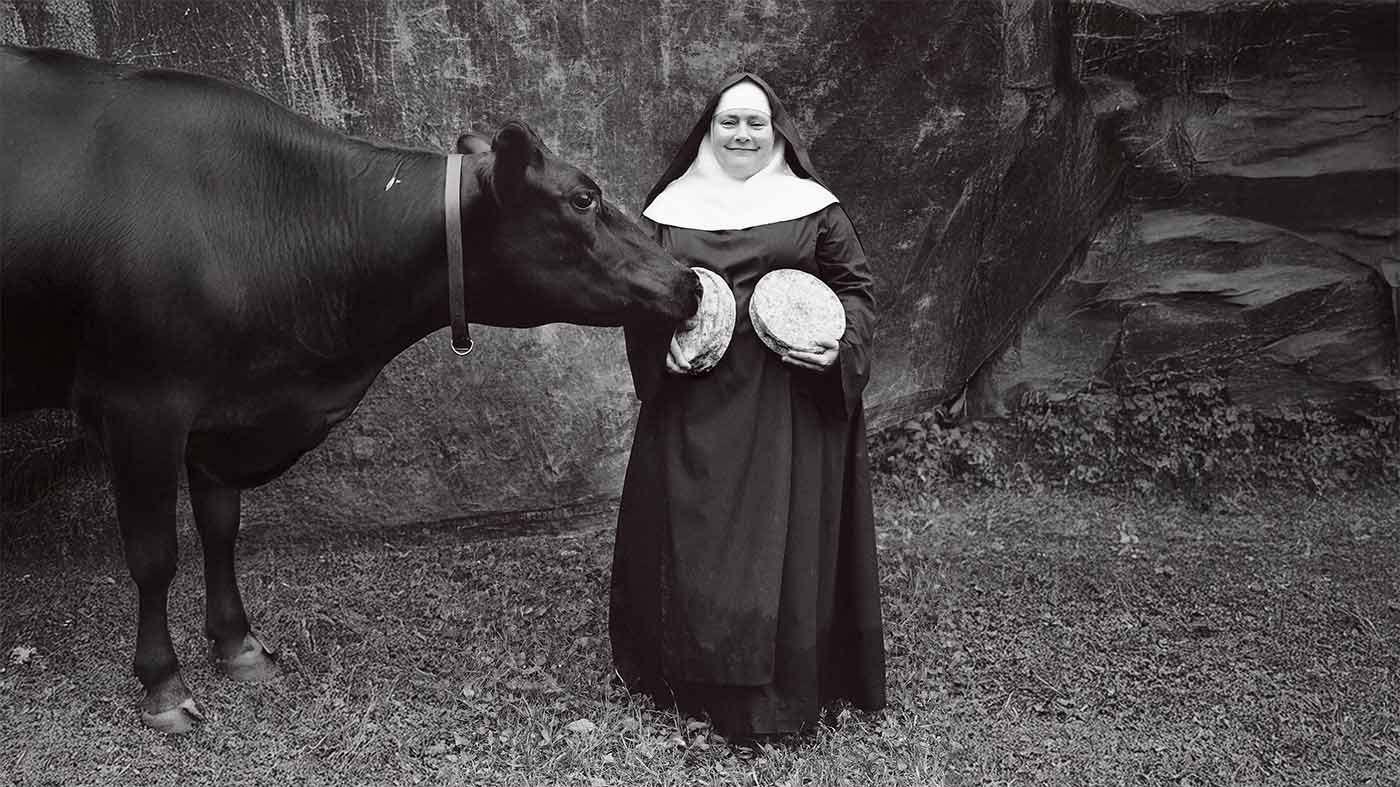
Mother Noella Marcellino is one of the most consequential figures in American artisan food history. A Benedictine nun holding a PhD in microbiology, she spent more than four decades making raw milk cheese at a Connecticut abbey before moving to lead a monastery in Washington State, and her landmark wooden barrel experiment produced scientific evidence that has shaped cheesemaking law, food safety policy, and the global artisan cheese movement.
Known worldwide as “The Cheese Nun” — a nickname she initially resisted but accepted on the advice of fellow nun Mother Dolores Hart, who told her flatly that no one would watch a documentary called Biodiversity — she remains the most cited scientific voice in the defense of traditional raw milk cheesemaking.
From College Dropout to Cloistered Nun
Born Martha A. Marcellino on June 30, 1951, she did not take a conventional path to her vocation. She enrolled at Sarah Lawrence College in 1969 — choosing it, she later said, because it was “the most radical school in the country” — and left two years later. In her own words: “That was the time of the Vietnam War. We had lost faith in our government and in authority.”
In the early 1970s, students from East Coast colleges began making their way to a Benedictine monastery in rural Connecticut. The Abbey of Regina Laudis sits on 360 acres in Bethlehem, Connecticut, and operates a working farm. Marcellino entered the abbey in 1973.
A Cow, a Frenchwoman, and a Wooden Barrel
Cheesemaking came to Mother Noella not by choice but by assignment. Within a few years of her arrival, the abbey acquired its first dairy cow, and she was tasked with learning to make cheese. Her early attempts were failures — batches inedible enough to be fed to the pigs.
A young Frenchwoman eventually arrived at the abbey carrying her grandmother’s technique: a traditional Saint-Nectaire from the Auvergne region — a pressed, semi-hard, fungal-ripened washed-rind cheese produced in central France since at least the seventeenth century. Mother Noella began making the abbey’s Bethlehem cheese in 1977 using that technique. Central to the method was a wooden barrel — a detail that would soon put her on a collision course with federal regulators.
The Barrel, the Vat, and the FDA
In 1985, a Listeria monocytogenes outbreak linked to an unaged raw milk cheese killed twenty-nine people in Southern California. The FDA responded with sweeping crackdowns on raw milk dairies nationwide. One of the first casualties at the abbey was Mother Noella’s wooden cheese barrel — the local inspector demanded she replace it with a stainless-steel vat.
The consequences were immediate. “All of a sudden, we were finding E. coli in our cheese,” she recalled, “after never having a problem with it before.”
Rather than simply comply, Mother Noella — by then enrolled in microbiology coursework at the University of Connecticut — designed a controlled experiment. She produced two simultaneous batches of cheese: one in the sterile stainless-steel vat, one in the traditional wooden barrel. Both were inoculated with E. coli. The results were unambiguous: E. coli populations thrived in the stainless-steel batch even after aging, while in the wooden barrel batch they steadily declined and died off.
The mechanism was straightforward. The porous wood harbored colonies of beneficial lactic acid bacteria accumulated over years of use. These bacteria produced acid that made the environment hostile to pathogens. The feature regulators deemed a sanitation hazard was in fact performing a protective function no sterile surface could replicate.
She was the first researcher to provide laboratory evidence that raw milk cheeses contain naturally occurring organisms that actively suppress pathogens. Her local inspector was persuaded. The FDA, however, was not — at least not immediately.
The issue resurfaced in 2014 when the FDA issued a letter declaring wooden surfaces non-compliant with its Current Good Manufacturing Practice regulations, effectively threatening to end the aging of cheese on wood across the United States. The ruling put hundreds of American artisan cheesemakers at risk and would have blocked imports of wood-aged European cheeses including Parmigiano Reggiano, Comté, and Beaufort. The backlash was swift: the American Cheese Society mobilized, Senator Charles Schumer and Representative Peter Welch moved to block enforcement funding in Congress, and thousands of consumers signed petitions. Within days, the FDA backed down, stating it had no intention of banning wooden shelves and would engage with the cheesemaking community on the matter. Mother Noella’s barrel experiment — by then widely cited — had helped establish the scientific foundation that made that defense possible.
A PhD in Microbiology, Earned Without a Bachelor’s Degree
The barrel experiment set Mother Noella on an extraordinary academic path. The Archbishop of Hartford granted special permission for cloistered nuns to pursue advanced degrees, and in December 1986 Marcellino and three fellow nuns enrolled at the University of Connecticut. She had no undergraduate degree. She began at UConn’s Waterbury campus with introductory science courses — algebra, trigonometry, the foundations she had never completed.
The direction of her research crystallized through an unexpected encounter. A UConn adviser visited the abbey’s cheese-aging cellar and, seeing the operation firsthand, told her: “Your doctorate is in this cellar.” She pivoted from her original plan to study nutrition and focused entirely on cheese microbiology.
She worked through the sciences over the following years — all while continuing to make cheese and living within the abbey — and earned her doctorate in Microbiology from UConn’s Department of Molecular and Cell Biology in 2003. The path from first enrollment to PhD took seventeen years.
Her doctoral research focused on Geotrichum candidum, a yeast-like fungus found on the rinds of traditional raw milk cheeses. The organism contains enzymes that break down protein and fat, softening texture and deepening flavor during ripening. Through her studies, she genetically isolated a large number of distinct strains, mapping that diversity to specific cheese types and regions across France.
The Fulbright, France, and 30,000 Kilometers of Cheese Caves
With her doctoral research underway, Mother Noella pursued the ancient cheese caves of France — the environments where Geotrichum candidum had co-evolved with traditional cheesemaking over centuries.
Supported by a Fulbright Scholarship in 1994 and a subsequent three-year fellowship from the Institut National de la Recherche Agronomique (INRA), she traveled 30,000 kilometers through France’s traditional cheesemaking regions, collecting native strains of Geotrichum candidum from cave surfaces and cheese rinds to map their biochemical and genetic diversity.
A planned nine-month visit stretched into four years. When she found the same fungal strains present in Auvergne caves also growing on the abbey’s Connecticut cheeses, it confirmed a key finding: traditional cheesemaking environments actively select for the organisms that define flavor, independent of geography. The cave itself functions as a living culture.
Rémy Grappin, the late Director of Research at France’s National Institute of Agricultural Research, said no one was working harder to preserve the biodiversity of raw milk cheese fungi against the pressures of standardization and pasteurization.
The broader implication was stark: cheesemakers abandoning ancient ecological environments are not merely sacrificing flavor — they are eliminating a fungal biodiversity that small family farms spent centuries cultivating.
Bethlehem Cheese: Raw Milk from Heritage Cattle
The cheese Mother Noella has spent decades refining is Bethlehem Cheese — named for the Connecticut town where the abbey sits, and modeled on the Saint-Nectaire of the Auvergne. It is made entirely from the raw milk of the abbey’s own herd.
Since 1991, the abbey has focused on preserving heritage cattle breeds, particularly the Dutch Belted and the Milking Shorthorn — breeds valued for milk with high protein, butterfat, and milk solids. The dairy holds one of the few licenses in Connecticut for raw milk production and retail sales.
From that raw milk, the nuns produce butter, yogurt, mozzarella, ricotta, cheddar, and the étoile, all made in a kitchen beneath the barn. As the Bethlehem cheese ages in its cave, Geotrichum candidum appears on the rind within days — the same slow fungal transformation that became the subject of Mother Noella’s doctoral research and Fulbright fieldwork.
The cheese is not widely distributed. When available, it can be purchased at the abbey’s gift shop. Visitors are encouraged to call ahead.
Awards and Global Recognition
The scientific and culinary communities have recognized Mother Noella’s contributions extensively.
She was inducted into the Grand Ordre Des Gourmandins et Gourmandines des Fromages d’Auvergne in 2002, received the first-ever French Food Spirit Award in 2003 for promoting traditional French cheesemaking methods, and was awarded the Grand Prix de la Science de l’Alimentation from the International Academy of Gastronomy in 2005.
She delivered a guest lecture for the Harvard University Science & Cooking Public Lecture Series in 2016, gave a plenary presentation at the University of Arizona’s Nutrition and Health Conference in 2018, and delivered the Medical Grand Rounds lecture at the Mayo Clinic in December 2020. She is a contributing author to The Oxford Companion to Cheese (Oxford University Press, 2016) and to the American Society of Microbiology’s Cheese and Microbes (2014).
She appeared in Michael Pollan’s Cooked on Netflix, where her barrel experiment was presented as a foundational demonstration of the living ecology at the heart of traditional fermented food.
The Science Case for Raw Milk Cheese
Mother Noella’s work provides some of the most rigorous scientific grounding available for the defense of raw milk cheesemaking.
Her barrel experiment demonstrated in controlled conditions what traditional cheesemakers had long observed empirically: that a microbially rich environment — raw milk, aged wood, cave surfaces — creates a self-regulating ecosystem in which pathogens struggle to establish. Sterilization does not make cheese safer by default; it can eliminate the very microbial competition that keeps dangerous organisms in check.
Her biodiversity research showed that the fungal complexity of traditional raw milk cheeses is not incidental — it is the product of centuries of ecological selection, and it is irreplaceable once lost. She has compared the preservation of cheese fungi biodiversity to saving the rainforest: once standardized industrial processes replace traditional ones, the microbial heritage those processes sustained disappears.
Her position on raw milk is precise rather than absolutist. She acknowledges that pasteurization offers protection when milk handling is poor or animals are diseased, but argues it eliminates the native microbial communities essential to traditional cheesemaking — communities that commercial producers must then attempt to reconstitute artificially. Her stated standard: “I am a champion of any cheese done well with clean milk.”
A New Chapter: Our Lady of the Rock
After more than four decades at Regina Laudis, Mother Noella relocated to Our Lady of the Rock Monastery on Shaw Island, Washington, arriving in 2018 and formally installed as Prioress in September 2020.
Our Lady of the Rock has its own raw milk history. In 1981 the monastery received one of the first licenses in Washington State to produce cheese and raw milk as a licensed Grade A Dairy — and was the first certified raw milk dairy in the state. The cheese was sold publicly at the Shaw Island store, Orcas landing, and Frederick & Nelson department store in Seattle, relying entirely on native microorganisms with no added cultures.
The dairy did not survive COVID. According to Northwest Catholic, the monastery’s guest mistress Mother Hildegard confirmed: “we closed our dairy in the midst of COVID and most probably will not continue it.” Mother Noella’s role there is scholarly and administrative — according to the monastery’s own installation announcement, she teaches Gregorian chant and manages the websites for both the Shaw Island monastery and Regina Laudis in Connecticut.
Sources
- Noella Marcellino — Wikipedia
- The Cheese Nun — CBS News
- Mother Noella & The Ecosystems of Cheese — New Worlder
- Cheese Nun: Mother Noella Marcellino — Berkshire Style
- Mother Noella Marcellino, OSB, Ph.D. — Scala Foundation
- Lessons from the Cheese Nun — Plough Quarterly
- Cheese and Biodiversity — Slow Food
- Making Cheese at the Abbey of Regina Laudis — Chronogram
- The Nun and the Cheese — Eclas/Shorthand