MAHA’s Pesticide Problem: One Win, a Hundred Losses
The Make America Healthy Again movement has claimed significant ground in 2026. A pesticide liability shield was stripped from the Farm Bill. Dietary guidelines were rewritten toward whole foods. Food dye timelines are moving. By the movement’s own count, the wins are adding up.
The bigger picture runs in the opposite direction. Under the administration MAHA helped elect, the EPA approved two new “forever chemical” pesticides for use on food crops, with more in the pipeline. The White House invoked a Cold War-era defense law to guarantee the domestic glyphosate supply and extend liability protections to its producers. The Forest Service expanded large-scale herbicide application across national forests. Drinking water protections the Biden EPA put in place are being dismantled. More than a billion dollars in programs connecting local farms to school cafeterias were cut and replaced with a fraction of the funding.
When it comes to how much chemical exposure actually reaches American food, the numbers are running in the wrong direction.
Averting the Pesticide Liability Shield
Start with what the movement blocked. The House-passed Farm, Food, and National Security Act of 2026 originally contained a provision that would have shielded pesticide manufacturers from liability lawsuits as long as their products complied with EPA labeling rules. It would also have preempted states and localities from setting stricter warning requirements. Critics, including many who have no connection to MAHA, called it a corporate liability shield tailored to protect Bayer from the tens of thousands of Roundup cancer lawsuits working through the courts.
Representative Anna Paulina Luna of Florida introduced an amendment to strip the language. It passed 280 to 142, with 73 Republicans joining nearly all Democrats in support. The broader farm bill passed the House on April 30 by a vote of 224 to 200 and now awaits Senate action.
Removing the liability shield preserves the legal status quo: Roundup plaintiffs can still sue, and states can still set stricter labeling rules. That matters. The lawsuits are among the most significant accountability mechanisms that forced any public reckoning with glyphosate’s cancer risk in the first place.
What the amendment did not do is reduce the amount of glyphosate being used, restrict any other pesticide, or change the trajectory of chemical exposure for anyone eating American food. The liability shield fight was about courtroom access for people already harmed. It was a defensive victory against a provision their own party put in the bill, while that same party’s broader agricultural agenda moves pesticide exposure in the opposite direction.
Glyphosate: The Central Contradiction
Three months before the Farm Bill vote, the Trump administration moved in the opposite direction on glyphosate more directly than any administration in recent years.
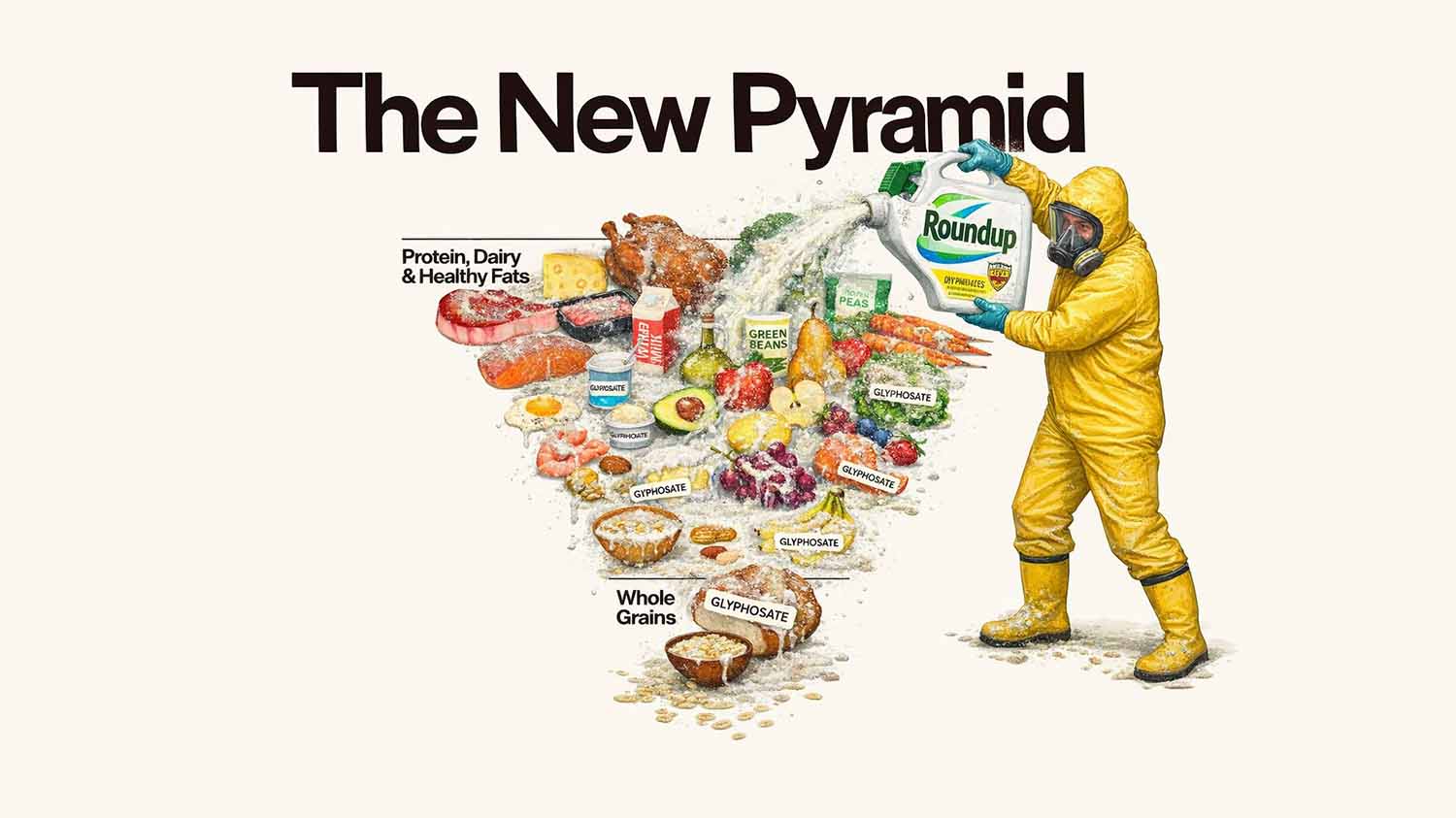
On February 18, 2026, President Trump signed an executive order titled Promoting the National Defense by Ensuring an Adequate Supply of Elemental Phosphorus and Glyphosate-Based Herbicides. The order invoked the Defense Production Act of 1950 to compel domestic production of glyphosate, described the herbicide as “a cornerstone of this Nation’s agricultural productivity,” and extended certain liability protections to domestic producers. The Secretary of Agriculture was directed to ensure that no rules or regulations place “the corporate viability of any domestic producer” of glyphosate at risk. The executive order came one day after Bayer proposed a $7.25 billion settlement with cancer claimants who alleged that Roundup had caused their illness.
Separately, a Mother Jones investigation found the Forest Service spraying glyphosate across tens of thousands of acres of national forest land, framing mass herbicide application on clear-cut and wildfire-affected terrain as a cost-effective “conifer release” method. California forests alone received 266,000 pounds of glyphosate in 2023, nearly five times the application rate of two decades earlier, a trend Trump’s March 2025 executive order directing a 25 percent increase in federal timber production is expected to accelerate across more than 100 million acres of national forest land. A new phosphate mine on public land was also approved to secure a key glyphosate precursor.
The timing is significant. In late 2025, the journal Regulatory Toxicology and Pharmacology retracted a hallmark year-2000 study asserting glyphosate’s safety over “serious ethical concerns,” after evidence emerged that Monsanto employees had ghostwritten portions of it and that financial compensation from the company had not been disclosed. The EPA is also conducting a court-ordered safety reevaluation of glyphosate, with findings expected later in 2026. The administration locked in a guarantee of glyphosate supply, with built-in producer liability protections, at the same moment the science behind its regulatory approval was under challenge in court and at the agency level.
RFK Jr.’s response to the executive order completed the picture. Kennedy had described glyphosate in 2024 as “one of the likely culprits in America’s chronic disease epidemic” and promised to ban it if elected. After the executive order was signed, he said: “Donald Trump’s executive order puts America first where it matters most — our defense readiness and our food supply. We must safeguard America’s national security first, because all of our priorities depend on it.” The same week the Farm Bill liability shield was stripped from the House floor, the White House filed a brief at the Supreme Court arguing on behalf of Bayer in a case that could make it significantly harder for cancer plaintiffs to sue the company over Roundup.
PFAS Pesticides: Forever Chemicals on Food Crops
Glyphosate has decades of regulatory history. The PFAS pesticide approvals represent a newer and in some respects more troubling front.
PFAS, or per- and polyfluoroalkyl substances, are synthetic compounds that do not break down in the environment or the human body. The “forever chemical” designation is not rhetorical: some PFAS compounds persist in soil and water for decades. They have been linked to cancer, birth defects, reproductive harm, decreased immunity, kidney disease, and elevated cholesterol.
Under the Trump EPA, the following PFAS pesticides were approved for use on food crops and turf:
Cyclobutrifluram: Approved November 2025 for use on golf courses, lawns, cotton, soybeans, and lettuce. A fungicide with a half-life in soil and water of up to three years. Half of any single application will still be present in the environment three years after it was sprayed.
Isocycloseram: Approved November 2025 for use on oranges, tomatoes, almonds, peas, oats, and for landscape maintenance. The compound is known to transform into 40 smaller PFAS chemicals, some more persistent than the parent compound. Documented harms include reduced testicle size, lower sperm count, and liver toxicity. The EPA determined that dietary exposure would not reach levels causing these effects in adults, but chose not to apply the child-safety buffer that other pesticides receive to account for children’s heightened chemical sensitivity. Had the buffer been applied, young children would have been found to be at high risk from dietary exposure.
In 2025 alone, the Trump EPA proposed four new PFAS pesticides and finalized approval for two of them, with additional approvals in the pipeline. The EPA’s pesticide office was notably not subject to the furloughs that affected other parts of the agency, prompting Nathan Donley of the Center for Biological Diversity to observe: “That shows you where the priorities are.”
While new PFAS pesticides were being approved, the same EPA was dismantling protections against PFAS already in the water supply. In May 2025, the agency delayed compliance deadlines for PFOA and PFOS drinking water limits by two years, pushing them to 2031. In September 2025, the EPA filed a motion in federal court to eliminate enforceable limits for four additional PFAS compounds in drinking water. By May 2026, the administration proposed to eliminate those 2024 drinking water standards entirely, affecting water systems serving an estimated 105 million people. The standards, which the Biden EPA finalized in 2024 after decades of advocacy, were the first national drinking water limits for PFAS compounds. The EPA characterized them as legally flawed; environmental lawyers characterized the reversal as an attempt to evade congressionally imposed limits.
The EPA was simultaneously approving PFAS for use in agriculture while withdrawing the rules meant to keep PFAS out of the water supply those farms and surrounding communities rely on.
Wins Claimed, Programs Cut
The farm-to-school funding story follows a pattern that runs through the broader MAHA record: a large program is cut, a smaller one is reinstated with a press release, and the smaller figure is announced without reference to what was cut.
In March 2025, the USDA terminated two Biden-era programs that had been distributing over a billion dollars to help schools and food banks buy food from local farms. The Local Food for Schools Cooperative Agreement Program, worth $660 million, was eliminated. So was the Local Food Purchase Assistance Cooperative Agreement Program, which had been set to distribute an additional $420 million to food banks. The USDA told recipients the programs “no longer effectuate the goals of the agency.” The Biden administration had recently announced a $1.13 billion expansion of both programs, which was also canceled.
Six months later, in September 2025, Agriculture Secretary Brooke Rollins announced the “largest single-year investment” in the Patrick Leahy Farm to School Grant Program, framing it as a MAHA-aligned commitment to local food. The investment: $18 million. The announcement made no mention of the $660 million program that had been canceled six months earlier. The National Farm to School Network noted that the $18 million announcement also followed the cancellation of the same program’s $10 million 2025 funding cycle, for which schools and organizations had already applied.
The net result: over $1 billion in local food purchasing capacity removed, $18 million restored.
The same dynamic appears in the food dye story, though less dramatically. MAHA has claimed the administration’s food dye timeline as a movement victory. The timeline began under Biden. In January 2025, the outgoing Biden administration banned Red Dye No. 3 based on its established link to cancer in animal studies. State-level bans on synthetic dyes in school foods had been advancing since California’s 2023 legislation. Asked directly whether the Biden administration deserved credit for starting the federal dye initiative, Kennedy said yes, though he added that it should have happened sooner. The broader six-dye voluntary phase-out Kennedy announced in April 2025 built on that foundation.
MAHA Gets Dragged by Big Ag
The MAHA policy record under this administration reflects a consistent pattern. Where movement goals align with existing political coalitions on the right, real action sometimes follows. Where they conflict with agricultural chemical industry interests, the industry wins and the movement receives a symbolic gesture, a press release, or a defensive consolation that preserves the status quo without advancing it.
The glyphosate executive order is the clearest example because Kennedy’s reversal was so complete and so documented. But the PFAS pesticide approvals, the drinking water rollbacks, the farm-to-school funding arithmetic, and the Farm Bill’s subsidy structure all cut in the same direction. The personnel record points the same way: Trump and EPA Administrator Lee Zeldin appointed Kyle Kunkler, a former lobbyist for the American Soybean Association and vocal critic of MAHA, as the EPA’s top pesticide regulator.
When the MAHA Commission’s second report surfaced without pesticide restrictions, an Atlantic report on the fallout captured the moment with food policy scholar Marion Nestle’s framing: “MAHA versus the realities of MAGA.” The same report noted that the White House had privately promised farm lobbyists, ahead of the report’s release, that the administration would side with them over MAHA by refusing to restrict pesticide use. The promise was kept.
The split runs along a predictable line. Grassroots MAHA activists, the ones who turned out for the Supreme Court rally against Bayer and flooded congressional offices before the Farm Bill vote, have organized specifically around food safety concerns. The institutional leadership of the movement operates inside a MAGA political coalition where agricultural chemical interests have decades of infrastructure and relationships. When the two sets of priorities conflict, as NPR noted covering the Farm Bill fight, the discord raises questions about whether the alliance can hold. The pesticide record so far suggests which side has been winning those internal arguments.
The Farm Bill that passed the House with MAHA’s support also passed with SNAP cuts preserved from the 2025 reconciliation package. The mega-crop subsidy architecture that overwhelmingly benefits large commodity operations growing the corn and soy that flow into ultra-processed food remained intact. The soda exclusion from SNAP, a measure some MAHA-aligned members tried to add by amendment, failed 186 to 238.
The bill has not yet passed the Senate, where it faces a difficult path. The liability shield fight showed that MAHA has genuine congressional leverage when it mobilizes. The larger record shows this leverage has been most effective at blocking the worst outcomes, not at producing the changes the movement’s stated goals would require.
That distinction matters. Blocking a liability shield is a contribution to legal accountability. It is not the same as reducing how many pounds of PFAS compounds are applied to food crops, reversing an executive order that guarantees glyphosate supply with built-in producer liability protections, or restoring a billion dollars in local food purchasing to school cafeterias.
What the Scorecard Shows
The Trump administration’s net pesticide posture since January 2025:
Glyphosate production guaranteed by executive order under the Defense Production Act, with liability protections extended to domestic producers. The Forest Service has expanded glyphosate application across tens of thousands of acres of national forest land under a parallel directive to increase federal timber production by 25 percent. EPA reevaluation of glyphosate safety ongoing while the administration simultaneously guarantees its supply.
Two PFAS pesticides approved for use on food crops, with additional approvals in the pipeline. The child-safety buffer waived on one of them. PFAS drinking water protections delayed and in the process of being dismantled.
More than a billion dollars in programs connecting local farms to school cafeterias eliminated. A small fraction restored under a different program name, celebrated as if it were a gain.
On the other side of the ledger: a liability shield stripped from a farm bill that hasn’t cleared the Senate. Dietary guidelines language emphasizing whole foods. A voluntary food dye phase-out built on a ban the Biden FDA initiated.
MAHA voters helped elect this administration, with no meaningful leverage, while the forces they claim to be against are drafting policy unchecked. What the record shows is a pattern: contentious provisions get inserted into legislation, stripped in public floor fights, and claimed as victories, while the pesticide approvals, the glyphosate supply guarantee, and the drinking water rollbacks advance without friction. MAHA will be measured by its effects, not by its words or intentions, and the result is more pesticides.