Italy’s Raw Milk Vending Machines: The Distributori di Latte Crudo
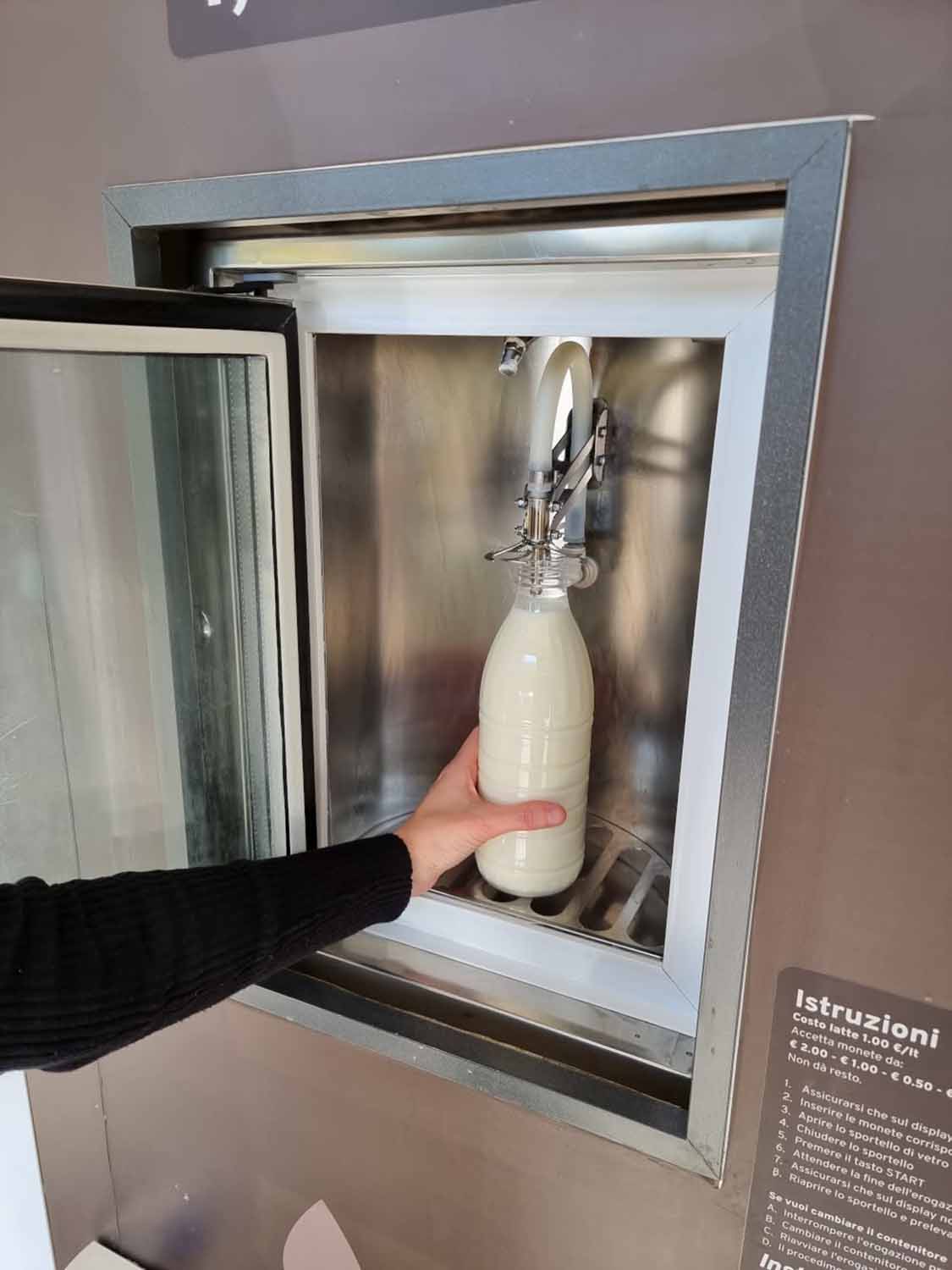
Italy operates one of the largest raw milk vending machine networks in the world. The machines, called distributori di latte crudo (literally “raw milk dispensers”), dispense unpasteurized cow’s milk directly from individual farms at roughly €1 per liter, 24 hours a day, 365 days a year. Latte crudo, meaning raw milk, is sold without pasteurization or homogenization, exactly as it comes from the producing animal. Consumers bring their own glass bottles or purchase them on-site, fill what they need, and take it home. The system has been operating under a national regulatory framework since 2007.
National Authorization
Raw milk vending machines became legal across Italy on January 25, 2007, when the Italian government and regional authorities signed the Intesa Stato-Regioni (State-Regions Agreement), formally authorizing machine-based raw milk sales nationwide. The agreement was published in the Gazzetta Ufficiale on February 13, 2007. Before that date, machines had appeared in Italian cities and towns on the authority of local governments, which had begun permitting them in the early 2000s as demand for direct farm-to-consumer sales grew.
The authorization built on EU Regulation (EC) No. 853/2004, which permits member states to allow raw milk sales for direct human consumption subject to national hygiene conditions. Italy’s agreement set out those conditions in detail: mandatory microbiological testing, continuous temperature requirements, traceability rules tying each machine to a single originating farm, and specific labeling language.
The framework was tightened in subsequent years through a series of Ministry of Health ordinances (December 2008, January 2009, November 2011) and ultimately codified permanently by the Legge Balduzzi (Law 189/2012) and its implementing decree, published in the Gazzetta Ufficiale n. 24 on January 29, 2013. That 2013 framework remains the governing regulation for distributori di latte crudo in Italy today.
Machine Requirements
Each distributore di latte crudo must meet a defined set of technical and regulatory requirements under the 2007 Intesa Stato-Regioni and 2013 Balduzzi framework.
Temperature. Milk must be held between 0°C and 4°C at all times. The machine must include an automatic device that stops dispensing if power is interrupted or the temperature threshold is exceeded.
Warning label. The front of the machine must display in red text, minimum 4 centimeters in height: “prodotto da consumarsi solo dopo bollitura” (“product to be consumed only after boiling”). Italy’s regulatory framework places responsibility for following that instruction explicitly on the consumer. The Ministry of Health has described buyers as “active participants in product safety.” Under Italian law, operators who display the required warning, maintain HACCP records, and keep test results within regulatory parameters carry their legal obligations fully, a framework Italian courts have consistently upheld.
Farm identification. Each machine must carry the designation latte crudo di vacca (raw cow’s milk), along with the name, address, and registration number of the producing farm. Pooling milk from more than one farm is prohibited; each machine is traceable to a single source.
Restocking. Milk must be replenished every 24 hours. Any milk remaining from the previous day may only be diverted to cheesemaking. It cannot be dispensed through the machine. The use-by date for milk purchased at a machine is three days from delivery to the consumer.
Post-cleaning protocol. After each cleaning cycle, the first liter dispensed must be discarded to eliminate residual detergent before milk is made available to consumers.
On-site consumption. Containers intended for drinking at the machine are explicitly prohibited under the 2013 framework. All purchases must be taken off-site.
Bottled milk option. Some machines include a bottling function. In those cases, each container must carry the farm’s identification, the date of milking, an expiry date, storage instructions (0–4°C), and the boiling warning, all in red text of at least 1 centimeter.
Microbiological testing. Each farm supplying a machine must conduct two analytical controls per month. Total plate count must not exceed 100,000 CFU/mL. Somatic cell count must not exceed 400,000/mL. Sales are suspended at any suspicion of contamination.
Placement. A machine may be installed at the producing farm or off-farm, at any location within the same province or a neighboring province (province contermini), provided the location has an electrical connection (ASL Alessandria regulatory guidance on the Intesa Stato-Regioni, 2007). DF Italia, the leading raw milk dispenser manufacturer, notes that its machines can be placed inside or outside farm buildings, inside or outside supermarkets, or in any location with electricity and 24/7 access.
Farm Economics
The price differential between direct machine sales and dairy cooperative delivery is the core economic argument for the distributore di latte crudo. Italian farm-gate milk prices paid to producers by cooperatives have historically ranged between approximately €0.35 and €0.45 per liter, depending on the period and region, according to CLAL, an Italian dairy market analysis firm that tracks farm-gate prices for Lombardy and other major dairy regions. At the standard vending machine price of €1.00 per liter, a farmer selling direct through a machine retains substantially more per liter than one selling into the cooperative supply chain, with the difference absorbed by the elimination of processing, packaging, and distribution intermediaries.
At that €1.00 standard price, consumers can purchase as little as 20 centiliters for €0.20, making small purchases practical. The full liter price is comparable to or below the cost of pasteurized milk in Italian supermarkets.
Scale and Geographic Reach
The network reached more than 1,400 machines in 2012, according to Food Safety News reporting on Italian health ministry data. By 2017, the count stood at more than 1,000 (agrodolce.it, February 2017). The machines are concentrated in northern Italy, where the country’s major dairy regions are located. The provinces of Turin, Bologna, Milan, Venice, Bergamo, Brescia, Como, Lecco, Padua, Treviso, and Varese have the densest coverage.
The network extends south and to the islands. Fixed machines operate near Rome, Latina, Salerno, L’Aquila, Teramo, Bari, and Taranto. In Sicily, machines have been documented near Ragusa, Siracusa, Agrigento, and Palermo. Sardinian coverage includes Sassari, Tortolì, and the provinces of Nuoro and Oristano (agrodolce.it, 2017).
Coldiretti, Italy’s largest farmers’ association, maintains provincial directories of distributori di latte crudo through its regional portals. Find current machine locations and raw milk farms across Italy at raw milk in Italy.
Manufacturers and Export
DF Italia, the Veneto-based manufacturer whose dispensers dominate the Italian market, was founded in 2004 in Sandrigo specifically to produce raw milk dispensers before expanding to a broader range of vending equipment. Its machine range runs from 100 to 1,800 liters of tank capacity. Machines can be installed indoors or outdoors at any location with an electrical connection. DF Italia machines have been exported to Slovenia, Ireland, and New Zealand, among other markets.
Village Milk, a New Zealand operation founded by Mark and Phillipa Houston in Takaka, Golden Bay, imported the first DF Italia machine to New Zealand in 2011 at a cost of approximately NZ$60,000. Raw milk sales in New Zealand are governed by the Raw Milk for Sale to Consumers Regulations 2015, which permits farm-gate sales only, with a maximum of five liters per consumer per visit. Village Milk grew into a franchise operation, reaching six farm-gate locations across New Zealand within the first year. Richard Houston serves as managing director; Mark Houston as CEO.
The broader European market is also served by Brunimat GmbH, based in St. Gallen, Switzerland. Founded in 1994 by dairy farmer Fredi Bruni, Brunimat predates DF Italia by a decade and was the first European manufacturer of raw milk vending machines. Its machines are produced exclusively in Switzerland and are installed across Austria, Slovenia, and more than 40 countries worldwide.
Slow Food, the international food culture organization, grew out of a 1986 protest by Carlo Petrini against the opening of a McDonald’s in Rome’s Piazza di Spagna, and was formally established in Bra, Piedmont in 1989. Petrini and Slow Food have consistently backed latte crudo access, including through vending machines, as part of a wider defense of Italy’s raw milk cheese heritage. In July 2025, new Italian Ministry of Health guidelines on STEC control in unpasteurized dairy products prompted Petrini to warn that overly restrictive regulation risked undermining the very products that define Italian dairy identity. “We must learn from the French in this regard,” he said at the Slow Food Cheese 2025 event. “They would never allow their raw milk cheeses to be put at risk.”
For a broader overview of how raw milk vending machines operate across Europe, including the regulatory frameworks governing each country, see Raw Milk Vending Machines in Europe.