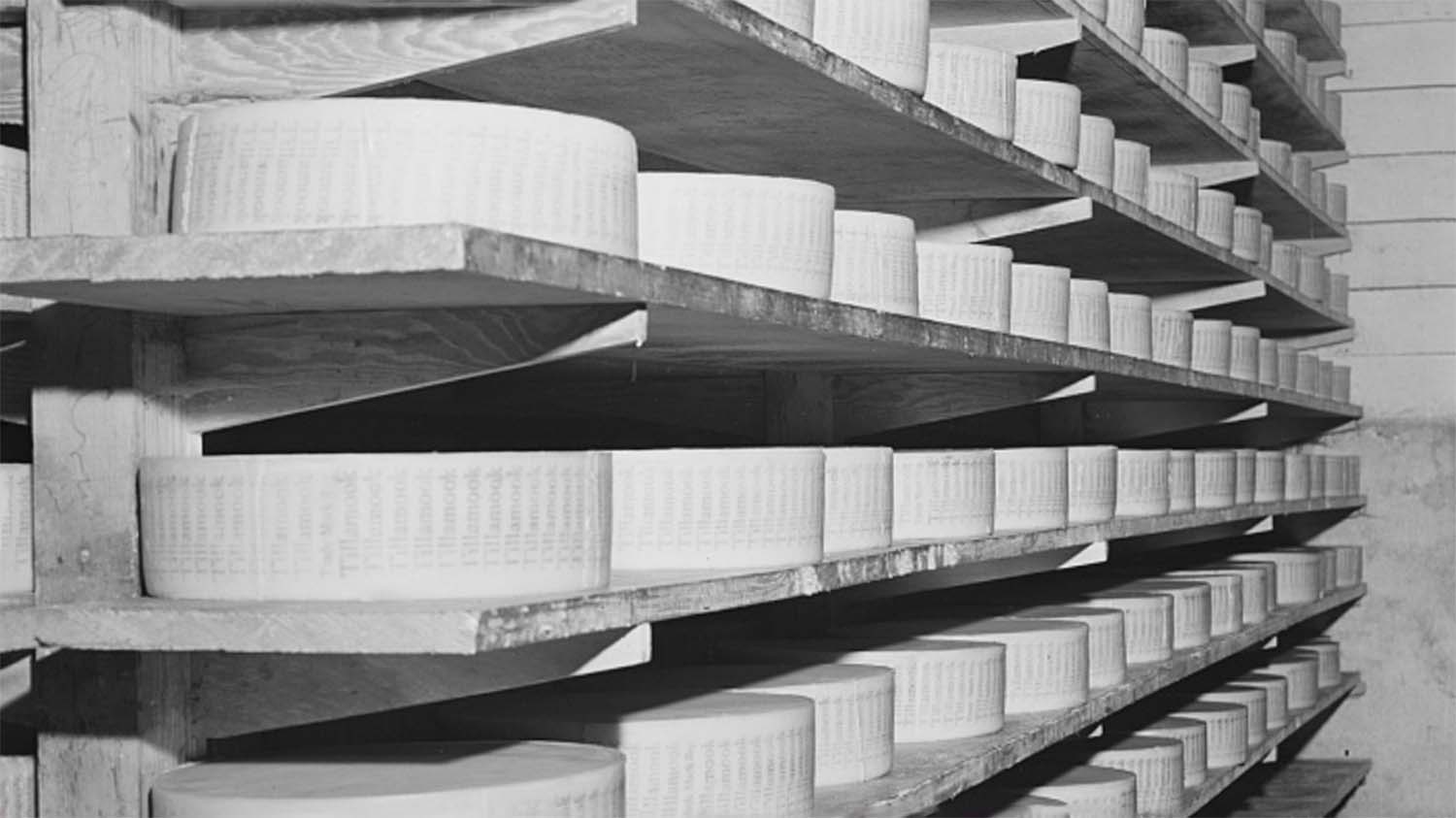
Cheese aging on wooden shelves at the Tillamook cheese plant, Tillamook County, Oregon, circa 1940. The 60-day federal aging requirement for raw milk cheese was codified nine years after this photograph was taken. Photo: Library of Congress, Prints & Photographs Division, Farm Security Administration/Office of War Information Black-and-White Negatives. No known copyright restrictions.
Where the 60-Day Raw Cheese Aging Rule Came From and What It Was Designed For
The federal requirement that raw milk cheese be aged for at least 60 days before interstate sale in the United States was codified in 1949. It predates the discovery of DNA’s double-helix structure, the interstate highway system, and the identification of the pathogen it would most conspicuously fail to address. Understanding what the rule was built to accomplish requires looking at the disease environment that produced it.
The Disease Burden That Made the Rule Necessary
In 1917, approximately 10% of dairy cattle in the United States were infected with Mycobacterium bovis, the organism responsible for bovine tuberculosis, though in some older northeastern dairy regions rates ran as high as 50 to 100 percent. The bacterium passed readily into milk and caused tuberculosis in humans, particularly children, through fluid milk consumption. Before pasteurization became widespread, contaminated milk was one of the primary routes of tuberculosis transmission in American cities.
The USDA’s cooperative state-federal bovine tuberculosis eradication program, launched in 1917, systematically tested cattle herds and culled reactor animals. By 1940, the national TB reactor rate in dairy cattle had fallen below 0.5%. The disease had not been eliminated, but the eradication program had transformed bovine TB from a near-universal cattle condition into a manageable minority problem. Raw dairy remained a transmission route, but the risk profile had changed substantially.
Brucella abortus, the cause of brucellosis in cattle and undulant fever in humans, presented a concurrent problem. Infected cows shed Brucella in milk, and human consumption produced a prolonged febrile illness characterized by cyclical fever, sweating, joint pain, and fatigue that could persist for months. In the 1940s, the United States reported more than 6,000 human brucellosis cases per year, with raw dairy consumption accounting for a significant share of foodborne cases. Occupational exposure among farmers and veterinarians accounted for others.
Both M. bovis and B. abortus shared a characteristic that made aging a viable control strategy: sensitivity to the combined effects of lactic acid, salt, and reduced water activity over time. Laboratory work in the 1940s demonstrated that neither organism survived extended aging in hard and semi-hard cheese styles under properly controlled conditions.
What the 1949 Rule Actually Says
The 60-day aging requirement was codified in what is now 21 CFR Part 133, which establishes federal standards of identity for cheeses and related cheese products. The specific requirement is that raw milk cheese intended for interstate commerce must be held at a temperature of not less than 35°F (2°C) for a period of not less than 60 days from the start of manufacturing.
The rule applies to hard and semi-hard cheese styles whose manufacturing process naturally drives down water activity and pH over the aging period. Soft fresh cheeses were not included in the exemption: their high moisture content and minimal acid development offered no comparable pathogen reduction, and they cannot be produced from raw milk for interstate sale under current federal standards.
The 60-day requirement was framed as a functional equivalent to pasteurization for the target organisms under the conditions of mid-20th-century commercial cheesemaking. It was a calculated compromise: a minimum aging period calibrated to the observed inactivation kinetics of M. bovis and B. abortus in aging cheese, allowing the interstate sale of raw milk hard cheese without the pasteurization requirement that governed fluid milk.
Why the 60-Day Rule Reliably Eliminates M. bovis and Brucella abortus
Mycobacterium bovis and Brucella abortus are both vulnerable to the acidic, low-moisture conditions that develop during hard cheese aging. M. bovis is sensitive to low pH and reduced water activity and does not persist in environments where lactic acid bacteria have driven the pH below 5.0 and salt has reduced the aw below 0.92. B. abortus is similarly susceptible: a gram-negative, non-spore-forming bacterium with no specialized acid resistance mechanisms.
For both organisms, 60 days of aging in properly manufactured cheddar or similar hard cheese styles provided a substantial safety margin. The research basis for the rule was adequate for the organisms it was designed to address, and the rule has continued to accomplish that objective. The national cattle brucellosis reactor rate fell below 0.01% by the late 1980s following the USDA’s eradication program. Human brucellosis cases attributable to domestic raw dairy are now rare. M. bovis in American dairy cattle is similarly uncommon.
A Chronology: From the 1917 Eradication Program to the Research That Challenged the Rule
The gap between what the rule was designed for and what the food safety environment now requires can be mapped against a straightforward chronology.
| Year | Event |
|---|---|
| 1917 | USDA bovine TB eradication program launched; ~10% of dairy cattle infected nationally |
| 1940s | B. abortus causes more than 6,000 human brucellosis cases per year in US |
| 1949 | 60-day aging rule codified in 21 CFR Part 133 |
| 1982 | E. coli O157:H7 identified as a human pathogen for the first time |
| 1993 | Jack in the Box outbreak; O157:H7 established as a major food safety concern |
| 1996 | Reitsma and Henning find viable O157:H7 in cheddar cheese at 158 days |
| 2006 | Schlesser et al. show less than 1-log reduction in raw milk cheddar after 60 days |
| 2010 | D’Amico et al. recover viable O157:H7 from raw milk cheddar and Gouda beyond 270 days |
| 2014 | FDA issues Import Alert 12-10 targeting high-moisture European raw milk cheeses |
| 2015 | Joint FDA/Health Canada risk assessment concludes aging does not reliably mitigate Listeria in soft cheese |
The Pathogen the Rule Did Not Anticipate
Escherichia coli O157:H7 was not identified as a human pathogen until 1982, thirty-three years after the 60-day rule was written. The organism was characterized following two outbreaks of hemorrhagic colitis in Oregon and Michigan, both linked to undercooked ground beef. No regulatory framework written in 1949 could have incorporated a pathogen that did not enter the scientific record until 1982.
What made O157:H7 a poor fit for the existing cheese aging framework was its acid tolerance response (ATR): an adaptive mechanism by which the organism, when exposed to mildly acidic conditions typical of early-stage curd, upregulates protective proteins that allow it to survive pH levels that would kill non-adapted cells. Non-adapted O157:H7 has a minimum growth pH of approximately 4.4. ATR-adapted cells can survive exposure to pH as low as 3.5. The mild acidity of developing curd effectively prepares O157:H7 to withstand the more extreme conditions that develop as aging progresses.
The direct challenge to the 60-day rule’s adequacy came from Reitsma and Henning, publishing in the Journal of Food Protection in 1996. Their study found viable O157:H7 in cheddar at 158 days, nearly three times the regulatory minimum. Their work used pasteurized milk, but the finding established that the acid and salt conditions of cheddar aging posed no reliable barrier to this organism.
Research in raw milk cheese extended the finding. Schlesser et al. (2006) demonstrated less than a 1-log reduction of O157:H7 in raw milk cheddar after 60 days under commercial production conditions. A 1-log reduction represents a 90% decrease in population, leaving 10% of the starting count alive. For a pathogen with an infectious dose as low as 10 to 100 cells, a 10% survivor fraction in a large commercial batch is a meaningful risk. D’Amico et al. (2010) recovered viable O157:H7 from raw milk cheddar and Gouda beyond 270 days using selective enrichment, establishing that the organism does not merely survive the 60-day threshold but persists through aging periods more than four times longer.
Which Pathogens the 60-Day Rule Eliminates and Which It Does Not
The relationship between the rule and the organisms it targeted versus those it did not can be summarized directly.
| Pathogen | Year Identified | Eliminated by 60-Day Aging | Infectious Dose |
|---|---|---|---|
| Mycobacterium bovis | 1898 | Yes | Requires sustained exposure |
| Brucella abortus | 1897 | Yes | 10-100 organisms |
| Listeria monocytogenes | 1926 (food safety risk: 1980s) | No, in soft and surface-ripened styles | ~1,000 cells |
| E. coli O157:H7 | 1982 | No, documented surviving beyond 270 days | 10-100 cells |
Listeria monocytogenes was first described in 1926 but its significance as a food safety pathogen was not established until a series of listeriosis outbreaks linked to soft-ripened cheeses in the 1980s. A 2015 FDA/Health Canada quantitative risk assessment concluded that the 60-day rule provides no reliable protection against Listeria in soft and surface-ripened styles, where ripening cultures raise the surface pH back toward neutral during aging.
Regulatory Responses Since 1949
The FDA has acknowledged the scientific limitations of the 60-day rule at various points without fundamentally revising it. In 2014, the agency issued Import Alert 12-10, targeting European raw milk cheeses with moisture levels above defined thresholds, citing Listeria concerns. The move drew significant opposition from the American artisan cheese industry and affected established imported varieties with decades of safe commercial history in the United States. The agency subsequently moderated its enforcement posture.
The core obstacle to revising the rule is structural. Changing the 60-day standard requires formal rulemaking under the Administrative Procedure Act, including public comment periods and substantial scientific documentation. The rule is also entangled with trade agreements governing imported European cheeses, giving any proposed change diplomatic dimensions beyond domestic food safety policy.
There is also a legal dependency: the 60-day rule is the regulatory mechanism that permits interstate raw milk cheese sales which would otherwise be prohibited under the broader federal restrictions on interstate raw milk commerce. Eliminating or substantially weakening the standard without a replacement framework could affect the legal standing of all interstate raw milk hard cheese sales regardless of aging duration or demonstrated safety record.
What the Rule Accomplishes Today
The 60-day rule still accomplishes precisely what it was designed to accomplish in 1949. Mycobacterium bovis and Brucella abortus are reliably eliminated during properly executed aging in hard and semi-hard cheese styles. The national cattle tuberculosis reactor rate is now below 0.001%. Human brucellosis cases attributable to domestic raw dairy are rare. For the specific disease burden of the mid-20th century, the rule was sound, calibrated, and effective.