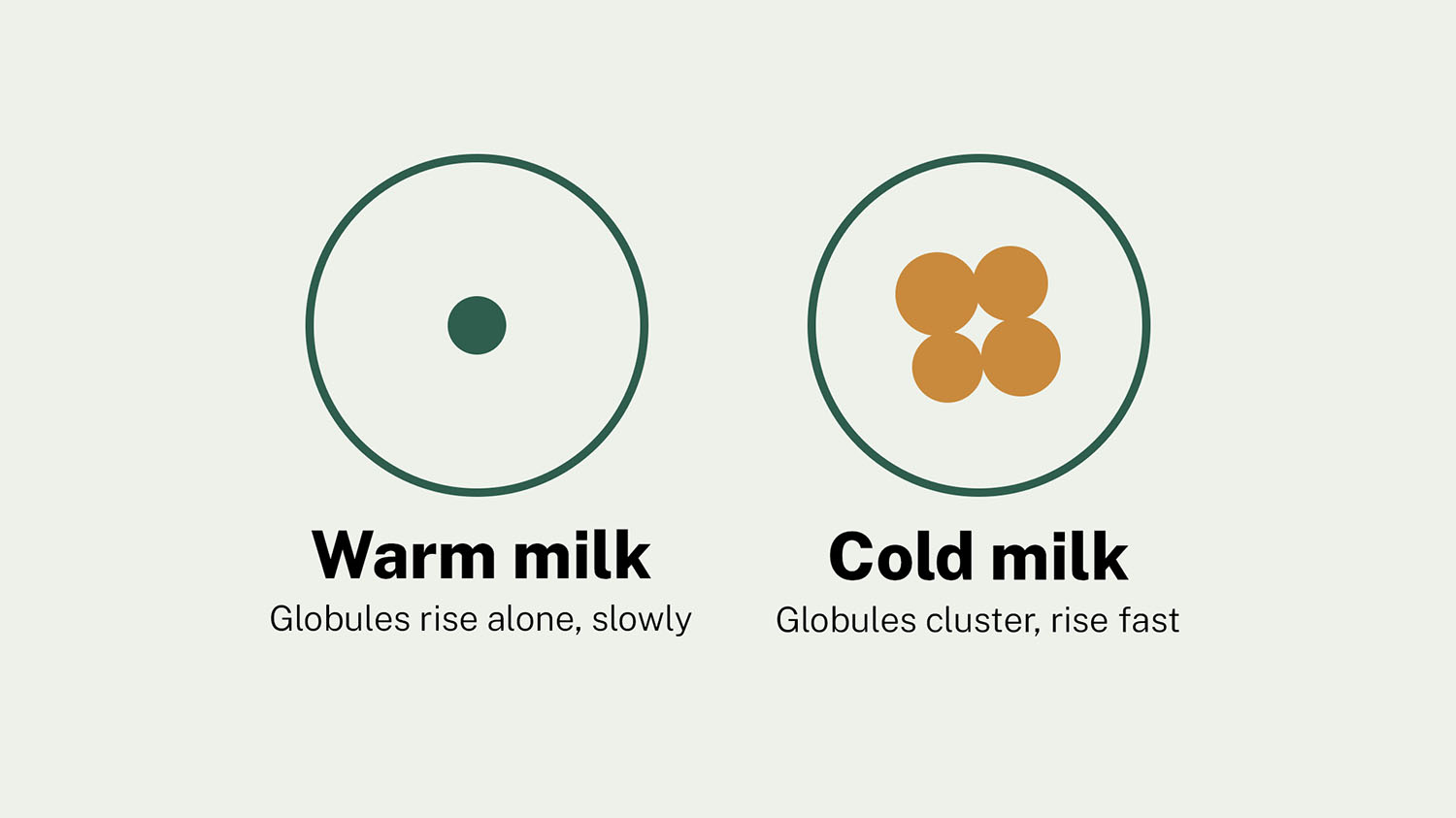
Cold agglutination clusters fat globules together at refrigerator temperatures through an IgM-lipoprotein complex, and clusters rise through milk considerably faster than individual globules do.
Cold Agglutination: The Real Reason Cream Rises Fast in Raw Milk
Leave raw milk in the fridge for half an hour and a distinct cream layer has often already formed on top. That’s faster than simple physics alone would explain. A specific, well-characterized immune mechanism is doing most of the work, and it’s worth understanding both because it’s genuinely interesting chemistry and because it’s directly, measurably disabled by pasteurization.
Key facts:
- Fat globules rise in milk because they’re less dense than the surrounding liquid, but in cold raw milk, creaming happens considerably faster than density differences alone would predict.
- The accelerant is a specific immune complex: IgM binds with lipoproteins to form what’s called a cryoglobulin, which precipitates onto fat globules and causes them to cluster together specifically at cold temperatures.
- A foundational 1984 study confirmed IgM as the heat-labile component responsible for this clustering, functioning as what researchers call a cryoagglutinin.
- Confocal microscopy work found clear agglutination at 5°C, markedly reduced agglutination at 15°C, and no detectable interaction at all at 20°C or 37°C, confirming the phenomenon’s sharp temperature dependence.
Creaming Is Faster Than Physics Alone Explains
Milk fat is less dense than the rest of milk, so fat globules rise to the top given enough time, a basic physical process described by Stokes’ Law. That law predicts a specific rate of rise based on globule size and the density difference between fat and the surrounding liquid. In cold raw milk, though, creaming consistently happens faster than Stokes’ Law alone would predict, and the gap has a specific, well-understood explanation: fat globules aren’t rising individually, they’re clustering together first, and clusters rise considerably faster than single small globules do.
The Mechanism: IgM and Lipoproteins
The clustering itself comes from a specific immune complex formed between an antibody and a lipoprotein. IgM, one of milk’s immunoglobulins, binds with lipoproteins to form what’s called a cryoglobulin, sometimes referred to as a cryoagglutinin in this specific context. This complex precipitates directly onto the surface of fat globules and causes them to flocculate, clustering together rather than staying dispersed as individual particles. As those clusters form and grow, they rise through the milk faster than any single globule would, and in the process they sweep up smaller, unclustered globules along with them. This entire process is called cold agglutination, and it’s specifically why a cream layer can form within just 20 to 30 minutes in cold raw milk.
A foundational 1984 study established the key details of this mechanism directly. It confirmed that IgM was the specific heat-labile component responsible for fat globule clustering, functioning as a cryoagglutinin rather than through some other pathway researchers had previously considered. That study also found that normal creaming requires both IgM and a separate component, the skim milk membrane fraction, working together, not IgM acting alone. Only a small fraction of the total IgM present in milk actually participates in any single creaming event, roughly 7 percent by one estimate, meaning the effect is driven by a relatively small, specific pool of the antibody rather than requiring milk’s entire IgM content to be involved.
How Sharply Temperature-Dependent This Actually Is
The temperature sensitivity of cold agglutination has been directly visualized, not just inferred from creaming rates. Using confocal laser scanning microscopy with fluorescently labeled antibodies, researchers were able to watch IgM-fat globule interactions happen in real time under different storage temperatures. The results were unambiguous: clear, visible agglutination occurred at 5°C. That agglutination was markedly reduced at 15°C. By the time the milk reached 20°C or 37°C, no detectable interaction between IgM and the fat globules remained at all. This is about as sharp a temperature-dependent on/off switch as biology gets, and it maps directly onto ordinary refrigerator temperatures, which is exactly why the effect is so noticeable in milk stored cold at home.
Pasteurization Measurably Disables This Same Mechanism
Because the entire process depends on intact IgM, and IgM is itself a heat-sensitive protein, standard heat treatment interferes with cold agglutination directly. Heating milk to roughly 70°C for 30 minutes, or to 77°C for about 20 seconds, inactivates the agglutination mechanism entirely. After that kind of heat treatment, only single, non-clustered fat globules rise in the milk afterward, at the slower rate Stokes’ Law alone would predict. This happens because the IgM itself denatures in that same general temperature range, the same range associated with other heat-sensitive milk proteins discussed in this site’s article on whey protein and immunoglobulin denaturation. The connection is straightforward: whatever pasteurization does to IgM generally, it does specifically enough here to shut off this particular clustering behavior.
A Traditional Cheesemaking Application
Natural creaming through cold agglutination isn’t just a phenomenon raw milk drinkers notice at home, it has real functional significance in traditional dairy production. It’s specifically the first processing step in producing Grana Padano and Parmigiano Reggiano, two Protected Designation of Origin (PDO) Italian cheeses with centuries of production history. Beyond simply concentrating milk fat for the cheesemaking process, this natural creaming step also plays a documented role in physically removing certain spore-forming bacteria, specifically Clostridium species, that would otherwise cause a defect called “late blowing” in the aged cheese. The same immune-complex mechanism that makes cream rise quickly in a home refrigerator has been put to deliberate, practical use in cheese production for generations.
What This Research Does Not Show
The mechanism described here is well established for bovine milk specifically: IgM forms a cryoglobulin complex with lipoproteins, that complex clusters fat globules together at cold temperatures, the effect has been directly visualized and shown to be sharply temperature-dependent, and it’s measurably disabled by standard heat treatment.
What this research does not show is anything about milk’s nutritional content, safety, or health effects tied to this mechanism. Specifically:
- This is documented physical and immunological chemistry describing how and why cream separates the way it does; none of the sources cited here connect cold agglutination to any nutritional or health claim, and it shouldn’t be read as evidence about milk quality beyond the creaming behavior itself.
- The specific temperature thresholds described (clear agglutination at 5°C, none by 20°C) come from controlled laboratory visualization; a home refrigerator’s actual temperature can vary within and above this range depending on the specific unit and its settings, which could affect how much agglutination occurs in practice.
- The 7 percent figure for IgM participation in a single creaming event comes from one specific foundational study; it’s a useful indicator of scale, not necessarily a precise figure that applies identically to every milk sample.
- This article describes bovine milk specifically; the mechanism’s applicability to milk from other species isn’t addressed by the sources reviewed here.
- The specific mechanistic link between IgM-mediated fat globule clustering and the bacterial spore removal described in the cheesemaking section is not fully proven; a related study notes that immunoglobulins are the likely candidate responsible for that adhesion, but explicitly states no direct evidence has yet confirmed the connection, leaving open the possibility that other factors, such as physical entrapment of spores among globule clusters, also contribute.
Key Terms
- Cold agglutination: the temperature-dependent clustering of milk fat globules caused by an IgM-lipoprotein immune complex, which accelerates natural creaming in cold raw milk.
- Cryoglobulin (cryoagglutinin): the specific complex formed when IgM binds with lipoproteins, which precipitates onto fat globules and causes them to flocculate at cold temperatures.
- Flocculation: the clustering of small particles, in this case fat globules, into larger aggregate groups, distinct from coalescence, in which particles physically merge together.
- Stokes’ Law: the physical principle predicting how quickly a particle rises or falls through a fluid based on the particle’s size and the density difference between the particle and the surrounding fluid.
- Skim milk membrane fraction: a separate milk component that, alongside IgM, is required for normal cold agglutination and creaming to occur.
Frequently Asked Questions
Why does cream separate so quickly in raw milk? Density differences alone (Stokes’ Law) explain some of it, but the main accelerant is cold agglutination, a process where an IgM-lipoprotein complex clusters fat globules together at cold temperatures, and clustered globules rise much faster than individual ones.
Does pasteurization stop this creaming effect? Yes. Heating milk to roughly 70°C for 30 minutes, or 77°C for about 20 seconds, denatures the IgM responsible for cold agglutination, and after that treatment only single, unclustered fat globules rise, at the slower rate predicted by density differences alone.
At what temperature does cold agglutination actually happen? Directly visualized research found clear agglutination at 5°C, markedly reduced agglutination at 15°C, and no detectable interaction at 20°C or 37°C, showing the effect is sharply concentrated in the range of standard refrigeration.
Is cold agglutination used for anything besides home refrigeration? Yes. It’s the first processing step in producing Grana Padano and Parmigiano Reggiano cheeses, where it also helps physically remove certain spore-forming bacteria that would otherwise cause quality defects in the aged cheese.
Does cold agglutination tell you anything about milk’s nutritional quality? No. This is a physical and immunological mechanism explaining creaming behavior specifically; it isn’t evidence about nutritional content or safety.