In susceptible individual cows' milk, simply cooling it after milking is enough to make fat globules vulnerable to breakdown by lipoprotein lipase, no membrane damage or bacteria required.
Spontaneous Lipolysis: When Cooling Alone Triggers Rancidity
Not every source of enzyme activity in cold-stored milk comes from bacteria. Milk carries its own native fat-digesting enzyme, and in a specific subset of individual cows’ milk, the simple act of cooling fresh milk after it’s collected is enough on its own to switch that enzyme on and start breaking down fat, no bacteria, no physical damage, no mechanical disruption required.
Key facts:
- Lipoprotein lipase (LPL) is milk’s major native lipid-digesting enzyme, distinct from the microbial lipases produced by cold-tolerant bacteria, and it originates from blood rather than the mammary gland itself.
- Under normal conditions the intact fat globule membrane physically keeps this enzyme away from the fat it would otherwise digest; simply cooling certain individual milks soon after secretion can trigger what’s called spontaneous lipolysis without any membrane damage at all.
- Susceptibility to spontaneous lipolysis varies dramatically between individual cows; some cows’ milk is highly prone to it while others show almost none under identical cold-storage conditions.
- Standard HTST pasteurization is generally accepted to almost completely inactivate LPL, meaning this is specifically a raw-milk, pre-processing consideration.
What Lipoprotein Lipase Actually Is
Lipoprotein lipase is milk’s principal indigenous fat-digesting enzyme, and unlike most of the milk components discussed elsewhere on this site, it doesn’t originate in the mammary gland’s normal milk-production process. It comes from blood, entering milk through ordinary leakage across the mammary cell membrane during secretion. Once present, LPL is fully capable of breaking down a large share of milk’s fat into free fatty acids, and the total lipase activity naturally present in raw milk would be more than sufficient to cause rapid, widespread fat hydrolysis if nothing were stopping it.
Something does stop it, under normal circumstances: the intact fat globule membrane. This membrane physically separates the enzyme from the triglycerides inside each fat globule, acting as a barrier that keeps LPL’s activity in check regardless of how much of the enzyme is actually present in the milk. That’s the key structural fact underlying everything else in this article, because most of what makes spontaneous lipolysis interesting is that it can happen without that barrier ever being breached.
The Core Finding: Cooling Alone Can Switch the Enzyme On
In a specific subset of individual cows’ milk, simply cooling the milk soon after it’s collected is enough, on its own, to trigger measurable lipolysis, without any physical damage to the fat globule membrane and without any bacterial involvement. This is called spontaneous lipolysis, and it’s genuinely distinct from the more commonly discussed causes of rancidity, which typically involve either mechanical disruption of the membrane or bacterial lipase activity.
The precise biochemical trigger behind spontaneous lipolysis is explicitly described in the dairy science literature as still not fully understood. What is understood is that susceptibility appears to depend on a shifting balance between naturally occurring activating substances and naturally occurring inhibiting substances already present in the milk itself, rather than on any single external factor. Whatever the exact mechanism, its practical effect is clear: cooling, all by itself, can be enough to start the clock on rancidity in susceptible milk. Lipolysis in refrigerated milk that’s prone to this phenomenon tends to occur within 24 hours at temperatures below 10°C.
Why Some Cows’ Milk Is Susceptible and Others Aren’t
One of the more striking findings in this area of research is just how much individual cow-to-cow variation exists. A study measuring lipase redistribution and activation across 135 individual milk samples found that all of them were susceptible to activation treatments to some degree, but the response varied considerably, and correlations between gentle activation treatments and spontaneous lipolysis were notably stronger than correlations involving more vigorous treatments, which tended to level off in milks that already showed high spontaneous lipolysis to begin with. In practical terms, this means spontaneous lipolysis isn’t a property of milk in general, it’s a property of specific individual animals, and mixing milk from many cows into a bulk tank tends to average out and dilute the effect of any single highly susceptible cow.
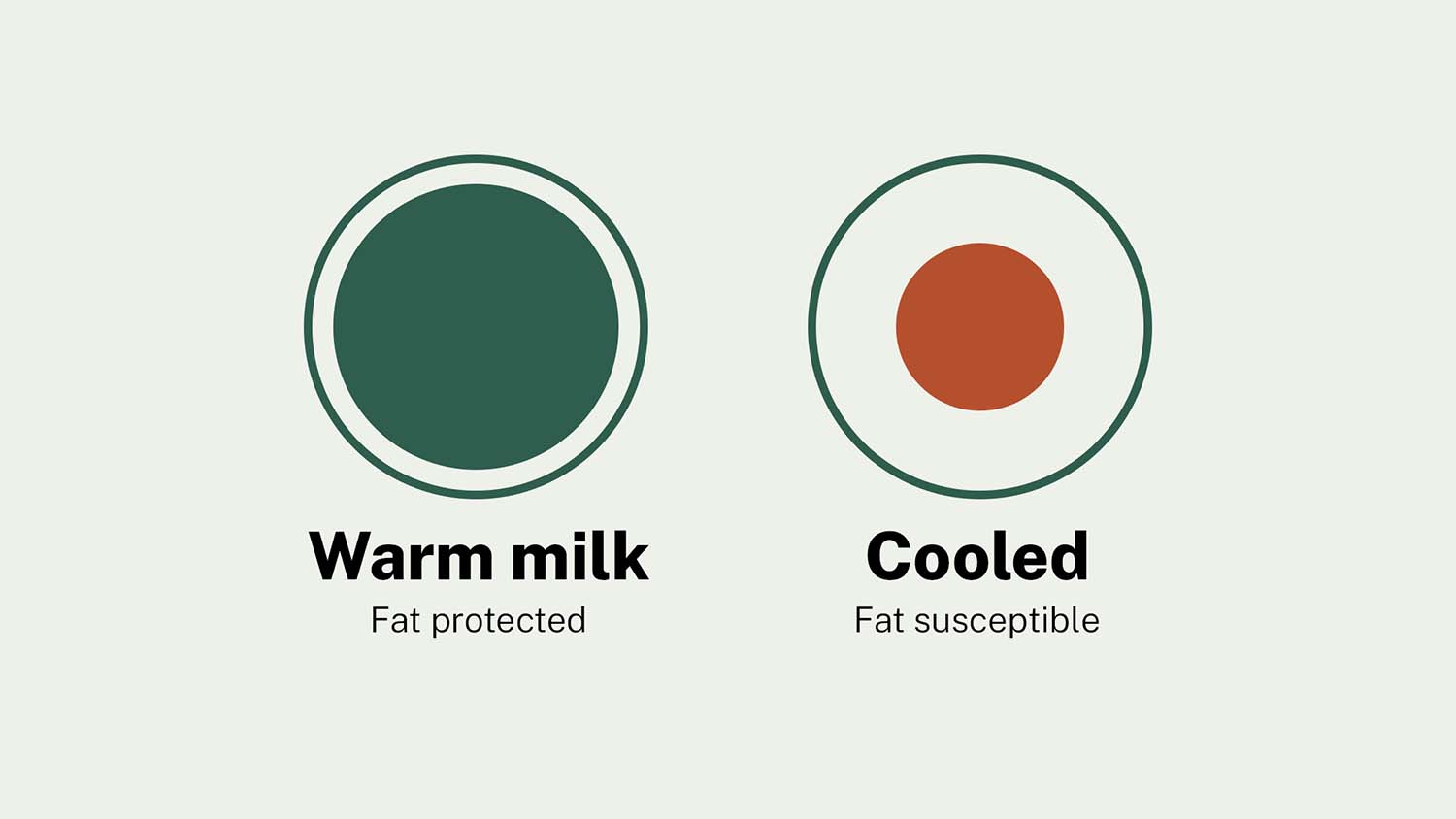
A separate study working directly with isolated fat globules adds a genuinely counterintuitive detail to this picture. Fat globules pulled straight from fresh milk that was still warm barely broke down at all when exposed to purified lipase, and that held true even for globules sourced from cows whose milk was already known to be lipolysis-prone; cooling those same globules made them susceptible to rapid breakdown. What’s counterintuitive is what happened next: once cooling had made the globules vulnerable, simply rewarming them did not reverse that vulnerability. The globules stayed susceptible to lipolysis even after being brought back to a warmer temperature, meaning cooling appears to trigger a lasting structural change in the fat globules themselves, not just a temporary condition that resolves once the milk warms back up.
Rancidity Isn’t the Only Outcome
What lipolysis actually produces, and when that becomes a problem, is worth being precise about. Free fatty acids, the direct product of LPL breaking down triglycerides, aren’t purely a negative outcome. At low concentrations, they contribute to the normal, desirable flavor of milk and many cheeses. It’s specifically excessive lipolysis, well beyond the low background level found in healthy milk, that produces the rancid, soapy, or bitter off-flavors associated with the phenomenon. The distinction matters because it means the presence of some free fatty acid activity in milk isn’t itself evidence of a problem; it’s a matter of degree.
A Distinct Trigger: Mechanical Disruption
Spontaneous lipolysis, triggered by cooling alone, is only one of two main categories of lipolysis recognized in dairy science. The enzymes responsible for lipolysis’s detrimental effects come from two main sources, those indigenous to milk and those of microbial origin, and the same basic split applies to how lipolysis itself gets triggered. Spontaneous lipolysis is specifically initiated by cooling raw milk below roughly 10°C soon after it leaves the cow. The other main category, called induced lipolysis, results from mechanical disruption, agitation, excessive pumping, or homogenization of raw milk, all of which physically damage the fat globule membrane and dramatically increase the enzyme’s access to the fat inside. This is a meaningfully different trigger than the pure-cooling effect that’s the focus of this article, though the two can compound each other in practice. It also shares a mechanism with something covered in a separate article on this site: ice crystal formation during freezing can rupture the fat globule membrane in much the same way physical agitation does, removing the same protective barrier through a different, freezing-specific route.
What This Research Does Not Show
The mechanism described here is real and specific: cooling alone, without membrane damage or bacterial involvement, can trigger lipolysis in a subset of individual cows’ milk, individual cow susceptibility varies substantially, and standard pasteurization is generally understood to largely inactivate the enzyme responsible.
What this research does not show is a clear, complete explanation for why cooling alone triggers this response in susceptible milk, or a way to predict which specific cows’ milk will be affected without testing it directly.Specifically:
- The precise biochemical mechanism behind cold-triggered activation is explicitly described in the literature reviewed here as still poorly understood; treat this as a documented phenomenon with an incompletely characterized cause, not a fully solved mechanism.
- None of the sources cited here frame excessive lipolysis or the resulting rancidity as a food safety hazard; the documented effects are about flavor and palatability, not safety.
- The individual-cow variability data comes from a study of 135 samples measuring response to a range of activation treatments; it demonstrates that susceptibility varies substantially, but it doesn’t provide a simple way to predict in advance which individual animals will be prone to spontaneous lipolysis without direct testing.
- This article focuses specifically on lipoprotein lipase, milk’s native enzyme; it does not cover the separate, bacterially-produced lipases discussed in this site’s article on psychrotrophic bacteria, which operate through an entirely different source and mechanism.
Key Terms
- Lipoprotein lipase (LPL): milk’s principal native fat-digesting enzyme, originating from blood rather than the mammary gland’s milk-production process, normally kept away from milk fat by the intact fat globule membrane.
- Spontaneous lipolysis: fat breakdown triggered simply by cooling certain susceptible milk, without any physical membrane damage or bacterial involvement, through a mechanism that remains only partially understood.
- Induced lipolysis: fat breakdown triggered by physical or mechanical disruption of the fat globule membrane, such as agitation, pumping, or homogenization, distinct from the cooling-only trigger that defines spontaneous lipolysis.
- Free fatty acids (FFAs): the direct product of lipase activity breaking down triglycerides; contribute to normal flavor at low levels but cause rancid or soapy off-flavors when present in excess.
- Fat globule membrane: the structure surrounding each fat droplet in milk that normally prevents LPL from accessing the triglycerides inside, discussed in more detail in this site’s dedicated article on MFGM proteins.
Frequently Asked Questions
Can raw milk go rancid just from being refrigerated? Yes, in certain susceptible individual cows’ milk. Simply cooling fresh milk after collection can trigger spontaneous lipolysis, breaking down fat into free fatty acids, without any mechanical damage or bacterial involvement required.
Why does this happen to some milk and not other milk? Individual cow susceptibility varies substantially. A study of 135 individual milk samples found all were susceptible to lipase activation to some degree, but the extent varied considerably between animals, meaning some cows’ milk is much more prone to spontaneous lipolysis than others under identical conditions.
Does pasteurization destroy lipoprotein lipase? Standard HTST pasteurization is generally accepted to almost completely inactivate LPL, meaning spontaneous lipolysis triggered by cooling is specifically a consideration for raw milk before any heat treatment, not something that carries through into pasteurized products.
Is rancidity from lipolysis a food safety issue? The sources reviewed here describe excessive lipolysis and the resulting rancid or soapy off-flavors as a quality and palatability issue, not a documented food safety hazard.
Is spontaneous lipolysis the same thing as rancidity caused by bacteria? No. Spontaneous lipolysis is triggered by milk’s own native lipoprotein lipase responding to cooling alone, an entirely different source and mechanism than the heat-stable lipases produced by psychrotrophic bacteria during cold storage, covered in a separate article on this site.