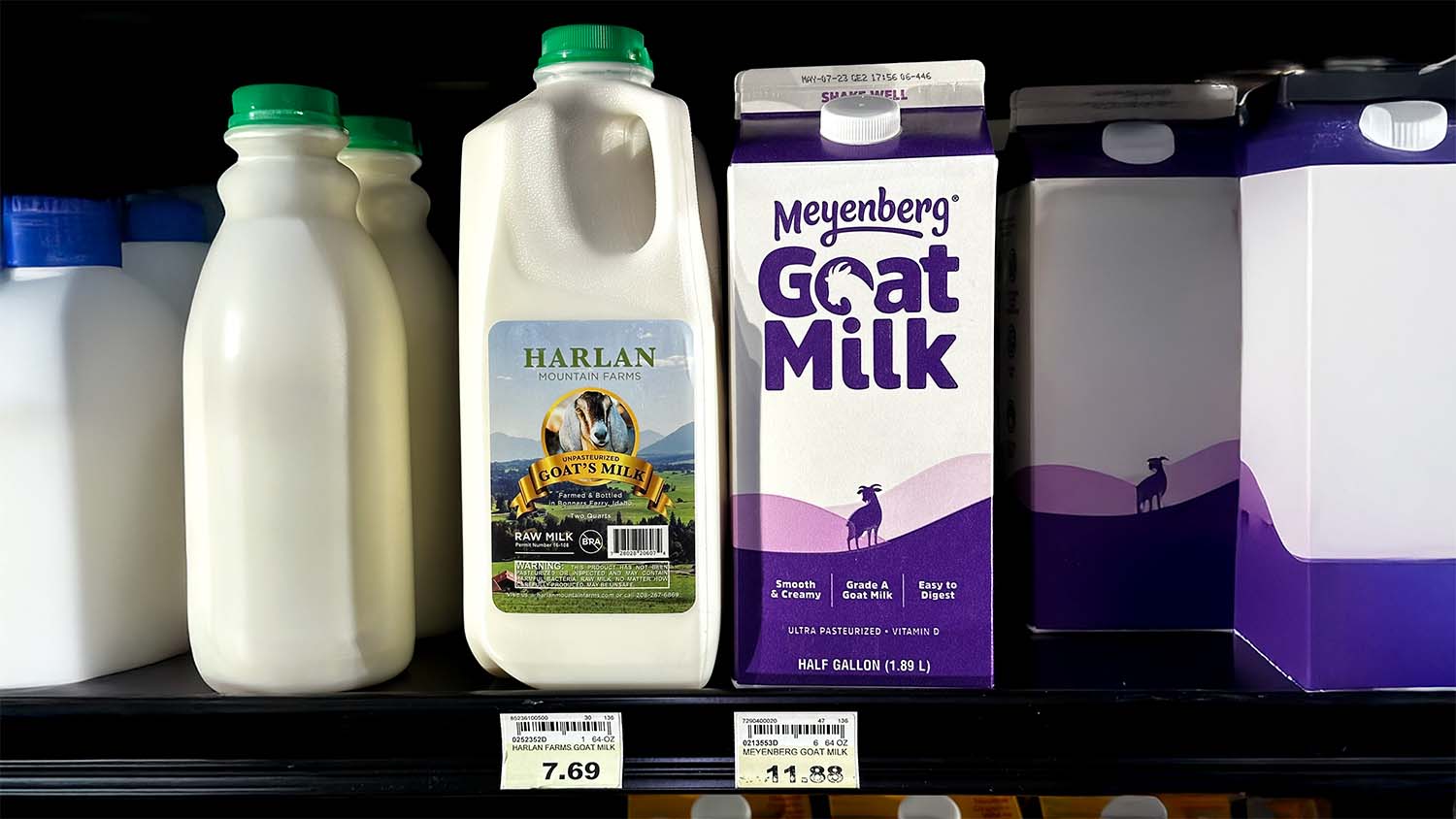
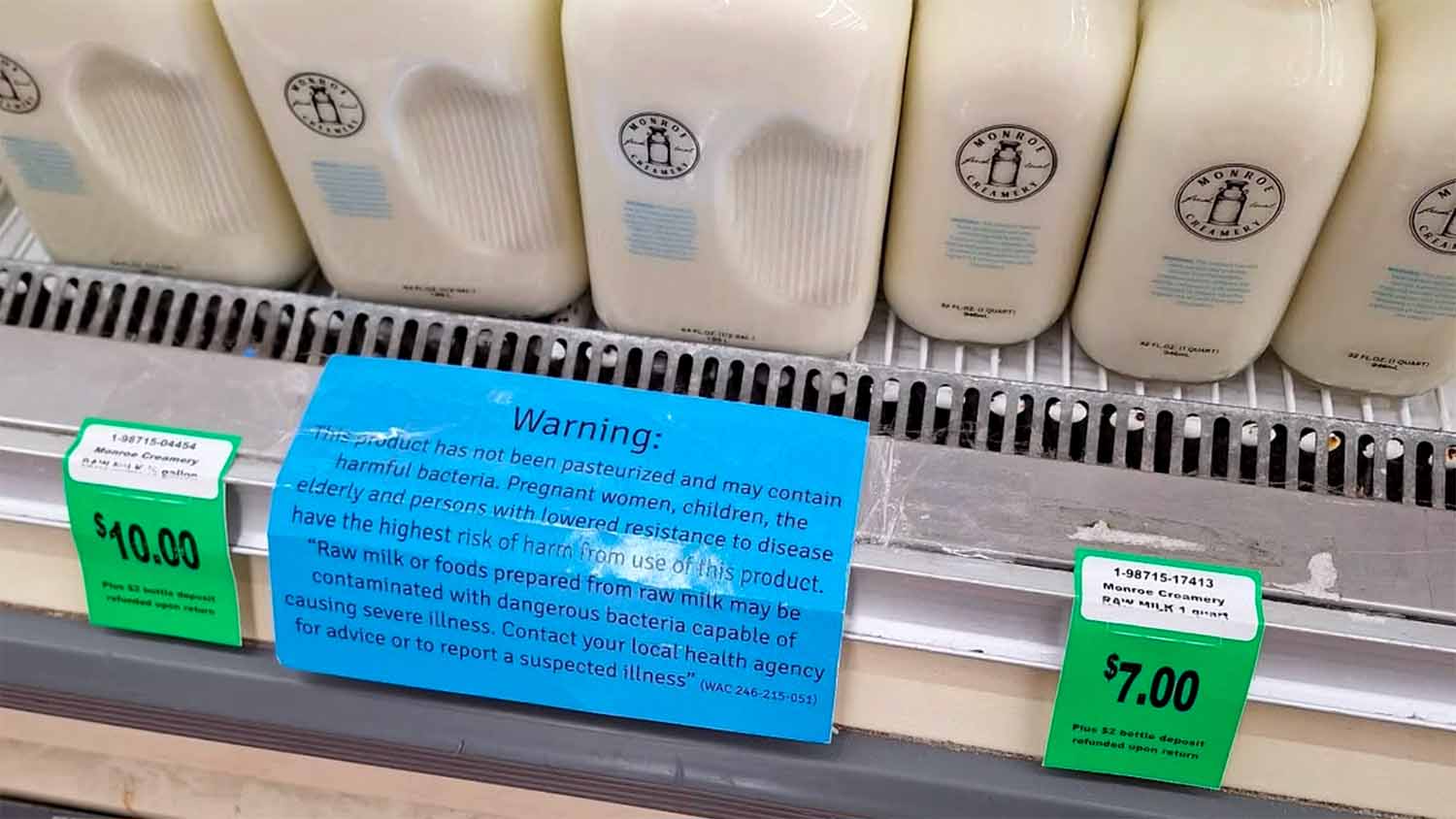
Raw milk sold legally at retail typically carries a mandated warning label like this one, informing buyers of the same risk this article covers directly.
Is Raw Milk Safe? What the Research Shows
The best available peer-reviewed surveillance data puts raw milk’s risk of foodborne illness, in absolute terms, below everyday foods such as leafy greens. At the same time, that risk is real and non-zero, and US public health authorities, including the CDC and FDA, consistently recommend against raw milk consumption. What follows covers the data and sourcing behind both.
Key facts:
- Combining the outbreak illness estimate from Costard et al. 2017 with consumer counts from FDA surveys puts the raw milk illness rate at about 1 in 13,000 to 1 in 15,000 consumers per year.
- The hospitalization rate from the same study is roughly 1 in 450,000 to 1 in 520,000 consumers per year. The study’s outbreak dataset recorded 17 deaths, 16 of them from Listeria. Unpasteurized dairy accounted for one Listeria illness in the dataset; pasteurized products accounted for 100.
- In a peer-reviewed analysis of CDC outbreak data from 2005 to 2020, raw milk was linked to two deaths in 16 years, and pasteurized fluid milk to four. Fatal foodborne disease over the period “was dominated by fruits, vegetables, peanut butter, and pasteurized dairy.”
- CDC’s own current guidance is direct and unambiguous: it recommends choosing pasteurized milk, noting that farm-level care can lower contamination risk without eliminating it entirely.
- H5N1 avian influenza in dairy cattle has substantially declined since 2024 but isn’t fully resolved: the virus survives in refrigerated raw milk for at least five weeks in laboratory testing, CDC currently rates general public risk as low, and no human case has been definitively attributed to drinking raw milk specifically, as distinct from occupational exposure to infected animals. In cattle themselves, mortality has averaged 2% or less, and most affected cows recover with supportive treatment.
How Many People Actually Get Sick
The most widely used illness estimate comes from Costard et al. 2017, published in the CDC’s journal Emerging Infectious Diseases by consultants at EpiX Analytics. It estimated about 730 outbreak-related illnesses a year from unpasteurized milk and cheese, adjusted for underreporting and underdiagnosis. Divided by the 3.2% of the population the study counted as raw milk drinkers (from a 2006 to 2007 survey), that is about 1 in 13,000 per year. FDA surveys from 2016 and 2019, published in 2022, counted about 11 million adult raw milk drinkers, which brings the rate to about 1 in 15,000. The full calculation and its limitations are covered separately.
Costard’s headline figure of 761 illnesses a year covers all dairy outbreaks, pasteurized and unpasteurized. Unpasteurized milk and cheese account for 96% of it, about 730 illnesses, and that combined milk-and-cheese figure is the one used for per-consumer rates. The consumer denominator counts raw milk drinkers only, which makes the resulting rate slightly conservative. For cheese-specific pathogen risk, the cheese-aging science cluster covers that territory directly.
Illness isn’t the only outcome worth measuring; hospitalization is a more severe outcome and deserves its own figure. Costard et al. 2017 estimated 22 dairy outbreak hospitalizations a year, about 21 of them attributable to unpasteurized products. Against 9.6 to 11 million raw milk drinkers, depending on which consumer survey is used, that is roughly 1 in 450,000 to 1 in 520,000 per year.
The same outbreak dataset recorded 17 deaths across the 2009 to 2014 study period, in 10 outbreaks. According to the study’s Table 1, 16 of the deaths were from Listeria monocytogenes and one from Campylobacter. The table also shows where Listeria came from: 10 outbreaks, 100 illnesses and 87 hospitalizations from pasteurized products, against one outbreak with a single illness from unpasteurized products. At most one of the 16 Listeria deaths could have come from raw dairy, and the Campylobacter death is not attributed by pasteurization status. Deaths attributable to unpasteurized milk or cheese in this dataset are therefore between zero and two of 17.
Illness rates in this space get reported two different ways, per serving consumed and per consumer, and they produce very different-looking numbers from the same data. This distinction has its own dedicated treatment, and it is the source of the widely circulated “840 times more likely” statistic, which measures something narrower than most people assume: the ratio of outbreak illness rates per serving between raw and pasteurized dairy, across four pathogens. For comparison against an everyday food, leafy greens show a higher per-consumer illness rate than raw milk, even after a generous allowance for raw milk illness outside recognized outbreaks.
Deaths, in Context
The most rigorous available answer comes from a 2024 peer-reviewed analysis of CDC outbreak data for 2005 through 2020. Stephenson, Coleman and Azzolina, published in the Journal of Epidemiology and Global Health, counted two deaths linked to raw milk over the 16 years, both in patients with pre-existing underlying disease, and four linked to pasteurized fluid milk. Across all foods, the authors found that fatal foodborne disease “was dominated by fruits, vegetables, peanut butter, and pasteurized dairy.” Cattle deaths compared with raw milk deaths and a case-by-case review of raw-milk-linked fatalities both cover this in more depth.
This finding has a real limitation: foodborne deaths of any kind are rare enough that a single outbreak can change the comparison. The authors did not run statistical tests on milk mortality for that reason.
Has the Trend Changed as Access Has Expanded?
More states have legalized some form of raw milk sale over the past two decades, and a natural question is whether wider access has meant more illness. Research adjusting for consumption volume, rather than raw outbreak counts alone, found that outbreak rates have actually declined as legal access has expanded, a meaningfully different picture than studies that measured raw outbreak counts without controlling for how many more people were drinking raw milk during the same period. Separately, one of the largest raw milk outbreaks in recent US history, a 2023 Salmonella outbreak linked to Raw Farm in California, caused 171 cases and no deaths, and the dairy recalled its products within a week of the state investigation starting. By the standards of major foodborne outbreaks, that is a modest count, and existing surveillance and recall systems identified and stopped it.
What Happens When Something Goes Wrong
Raw milk sold at retail in states where that’s legal operates under a real regulatory response system, not an honor system. The typical process runs from detection (routine testing or an illness cluster) to a voluntary hold on sales while confirmatory lab testing is completed, then to a public recall notice if that testing confirms a problem; a structured recall process begins covering everything from initial detection through public notification to resuming normal operations. Most recalls, in raw milk and in the US food system generally, happen this way: a producer acting voluntarily, sometimes at a regulator’s request, rather than under a mandatory order.
That voluntary system doesn’t always move quickly, though. In a 2026 multistate E. coli investigation, the country’s largest raw milk producer delayed its recall for several weeks, citing its own negative internal testing, before recalling under protest; FDA’s later analysis still identified the company’s products as the outbreak source. Common questions about how this process works, what triggers a recall, and what a recall does and doesn’t indicate about a specific farm’s practices are covered in more depth separately.
Pasteurized milk isn’t held to a zero-bacteria standard either. The federal Pasteurized Milk Ordinance allows up to 20,000 bacteria per milliliter in finished pasteurized milk, a standard licensed raw dairies are sometimes measured against for useful context, even though the two products are regulated under different specific frameworks given the different risk profile heat treatment creates.
What Farms Actually Do
Farm-level practice varies substantially, and that variation is a real driver of the overall risk picture, not just a caveat. Most raw milk sold at retail operates under some form of state-level licensing and testing requirement as a baseline. California’s framework is illustrative: licensed raw milk producers must meet the same bacteria count standard applied to pasteurized milk, no more than 15,000 bacteria per milliliter and no more than 10 coliform bacteria per milliliter at the point of delivery to the consumer, on top of the same sanitary design and operational requirements that apply to Grade-A dairy farms generally. That’s the kind of regulatory floor most licensed operations work within, not an optional extra. Beyond that baseline, many raw milk producers, particularly those pursuing retail sale where it’s legal, conduct regular on-farm bacterial testing before milk ever leaves the property, on top of whatever their state already requires.
A documented vetting checklist exists for evaluating any specific farm directly, covering herd health, cleanliness, and chilling practices specifically, useful regardless of whether a given farm belongs to any particular program. One voluntary program worth knowing about: the Raw Milk Institute (RAWMI) lists farms that complete its training and testing program and meet its published standards. RAWMI listing is sometimes treated as a general industry benchmark, but the scale doesn’t support that: RAWMI currently lists just over 50 farms across the US and Canada combined, a small fraction of the well over 1,300 raw milk sources tracked by directories alone, and likely under 1% of all raw milk producers once informal and undocumented sources are counted. RAWMI listing is a genuine, meaningful signal where it applies, but it describes a small minority of farms, not the norm.
None of this eliminates risk, but it means the population-level statistics cited throughout this article represent an average across a wide range of actual practice, from rigorously tested operations to considerably less careful ones, and a specific farm’s practices are not fully captured by an aggregate national figure.
Illness Clusters at Specific Sources, Not Evenly Across Every Glass
The population-level statistics in this article describe an average, and averages can create a misleading mental picture: that every glass of raw milk carries some small, ambient chance of causing illness, independent of where it came from. The actual outbreak data doesn’t support that picture. Most unpasteurized dairy-related outbreaks trace to contamination at the dairy farm itself, Costard et al. 2017 states directly, and the same paper reports that bulk tank surveys of US raw milk farms found the major pathogens present in only a minority of tanks tested at any given time: E. coli O157 in roughly 2.5% of tanks, Salmonella in 4.6%, Listeria in 2.5%, and Campylobacter in 4.7%. Contamination isn’t spread evenly across the supply; it’s concentrated at specific sources at specific times.
Individual outbreak investigations make the same point concretely. A 2023-2024 Salmonella Typhimurium outbreak traced 171 illnesses to a single named dairy farm’s product in California, not to raw milk broadly. That pattern, a cluster of illnesses tracing back to one specific source rather than a diffuse scattering of unrelated cases, is how raw milk outbreaks typically present.
This isn’t a story about careless farms versus careful ones in every case, though practice does matter. A well-documented Pennsylvania case makes that nuance clear: a dairy that had “consistently adhered to” state requirements and tested more frequently than required still experienced two separate Campylobacter outbreaks about a year apart, 148 cases in the first, a smaller cluster in the second. Looking at the broader pattern in the same state over a longer window: Pennsylvania recorded 17 raw-milk-linked outbreaks from 2005 to 2013, and five producers accounted for more than one each. The investigators point to seasonal shifts in bacterial shedding by the animals themselves, or gaps in collection-day quality control, as plausible contributors to recurrence, not necessarily negligence. Most producers who had an outbreak had exactly one; a smaller number had a genuine, recurring source issue that took more than a single incident to fully resolve.
The practical upshot: risk in this space behaves like a series of discrete, traceable events tied to specific sources, not a uniform background hum. That’s exactly the structural logic behind the licensing, testing, and recall systems described throughout this article, they exist specifically to catch and address source-level problems, not to manage risk that’s distributed evenly and can’t be localized.
The US Public Health Position
This site serves readers in more than 60 countries, and official positions on raw milk vary by country. The guidance below reflects the United States specifically, where most of the data in this article originates. US public health authorities take a clear position. CDC’s current guidance (last reviewed January 2025) opens with three summary points stated as plainly as this:
“Pasteurization is crucial for milk safety, killing harmful germs that can cause illness. Consuming raw milk can lead to serious health risks, especially for certain vulnerable populations. Choosing pasteurized milk and dairy products is the best way to safely enjoy the nutritional benefits of milk.”
The page’s overview section adds a specific point about farm practices: “While good practices on farms can reduce contamination, they cannot guarantee safety from harmful germs.” The American Medical Association’s patient guidance takes a similar position, and both organizations specifically flag increased severity risk for particular groups: children under 5, adults over 65, pregnant women, and people with weakened immune systems.
This position isn’t necessarily in direct conflict with the population-level statistics discussed above; it reflects a different question. Population-level illness rates describe what happened, on average, across a large and varied population over a defined study period. A public health recommendation is a forward-looking risk-minimization stance, and public health agencies generally recommend the lower-risk option even when the absolute risk of the higher-risk option is small, particularly for outcomes that can be severe. Readers evaluating this question for themselves are best served by seeing both the data and the recommendation stated plainly, rather than only one or the other.
A risk of about 1 in 13,000 to 1 in 15,000 a year isn’t an unusual thing for people to knowingly accept in other parts of daily life. Activities like driving, recreational sports, and a range of foods and lifestyle choices carry comparable or higher risk levels than this, generally without much individual deliberation or social controversy attached. That comparison doesn’t settle anything about raw milk specifically, since context, severity, and personal circumstance all matter, but it’s a useful reference point: treating any nonzero risk as automatically disqualifying would rule out a great deal of ordinary life, not just raw milk.
What the Public Actually Believes
A recommendation from public health authorities is one kind of evidence. What people actually believe, and how that differs from what the data shows, is a separate and measurable thing. The most direct source on this is a 2024 survey by the Annenberg Public Policy Center at the University of Pennsylvania, conducted by SSRS on a probability-based panel of 1,031 US adults, with a margin of error of ±3.5 percentage points.
Asked to compare raw milk’s safety to pasteurized milk, 47% of respondents said raw milk is less safe. Among the remaining respondents, 9% said raw milk is safer, 15% said the two are equally safe, and 30% said they weren’t sure. Belief split along political and geographic lines: 57% of Democrats said raw milk is less safe, compared with 37% of Republicans, and 49% of urban respondents said the same, compared with 32% of rural respondents. A regression analysis in the same report found that political affiliation and rural-versus-urban residence each independently predicted belief about raw milk’s relative safety.
The same survey also asked whether pasteurization destroys nutrients in milk, treating “no” as the correct answer in line with CDC’s public messaging that pasteurized milk “offers the same nutritional benefits” as raw. Only 43% answered that way; 16% said pasteurization does destroy nutrients, and 41% weren’t sure. That framing doesn’t match the vitamin-by-vitamin research: a 40-study meta-analysis found statistically significant decreases in vitamins B1, B2, C and folate after pasteurization, no significant change in B6, qualitative decreases in B12 and E, and an increase in vitamin A. The authors judged the overall effect on milk’s nutritive value to be small because several of these vitamins occur at low levels in milk, while noting that milk is an important dietary source of B2. “Pasteurization does not destroy nutrients” is a simplified public message, not an accurate description of that data, and treating disagreement with it as a knowledge gap overstates how settled the science is. Whether that simplification reflects a deliberate communication choice, an institutional blind spot or something else isn’t something this article can determine, but the gap between the message and the data behind it is real.
Separately, consumption itself appears to be rising. The same report cites Associated Press reporting that weekly raw milk sales grew from roughly 21% to as much as 65% year-over-year during a several-week window in spring 2024, coinciding with the initial 2024 bird flu news cycle. Whether that reflects considered risk tolerance, distrust of the recommendation itself, or simply increased attention to raw milk as a topic isn’t something this survey or sales data can distinguish.
What This Research Does Not Show
Every figure and finding in this article reflects population-level, historical, or currently available data. None of it is a substitute for a personal medical or food-safety decision, and none of it should be read as a guarantee about any specific raw milk source’s risk.
What this article is not saying is that raw milk is risk-free, or that population-level statistics predict the outcome for any individual person or any individual farm’s milk. Specifically:
- Illness and mortality statistics discussed here are population-level averages across a wide range of actual farm practice; they do not describe the risk profile of any specific source, and a rigorously tested, well-managed operation is not the same risk as the dataset’s average.
- Most illness figures here count outbreak-related illness only. A 2014 Minnesota study found that lab-confirmed sporadic patients who reported drinking raw milk outnumbered raw milk outbreak cases by about 25 to 1, though the authors note those illnesses could not be definitively linked to the milk. How that affects comparisons with other foods is covered separately.
- Severity risk is not evenly distributed. Children under 5, adults over 65, pregnant women, and people with weakened immune systems face meaningfully higher risk of severe outcomes from the same pathogens, a point every public health source cited in this article makes explicitly.
- This article describes documented research and current public health guidance. It is not health or legal advice, and does not substitute for a conversation with a medical professional about individual risk factors.
- All of the illness, hospitalization, mortality, outbreak-source, public opinion, and regulatory data cited here is US-specific. Raw milk regulation, testing standards, outbreak surveillance systems, and official public health positions vary by country, and readers outside the US should not assume this data or CDC’s specific recommendation applies directly to their own country’s dairy supply.
- The public belief survey reflects a single measurement at one point in time (June 2024) and hasn’t been repeated since, so it may not reflect current attitudes. The cited sales growth figures describe a specific, short window during the initial 2024 H5N1 news cycle and don’t establish what’s driving longer-term consumption trends.
- Outbreak illness being concentrated at specific sources rather than distributed evenly doesn’t mean a well-tested, well-managed farm carries zero risk. Contamination has occurred even at operations following standard testing requirements, and source-level risk can be reduced through careful practice without being eliminated entirely.
Key Terms
- Per-consumer illness rate: the number of illnesses attributed to a food divided by the number of people who consume that food, expressed as a rate per year; the metric closest to what most people mean when asking “how likely am I to get sick.”
- Per-serving illness rate (incidence rate ratio): a comparative metric dividing illness counts by total servings consumed rather than by number of consumers; produces different, often much larger, ratios than per-consumer comparisons for foods with a small but frequent-consuming user base.
- Outbreak-reported illness: cases formally investigated and attributed to a specific food source by public health authorities, a fraction of total foodborne illness for any food category, since most foodborne illness is never formally investigated or attributed.
- Pasteurized Milk Ordinance (PMO): the federal standard governing bacterial limits and safety requirements for pasteurized milk sold in the United States.
Frequently Asked Questions
Is raw milk safe to drink? Population-level statistics show raw milk’s risk is lower, in absolute terms, than everyday foods such as leafy greens, while that risk is still real and non-zero, and US public health authorities consistently recommend against raw milk consumption. Both are accurate; this article presents both rather than resolving the tension into a simple yes or no.
How many people get sick from raw milk each year? Costard et al. 2017 estimated about 730 outbreak-related illnesses a year from unpasteurized milk and cheese. Divided by roughly 10 to 11 million raw milk drinkers, that is about 1 in 13,000 to 1 in 15,000 per year.
How does the hospitalization rate compare? Costard et al. 2017 estimated about 21 hospitalizations a year from unpasteurized dairy, roughly 1 in 450,000 to 1 in 520,000 raw milk drinkers. The study’s dataset recorded 17 deaths, 16 from Listeria, which came almost entirely from pasteurized products in that period.
Has anyone died from drinking raw milk? Yes, though rarely. A peer-reviewed analysis of CDC outbreak data for 2005 to 2020 counted two deaths linked to raw milk, both in patients with underlying disease, and four linked to pasteurized fluid milk. Fatal foodborne disease in that period was dominated by fruits, vegetables, peanut butter and pasteurized dairy.
Is H5N1 bird flu still a concern for raw milk? Less than it was in 2024. The virus survives in refrigerated raw milk for weeks in laboratory testing, and CDC currently rates general public risk as low. No human case has been definitively attributed to drinking raw milk specifically, as distinct from occupational exposure to infected animals. Pasteurization reliably eliminates the virus.
Does the CDC recommend drinking raw milk? No. CDC’s current guidance recommends choosing pasteurized milk and dairy products, and its stated position is that farm-level care can lower contamination risk without eliminating it entirely.
Who faces the highest risk from raw milk specifically? Children under 5, adults over 65, pregnant women, and people with weakened immune systems face meaningfully higher risk of severe outcomes from the same pathogens that affect the general population less severely, a point consistently made across CDC, AMA, and peer-reviewed sources.
Is the risk of raw milk spread evenly, or concentrated in specific incidents? Concentrated. Outbreak data consistently traces illness clusters back to specific farm sources rather than showing a diffuse, evenly distributed risk across all raw milk. Bulk tank surveys found major pathogens present in only a small minority of farms’ tanks at any given time, and individual outbreak investigations typically identify one specific source, not a broad pattern across unrelated producers.
Does the public generally agree with CDC’s position? Not uniformly. A 2024 Annenberg Public Policy Center survey found 47% of US adults believe raw milk is less safe than pasteurized milk, while the remainder said it’s safer, equally safe, or weren’t sure. Belief varied by political affiliation and by rural versus urban residence.
Is it true that pasteurization doesn’t destroy nutrients in milk? Not as a blanket statement. A 40-study meta-analysis found significant decreases in vitamins B1, B2, C and folate after pasteurization, no significant change in B6, and an increase in vitamin A. The authors judged the overall nutritional effect small, but milk is an important source of B2.