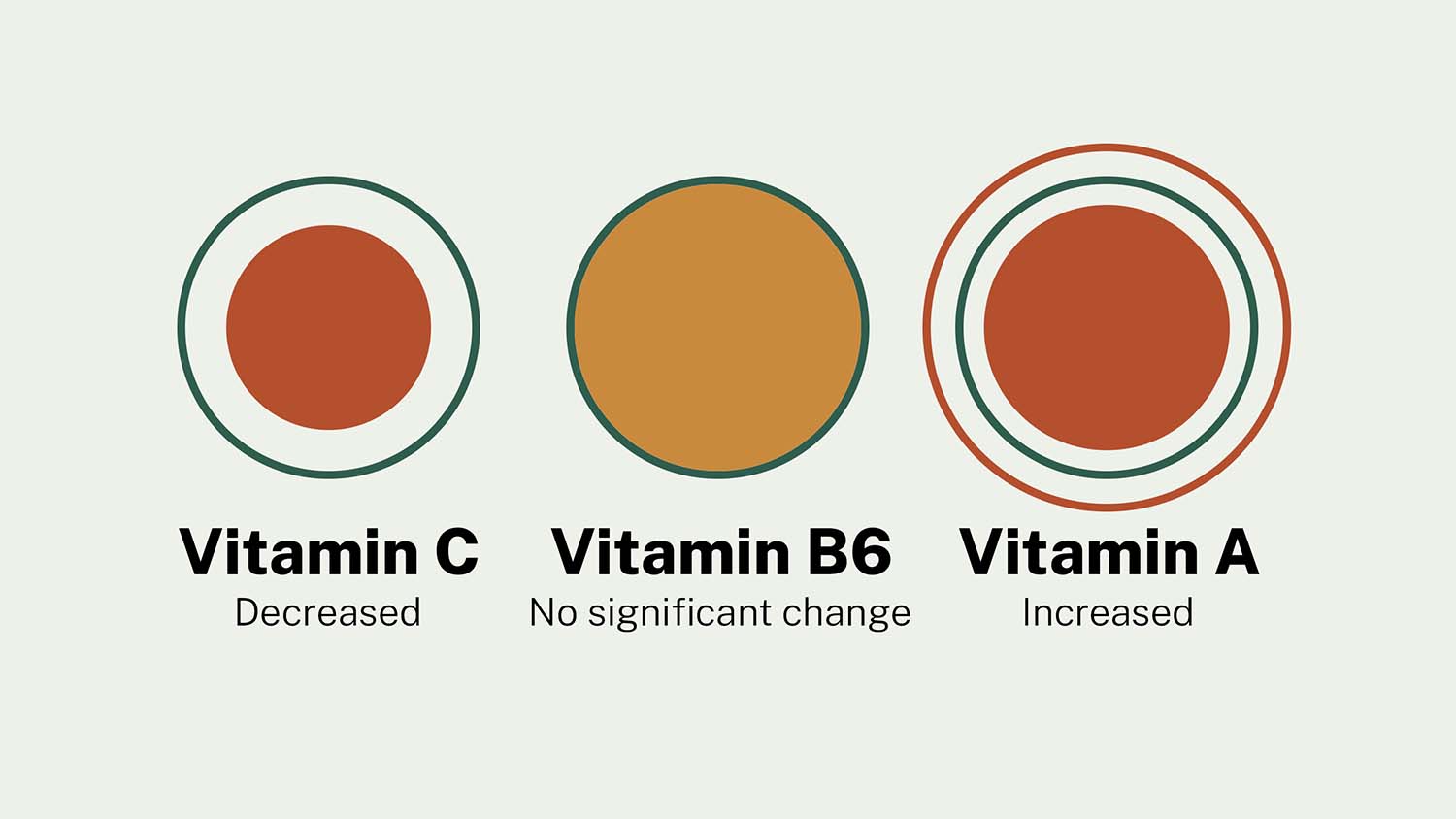
Vitamin C decreases and B6 shows no significant change under standard pasteurization, while vitamin A concentrations rise, likely due to retinol isomerization or a sampling artifact rather than heat generating new vitamin A.
What Pasteurization Does to Each Vitamin in Milk
Milk contains measurable amounts of eight commonly studied vitamins, and pasteurization does not treat them uniformly. Some drop by a statistically significant margin across pooled research. Others show no significant change at all. One, oddly, has been measured going up. The most complete picture comes from a single large systematic review that pooled decades of individual studies together, and its vitamin-by-vitamin findings are more specific, and more mixed, than “pasteurization destroys nutrients” or “pasteurization has no effect” would suggest.
Key facts:
- A systematic review and meta-analysis of 40 studies on milk vitamins found statistically significant decreases in vitamin B1 (thiamin), B2 (riboflavin), C, and folate after pasteurization, while vitamin B6 showed no significant change.
- The same meta-analysis found that vitamin B12 and vitamin E decreased qualitatively, while vitamin A concentrations increased following pasteurization, based on the studies available.
- Effect sizes varied enormously by vitamin: folate showed the largest pooled decrease (standardized mean difference of -11.99), while riboflavin showed the smallest statistically significant one (-0.41).
- An older HTST study found 18.7 percent loss of vitamin C and 3 percent loss of thiamin, with no measurable change to riboflavin, at 71 to 83°C for 22 seconds.
- Processing intensity matters as much as the raw-versus-pasteurized distinction: a comparative goat milk study found vitamin C losses ranging from 25 percent at HTST temperatures up to 70 percent under full sterilization.
What the Largest Study on This Topic Found
A 2011 systematic review and meta-analysis, conducted by researchers at the University of Guelph’s Ontario Veterinary College, is the most comprehensive pooled analysis of pasteurization’s effect on milk vitamins to date.The researchers searched five databases going back to each database’s inception through May 2009, screening for studies measuring vitamins A, B1, B2, B6, B12, C, E, and folate in milk before and after pasteurization.
Forty studies met the initial relevance criteria, but a substantial number were later excluded from the quantitative meta-analysis for methodological reasons: missing standard deviations, unreported sample sizes, or results presented only as text rather than usable data. The review also excluded vitamin D entirely from its scope, since secreted bovine milk naturally contains little vitamin D relative to human nutritional needs, a separate issue from pasteurization’s effects on the vitamins milk does naturally carry in meaningful amounts. For vitamin C alone, 19 studies were identified but only 7 had data usable for pooling, contributing 11 total trials once studies with multiple experiments were counted separately. That screening process is worth keeping in mind when reading the pooled results below: they represent the subset of research with reporting rigorous enough to combine, not the full universe of studies on the topic.
Vitamins With a Statistically Significant Decrease
| Vitamin | Standardized mean difference | 95% confidence interval | Statistical significance |
|---|---|---|---|
| B1 (thiamin) | -1.77 | -2.57 to -0.96 | P < 0.001 |
| B2 (riboflavin) | -0.41 | -0.81 to -0.01 | P < 0.05 |
| C | -2.13 | -3.52 to -0.74 | P < 0.01 |
| Folate | -11.99 | -20.95 to -3.03 | P < 0.01 |
Data from the University of Guelph meta-analysis. A negative standardized mean difference indicates lower vitamin concentrations after pasteurization relative to before.
Folate’s effect size stands out as far larger than the other three, but so does its confidence interval, spanning from -20.95 to -3.03. That width signals substantial variation between the individual studies feeding into the pooled estimate, meaning the true average effect is real and negative but not pinned down with much precision. Riboflavin sits at the opposite end: a small but statistically significant decrease, with a confidence interval that only barely excludes zero. The researchers flagged riboflavin as the one result worth the most practical attention, not because the effect size was large, but because milk is an important dietary source of B2 for many people in a way it is not for vitamin C or folate.
Vitamin B6: No Statistically Significant Effect
Pooled analysis of vitamin B6 found a standardized mean difference of -2.66 with a 95 percent confidence interval spanning -5.40 to 0.8, a range that includes zero, meaning the meta-analysis could not conclude pasteurization has a real effect on B6 concentrations. Of the six identified studies covering B6, half were dropped from the pooled analysis because they lacked a reported standard deviation or other dispersion measure, which narrowed the usable evidence down to 10 trials drawn from the remaining three studies. The wide confidence interval reflects that small remaining sample rather than a settled finding of no effect; a P value of 0.06 sits just outside the conventional 0.05 significance threshold, close enough that a modestly larger set of usable studies could plausibly have tipped the result either way.
Vitamin B12, E, and A: The Qualitative Findings
Not every vitamin in the review had enough comparable data across studies to support a pooled statistical estimate. For vitamin B12 and vitamin E, the researchers reported a qualitative decrease following pasteurization based on the available studies, without a combined SMD and confidence interval of the kind calculated for B1, B2, C, and folate.
Vitamin A stands apart from every other vitamin in the review: it increased following pasteurization in the studies examined, and this is the finding most worth unpacking rather than taking at face value. The review’s authors note this is not considered a public health concern in either direction, since milk is not generally treated as a primary dietary source of vitamin A regardless of how its concentration shifts during processing. But an increase in a nutrient after heat treatment is counterintuitive enough that it’s worth asking what could actually produce that result, and two separate, documented explanations exist in the literature, neither of which requires vitamin A being created by heat.
The first is a structural change, not a quantity change. Heat measurably converts a portion of milk’s vitamin A from its natural all-trans configuration into cis-retinol isomers. According to a Dietary Reference Intake review published by the National Academies of Sciences, Engineering, and Medicine, standard pasteurization of cow’s milk results in 3 to 6 percent isomerization to cis-retinol, rising to 16 percent under UHT treatment and 34 percent under sterilization. Isomerization does not add vitamin A to the milk; it changes the molecular shape of retinol already present. Depending on the specific analytical method a given study used, older assay techniques may not have cleanly distinguished between isomers, which could plausibly contribute to apparent shifts in measured “vitamin A” that don’t reflect an actual change in total quantity.
The second is a sampling artifact rather than a chemical one. A 2025 study on Holder-pasteurized human milk, the same study cited elsewhere in this article for its lactoferrin and IgA findings, encountered a similar unexpected increase in retinol and two tocopherols after pasteurization, and proposed a specific explanation: fat-soluble components of milk aren’t necessarily distributed evenly throughout a sample, and can settle into layers as time passes, including during the wait while a sample sits ready for analysis on lab equipment. If the pre- and post-pasteurization samples in a given study weren’t drawn from an equally representative, well-mixed portion of the milk, a measured “increase” could reflect where in the fat layer the sample was taken from rather than any effect of the heat treatment itself. The same 2025 paper noted that the vitamin A increase pattern it observed was consistent with what earlier bovine milk research had reported, while cautioning that the bovine studies used higher pasteurization temperatures than Holder pasteurization.
Both explanations point the same direction: the vitamin A increase is very likely a measurement and methodology story rather than evidence that heat treatment generates additional vitamin A in milk. But it’s worth being direct about the limits of that conclusion, too. Neither explanation has been definitively confirmed as the cause behind the specific studies pooled in the 2011 meta-analysis, since isomerization and sampling artifacts weren’t isolated and tested against each other within those particular studies. The honest summary is that an increase was measured, at least two plausible non-magical mechanisms exist to explain it, and no source reviewed here treats the finding as evidence that pasteurization improves milk’s vitamin A content in any meaningful nutritional sense.
Why the Numbers Vary So Much Between Studies
Two features of the meta-analysis are worth understanding before treating any single figure above as definitive. First, a statistical check for publication bias called Egger’s test flagged a real asymmetry in the published literature specifically for vitamin B1 and folate, suggesting smaller or null-result studies on those two vitamins may be underrepresented among what actually got published. No comparable bias turned up for the other vitamins tested. Second, a regression analysis on the vitamin B1 data checked whether sample size, pasteurization temperature, holding time, or study type individually predicted the size of the effect, and none of them did on their own; only when temperature and time were combined into a single multivariate model did their joint influence become statistically detectable. In plain terms: hotter and longer pasteurization treatments were associated with larger thiamin losses, even though neither variable alone explained the pattern.
There was also significant heterogeneity between studies in the vitamin B1 analysis specifically, meaning the individual trials disagreed with each other by more than chance alone would predict. That kind of heterogeneity is common in meta-analyses pooling decades of research using different milk sources, equipment, and measurement techniques, and it is part of why the review presents confidence intervals alongside every point estimate rather than a single clean number.
What Older Individual Studies Found
Behind the pooled figures are individual studies stretching back to the 1930s, and a few of the older ones illustrate the range concretely. A classic HTST study from 1945 found that pasteurization at 71 to 83°C for 22 seconds resulted in an 18.7 percent loss of vitamin C and a 3 percent loss of thiamin, with no measurable change to riboflavin content.
A later comparative study on goat milk tested multiple heat treatments side by side and found vitamin C losses that scaled directly with processing intensity: roughly 40 percent under low-temperature long-time (LTLT) treatment at 63.5°C for 30 minutes, 25 percent under HTST at 76°C for 16 seconds, 30 percent under UHT at 135°C for 4 seconds, and 70 percent under full sterilization at 121°C for 15 minutes. The HTST figure landing lower than the LTLT figure in that particular study is a reminder that temperature and time trade off against each other in ways that do not always produce a simple, linear relationship with nutrient loss.
Pasteurization Method Matters: A Human Milk Comparison
Not all pasteurization protocols are the same, and a recent study on donor human milk illustrates how much the specific method matters. Using Holder pasteurization, a gentler protocol common in milk banking that heats milk to 62.5°C for 30 minutes rather than the higher temperatures used in commercial HTST processing, researchers measured eight water-soluble vitamins in human milk before and after treatment and found only a modest thiamine decline, averaging 8.3 percent. None of the other water-soluble vitamins tracked in that study, including riboflavin, niacin, and B12, showed a change large enough to register as significant. The same study did find more substantial losses in other components, including lactoferrin, but the vitamin results specifically suggest that gentler time-temperature combinations can preserve water-soluble vitamins more effectively than the industrial HTST minimum, even though both are legitimately called “pasteurization.”
What This Research Does Not Show
The vitamin concentration data above is well documented across a large and reasonably rigorous body of research, culminating in a formal meta-analysis that pooled the strongest available studies.
What this research does not show is that these changes translate into a meaningful nutritional gap for the average consumer. Specifically:
- The meta-analysis’s own authors concluded that pasteurization’s effect on milk’s overall nutritive value was minimal, because most of the vitamins showing a significant decrease, vitamin C and folate in particular, are not ones for which milk is typically considered a primary dietary source in the first place.
- None of the studies pooled here measured a clinical nutrient-deficiency outcome in people who drink pasteurized milk versus raw milk; they measured vitamin concentrations in the liquid itself.
- The riboflavin finding is the one the review’s authors flagged as worth further attention, precisely because milk is a meaningful dietary source of B2 for many people, but even that finding was a modest effect size with a confidence interval that only narrowly excluded zero.
- Publication bias detected in the B1 and folate analyses means those two pooled estimates in particular should be read as directionally informative rather than precisely quantified.
Key Terms
- Standardized mean difference (SMD): a statistical measure of effect size, here representing the average difference in vitamin concentration between pasteurized and unpasteurized milk, standardized across studies that used different measurement scales.
- Confidence interval (CI): the range within which the true effect size is likely to fall; a 95 percent confidence interval that includes zero indicates the analysis could not rule out no effect at all.
- Publication bias: a tendency for studies with statistically significant or notable results to be published more often than studies with null results, which can skew a pooled meta-analysis.
- Meta-regression: a statistical method used to test whether specific study characteristics, such as temperature or sample size, help explain differences in outcomes across the pooled studies.
- Holder pasteurization: a gentler heat treatment protocol, typically 62.5°C for 30 minutes, commonly used in human milk banking rather than commercial dairy processing.
- Isomerization: a heat-induced structural rearrangement of a molecule into a different geometric configuration, such as retinol converting from its natural all-trans form into cis-retinol, without changing the underlying quantity of the compound present.
Frequently Asked Questions
Does pasteurization destroy vitamins in milk? It reduces some. A large meta-analysis found statistically significant decreases in vitamin B1, B2, C, and folate after pasteurization, no significant change in vitamin B6, and an increase in vitamin A. Vitamin B12 and E decreased qualitatively in the available studies.
Which vitamin is most affected by pasteurization? Folate showed the largest pooled effect size in the meta-analysis, though its wide confidence interval reflects substantial variation between the underlying studies. Among the vitamins with a precisely estimated effect, thiamin (B1) and vitamin C showed the largest significant decreases.
Does pasteurization increase any vitamins in milk? Vitamin A concentrations were found to increase following pasteurization in the studies reviewed, but this likely isn’t heat creating additional vitamin A. Two documented explanations exist: heat-induced isomerization of retinol into a different molecular form, and a sampling artifact from fat-soluble nutrients separating within a milk sample before testing. Either way, the review’s authors don’t treat it as a significant public health finding, since milk isn’t typically considered a primary dietary source of vitamin A.
Is vitamin B2 (riboflavin) loss from pasteurization a nutritional concern? It’s the one finding the researchers behind the meta-analysis flagged as worth further consideration, specifically because milk is a meaningful dietary source of riboflavin for many people, unlike vitamin C or folate.
Does the pasteurization method affect how much vitamin loss occurs? Yes. A goat milk study found vitamin C losses ranging from 25 percent at standard HTST temperatures up to 70 percent under full sterilization, and a human milk study found gentler Holder pasteurization (62.5°C for 30 minutes) left most water-soluble vitamins essentially unchanged aside from a modest thiamine decline.
How reliable are these pooled findings? The meta-analysis’s authors identified significant publication bias in the vitamin B1 and folate results specifically, and several vitamins (B12, E, A) had too little comparable data across studies to support a formal pooled statistical estimate, relying instead on qualitative findings from individual studies.