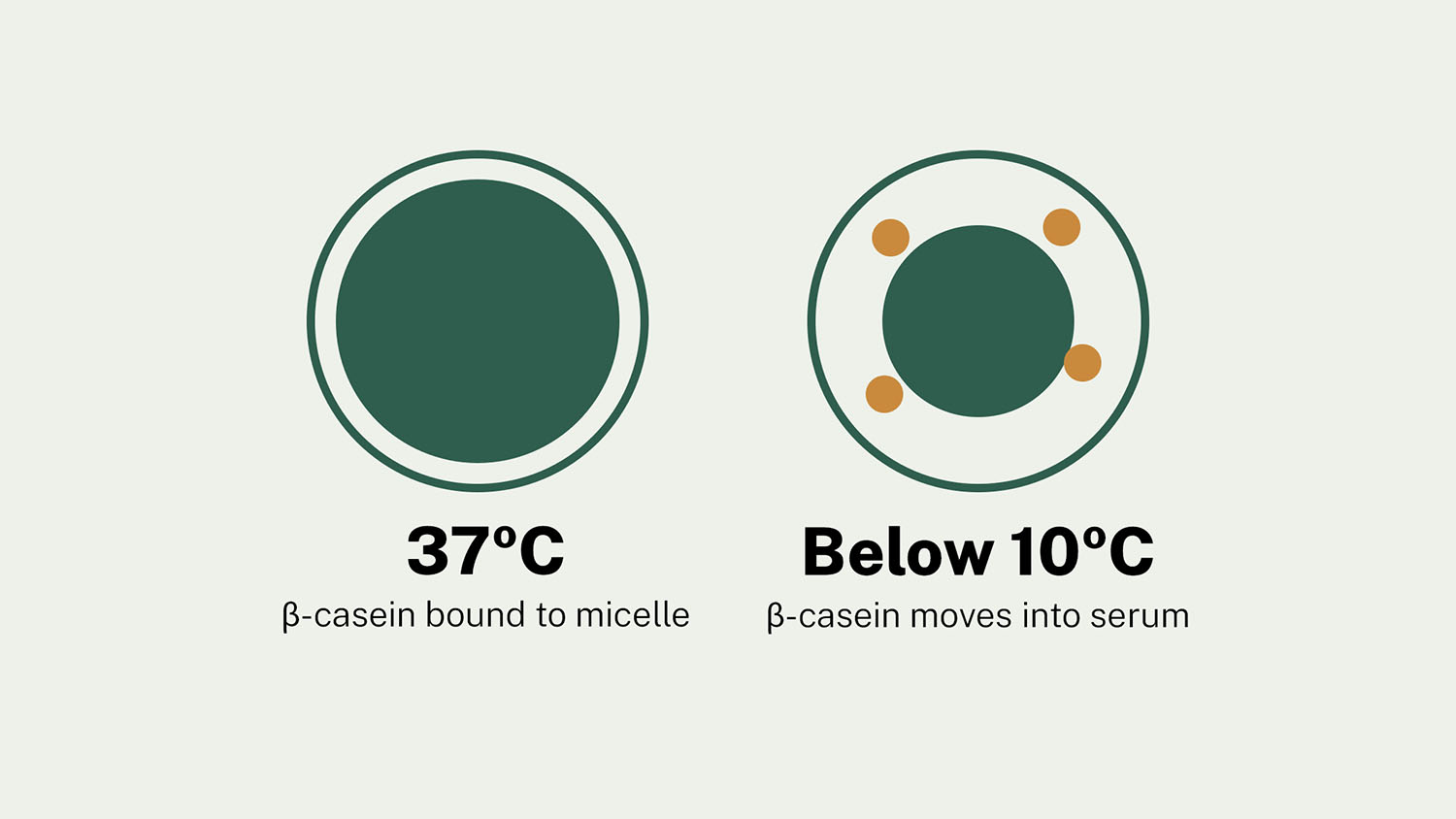
Below roughly 10u00b0C, a substantial share of u03b2-casein physically leaves the casein micelle and moves into the surrounding milk serum, a fully reversible effect that undoes itself once the milk warms back up.
How Cold Changes Milk’s Protein Structure
Most of milk’s proteins hold their structure regardless of temperature, at least within the range milk is normally kept. One of the four major casein proteins doesn’t follow that rule. Below about 10°C, a real share of it physically leaves the protein structure it’s normally bound within, dissolves into the surrounding liquid, and then returns once the milk warms back up. This has nothing to do with heat damage or bacterial activity, it’s simply a function of temperature.
Key facts:
- At milk’s normal physiological temperature (around 37°C), most β-casein stays closely bound to the casein micelle, but at colder temperatures, below roughly 10°C, a substantial share of it dissociates from the micelle and moves into the liquid portion of milk instead.
- This is foundational, decades-old dairy science: the phenomenon was first documented by Creamer, Berry, and Mills in 1977 and remains a frequently cited reference point in casein research today.
- The process is fully reversible: research using radioactively labeled protein found that roughly 95 percent of the dissociated β-casein returns to the micelle after the milk is rewarmed to 37°C for a few hours.
- The dissociation isn’t complete even after extended cold storage; only around 60 percent of total β-casein can be removed this way, suggesting β-casein exists in two distinct structural states within the micelle.
What a Casein Micelle Is, and Why β-Casein Is Different
Casein makes up the majority of milk’s protein content, and most of it exists in the form of casein micelles, roughly spherical protein clusters suspended throughout milk. There are four major casein proteins that make up these structures: αs1-casein, αs2-casein, β-casein, and κ-casein. Three of these four, αs1, αs2, and κ-casein, hold their position within the micelle regardless of temperature changes within milk’s normal handling range. β-casein is the exception.
The reason for that difference comes down to the specific chemistry holding each protein in place. β-casein’s association with the micelle is thought to be driven largely by hydrophobic interactions, a type of bond that weakens as temperature drops. The other three caseins are held in place by different, comparatively temperature-independent mechanisms. That single chemical distinction is why cooling milk selectively pulls β-casein out of the micelle structure while leaving the other three caseins essentially undisturbed.
The Core Finding: A Reversible Structural Shift
At milk’s normal physiological temperature, around 37°C, the temperature it exists at inside the animal, most β-casein is closely associated with the micelle and distributed throughout its structure. Once milk is cooled below roughly 10°C, a substantial portion of that β-casein physically leaves the micelle and moves into the milk serum, the liquid phase surrounding the micelles, instead. This isn’t a subtle or marginal effect; in human milk specifically, research found an initial loss of about 80 percent of the protein’s optical density signal upon cooling to 4°C, with the dissociation continuing over time before leveling off.
What makes this phenomenon particularly interesting from a chemistry standpoint is that it’s fully reversible. Using radioactively labeled β-casein, researchers tracked the protein’s movement and found that roughly 95 percent of it returned to the micelle structure after the cooled milk was rewarmed to 37°C for a few hours. The dissociation isn’t a breakdown or a degradation of the protein, it’s a temperature-dependent repositioning that undoes itself once the temperature conditions that caused it are reversed.
The Dissociation Is Real But Incomplete
One detail that adds nuance to this phenomenon: even under extended cold storage, the dissociation of β-casein from the micelle never goes to completion. Only around 60 percent of the total β-casein present can be removed through cooling, no matter how long the cold storage continues. The remaining share stays bound to the micelle structure regardless of temperature. This has led researchers to propose that β-casein may actually exist in two distinct structural states within the micelle, one that’s genuinely cold-labile and dissociates readily, and another that’s more tightly integrated and stays put no matter how cold the milk gets. The exact physical basis for this two-state arrangement is still an active area of structural research, but the observation itself, that dissociation plateaus well short of 100 percent, is consistent across multiple independent studies.
A more recent study adds a layer of chemical detail to why that plateau exists. Comparing β-casein across fractions separated at different temperatures, researchers found the protein’s own phosphorylation level, how many phosphate groups are attached to it, shifted depending on which fraction it ended up in: β-casein that stayed bound to the micelle at 4°C was dominated by a single, non-phosphorylated form, while the fraction that dissociated into the liquid phase contained a broader mix of phosphorylation states. That’s a plausible chemical explanation for the two-state pattern described above, non-phosphorylated β-casein appears to bind the micelle more securely than its more heavily phosphorylated counterparts, though the researchers who reported it were careful to frame it as one contributing factor rather than the complete explanation.
Where This Matters Beyond the Chemistry Itself
This isn’t purely an academic curiosity confined to structural biology papers. The temperature-dependent behavior of β-casein has genuine practical applications in dairy processing. It’s specifically exploited through a technique called cold microfiltration, which uses the fact that β-casein moves into the liquid phase at cold temperatures to physically separate it from the rest of the casein micelle structure, producing specialized β-casein-depleted milk protein concentrates and isolated β-casein fractions used as functional dairy ingredients. The phenomenon also has downstream relevance to cheesemaking, since it affects how milk’s proteins respond to rennet during coagulation, an early and critical step in converting milk into cheese.
What This Research Does Not Show
The temperature-dependence of β-casein dissociation is well documented: the phenomenon is reversible, well characterized mechanistically as driven by hydrophobic interactions, and has been independently confirmed across multiple studies using different methods, from light scattering to electron microscopy to mass spectrometry.
What this research does not show is a single, universal percentage or timeline that applies identically across every study, species, and set of milk-handling conditions. Specifically:
- Much of the most detailed structural characterization work, including the specific 80 percent and 95 percent figures cited in this article, comes from research on human milk casein micelles, not bovine milk exclusively; figures should be understood as specific to the study and species they came from rather than assumed to be universal across species.
- None of the sources reviewed here measured a nutritional or health outcome tied to β-casein’s temperature-dependent behavior; the research described is entirely about physical protein structure, not about digestion, absorption, or any consumption-related outcome.
- The exact structural basis for why roughly 60 percent of β-casein dissociates while the remaining 40 percent stays bound, the proposed “two-state” hypothesis, remains an area of ongoing structural research rather than a fully settled mechanism.
- This phenomenon describes β-casein’s physical location within or outside the micelle structure; it does not describe any change in the protein’s own molecular identity, and the reversibility findings indicate the protein itself isn’t altered by the temperature cycling, only its position.
Key Terms
- Casein micelle: a roughly spherical colloidal protein cluster suspended in milk, built from four major casein proteins, that gives milk much of its structure and its white, opaque appearance.
- β-casein: one of milk’s four major casein proteins, distinguished from the other three by its temperature-dependent association with the casein micelle, driven largely by hydrophobic interactions.
- Milk serum: the liquid phase of milk surrounding the casein micelles, distinct from the colloidal (micelle-bound) phase; where dissociated β-casein moves to when milk is cooled.
- Hydrophobic interaction: a type of molecular bond that weakens as temperature drops, distinct from the more temperature-stable bonds (such as calcium phosphate bridging) that hold milk’s other major caseins in place within the micelle.
- Cold microfiltration: a dairy processing technique that exploits β-casein’s cold-induced dissociation to physically separate it from the rest of the casein micelle, used to produce specialized dairy protein ingredients.
Frequently Asked Questions
Does refrigerating milk change its protein structure? Yes, specifically for one of milk’s four major casein proteins. β-casein dissociates from the casein micelle and moves into the liquid portion of milk when refrigerated below roughly 10°C, a well-documented and fully reversible temperature effect.
Is this the same thing as protein denaturation from heat? No. This is a temperature-driven structural repositioning, not a denaturation or breakdown of the protein. The process is fully reversible; the protein returns to its original position within the micelle once the milk is rewarmed.
Does all of the β-casein leave the micelle when milk is cooled? No. Even under extended cold storage, only around 60 percent of total β-casein dissociates. The remainder stays bound to the micelle regardless of how cold the milk gets or how long it’s stored cold.
Is cold-induced casein dissociation used for anything in dairy processing? Yes. It’s specifically exploited through cold microfiltration to separate β-casein from the rest of the casein micelle, producing specialized β-casein-depleted concentrates and isolated β-casein fractions used as dairy ingredients.
Who first discovered this phenomenon? The foundational research documenting cold-induced β-casein dissociation was published by Creamer, Berry, and Mills in 1977, and it remains a frequently cited reference point in casein structural research today.