Roughly 11 million Americans drink raw milk in a given year. Nearly the entire country eats lettuce. The scale gap helps explain the outbreak data in this article.
Why Raw Milk Outbreaks Are Traced Faster Than Produce Outbreaks
Two federal surveillance studies, published four years apart in the same peer-reviewed journal, drawing on the same national reporting system, tell an unexpected story about which food carries the heavier outbreak death toll. A CDC analysis of unpasteurized milk outbreaks found 202 outbreaks, 2,645 illnesses, 228 hospitalizations, and three deaths across a twenty-year span from 1998 to 2018. A separate CDC analysis of raw produce outbreaks found 972 outbreaks, 34,674 illnesses, 2,315 hospitalizations, and 72 deaths across a fifteen-year span from 1998 to 2013.
Raw milk consumption is a minority behavior: roughly 4.4% of US adults, or about 11.4 million people, according to FDA survey data. Fresh produce is eaten by nearly the entire population on a regular basis. That gap in exposure explains part of the difference in outbreak volume. It does not explain why raw milk outbreaks are so consistently traced to a named farm within days, while a large share of produce outbreaks are never traced to a specific source at all. The difference comes down to how each supply chain is built, and what that structure does to an investigation once people start getting sick.
Two National Datasets, Built the Same Way
The unpasteurized milk numbers come from Koski et al., published in Epidemiology & Infection in 2022. The produce numbers come from Bennett et al., published in the same journal four years earlier. Both were authored by CDC’s Division of Foodborne, Waterborne, and Environmental Diseases, and both draw on the Foodborne Disease Outbreak Surveillance System, the government’s national outbreak reporting infrastructure. That shared methodology matters: these two datasets are measuring the same thing, the same way, which makes them unusually comparable as a pair. The Koski study is also the source behind a separate per-consumer illness-rate analysis published elsewhere on this site, which uses the same underlying data to answer a different question: not how many total outbreak deaths occurred, but how likely any individual raw milk drinker is to get sick in a given year.
Of the 202 milk-linked outbreaks, Campylobacter caused the largest share. Of the 972 produce outbreaks, vegetable row crops, the category that includes lettuce and other leafy greens, accounted for 38%, the largest single category, ahead of fruits at 35% and seeded vegetables at 11%. Norovirus was the most common cause, followed by Salmonella and Shiga toxin-producing E. coli. Read side by side, the two studies show a twenty-four-fold difference in outbreak-associated deaths, on the food eaten by a far larger share of the population.
A Single Point of Sale Makes Raw Milk Traceable
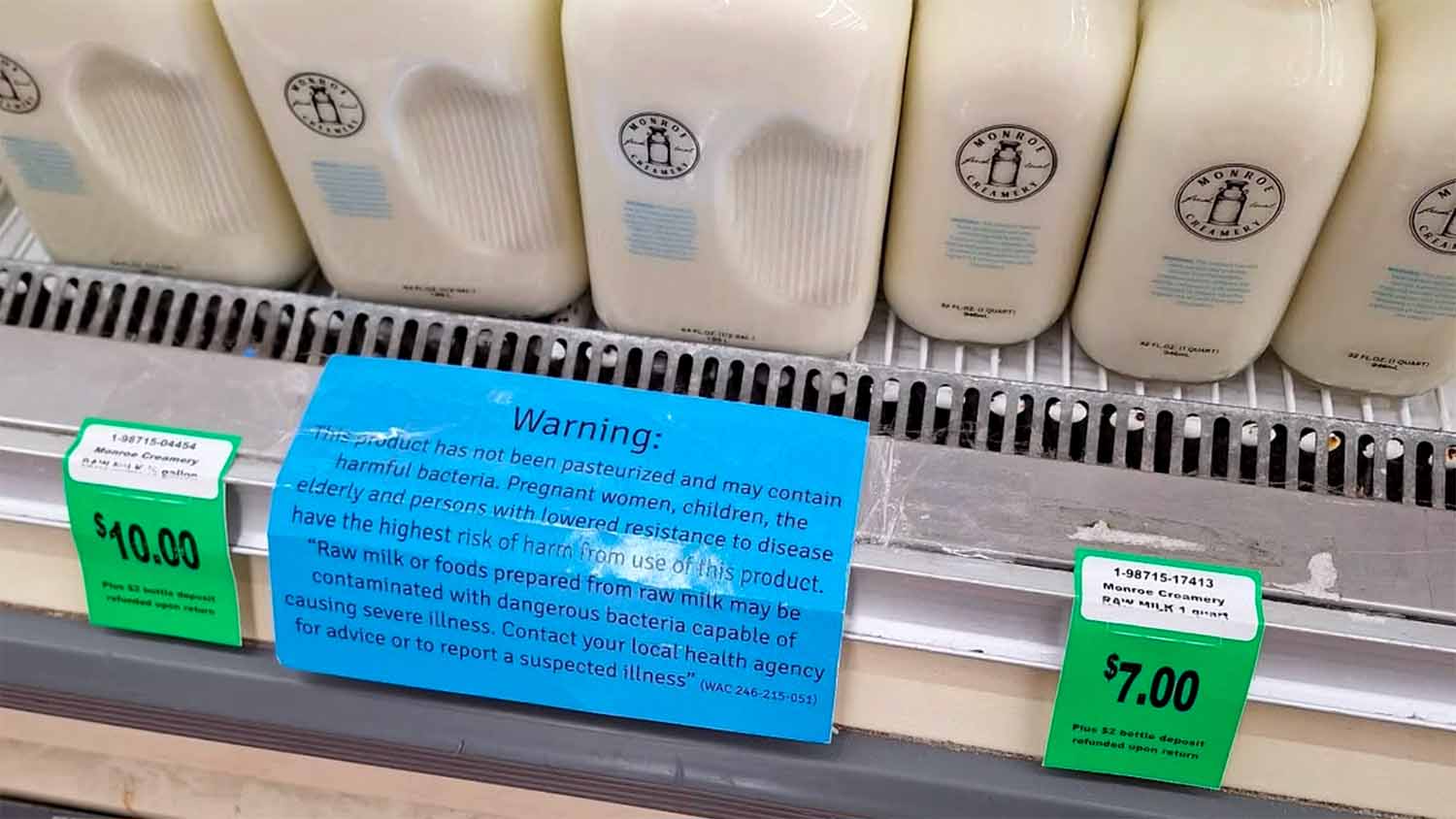
Raw milk in the United States rarely moves through a long, comingled supply chain. It goes from one dairy to a defined, relatively small set of buyers, whether through direct farm sales, herdshare agreements, or, in the states where it’s legal, retail shelves stocked by a single named producer. Herdshare and membership programs keep rosters of who bought milk and when. Retail sales still carry one farm’s name on the label.
When a health department identifies a cluster of illnesses and starts asking what people ate, a “yes” to raw milk consumption immediately narrows the field. There are only so many raw dairies operating in a given state, and most sell through a handful of identifiable channels. Investigators can typically name the source dairy within days and confirm it through the same recall process used across the dairy industry, with product testing conducted at one location.
A Bag of Lettuce Has No Single Point of Origin
Fresh lettuce follows a different path. A handful of growing regions, concentrated in Arizona and California, supply most of the country’s romaine and leaf lettuce during any given season. Product from multiple farms is routinely comingled during washing, chopping, and bagging, so a single bag of salad mix can contain lettuce grown on several different farms.
The spring 2018 E. coli outbreak linked to Yuma-region romaine shows how far that comingling can spread an investigation. The outbreak sickened 240 people across 37 states, hospitalized 104, and caused 28 cases of hemolytic uremic syndrome and five deaths. FDA’s traceback work eventually connected the outbreak to a pool of 36 fields across 23 farms in the growing region, but comingled product and inconsistent lot-coding meant only one narrow leg of that traceback could be pinned to a single named farm; every other route dead-ended at the regional level. CDC laboratory testing eventually matched the outbreak strain to bacteria found in an irrigation canal running through the region, giving investigators a likely contamination pathway without ever naming a single responsible farm. The same pattern is playing out live in a 2026 multistate cyclospora outbreak, where federal investigators are tracking six separate active clusters and have converged on a named supplier for only one of them.
Why Lettuce Isn’t Suspected First
Food history interviews are the starting point of most outbreak investigations, and they work best when a food is eaten by a small, identifiable subset of the sick population. Raw milk consumption fits that pattern. Lettuce does not. Nearly everyone eats lettuce regularly, so when investigators ask sick people what they’ve eaten recently, “salad” or “lettuce” comes back as a near-universal answer, whether or not it’s the actual source. A food eaten by almost everyone provides little statistical power to distinguish cases from non-cases until a large number of interviews have been collected and analyzed.
Lettuce is also eaten raw, with no cooking or pasteurization step to eliminate pathogens introduced during growing or processing, unlike foods that receive a final heat-treatment step before reaching a plate.
What Outbreak Surveillance Can’t Fully Capture
The Foodborne Disease Outbreak Surveillance System is a passive, voluntary system: state and local health departments report outbreaks they recognize and investigate, and underreporting is a well-documented limitation across every food category. A second, more specific limitation matters here: this kind of surveillance was built to catch illness clustered tightly around one food and one identifiable group of eaters. An outbreak scattered thinly across many unrelated farms and a broad, largely undifferentiated population is a much harder thing for the system to pick up at all. That’s a limitation of the method, not a flaw specific to either study, and it cuts against produce, not in its favor. If diffuse, hard-to-trace outbreaks are more likely to go unrecognized or unresolved than concentrated, single-source ones, the 72 produce deaths in the Bennett data are more plausibly a floor than a ceiling.
Scale, for Context
Roughly 11.4 million US adults report drinking raw milk in a given year. Lettuce, by contrast, moves through the food supply at a scale implying near-universal consumption: per capita availability of all lettuce types combined reached approximately 28.6 pounds per person in 2024, according to USDA Economic Research Service data, across a population of roughly 340 million.
Despite a consumer base roughly thirty times larger, and despite structural risk factors including no kill step, concentrated growing regions, and routine product comingling, produce accounted for 72 deaths over fifteen years of federal surveillance data. Raw milk, consumed by a far smaller population moving through a far more traceable supply chain, accounted for three. A broader comparison of raw milk against other foods is available elsewhere on this site, using a different set of studies and a per-serving rather than a total-count framework.
What This Means for How the Two Get Covered
Raw milk carries a reputation as the riskier choice in most media coverage and legislative debate. The surveillance data doesn’t support that framing on outbreak-associated deaths, and the traceability difference helps explain why. A raw milk outbreak is a discrete, quickly named event: one farm, one health advisory, one clear resolution in the data. A produce outbreak is frequently a diffuse, unresolved one, covered in the news as illness counts climb week over week without a specific farm attached to blame, and in a meaningful share of cases, never conclusively resolved at all.