Laboratory inhibition zones show lactic acid bacteria measurably suppressing most tested pathogens, but the effect is notably smaller against Listeria monocytogenes, which resists it more than other major pathogens.
Does Natural Souring Protect Raw Milk From Pathogens?
When raw milk sours on its own, it isn’t simply decaying. Lactic acid bacteria already present in the milk multiply and produce antimicrobial compounds, and this site’s cheese-aging science cluster already covers the underlying mechanism in detail: how LAB acidify milk, produce bacteriocins like nisin, and why that protection has real, well-documented limits. This article looks specifically at what that same mechanism means for raw milk that sours naturally on its own, outside a cheesemaking context, drawing on two independent meta-analyses and a detailed field study of traditional raw milk fermentation that go beyond what the cheese cluster covers.
Key facts:
- Two independent 2024 and 2025 systematic reviews and meta-analyses, drawing on a combined 59 primary studies, both found that lactic acid bacteria (LAB) from dairy sources measurably inhibit Listeria monocytogenes, Staphylococcus aureus, and Salmonella in laboratory testing, with more acidic LAB preparations producing significantly larger inhibition effects in both reviews.
- A detailed study of Mabisi, a traditionally fermented raw milk product, found that under deliberately worst-case conditions, Salmonella specifically failed to meet EU regulatory safety requirements at the standard 48-hour fermentation mark, only reaching acceptable levels after fermentation was extended to 72 hours.
- Listeria monocytogenes stands out as the least reliably controlled of the major raw milk pathogens across multiple independent lines of research, consistent with why this site’s cheese-aging cluster identifies it as uniquely difficult to control even outside a fermentation context: a separate refrigerated-storage study found it grew significantly in 8 of 12 test replicates by the second week under proper refrigeration, while three other major pathogens showed no growth at all under the same conditions.
What Actually Happens When Milk Sours
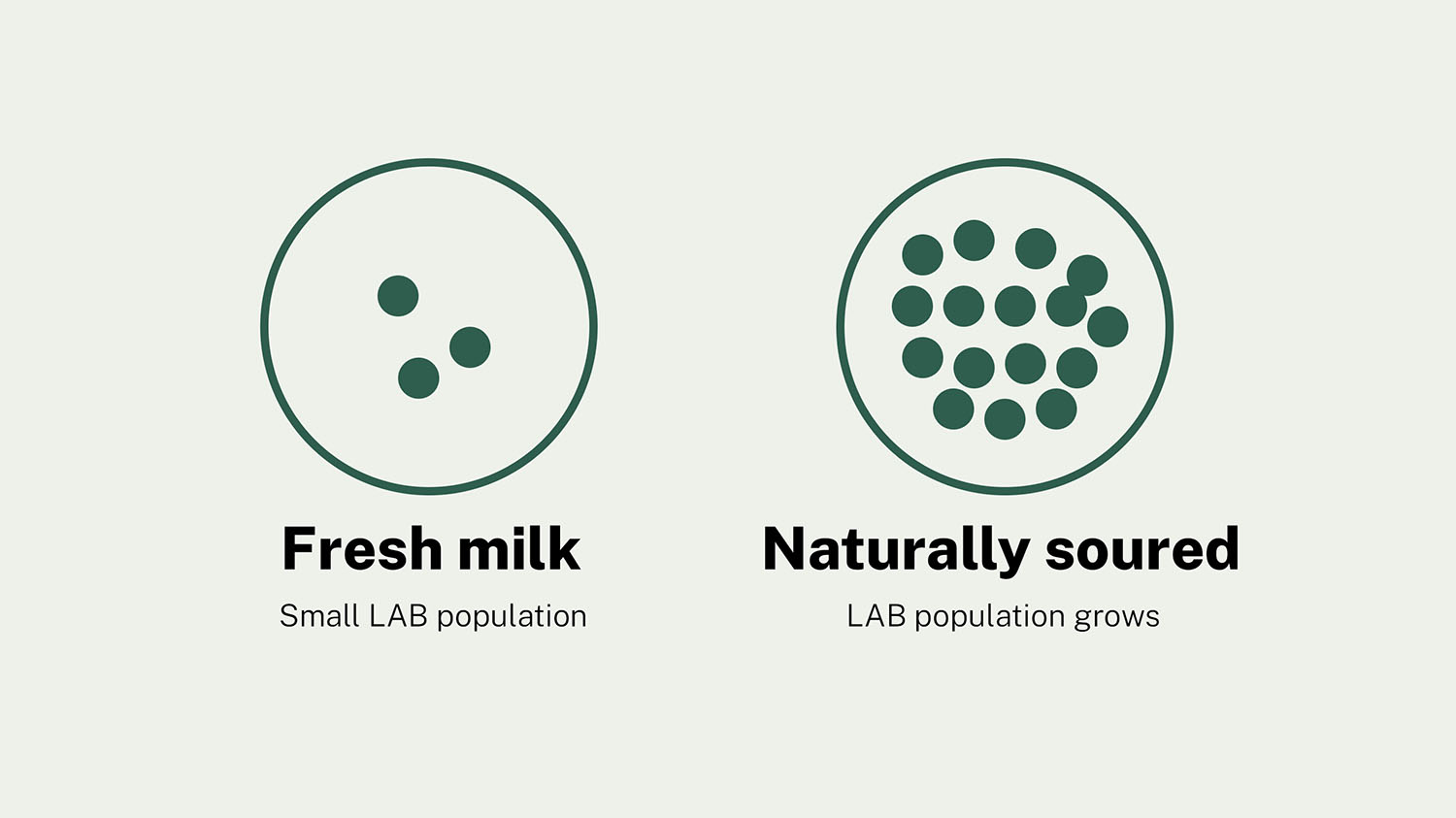
Raw milk naturally contains lactic acid bacteria, a broad group that includes genera like Lactobacillus, Lactococcus, and Enterococcus. Left at a suitable temperature, these bacteria consume the lactose in milk and convert it into lactic acid, which is what gives soured or clabbered milk its sour taste and thicker texture. As the LAB population grows, it also produces additional antimicrobial compounds beyond lactic acid itself, including bacteriocins (antimicrobial proteins) like nisin, hydrogen peroxide, and other organic acids.
This general phenomenon, food preservation through the natural activity of these compounds, is referred to in food science as biopreservation. This site’s cheese-aging cluster covers this mechanism in more depth, including how LAB acidification interacts with pathogen-specific adaptations like E. coli O157:H7’s acid tolerance response, and why bacteriocin production is a real but bounded safety contributor rather than a primary control. The rest of this article focuses specifically on what the same underlying mechanism looks like in raw milk that sours naturally, rather than in a controlled cheesemaking process.
Two Independent Reviews Found the Same Basic Pattern
Two separate systematic reviews and meta-analyses, published independently in 2024 and 2025, each pooled dozens of individual laboratory studies to answer the same underlying question: how much do LAB from dairy sources actually inhibit major foodborne pathogens, measured directly rather than assumed. One review pooled 20 studies and 397 individual observations, finding that Lacticaseibacillus strains produced the largest inhibition zones against both Listeria monocytogenes (21.49 mm) and Staphylococcus aureus (21.06 mm), while Lactobacillus strains were most effective against Salmonella (roughly 20 mm). The second, larger review pooled 39 studies and 510 observations and found a similar overall pattern using a different specific breakdown: Enterococcus strains were most effective against L. monocytogenes (15.90 mm), Lacticaseibacillus against S. aureus (11.89 mm), and L. monocytogenesemerged as the single most susceptible of the three pathogens tested across the combined dataset.
The two reviews don’t agree on every specific number, which is unsurprising given they pooled different sets of underlying studies using different specific LAB strains and testing conditions. What they do agree on is the core finding: LAB antimicrobial activity against these three pathogens is real, measurable, and significantly tied to acidity. Both reviews independently found that more acidic LAB preparations produced meaningfully larger inhibition effects, directly connecting the antimicrobial activity to the same acidification process that defines natural souring. Separately, in raw buffalo milk specifically, several naturally occurring LAB strains isolated directly from the milk achieved complete inhibition of Listeria monocytogenes after 6 to 8 days of fermentation, a specific, measured, replicated result rather than a general claim about fermentation being protective in the abstract.
Where the Protection Has Documented Limits
None of this means natural souring reliably eliminates pathogens, and the same research area that documents the antimicrobial effect also documents real, specific limits. A detailed study on Mabisi, a traditionally fermented raw milk product from Zambia, deliberately tested this question under worst-case conditions, inoculating milk with high levels of pathogens and using a slow-acidifying starter culture to stress-test the process. Under those conditions, Salmonellaspecifically failed to meet European Union regulatory requirements at the standard 48-hour fermentation mark, only dropping to acceptable levels after fermentation was extended to 72 hours, and Staphylococcus aureus reached levels described by the study’s own authors as close to, though technically below, the threshold at which toxin production becomes a concern. The study’s overall conclusion was that traditional Mabisi processing can produce a microbiologically safe product, but that conclusion came with an explicit caveat from the researchers themselves: some potential pathogens approached critical safety limits, and the outcome depended specifically on adequate fermentation time and swift acidification, not on souring alone being automatically protective.
Listeria monocytogenes deserves particular attention here, because it shows up as the exception across more than one line of research, not just this study, and this site’s cheese-aging cluster documents the same pattern in a fermented dairy context: the organism’s cold tolerance, salt tolerance, and biofilm-forming capacity give it a biological profile that overlaps extensively with conditions that suppress most other pathogens. A separate, carefully controlled study inoculated raw milk with several major pathogens and tracked their populations over two weeks under proper refrigeration, a different condition than fermentation but a useful parallel. Campylobacter, E. coli O157:H7, and Salmonella all showed no growth over the full 14-day period. Listeria monocytogenes was the clear exception, showing statistically significant growth in 8 of the 12 test replicates by the second week.
A separate review of naturally fermented milk research states the broader point even more directly: specific pathogens, including E. coli O157:H7, L. monocytogenes, and Salmonella enteritidis, have been reported in the scientific literature to survive, and in some conditions actively grow, in fermented milks, a finding independently corroborated by at least one other food safety review covering the same pathogens. This isn’t purely theoretical: E. coli O157:H7 specifically has been documented tolerating acidic conditions well enough to cause real outbreaks tied to other acidic fermented foods, including unpasteurized apple cider and fermented sausage, a reminder that acidity alone is not an automatic barrier for every pathogen.
The Timing Problem With Staphylococcus aureus
There’s a specific, narrower risk worth understanding on its own: timing. The same Mabisi research found fast acidification is specifically necessary to limit Staphylococcus aureus growth before it reaches population levels capable of producing enterotoxins, the actual cause of S. aureus food poisoning, and that low pH needs to be sustained for at least 24 hours to keep that risk controlled. In practical terms, this means the earliest hours of natural souring, before the lactic acid bacteria have fully acidified the milk, are a different risk picture than the finished, fully soured product; the antimicrobial mechanism this article describes needs time to take effect, and isn’t instantaneous.
What This Research Does Not Show
The laboratory evidence for LAB antimicrobial activity against several major foodborne pathogens is genuinely well replicated, and this site’s cheese-aging cluster documents the same mechanism operating, with the same real limits, in a cheesemaking context specifically.
What this research does not show, and what this article is not saying, is that natural souring makes raw milk safe, or that it functions as a substitute for pasteurization’s safety role. Specifically:
- In vitro inhibition, bacteria being suppressed on a laboratory plate or in a controlled supernatant test, is not the same measurement as pathogen elimination in an actual, variable batch of milk with its own unique starting bacterial population, temperature history, and LAB strain mix.
- Listeria monocytogenes specifically has been documented surviving fermentation, growing under simple refrigeration in a majority of test replicates in one study, and generally behaving less predictably than the other major raw milk pathogens across multiple independent lines of research, both in fermented raw milk and in the cheese-aging context this site covers separately.
- The Staphylococcus aureus toxin-timing risk means the earliest stage of souring is not obviously a safer state than unfermented milk; the protective effect described in this article depends on acidification being both fast and sustained.
- None of the sources reviewed here were designed to answer, and none of them do answer, the question of whether naturally soured raw milk is safe for any individual to consume. This article describes documented laboratory and field microbiology, not health or safety guidance.
Key Terms
- Lactic acid bacteria (LAB): a broad group of bacteria, including Lactobacillus, Lactococcus, and Enterococcusgenera, that ferment lactose into lactic acid and are naturally present in raw milk.
- Biopreservation: food preservation achieved through the natural or deliberate activity of microorganisms and the antimicrobial compounds they produce, rather than through heat, chemical preservatives, or other processing methods.
- Bacteriocin: an antimicrobial protein produced by certain bacteria, including many LAB strains, capable of inhibiting the growth of other bacteria; nisin is one specific, well-studied example, covered in more depth in this site’s cheese-aging cluster.
- Inhibition diameter: a laboratory measurement used to quantify antimicrobial activity, recording the size of the zone in which a test pathogen’s growth is suppressed around a sample of the antimicrobial substance being tested.
- Enterotoxin: a toxin produced by certain bacteria, including Staphylococcus aureus, that causes illness when consumed; the specific hazard the acidification-timing research in this article addresses.
Frequently Asked Questions
Does naturally souring raw milk kill harmful bacteria? Research shows lactic acid bacteria produce compounds that measurably inhibit several major foodborne pathogens in laboratory testing, but this is not the same as guaranteed elimination. Documented research also shows some pathogens, particularly Listeria monocytogenes, can survive or even grow under some of the same conditions.
Is soured or clabbered raw milk safer than fresh raw milk? The research reviewed here doesn’t answer that question directly. It documents a real antimicrobial mechanism and its measured limits, not a comparative safety assessment between fresh and soured milk.
Which pathogen is least affected by this natural antimicrobial process? Listeria monocytogenes stands out across the most independent lines of evidence, fermentation research and separate refrigerated-storage research alike, as a pathogen that survives or grows despite conditions that reliably suppress others. Salmonella also showed a specific limit in at least one worst-case-scenario fermentation study, failing to meet safety thresholds until fermentation time was extended.
Does the antimicrobial effect happen immediately when milk starts to sour? No. Research indicates the protective effect depends on acidification being both fast and sustained for at least 24 hours; the earliest hours of souring, before that acidification is complete, present a different risk picture than the fully soured product.
Is this the same mechanism used in cheesemaking? Yes, the underlying biology is the same. This site’s cheese-aging cluster covers how LAB acidification and bacteriocin production interact with cheese-specific conditions like salt and extended aging; this article focuses on what the same mechanism looks like in raw milk fermenting on its own.