What Lactic Acid Bacteria Do in Cheese: Acidification, Pathogen Suppression, and Flavor
Every safety outcome documented in this cluster traces back, in some way, to lactic acid bacteria. Campylobacter jejuni‘s elimination during early cheesemaking is driven by the acid and salt conditions that LAB establish. E. coli O157:H7’s paradoxical persistence is an adaptive response specifically to the mild acid the same bacteria produce. Listeria monocytogenes survives in soft-ripened styles partly because the surface organisms that give those cheeses their character undo the pH work that starter LAB accomplish. Lactic acid bacteria are the biological engine of cheesemaking, and understanding what they do and what they cannot do provides the unifying mechanism behind most of what the cluster has covered.
What Lactic Acid Bacteria Are and How They Are Classified in Cheesemaking
Lactic acid bacteria (LAB) are a group of Gram-positive bacteria that share a common metabolic characteristic: they ferment carbohydrates, primarily lactose in dairy contexts, and produce lactic acid as the primary metabolic end product. The major genera involved in cheese production include Lactococcus, Lactobacillus, Streptococcus, Leuconostoc, and Enterococcus, each contributing different properties at different stages of cheesemaking and aging.
In practical cheesemaking, LAB are categorized by temperature preference. Mesophilic strains, primarily Lactococcus lactis and associated species, grow optimally between 20 and 30°C and are used as starter cultures in cheddar, Gouda, and other styles produced at moderate temperatures. Thermophilic strains, including Streptococcus thermophilus and Lactobacillus helveticus, grow optimally between 37 and 45°C and are used in Swiss-type, mozzarella, and other cheeses requiring higher curd-cooking temperatures.
Starter cultures are selected strains added to milk at the beginning of cheesemaking to drive consistent acidification. They are distinct from non-starter lactic acid bacteria (NSLAB), which are present naturally in raw milk and in the processing environment and become increasingly important during the later stages of aging. NSLAB, which include Lactobacillus casei, L. plantarum, and L. rhamnosus, do not contribute significantly to the initial pH drop but play a substantial role in flavor development and the competitive microbial environment of long-aged cheeses.
How LAB Drive pH Development in Cheese
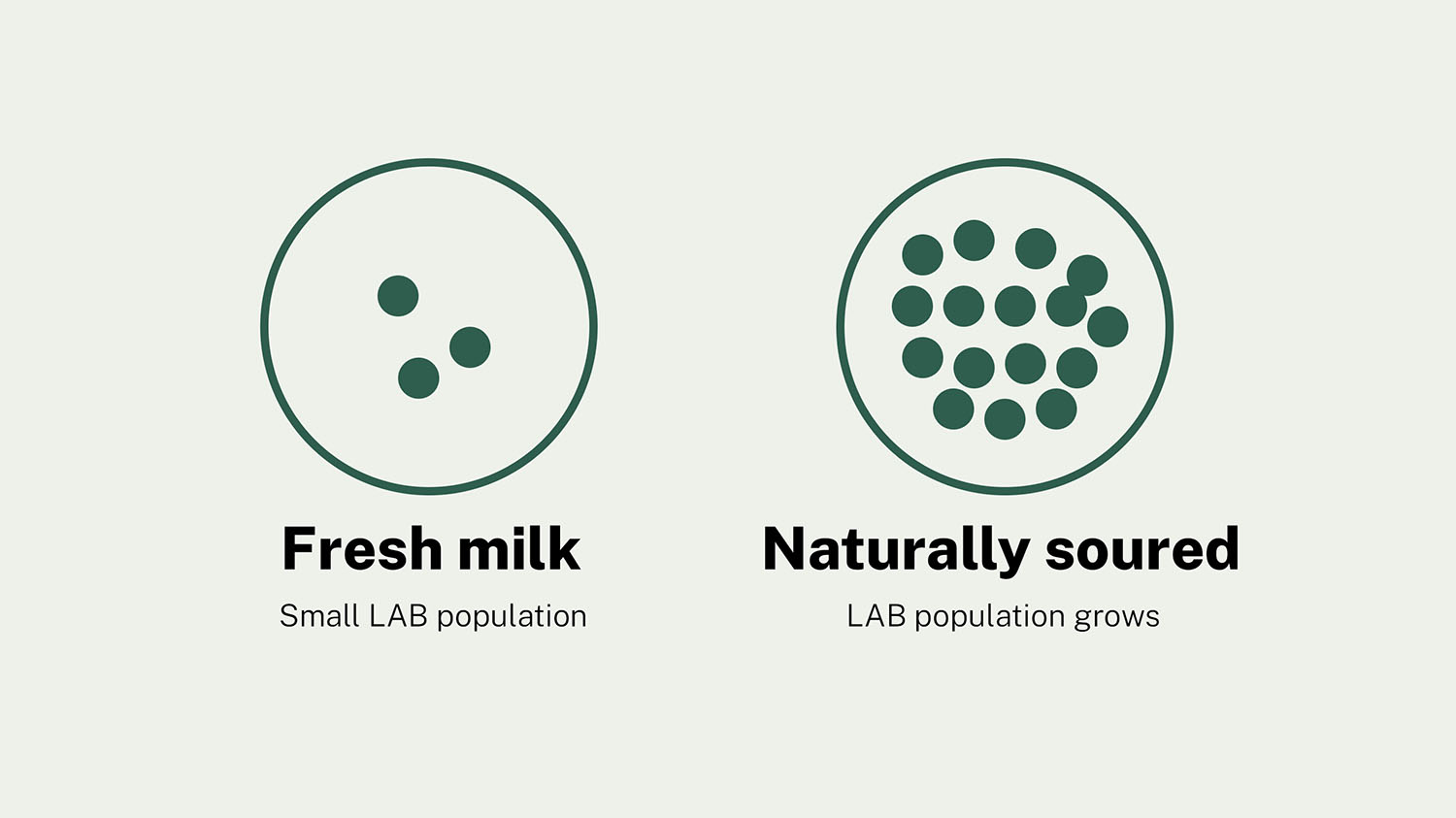
The primary safety contribution of LAB in cheesemaking is acidification. As starter cultures grow in the milk and developing curd, they consume lactose and produce lactic acid, dropping the pH of the fresh milk from approximately 6.6 to 6.7 down toward 4.5 to 5.2 depending on the cheese style. This acidification begins within hours of inoculation and continues through curd formation, drainage, pressing, and the early stages of aging.
The rate and extent of acidification depend on several variables: the strains used, the inoculation rate, the temperature at which the curd is processed, and the buffering capacity of the milk itself. Hard cheddar-style cheeses typically reach a curd pH of approximately 5.0 to 5.2 over six to eight hours of manufacture. Fresh lactic-acid cheeses such as chèvre may reach pH 4.5 or below. The pH difference between these styles has direct implications for the pathogen behavior documented throughout this cluster.
The connection between LAB acidification and the water activity reduction that salt drives is sequential rather than simultaneous. Acidification occurs first, during the active fermentation phase, and suppresses or eliminates acid-sensitive organisms before salt has fully equilibrated through the cheese matrix. The two mechanisms act in series, with LAB providing the initial acid hurdle and salt-driven aw reduction providing the subsequent moisture hurdle.
How LAB Acidification Determines Which Dairy Pathogens Survive Cheesemaking
The pH profile that LAB establish during cheesemaking explains a significant portion of the divergent pathogen outcomes the cluster has documented.
Campylobacter jejuni, with a minimum growth pH of approximately 4.9 and no acid tolerance mechanism, declines rapidly as curd pH drops below its tolerance threshold during the active LAB fermentation phase. The organism is effectively eliminated by the time the curd has been pressed and salted, well before any 60-day aging period begins. LAB acidification is the operative mechanism.
Mycobacterium bovis and Brucella abortus, the organisms the 60-day aging rule was designed to address, are both susceptible to the combined pH and moisture conditions that LAB and salt produce in hard cheese. Their elimination during aging is a direct consequence of LAB-driven acidification operating alongside progressive water activity reduction.
E. coli O157:H7 uses the mild acid of early LAB fermentation as a conditioning signal for its acid tolerance response. The pH range of 5.0 to 5.5 produced during the first hours of cheesemaking is precisely the range that induces the RpoS-mediated ATR. This is the mechanistic connection between LAB activity and O157:H7’s paradoxical persistence: the bacteria responsible for cheese safety are also responsible for training O157:H7 to resist the conditions they create.
Competitive Exclusion: How LAB Suppress Pathogens Beyond Acidification
LAB contribute to cheese safety through mechanisms beyond pH reduction. Competitive exclusion describes the process by which LAB populations suppress pathogenic organisms by competing for nutrients, by altering the physical environment, and by producing antimicrobial compounds.
Nutrient competition is the most basic form: LAB rapidly consume lactose and other available carbohydrates, reducing the nutrient supply available to competing organisms. As the carbohydrate source is depleted and acid accumulates, the environment becomes progressively inhospitable for species that cannot tolerate those conditions.
More specifically, some LAB strains produce bacteriocins: small antimicrobial peptides that kill or inhibit competing bacteria. The most extensively studied dairy bacteriocin is nisin, produced by Lactococcus lactis subsp. lactis. Nisin is active against Gram-positive pathogens including Listeria monocytogenes and Staphylococcus aureus and has been documented in both raw and commercial cheese environments. Research has shown nisin can reduce L. monocytogenescounts by approximately 3 log units within four hours of exposure in milk. Other bacteriocins relevant to dairy include lacticin 3147, produced by some Lactococcus strains, and various enterocins produced by Enterococcus species commonly found in raw milk cheeses.
The practical significance of bacteriocin production in raw milk cheese is real but bounded. Bacteriocin-producing LAB provide an additional antimicrobial layer beyond acidification, and raw milk cheese contains a more diverse LAB community than pasteurized-milk cheese, which may produce a broader range of competitive compounds. However, Listeria monocytogenes can develop resistance to nisin under repeated exposure, and bacteriocin production is not uniform across starter culture strains. Competitive exclusion through bacteriocins should be understood as a contributing factor rather than a primary safety control.
How LAB Shape Cheese Flavor
The flavor contribution of LAB is as significant as the safety contribution, and the two are mechanistically related. The same enzymatic activity that produces safety-relevant pH changes also drives the proteolysis and lipolysis that create flavor.
Proteolysis, the enzymatic breakdown of casein proteins, is the dominant flavor-generating process in aged cheese. Starter LAB produce proteinases and peptidases that cleave casein into progressively smaller peptides and eventually free amino acids. Those amino acids are the precursors to the volatile flavor compounds that define aged cheese character: sulfur-containing compounds from methionine and cysteine catabolism, short-chain fatty acids and esters from fatty acid metabolism, and aldehydes and alcohols from amino acid decarboxylation.
Lipolysis, the breakdown of milk fat, adds additional complexity. Some LAB strains produce lipases that release free fatty acids from triglycerides. Those fatty acids contribute directly to flavor and also serve as precursors to additional aromatic compounds. The rancid note in some raw milk cheeses and the peppery sharpness of aged Pecorino both reflect elevated levels of free fatty acids.
Secondary metabolites from LAB fermentation contribute distinct flavors. Diacetyl, produced by Leuconostoc mesenteroides and some Lactococcus strains from citrate metabolism, contributes the buttery character of some cheeses. Acetaldehyde contributes the fresh dairy note associated with young fresh cheeses. Carbon dioxide produced by heterofermentative LAB creates the characteristic eyes in Swiss-type and Gouda styles.
Why LAB Acidification Trains E. coli O157:H7 to Survive and Enables Listeria in Soft-Ripened Cheese
The mechanisms through which LAB contribute to cheese safety also create the conditions for some of the safety failures the cluster has documented.
The ATR paradox with E. coli O157:H7 is the clearest example: LAB acidification to pH 5.0 to 5.5 induces a stress response in O157:H7 that allows it to survive the more severe acid conditions that follow. The mechanism the 60-day rule depends on for safety is the same mechanism that makes O157:H7 difficult to control. This is not a failure of LAB to function correctly; it is a consequence of O157:H7 having evolved an adaptive response to exactly the range of mild acid stress that LAB-driven fermentation produces.
In surface-ripened and washed-rind styles, the problem is different. Starter LAB initially drive the surface pH down toward 4.5 to 5.0. But surface bacteria and molds added during ripening, including Brevibacterium linens in washed-rind styles and Penicillium camemberti in Camembert, consume lactic acid and produce alkaline compounds that raise the surface pH back toward 6.0 to 7.5. This pH reversal is essential to the flavor and texture of those styles, but it also transforms the rind from an environment that suppresses Listeria into one that approaches Listeria‘s growth optimum. In this sense, the ripening LAB and associated surface organisms undo part of the safety work that starter LAB accomplished.
Why Lactic Acid Bacteria Are Not a Sufficient Safety Control on Their Own
Lactic acid bacteria are not a uniformly reliable safety mechanism in cheese. They reliably eliminate organisms that cannot tolerate the pH and competitive conditions they produce. They are the decisive factor for Campylobacter, for the organisms targeted by the 60-day rule, and for many other pathogens that do not appear in cheese safety literature precisely because they cannot survive LAB acidification.
But LAB acidification also has limits that the cluster has traced in detail. It conditions O157:H7 to resist the conditions it creates. It fails to produce pH levels hostile to Listeria in most styles, and in soft-ripened styles it is actively reversed. For Salmonella, acidification suppresses but does not reliably eliminate, and whether suppression is sufficient depends on the initial contamination load in the source milk. It provides competitive exclusion benefits through bacteriocins, but those benefits are inconsistent and not sufficient to replace other control measures.
The safety of raw milk cheese is therefore not a function of LAB activity alone but of the interaction between LAB-driven pH development, salt-driven water activity reduction, temperature-controlled growth conditions, and the specific adaptive mechanisms of the organisms present in the milk. What the cluster has documented, across seven articles, is the consequence of those interactions working differently for each pathogen in turn.