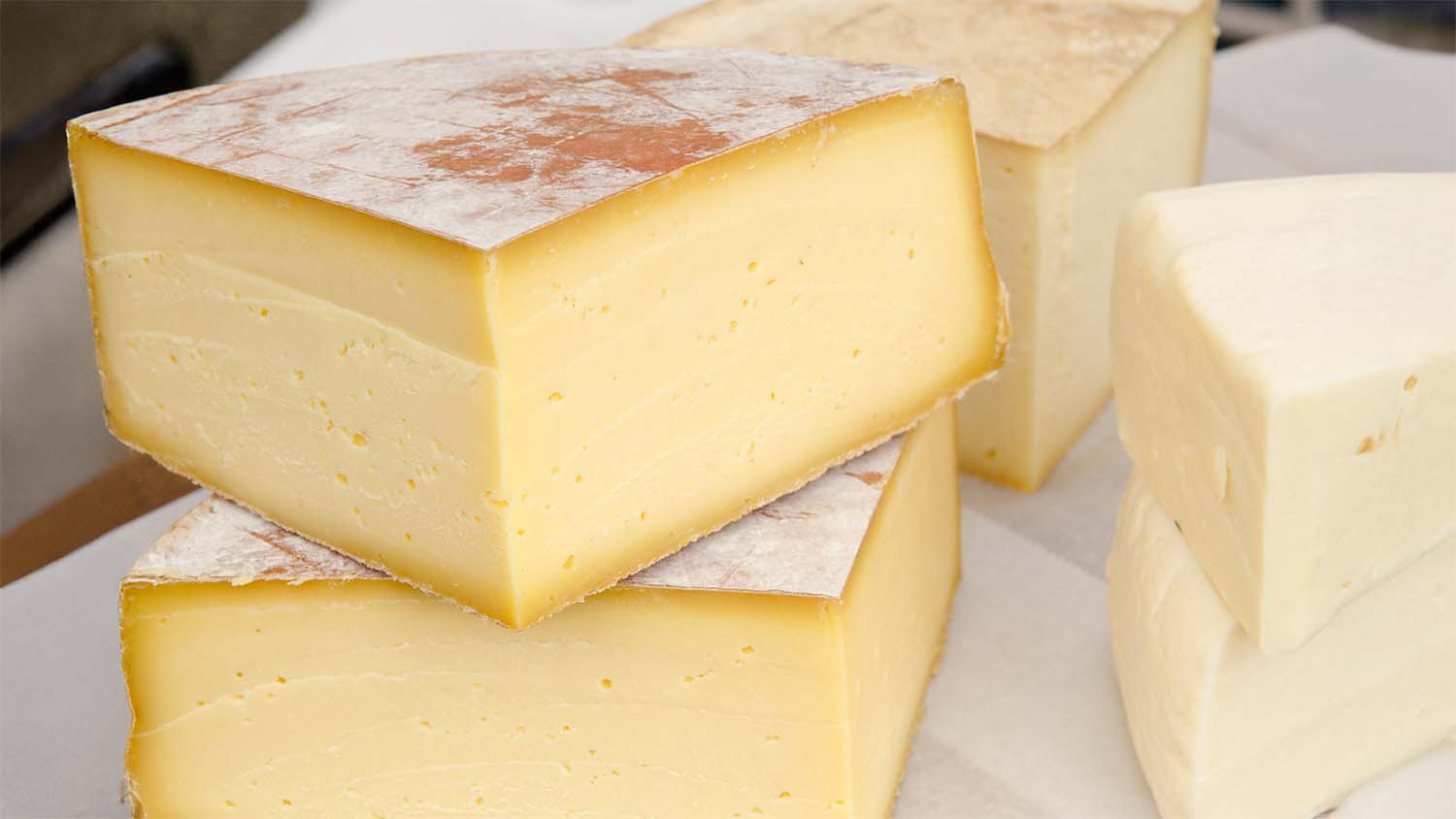
Aged cheese at a USDA Agricultural Marketing Service farmers market. Hard aged styles reach water activity levels that inhibit most bacterial growth, though not all pathogens are reliably eliminated during the aging process. Photo: Meredyth H. von Seelen / USDA AMS.
What Happens to Bacteria During Cheese Aging: Salt, Acid, and Time
Cheesemaking transforms milk through a sequence of chemical and biological changes that are hostile to many microorganisms. Salt draws moisture from the curd. Bacterial starter cultures acidify the environment. Time and controlled temperature continue both processes, progressively altering the conditions available to surviving cells. Together, these forces eliminate some pathogens reliably, reduce others significantly, and leave certain organisms largely unaffected.
Understanding which bacteria respond to which conditions, and why, requires examining each mechanism in detail.
Why Starting Contamination Levels Determine What Survives Cheese Aging
Raw milk contains a complex microbial community. Most organisms present are harmless or beneficial, but milk from any animal can carry pathogens including Escherichia coli O157:H7, Listeria monocytogenes, Salmonella spp., Campylobacter jejuni, and Staphylococcus aureus. The concentration of these organisms at the start of cheesemaking, called the initial load, has a direct bearing on what survives the process.
Pathogen reduction during aging follows log-reduction kinetics. Each log reduction represents a 90% decrease in bacterial population. A 4-log reduction eliminates 99.99% of organisms present. A 6-log reduction eliminates 99.9999%. If a cheese begins with 100 colony-forming units per gram (CFU/g) of a given pathogen, a 4-log reduction brings that figure to 0.01 CFU/g. If the same cheese begins with 1,000,000 CFU/g, the identical reduction leaves 100 CFU/g remaining. For pathogens like E. coli O157:H7, where the infectious dose can be as low as 10 to 100 cells, that remainder is clinically significant.
The same reduction process produces different safety outcomes depending on starting conditions. This relationship is central to understanding how contamination events can occur even when standard aging protocols are followed correctly.
Salt and Water Activity: How Moisture Control Shapes Bacterial Survival
Salt is added to cheese either by direct incorporation into the curd or by brining after pressing. Its primary antimicrobial mechanism is not chemical toxicity but physical: salt reduces water activity (aw), a measure of the free water available for microbial metabolism and reproduction.
Pure water has an aw of 1.0. Most bacteria require an aw above 0.90 to grow. As water activity falls below that threshold, cellular processes slow, membrane integrity degrades, and reproduction becomes impossible. Below approximately 0.85, bacterial growth ceases for most species.
Different cheese styles reach different water activity levels during and after aging:
- Fresh soft cheeses (ricotta, queso fresco): aw 0.97 to 0.99
- Semi-soft cheeses (Havarti, Fontina): aw 0.92 to 0.96
- Hard aged cheeses (cheddar, Parmesan, aged Gouda): aw 0.82 to 0.88
Hard aged cheeses fall at or below the lower limit of bacterial growth for many organisms. Soft fresh cheeses remain well within the range where pathogens can not only survive but multiply after production.
Salt tolerance varies significantly across pathogen species. Listeria monocytogenes can grow in sodium chloride concentrations up to 10% and maintains metabolic activity at aw levels as low as 0.92. Salmonella and E. coli O157:H7 are moderately salt-sensitive but can persist through the salt concentrations present in most commercial cheese styles. Campylobacter jejuni is among the most salt-sensitive of the major foodborne pathogens, with a minimum aw requirement of approximately 0.99, making it effectively inhibited by even modest salt levels in cheese.
How Lactic Acid Lowers Cheese pH and Why Some Pathogens Resist Acidification
Cheesemaking depends on lactic acid bacteria (LAB) as starter cultures, primarily species of Lactococcus, Lactobacillus, and Streptococcus thermophilus. These organisms ferment lactose into lactic acid, driving the pH of the curd from the near-neutral range of fresh milk (pH 6.5 to 6.7) down to the acidic range of aged cheese (pH 4.5 to 5.2, depending on style).
This acidification creates an environment hostile to many microorganisms. Most bacteria have a minimum growth pH between 4.5 and 5.0. Below those thresholds, enzyme systems fail and cells die or enter a non-reproductive state.
Beyond direct acidification, LAB exert competitive pressure through two additional mechanisms. First, they consume available nutrients rapidly, reducing the resources accessible to pathogens. Second, some LAB strains produce bacteriocins, which are antimicrobial peptides that act against competing bacteria. Nisin, produced by certain Lactococcus lactis strains, is specifically active against Listeria monocytogenes and is used in some commercial cheese applications for this reason.
The critical limitation of lactic acid as a safety mechanism is that acid tolerance is not uniformly distributed across pathogen species. Some organisms have developed adaptive responses to acidic environments that substantially alter their survival profile.
E. coli O157:H7 can induce an acid tolerance response (ATR) when exposed to mildly acidic conditions in the range of pH 5.0 to 5.5, a level typical of early-stage curd. This adaptive mechanism, regulated in part by the RpoS sigma factor, upregulates acid shock proteins that allow the organism to survive pH levels that would kill non-adapted cells. Non-adapted O157:H7 has a minimum growth pH of approximately 4.4. ATR-adapted cells can survive exposure to pH as low as 3.5. Pre-exposure to mild acidity during early curd formation therefore prepares O157:H7 to withstand the more extreme acid conditions that develop as aging progresses.
Listeria monocytogenes has a minimum growth pH of approximately 4.4. While it cannot reproduce at the pH of most finished cheeses, it can survive in a dormant state and resume growth if conditions shift, including during temperature fluctuation in storage or in higher-pH zones within inhomogeneous curd.
Campylobacter jejuni has a minimum growth pH of approximately 4.9 and lacks the acid adaptation mechanisms present in E. coli O157:H7. Combined with its requirement for microaerophilic conditions of 3 to 5% oxygen, its sensitivity to acid makes it highly susceptible to standard cheesemaking conditions.
The 60-Day Aging Rule: Origins, Limitations, and What the Science Shows
The 60-day aging requirement for raw milk cheese sold in the United States was established in 1949 and codified in 21 CFR Part 133. Its scientific basis was research demonstrating that Mycobacterium bovis and Brucella abortus, the pathogens then considered the primary threats in raw dairy, were reliably eliminated during extended aging through the combined effects of salt, acid, and time.
For those organisms, the standard accomplishes what it was designed to accomplish. Both M. bovis and Brucellaare sensitive to acidic conditions and low water activity and do not persist through a properly executed aging period.
The limitation is that E. coli O157:H7 was not identified as a human pathogen until 1982, thirty-three years after the rule was written. Reitsma and Henning, publishing in the Journal of Food Protection in 1996, found viable O157:H7 in cheddar cheese at 158 days, well past the 60-day threshold, though their study used pasteurized milk. Subsequent research in raw milk cheese confirmed and extended this finding: Schlesser et al. (2006) demonstrated less than a 1-log reduction of O157:H7 in raw milk cheddar after 60 days, and D’Amico et al. (2010) recovered viable O157:H7 from raw milk cheddar and Gouda beyond 270 days using selective enrichment.
Listeria monocytogenes presents a distinct challenge during aging. While low pH and reduced water activity inhibit its growth, Listeria remains viable at refrigeration temperatures down to 0°C (32°F), making it one of the few significant food pathogens capable of growth under standard cheese storage conditions. Its biofilm-forming capacity compounds this problem: Listeria biofilms on cheese surfaces and production equipment demonstrate resistance to sanitizers at concentrations 100 times or more above levels lethal to free-floating cells of the same organism. The 2015 Joint FDA/Health Canada Quantitative Assessment of the Risk of Listeriosis from Soft-Ripened Cheese Consumption concluded that aging alone cannot reliably mitigate the risk posed by Listeria contamination in raw soft cheese.
Temperature during aging interacts with all three mechanisms. Most cheese aging occurs between 10°C and 15°C (50°F to 59°F), well below the optimal growth temperatures of common LAB starter cultures, which range from 25°C to 45°C depending on species. At aging temperatures, LAB activity and acidification continue but at a reduced rate. Very cold aging slows pathogen metabolism as well, but the net effect can be a slower pH drop and less antimicrobial protection during the critical early weeks.
E. coli, Listeria, Salmonella, and Campylobacter: How Each Responds to Aging
The table below gives quantitative growth limits and survival characteristics for the five pathogens most relevant to aged cheese.
| Pathogen | Min. Growth Temp | Min. Growth pH | Min. aw | Infectious Dose | Survives 60-Day Aging |
|---|---|---|---|---|---|
| E. coli O157:H7 | 8°C (46°F) | 4.0 (ATR-adapted) | 0.95 | 10-100 cells | Yes, documented |
| Listeria monocytogenes | 0°C (32°F) | 4.4 | 0.92 | ~1,000 cells | Yes |
| Salmonella spp. | 5°C (41°F) | 3.8 | 0.94 | Highly variable; ~10^3 to 10^8 (serovar-dependent) | Variable |
| Campylobacter jejuni | 30°C (86°F) | 4.9 | 0.99 | 500-800 cells | No |
| Staphylococcus aureus | 7°C (45°F) | 4.0 | 0.83 | 1 µg enterotoxin | Organism no; toxins yes |
Campylobacter stands apart as the pathogen most consistently controlled by cheesemaking. Its minimum growth temperature of 30°C means it cannot reproduce at any point during aging or cold storage. Its high minimum aw requirement of 0.99 means standard salt levels effectively immobilize it. Raw milk cheese outbreaks linked to Campylobacter are rare in surveillance data; the organism’s risk is essentially confined to unpasteurized fluid milk.
Salmonella occupies a middle position. It is more susceptible to acid and salt than either Listeria or O157:H7, and its reduction during aging is more reliably achieved, though not guaranteed when initial contamination loads are high or when low-acid cheese styles are involved.
E. coli O157:H7 and Listeria monocytogenes most consistently challenge the limits of aging as a control mechanism. O157:H7 does so through its acid adaptation capacity. Listeria does so through its cold tolerance, salt tolerance, and physical persistence as biofilm.
Why Staphylococcal Enterotoxins Survive Both Pasteurization and Aging
Staphylococcus aureus occupies a different category from the other pathogens discussed here, and its behavior during aging illustrates the limits of thermal and chemical controls across food safety broadly.
S. aureus itself can be inhibited by the conditions of hard cheese aging: salt, low aw, and pH reduction suppress its growth, and the organism is killed by pasteurization. The problem is that S. aureus produces heat-stable protein enterotoxins during its growth phase in milk or curd. These toxins, including staphylococcal enterotoxin A (SEA) and staphylococcal enterotoxin B (SEB), are resistant to both heat and acid. Enterotoxin A retains biological activity after exposure to 121°C (250°F) for 30 minutes, a temperature and duration that sterilizes essentially all other biological material in food. Neither pasteurization nor extended aging at any temperature degrades staphylococcal enterotoxins once they are present.
The practical implication is that milk containing S. aureus at sufficient density to produce enterotoxins before cheesemaking begins will carry those toxins into the finished cheese regardless of subsequent processing. The infectious dose for staphylococcal food poisoning is approximately 1 microgram of enterotoxin, an amount that can be produced when S. aureus populations reach roughly 100,000 CFU/g of food.
How Cheese Style Affects Bacterial Risk: Hard, Soft, and Surface-Ripened Compared
The interaction of salt, acid, and aging plays out differently across cheese categories. The table below summarizes water activity, salt content, and primary pathogen concerns by style.
| Cheese Style | Typical aw | Typical NaCl % | Minimum Aging | Primary Pathogen Concern |
|---|---|---|---|---|
| Fresh soft (ricotta, queso fresco) | 0.97-0.99 | 0.5-1.0% | None | Salmonella, Listeria, E. coli O157:H7 |
| Bloomy rind (brie-style) | 0.95-0.98 | 1.5-2.5% | 2-4 weeks | Listeria (surface pH rebounds to 6.5-7.5) |
| Washed rind | 0.95-0.97 | 2.0-3.0% | 4-8 weeks | Listeria |
| Semi-hard (Havarti, Fontina) | 0.92-0.96 | 1.5-2.5% | 1-3 months | E. coli O157:H7, Listeria |
| Hard aged (cheddar, Parmesan) | 0.82-0.88 | 1.5-2.0% | 60 days minimum | E. coli O157:H7 |
| Brined (feta, halloumi) | 0.92-0.96 | 3.0-8.0% | Variable | Listeria |
Fresh soft cheeses present the highest risk profile. High moisture keeps water activity elevated. Minimal or absent aging means acid development is incomplete at the point of consumption. Lower salt content further limits pathogen suppression.
Surface-ripened cheeses introduce a specific complication. The ripening cultures used in washed-rind and bloomy-rind styles, including Penicillium camemberti and Geotrichum candidum, consume lactic acid during metabolism, raising the surface pH from the acidified value of approximately 4.5 back to as high as 6.5 to 7.5 in fully ripened examples. That surface pH is nearly identical to fresh milk. The conditions this creates are specifically favorable to Listeria monocytogenes, which accounts for the disproportionate association between surface-ripened raw cheeses and Listeria in outbreak surveillance data.
Hard aged cheeses provide the most hostile microbial environment. Extended aging, low moisture, and significant salt concentration bring water activity into the range where bacterial activity is severely constrained for most organisms. The documented survival of E. coli O157:H7 in properly aged cheddar demonstrates that even hard cheese does not offer categorical protection with respect to that pathogen.
Brined cheeses such as feta and halloumi achieve significant salt concentrations through prolonged submersion. The salt tolerance of Listeria monocytogenes means brining alone does not reliably control that organism, though it is effective against less tolerant species.
What Cheesemaking Reliably Accomplishes
The combined effects of salt, acid, and aging accomplish the following with reasonable consistency:
- Elimination of Campylobacter jejuni across all cheese styles
- Elimination of Mycobacterium bovis and Brucella abortus, the organisms the 60-day rule was designed to address
- Significant reduction of Salmonella in hard and semi-hard styles when starting loads are not excessive
- Inhibition of growth, though not elimination, of E. coli O157:H7 and Listeria monocytogenes in hard aged styles
- Reduction or elimination of Staphylococcus aureus cells, though not the heat-stable enterotoxins produced prior to processing
The limits of the process are equally consistent. E. coli O157:H7 and Listeria monocytogenes are not reliably eliminated by standard aging protocols across cheese styles. Salmonella reduction is load-dependent. Staphylococcal enterotoxins, once present, are not degraded by any cheesemaking condition.
Cheesemaking as a microbial control system is real, meaningful, and well-documented in its effects. It is also bounded, with limits that depend on the pathogen species, the cheese style, the initial contamination level, and the consistency with which production conditions are maintained.