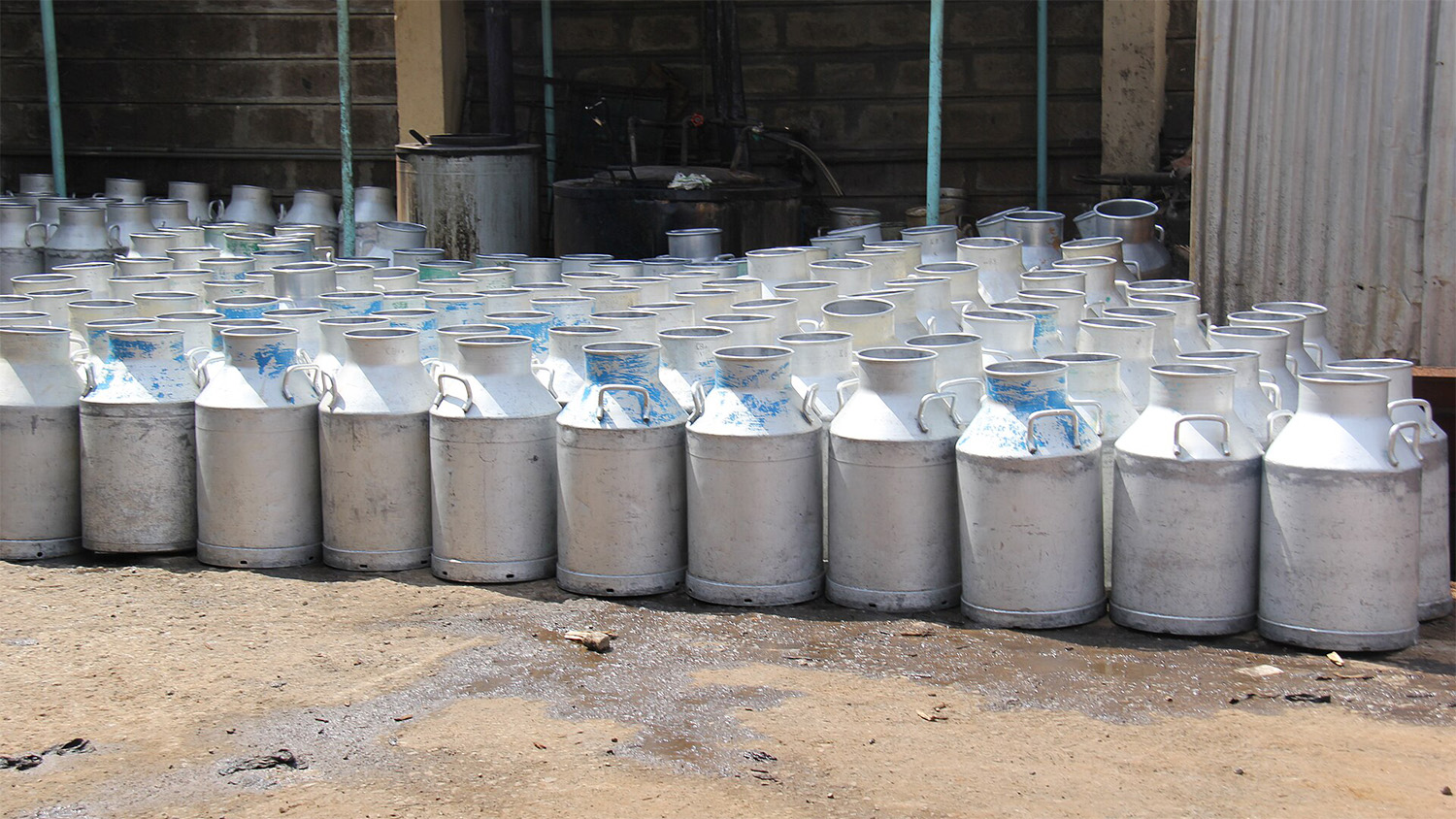
Milk cans at the Kiambaa Dairy Rural Sacco Society in Kenya, where around 80% of milk is sold through informal markets, mostly raw. Photo: ILRI/Eyeris Pictures Media, CC BY-SA 2.0, cropped.
How Many People Drink Raw Milk Worldwide?
No one has counted raw milk drinkers worldwide. National surveys in high-income countries find that somewhere between about 4% and 19% of people drink raw milk, depending on the country and how the question is asked. In much of Africa and South Asia, most milk is sold raw through informal markets, and no large survey has measured how much of it is drunk without heating. Drinking unboiled milk is common on dairy farms and in pastoralist communities.
The United States alone has about 11 million adults who drank raw milk in the past year, so the worldwide total is well above that figure.
Raw milk consumption by country
Only a handful of countries have measured raw milk consumption in a national survey. These are the most recent figures available.
| Country | Survey | Year | Who and when | Result |
|---|---|---|---|---|
| United States | FDA Food Safety Survey and Food Safety and Nutrition Survey | 2016 and 2019 | Adults, past 12 months | 4.4%, about 1.0% weekly |
| Canada | Foodbook 2.0 (Public Health Agency of Canada) | 2023 to 2024 | All ages, past 7 days | 4.4% |
| New Zealand | Ministry for Primary Industries telephone survey | 2014 | Adults, currently drinking | 5% |
| England, Wales and Northern Ireland | Food Standards Agency consumer survey | 2018 | Adults, current drinkers | 10% |
| Germany | BfR Consumer Monitor (Federal Institute for Risk Assessment) | 2022 | Age 16 and over, at least monthly | 19% |
| France, Germany, Italy, Poland and Sweden | Five-country online survey (Belluco et al.) | 2022 | Adults, any consumption | 37% |
| Ethiopia (Somali Region) | Household survey of pastoralists (Roess et al.) | 2022 | Adults | 71% drink fresh camel milk |
The Canadian figure stands out because selling raw milk for human consumption is illegal in Canada. Foodbook 2.0 surveyed 21,744 people across every province and territory, asking whether they had any unpasteurized (raw) dairy milk in the past seven days. The first Foodbook survey, run by telephone with 10,942 people in 2014 to 2015, found 2.8%. Both results are in line with US surveys that use the same 7-day question, which found 2% to 3%. Province-level results swing widely between the two surveys, so the national figure is the more reliable one.
New Zealand’s ministry concluded that consumption was rising. National nutrition survey data from 2009 put raw milk drinkers at nearly 1% of adults, with up to half of them probably living or working on dairy farms. By 2014, 5% of the 1,010 adults in a ministry-commissioned telephone survey said they currently drank raw milk.
The UK figures cover England, Wales and Northern Ireland, where raw milk can be sold directly by registered farms. Scotland has banned raw drinking milk since 1983. The share of adults who drink raw milk rose from 3% in 2012 to 10% in 2018, according to Food Standards Agency surveys summarized in a 2022 review in PeerJ.
Why raw milk survey numbers vary by country
How people are surveyed. The US and Canadian figures come from surveys that randomly sample households by phone or mailing address and weight the results to match the population, and the New Zealand figure comes from a telephone survey. The UK, German and five-country European figures come from online panels of people who signed up to take surveys. The authors of the five-country study note that volunteer panels may differ from the general population. In the surveys here, the online panel results are the highest.
What “raw milk” means to the person answering. Respondents may count fresh, unhomogenized or farm-bottled milk that has been pasteurized. The five-country study gave respondents the legal EU definition of raw milk before asking, which reduces that confusion. The German survey did not.
The time window. Canada asks about the past 7 days, the US about the past 12 months, Germany about how often people usually drink it, and the UK and New Zealand about current drinking. A weekly measure counts mostly regular drinkers, and a yearly or “ever” measure counts occasional ones too.
Farm households. Surveys that include rural and farm families pick up people who drink milk straight from their own animals. In a 2008 survey of Canadian dairy producers, 88.7% said they or their families drink unpasteurized milk from their own bulk tanks.
Raw milk consumption in Germany and Europe
The German figure comes from the Federal Institute for Risk Assessment’s 2023 special report on raw foods. Of 1,004 people aged 16 and over surveyed online in September 2022, 9% said they drink raw milk daily or several times a week, and another 10% about weekly or one to three times a month. That makes 19% who drink raw milk at least monthly.
The five-country study surveyed 1,059 adults in France, Germany, Italy, Poland and Sweden in 2022. After being given the EU definition of raw milk, 387 (37%) said they drink it. Among those drinkers, 40% drank it at least once a week. Frequent drinking was most common among French drinkers (53%) and least common among Swedish drinkers (23%). Poland has no formal legal pathway for selling raw drinking milk, yet Polish respondents still reported drinking it.
Raw milk consumption on farms
The highest rates of raw milk drinking in high-income countries are found on farms, where milk comes straight from the family’s own animals.
- Canada. 88.7% of dairy producers who answered a 2008 national survey said they or their families drink unpasteurized milk from their bulk tanks.
- Germany, Austria and Switzerland. In the GABRIELA study of more than 8,000 rural schoolchildren, 45.0% of farm children drank only farm milk, compared with 2.4% of non-farm children.
- United States. A 1996 to 1997 CDC survey found raw milk consumption of 8.6% among people living on a farm, compared with 1.1% in cities.
- New Zealand. Up to half of the adults who drank raw milk in 2009 probably lived or worked on dairy farms.
Where raw milk is sold legally
Legal raw milk markets give another view of demand. In several European countries, raw milk is sold through farm shops and self-service vending machines.
- England, Wales and Northern Ireland. The Food Standards Agency’s register of raw drinking milk premises listed 158 registered premises as of October 2026, 136 of them with cows and 17 with goats. UK production of raw drinking milk rose from 610,000 liters in 2012 to 3.2 million liters in 2017, according to the PeerJ review.
- Switzerland. About 400 farm-run raw milk vending machines operate across the country, SWI swissinfo.ch reported in 2024. More detail is in Raw Milk by the Liter: Switzerland and Austria.
- New Zealand. In 2014, the Raw Milk Producers’ Association had 54 members, and a ministry survey of buyers and sellers put total sales at around 20,000 liters a week.
- Italy, France and Norway. Italy built one of Europe’s largest raw milk vending machine networks, France sells raw milk at farm gates, in shops and from machines, and Norway sells cultured milk, sour cream, butter and cheese made from raw milk in ordinary shops. See raw milk in Italy, France and Norway.
Most milk in developing countries is sold raw
Across much of the world, raw milk is the normal way milk is bought. The Food and Agriculture Organization (FAO) estimates that more than 80% of the milk marketed in developing countries is handled by informal traders, without licensing or regulation.
- Pakistan, Tanzania and India. Traditional dairy markets held about 98% of the market in Pakistan and Tanzania and 76% in India, according to figures presented at a 2008 FAO regional dairy workshop.
- Kenya. Around 80% of Kenya’s milk is sold through informal markets, mostly raw and unpackaged. Consumers interviewed in Nairobi said they preferred raw milk for its freshness, taste and price.
These markets show how much of the world’s milk is sold without pasteurization. They do not show how many people drink it unheated. Some buyers heat milk at home, often in tea, and some drink it raw, but no national survey in these countries measures the split.
For scale, the world produced 930 million tonnes of milk in 2022, and about 150 million households around the globe are engaged in milk production.
Raw camel milk in pastoralist communities
Outside high-income countries, one of the few places raw milk drinking has been measured is among pastoralists. A 2022 study of 304 adults in the Somali Region of Ethiopia found that most adults drank fresh, unpasteurized milk: 80% drank fresh goat or sheep milk, 71% fresh camel milk and 44% fresh cow milk. About a quarter to a third also drank soured milk. Few other pastoralist communities have been surveyed this way.
So how many people drink raw milk worldwide?
A single worldwide number does not exist, and combining the surveys above would mix different questions, time windows and survey methods. What the data does show:
- In the US, Canada and New Zealand, phone and mail surveys put raw milk drinkers at about 4% to 5% of the population.
- In European online surveys, the share runs from 10% in the UK to 19% in Germany, and higher in one five-country study.
- On dairy farms and in pastoralist communities, drinking raw milk is common and often the norm.
- In most of the developing world, milk is sold raw, and how much of it is drunk without heating has not been measured.
The United States accounts for about 11 million past-year drinkers on its own. Add Canada, where about 1 in 23 people reported drinking raw milk in a single week, the European countries with legal farm and vending machine sales, and the farm and herding households that drink milk from their own animals, and the worldwide total runs far higher.
Country-by-country figures sit alongside US consumption and sales data in raw milk statistics.
For the full US breakdown, see How Many People Drink Raw Milk in the US? To check the rules where you live, see raw milk laws by country and state.