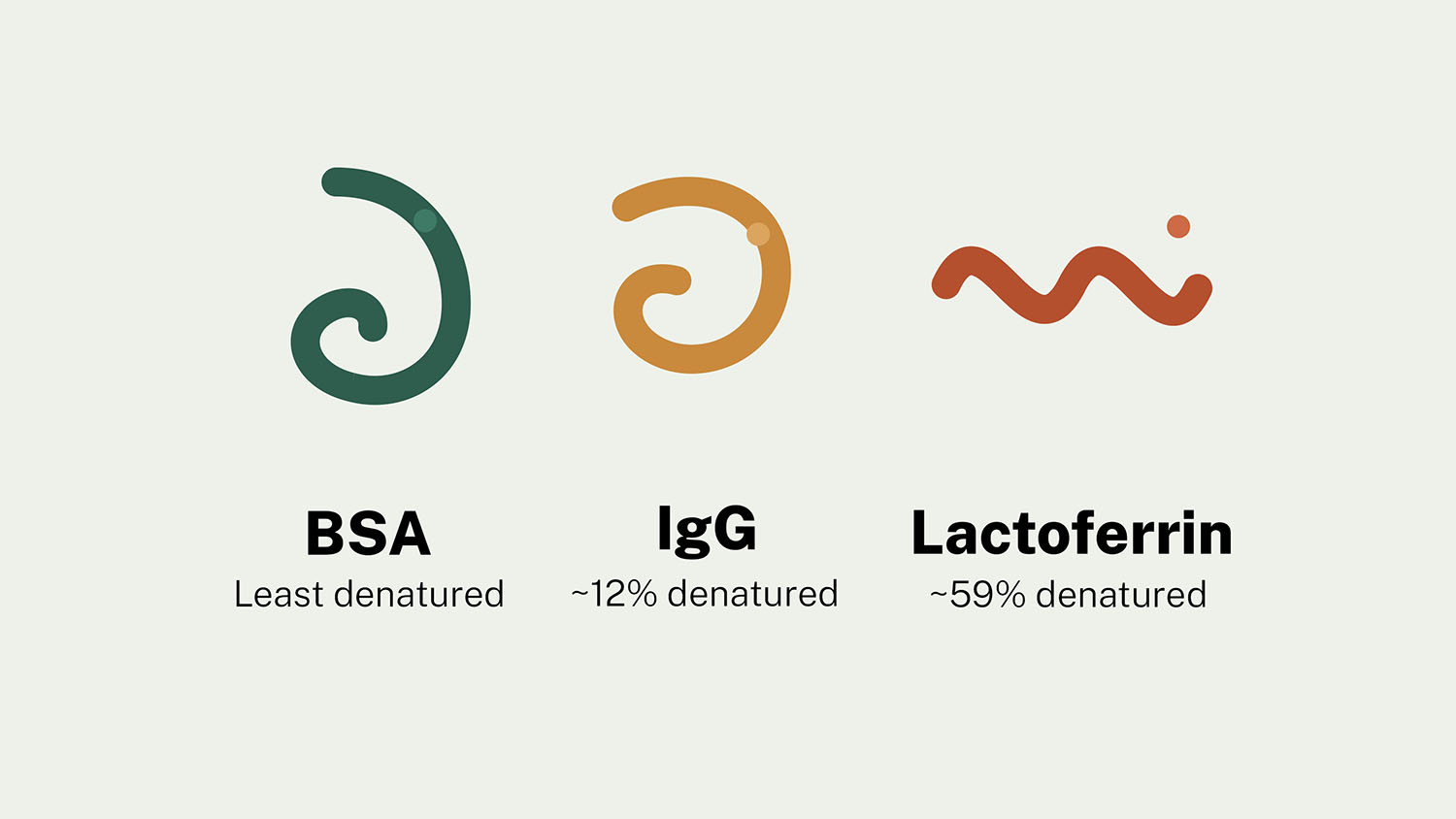
BSA, IgG, and lactoferrin denature at different rates under standard HTST pasteurization, with lactoferrin losing roughly 59% of its native structure compared to about 12% for IgG.
What Pasteurization Does to Whey Protein, Lactoferrin, and IgG
Milk’s whey fraction carries more than the two proteins most people have heard of, alpha-lactalbumin and beta-lactoglobulin. It also carries a smaller set of minor proteins, including lactoferrin and several immunoglobulin classes, present at roughly a tenth the concentration of the major proteins and considerably more heat-sensitive. Dairy science has measured how much of each survives standard pasteurization, and the picture is not uniform: some proteins denature substantially, others barely change, and the degree of loss tracks closely with how hot and how long the milk is heated.
Key facts:
- At high-temperature short-time (HTST) pasteurization (72°C for 15 seconds), a controlled study found roughly 59 percent of lactoferrin and 12 percent of immunoglobulin G (IgG) denature, while bovine serum albumin (BSA) was the least affected of the three proteins tested.
- A commercial-scale study tracking an actual HTST production line found significant reductions in lactoferrin, immunoglobulin A (IgA), and immunoglobulin M (IgM) after pasteurization, but no significant reduction in IgG.
- Denaturation is dose-dependent on heat: one filtration study found gentler pasteurization (72°C for 30 seconds) caused roughly 10 percent lactoferrin loss, while more intensive heating (90°C for 5 minutes) caused complete loss of native whey protein.
- In a half-fat cheddar cheese production study, total whey protein denaturation measured 2.8 percent at 72°C and rose to 34.1 percent at 87°C, a roughly twelve-fold increase across a 15-degree range.
- The same commercial-scale HTST study also found significant reductions in xanthine oxidase activity and in several milk fat globule membrane (MFGM) proteins, including lactadherin and fatty acid-binding protein, alongside the whey protein losses.
What Is Whey Protein Denaturation?
Denaturation is the heat-induced unfolding of a protein’s three-dimensional structure, and it is distinct from destruction: the underlying amino acids remain, but the protein loses the folded shape it needs to perform its original biological function. Whey proteins begin to denature at temperatures as low as 60°C, and the process accelerates as both temperature and holding time increase. Researchers measure denaturation through several methods: solubility testing at pH 4.6, hydrophobicity assays that detect newly exposed regions of the unfolded protein, gel electrophoresis that visualizes changes in protein size, and ELISA testing that checks whether a protein retains the structural regions antibodies recognize.
Not all whey proteins denature at the same rate, and part of the reason traces back to how much of each protein is present to begin with. Beta-lactoglobulin and alpha-lactalbumin dominate the whey fraction, together making up more than 70 percent of total whey protein by weight, with beta-lactoglobulin alone typically contributing about half of that total. Lactoferrin and the immunoglobulins occupy a much smaller share of the fraction by comparison, with lactoferrin typically present at roughly 0.03 to 0.2 grams per liter and total immunoglobulins at roughly 0.3 to 0.6 grams per liter in mature bovine milk. Despite their lower concentration, these minor proteins are consistently found to be the more heat-labile of the two groups.
What HTST Pasteurization Does to Lactoferrin and Immunoglobulins
Standard HTST pasteurization denatures lactoferrin and certain immunoglobulin classes substantially more than it denatures the major whey proteins, though the exact proportion varies by protein and by study. A controlled study of skim milk heated at 72, 75, and 78°C across holding times from 0 to 300 seconds found that denaturation of BSA, IgG, and lactoferrin all began at 72°C and increased progressively with both higher temperature and longer holding time. Under standard HTST conditions specifically, that study measured roughly 59 percent of lactoferrin denatured against about 12 percent of IgG, with BSA the least affected of the three.
A separate, commercial-scale study tracked raw milk and whey through two HTST pasteurization steps used in actual whey protein concentrate production, rather than a laboratory bench setup. It found the same pattern by a different method: lactoferrin, IgA, and IgM all showed statistically significant reductions after pasteurization, while IgG did not decrease significantly. IgG’s comparative resilience shows up across both studies despite their different milk sources and testing methods, while IgA, IgM, and lactoferrin consistently register as more heat-labile.
At gentler time-temperature combinations, the loss narrows considerably. A cross-flow filtration study using pasteurized skim milk found that 72°C for 30 seconds, a shorter hold than the standard 15-second HTST minimum but comparable temperature, caused only about a 10 percent loss of lactoferrin in the resulting whey. The same researchers noted that a considerably harsher treatment, 90°C sustained for 5 minutes, essentially eliminates native whey protein entirely, a heat load well beyond standard pasteurization and closer to some fermented-product processing.
Denaturation Scales With Heat Intensity
| Pasteurization temperature | Total whey protein denatured |
|---|---|
| 72°C | 2.8% |
| 77°C | 8.4% |
| 82°C | 20.2% |
| 87°C | 34.1% |
Figures from a half-fat cheddar cheese production study measuring whey protein denaturation in milk pasteurized at each of these four temperatures for 26 seconds.
The relationship is not linear. Denaturation roughly triples between 72°C and 77°C, then more than doubles again by 82°C. Some processors pasteurize above the 72°C HTST minimum specifically to address heat-resistant organisms such as Mycobacterium avium subspecies paratuberculosis, and these figures show that choice comes with a measurable tradeoff in whey protein denaturation alongside its intended food-safety benefit.
Beyond Whey Protein: MFGM Proteins and Xanthine Oxidase Loss
The commercial-scale HTST study did not limit its testing to whey proteins. Using gel electrophoresis and mass spectrometry, researchers also found significant reductions in xanthine dehydrogenase/oxidase, lactadherin, and fatty acid-binding protein, three proteins that are part of the milk fat globule membrane rather than the whey fraction, along with a measurable drop in xanthine oxidase enzyme activity. That overlap is a reminder that pasteurization’s effects are not confined to a single protein category; the same heat treatment that denatures lactoferrin in whey also acts on structurally unrelated proteins elsewhere in milk.
The 72°C-for-15-second HTST standard itself is calibrated around a specific food-safety target: it is designed to achieve a 5-log reduction of Coxiella burnetii, the most heat-resistant pathogenic bacterium found in milk. The whey protein and MFGM protein losses documented in this research are a byproduct of meeting that safety threshold, not a separate or avoidable step in the process.
Denaturation and Milk Immunogenicity: What the Cytokine Research Shows
Two related but distinct studies have tested how whey proteins interact with the human immune system in vitro, and it is worth keeping their findings separate rather than treating them as one result.
The first study, the same one that measured lactoferrin and IgG denaturation percentages above, also tested how different concentrations of native, unheated BSA and IgG affected cytokine secretion by human peripheral blood mononuclear cells (PBMCs). It found that skim milk spiked with IgG at a concentration of 1.6 milligrams per milliliter shifted cytokine secretion toward a Th1-dominant profile, the kind of immune signature not typically associated with Th2-driven allergic reactions, while BSA produced no comparable shift in immune response at the doses tested. This is a concentration-response finding about native protein, not a comparison of heated versus unheated milk.
A separate study by an overlapping research group directly compared processing methods. It tested HTST pasteurization (72°C for 15 seconds) against high-pressure processing (HPP) at 400, 500, and 600 megapascals for their effects on both protein denaturation and PBMC cytokine response. Among all the treatments compared, HTST pasteurization altered native protein structure the least and produced almost no shift in milk’s overall immunogenic profile. HPP, by contrast, denatured a different profile of proteins than heat does, primarily beta-lactoglobulin and IgG, with protein aggregation appearing at 600 MPa; the immunogenic response shifted toward a Th1-dominant cytokine profile as pressure increased, then diminished again at the highest pressure tested. Alpha-lactalbumin was the least affected protein under pressure treatment.
Taken together, these two studies point toward the same general conclusion from different angles: standard HTST pasteurization, despite measurably denaturing lactoferrin and certain immunoglobulins, has not been shown in this research to significantly alter milk’s in vitro immunogenic profile the way more intensive heat or high-pressure alternatives can.
What This Research Does Not Show
The structural and biochemical facts above are well documented: pasteurization denatures lactoferrin and specific immunoglobulin classes to a measurable, heat-dependent degree, while other whey proteins and even standard milk immunogenicity itself remain comparatively stable under HTST conditions specifically.
What the research does not show is a proven clinical health outcome tied to whey protein denaturation status.Specifically:
- The cytokine research cited here was conducted in vitro, using isolated human blood cells exposed to purified proteins or unheated skim milk, not in living subjects consuming whole milk over time.
- None of the studies cited here compared clinical allergy incidence, infection rates, or any other diagnosed health outcome between people drinking raw versus pasteurized milk.
- Lactoferrin and immunoglobulins have documented antimicrobial and immune-modulating functions in isolated laboratory and cell-culture settings, but no study cited here establishes what dose, if any, of these proteins consumed through whole milk produces a measurable effect on an adult human’s immune function.
- The denaturation percentages reported vary across studies depending on the exact time-temperature combination, milk source, and measurement method used, and should be read as a consistent pattern rather than fixed universal figures.
Key Terms
- Denaturation: the heat-induced unfolding of a protein’s three-dimensional structure, distinct from the breakdown of its underlying amino acids.
- Whey proteins: the group of milk proteins that remain soluble after casein is removed, including major proteins (alpha-lactalbumin, beta-lactoglobulin) and minor bioactive proteins (lactoferrin, immunoglobulins, bovine serum albumin).
- Lactoferrin: an iron-binding whey protein with documented antimicrobial properties in laboratory research, among the more heat-sensitive whey proteins.
- Immunoglobulins (IgA, IgG, IgM): antibody proteins present in milk with differing heat sensitivities; IgG is comparatively heat-stable under standard pasteurization, while IgA and IgM denature more readily.
- High-temperature short-time (HTST) pasteurization: the standard commercial pasteurization method, defined by federal standards as heating milk to at least 72°C for at least 15 seconds.
- High-pressure processing (HPP): a non-thermal alternative to pasteurization that uses mechanical pressure rather than heat to reduce microbial load, with a different protein-denaturation profile than heat treatment.
Frequently Asked Questions
Does pasteurization destroy lactoferrin? Pasteurization does not destroy lactoferrin outright, but it denatures a substantial portion of it. Standard HTST conditions (72°C for 15 seconds) have been measured to denature roughly 59 percent of lactoferrin in one controlled study, while gentler time-temperature combinations caused smaller losses and more intensive heat treatment caused complete loss.
Are all immunoglobulins in milk affected equally by heat? No. Research consistently finds that IgA and IgM are significantly reduced by standard HTST pasteurization, while IgG is comparatively heat-stable and does not show a statistically significant reduction in commercial-scale studies.
Which whey proteins are most heat-stable? Bovine serum albumin, alpha-lactalbumin, and beta-lactoglobulin, the major whey proteins, are consistently found to be less affected by standard pasteurization temperatures than the minor bioactive proteins like lactoferrin.
Does pasteurizing milk at a higher temperature than the minimum cause more protein damage? Yes. Whey protein denaturation increases sharply with temperature above the standard HTST minimum. One study found total denaturation rising from 2.8 percent at 72°C to 34.1 percent at 87°C, a range some processors use specifically to address heat-resistant organisms.
Does pasteurization change how milk interacts with the immune system? Research directly comparing processing methods found that standard HTST pasteurization caused the least protein denaturation among the treatments tested and left milk’s in vitro immunogenic profile largely unchanged, while high-pressure processing at higher intensities altered it more.
Is there a non-thermal alternative to pasteurization that preserves more whey protein structure? High-pressure processing (HPP) is one researched alternative. It does not eliminate protein denaturation, but it affects a different set of proteins than heat does, primarily beta-lactoglobulin and IgG rather than lactoferrin, and alpha-lactalbumin is comparatively unaffected by pressure treatment.