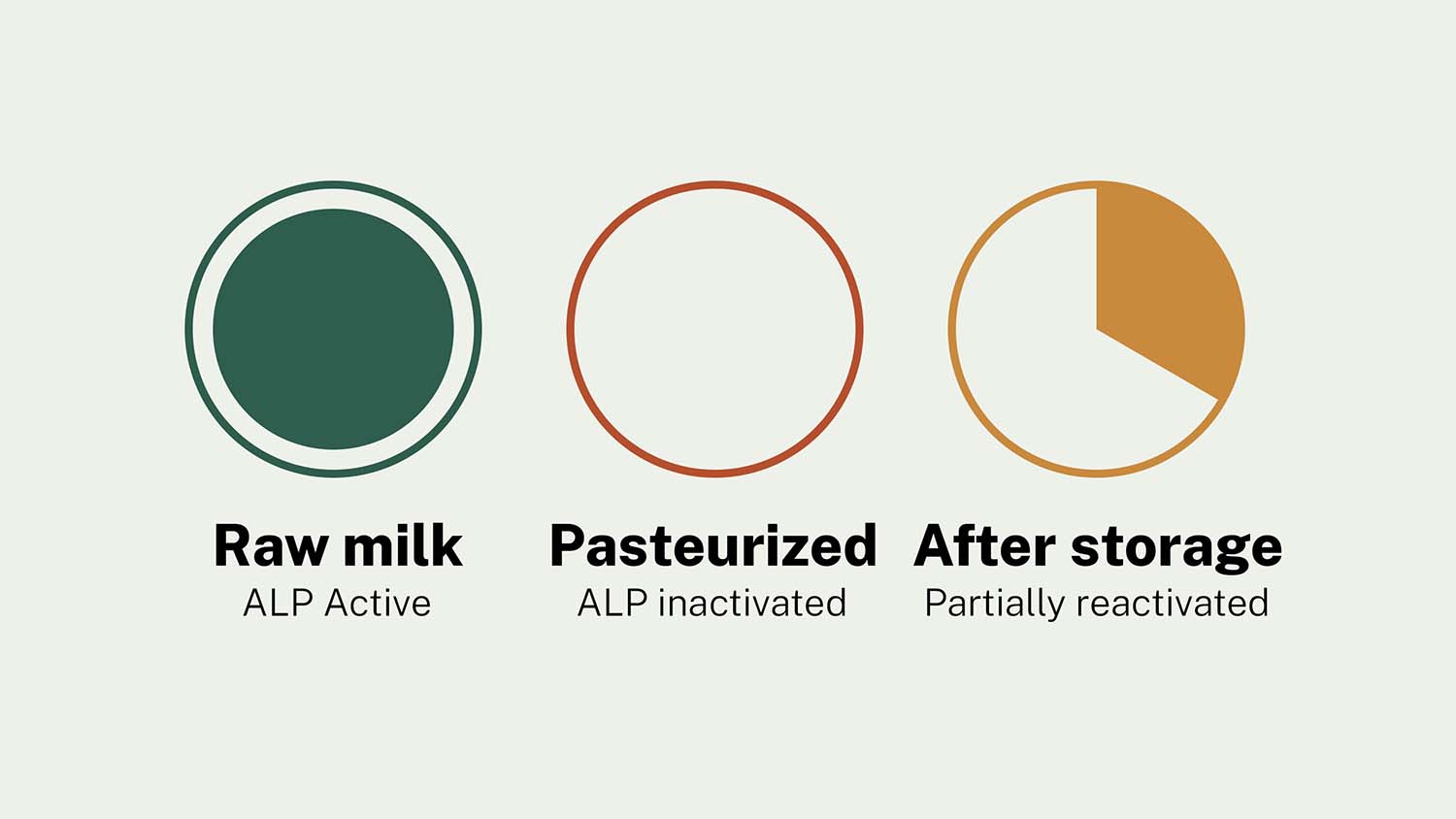
Alkaline phosphatase is active in raw milk, heat-inactivated by pasteurization, and can partially regain activity during storage, a phenomenon called reactivation.
Alkaline Phosphatase in Milk: More Than a Pasteurization Marker
Every carton of pasteurized milk has passed a test most consumers have never heard of: a check for residual activity of an enzyme called alkaline phosphatase (ALP). Regulators didn’t pick this enzyme by accident. Its own heat-inactivation curve tracks just above the pathogens pasteurization is designed to kill, which makes it a reliable proxy for whether the process worked. But ALP is not only a testing tool. It is one of dozens of enzymes naturally present in raw milk, and a small but specific body of research has started asking what, if anything, it does before pasteurization takes it out of the picture.
Key facts:
- Alkaline phosphatase is a membrane-bound glycoprotein (EC 3.1.3.1) and is one of more than 60 endogenous enzymes identified in raw bovine milk.
- ALP was selected as the standard pasteurization-verification marker because its thermal inactivation point sits slightly above that of the pathogenic bacteria that pasteurization time and temperature standards are built around, making a negative ALP test a reliable proxy for pathogen kill.
- Standard pasteurization destroys the large majority of ALP’s activity: kinetic modeling shows 63°C for 30 minutes or 72°C for about 15 seconds reduces enzyme activity by 99 to 99.9 percent, and inactivation speeds up dramatically with even small temperature increases.
- A negative ALP result is not always permanent: researchers first documented in 1953 that pasteurized milk can retest positive for ALP activity after storage at 22 to 37°C, even when the same milk tested negative immediately after processing, a phenomenon known as reactivation.
- In a controlled mouse study, pasteurized milk lost the allergy-protective effect that raw milk showed in the same model, and spiking pasteurized milk with purified ALP restored that protective effect.
- A separate hypothesis paper has proposed that milk-derived ALP may help explain the “French paradox,” though its author explicitly frames this as a hypothesis requiring further experimental work, not an established finding.
Why Alkaline Phosphatase Became the Standard Pasteurization Test
Regulators and processors rely on ALP activity to verify pasteurization because the enzyme’s own heat sensitivity happens to closely track the heat sensitivity of the pathogens pasteurization exists to eliminate. A 2010 invited review in the Journal of Dairy Science lays out the underlying logic: the pathogens driving pasteurization’s time and temperature standards are actually slightly more heat-sensitive than ALP itself, not the other way around. In practice, that means if a milk sample tests negative for ALP activity, the bacteria of greater concern were almost certainly inactivated too, since they denature at or below the temperature ALP does. This relationship is what makes ALP testing fast and practical: rather than culturing bacteria and waiting days for results, processors get a same-day chemical readout that stands in for pathogen kill.
The test itself works by adding a substrate, commonly disodium phenyl phosphate, to a milk sample. If active ALP is present, it cleaves a phosphate group from the substrate, releasing a compound that produces a measurable color change. Regulatory frameworks build directly on this logic: the European Food Safety Authority’s 2021 review of ALP testing across 15 countries notes that pasteurization is legally defined, in part, by the condition that treatment must be sufficient to inactivate alkaline phosphatase, using standards of at least 72°C for 15 seconds or 63°C for 30 minutes as reference points.
Put in concrete terms, standard pasteurization destroys the overwhelming majority of ALP’s activity, not just enough to nudge a test result. A kinetic study of ALP inactivation under both conventional and continuous-flow heating found that the standard commercial time-temperature combinations, 63°C for 30 minutes or 72°C for roughly 15 to 16 seconds, correspond to about 2 to 3 decimal reductions in ALP activity, meaning 99 to 99.9 percent of the enzyme’s original activity is gone by the time pasteurization is complete. The same study measured just how sharply that inactivation accelerates with temperature: the time needed to reduce ALP activity by 90 percent (its decimal reduction time, or D-value) dropped from roughly 1,250 seconds at 60°C to under 2 seconds at 75°C, a difference of more than three orders of magnitude across a 15-degree range.
What Alkaline Phosphatase Is and Where It’s Found in Milk
Alkaline phosphatase is a phospho-monoesterase enzyme, meaning it catalyzes the hydrolysis of phosphate esters at alkaline pH, releasing free phosphate and an alcohol group. It was first described in 1907, making it one of the earliest-characterized enzymes in dairy science, and it is far from alone: raw bovine milk carries more than 60 endogenous enzymes in total, of which ALP is simply the one that became commercially useful as a safety marker.
The specific form found in milk is the tissue-nonspecific ALP isoform, one of four distinct ALP isoforms found in the body alongside placental, germ-cell, and intestinal forms. Its distribution within raw milk isn’t uniform either: roughly a third sticks to the fat globules, and the rest stays dissolved in the milk serum, a split first measured back in 1953 that current reviews still cite. That fat association is also why cream and whole milk products carry proportionally more ALP activity than skim milk, a detail dairy processors account for when validating pasteurization across different product lines.
The Reactivation Problem: Why a Negative ALP Test Isn’t Always Final
ALP testing has one well-documented complication: the enzyme can regain measurable activity after being heat-inactivated, a phenomenon researchers call reactivation. Wright and Tramer were the first to document this in 1953: milk that had already tested ALP-negative right after pasteurization could flip back to a positive reading once it sat at room-to-body temperatures, roughly 22 to 37°C, for a while.
Reactivation does not mean pasteurization failed. It is a property of the denatured enzyme protein itself, which can partially refold into an active conformation under certain storage conditions. But it does mean ALP testing has practical limitations that dairy scientists have had to build into interpretation guidelines, alongside a related complication: some heat-resistant bacteria can themselves produce phosphatase, which can generate a false positive ALP reading in a product that was, in fact, properly pasteurized. Both issues are part of why the ALP test, despite being the global standard, is described in the dairy science literature as a tool requiring careful, judicious interpretation rather than a simple pass-fail readout.
What Happens When Alkaline Phosphatase Is Restored to Pasteurized Milk
A 2019 study went beyond measuring ALP as a marker and tested it as a potential biologically active component, using a controlled mouse model of food allergy. Researchers had previously shown that raw cow’s milk suppressed allergic symptoms in this model; the 2019 study set out to determine which component of raw milk was responsible. C3H/HeOuJ mice were treated with raw milk, pasteurized milk, skimmed raw milk, pasteurized milk spiked with purified ALP, or a saline control for eight days before being sensitized and challenged with ovalbumin, a standard model food allergen unrelated to milk itself.
Skimmed raw milk performed the same as whole raw milk, suppressing the acute allergic skin response and keeping ovalbumin-specific IgE and Th2-associated cytokines low, indicating fat content was not the active variable. That protection was accompanied by an increase in a specific immune cell population, CD103-positive CD11b-positive dendritic cells, and in regulatory T cells producing TGF-beta within the mesenteric lymph nodes, both associated with immune tolerance rather than allergic response. Pasteurized milk alone did not protect against the allergic response. But when researchers added purified ALP back into pasteurized milk, the protective effect returned. That result points specifically at ALP, rather than fat content or some other heat-sensitive component, as a contributor to the protective effect observed in this particular mouse model.
The “French Paradox” Hypothesis: An Open, Explicitly Unproven Idea
Separately from the allergy research, a 2016 paper in the journal Medical Hypotheses, a publication explicitly dedicated to proposing testable ideas rather than reporting new experimental data, proposed that milk-derived alkaline phosphatase could be part of the explanation for the French paradox: the observation that France has comparatively low cardiovascular disease rates despite high consumption of saturated fat, particularly from cheese.
The proposed mechanism centers on intestinal alkaline phosphatase (IAP), a related but distinct isoform with documented anti-inflammatory activity in its own right. The hypothesis holds that milk components including calcium, casein, and lactose stimulate IAP production, and that IAP in turn helps detoxify lipopolysaccharide (LPS), a pro-inflammatory bacterial component, potentially reducing the chronic low-grade inflammation linked to insulin resistance and cardiovascular risk. The paper’s author explicitly describes this as a hypothesis requiring further work, including systematic measurement of ALP activity across dairy products and controlled studies in animal models, and stops short of claiming the mechanism is established.
What This Research Does Not Show
The facts above are well documented at the enzymatic and regulatory level: ALP’s heat sensitivity is precisely characterized, its role as a pasteurization marker is settled dairy science, and at least one controlled animal study has directly implicated the enzyme in an allergy-protective effect.
What this research does not show is a proven human health outcome from consuming ALP-active raw milk.Specifically:
- The allergy-protective effect described above was demonstrated in a single mouse model using ovalbumin as the challenge allergen, not in a human clinical trial, and mouse immune findings do not automatically translate to human outcomes.
- The French paradox connection is, by its own author’s description, an unconfirmed hypothesis rather than a demonstrated mechanism, and it primarily concerns intestinal ALP produced by the body itself, not necessarily the milk-derived ALP consumed through diet.
- No study cited here measured a clinical allergy, cardiovascular, or inflammatory outcome in humans tied specifically to dietary ALP intake or activity.
- ALP’s practical significance in food safety, as a validated marker of successful pasteurization, is separate from and far better established than its proposed biological roles; the marker function does not depend on whether the biological hypotheses turn out to be correct.
Key Terms
- Alkaline phosphatase (ALP): a phospho-monoesterase enzyme naturally present in raw milk, used as the standard biochemical marker for verifying pasteurization.
- Reactivation: the phenomenon in which heat-denatured ALP partially regains measurable activity during storage, complicating interpretation of a positive test result after pasteurization.
- Intestinal alkaline phosphatase (IAP): a distinct tissue-specific isoform of ALP produced in the intestine, studied separately for its anti-inflammatory properties.
- Th2-skewed response: an immune response pattern associated with allergic reactions; a shift away from this pattern is generally associated with reduced allergic symptoms.
- Regulatory T cells (Tregs): a subset of immune cells that help suppress excessive immune responses and are associated with immune tolerance.
Frequently Asked Questions
Why is alkaline phosphatase used to test whether milk was pasteurized? Because ALP’s heat-inactivation point sits just above that of the pathogenic bacteria pasteurization is designed to eliminate. A negative ALP test result is a reliable, fast proxy for confirming those pathogens were also inactivated, without needing to culture bacteria directly.
Can pasteurized milk test positive for alkaline phosphatase even though it was properly processed? Yes, through a phenomenon called reactivation, first documented in 1953, where heat-denatured ALP can partially regain activity during storage at room temperature. Heat-resistant bacterial phosphatase production can also cause a false positive.
Does alkaline phosphatase do anything in milk besides serve as a pasteurization marker? Research suggests it might. A controlled mouse study found that adding purified ALP back into pasteurized milk restored an allergy-protective effect that pasteurization had removed, pointing to a possible biological role beyond its use as a safety indicator.
Is there evidence that alkaline phosphatase in milk affects human heart health? One hypothesis paper has proposed a connection to the “French paradox,” but the author explicitly frames this as an unconfirmed idea requiring further research, not an established finding, and it primarily concerns a related intestinal enzyme rather than milk-derived ALP directly.
Where is alkaline phosphatase located in milk? Roughly 30 percent is bound to the fat fraction, with the remainder distributed in the milk serum, which is why cream and whole milk products carry proportionally more ALP activity than skim milk.
How much alkaline phosphatase does standard pasteurization actually destroy? The large majority of it. Kinetic modeling shows that standard time-temperature combinations (63°C for 30 minutes or 72°C for about 15 seconds) reduce ALP activity by 99 to 99.9 percent, and that inactivation speeds up sharply with even small increases in temperature.