Australia’s “Useless” Land Is Full of Camels and a Working Dairy
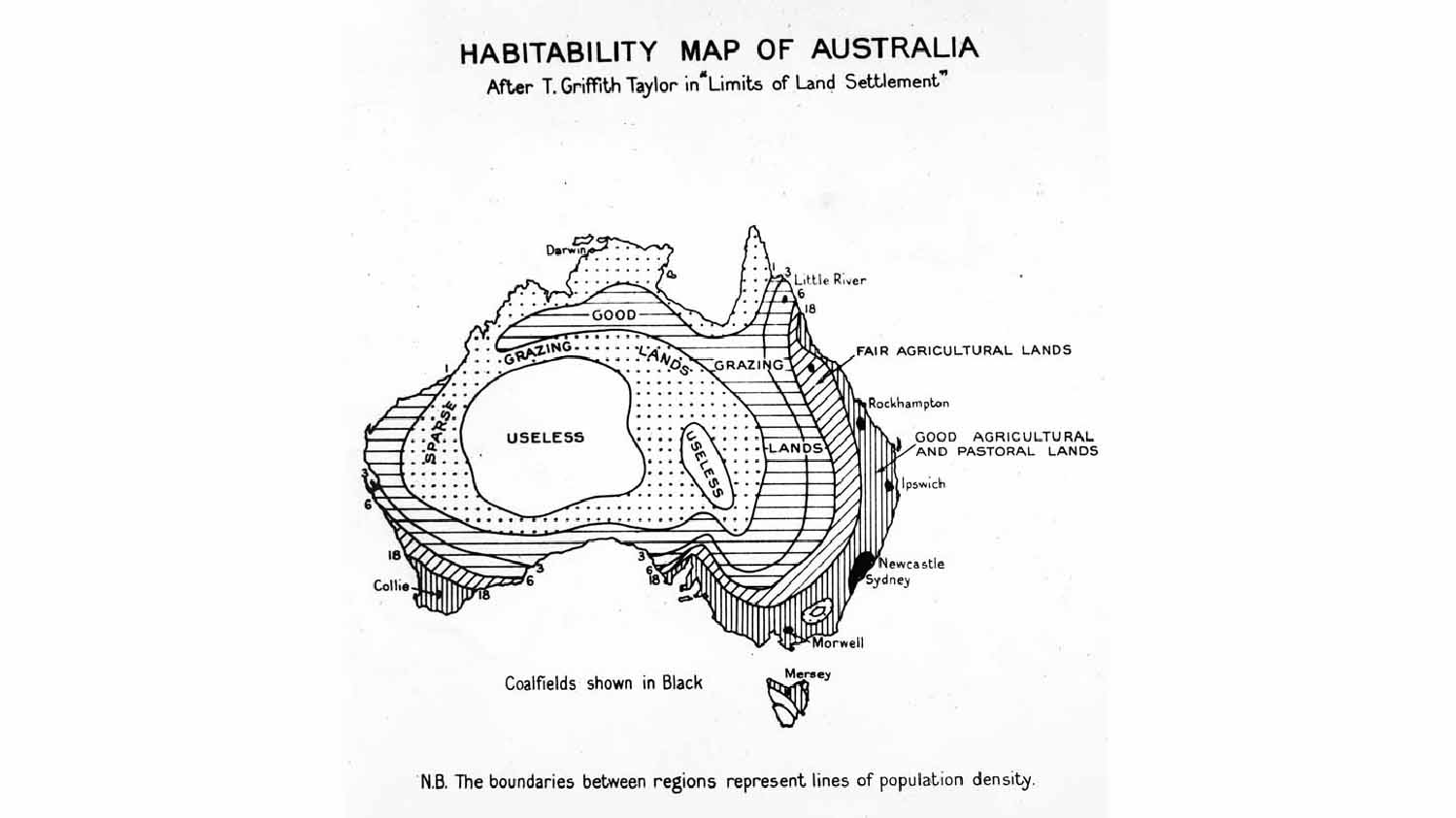
In 1946, a habitability map of Australia drew a hard line around the center of the continent and named it directly: USELESS. The map, based on geographer T. Griffith Taylor’s earlier work on the limits of land settlement, ranked Australian terrain by population density and agricultural potential, sorting the interior into bands from “good agricultural and pastoral lands” along the coast down to “sparse” and finally “useless” at the dead center.
The label held up for what it measured. The interior fails as cropland. Rainfall is too low, too unreliable, and too concentrated in brief bursts; the soils are thin and poor in organic matter; the heat strips moisture out of any seedbed faster than it can be replaced. By the standards of plow agriculture, the verdict was accurate then and remains accurate now.
But “useless” only describes one kind of use. The same terrain that fails as farmland has spent more than a century supporting one of the largest unmanaged animal populations on Earth, and in the last decade, a working dairy industry has grown up to draw from it directly.
How Camels Became Permanent in the Australian Outback
Camels were never native to Australia. The first one, a single survivor of a shipment from the Canary Islands, landed in 1840. The population that actually took hold came later and from elsewhere: starting in the 1860s, pastoralists imported thousands of camels from British India and Afghanistan to move people and freight across terrain that defeated horses and bullocks. Camel trains supported the construction of the Overland Telegraph Line and supplied remote pastoral stations and mining camps for decades. When motor vehicles took over freight work in the early twentieth century, the camels were no longer needed, and many were simply released.
Released into the same interior the 1946 map would later call useless, the camels did not die off. They thrived, growing to an estimated one million animals by the late 2000s. A government-funded cull between 2009 and 2013 killed roughly 160,000 camels, and most recent estimates put the population in the hundreds of thousands to around one million, spread across more than 3.3 million square kilometers of pastoral leases, mining land, Aboriginal land, and conservation land. It remains the largest population of wild camels anywhere in the world, and without sustained control the NSW Department of Primary Industries notes the herd can double in size every eight to ten years.
That growth has created real problems. Feral camels strip vegetation, damage fences and water infrastructure, and compete with livestock and native species for scarce water. Federal and state culling programs have run intermittently since the 2000s, including aerial shooting, with limited long-term effect on total numbers. A National Geographic report from April 2025 describes ranchers culling hundreds of camels a year on individual cattle stations just to keep pace. The land did not stop being difficult. It simply turned out to be difficult in a way that supports a particular kind of animal extremely well.
Why Animal Agriculture Works Where Crop Agriculture Doesn’t
This is not unique to Australia, and it is not really about camels specifically. Arid and semi-arid land that cannot support reliable crop yields can often support grazing animals, because animals convert sparse, scattered, low-quality vegetation into food in a way no harvester can. A camel can travel long distances between graze sites, go days without water, and extract nutrition from scrub that would not justify the diesel cost of running equipment over it. The Sahel, the steppes bordering the Gobi, and the Australian outback all developed herding traditions instead of farming traditions for the same underlying reason: livestock turns marginal land into a resource, where tillage cannot.
Seen this way, the 1946 map was not wrong. It was answering a narrower question than its label implied. “Useless” meant useless for the kind of agriculture the mapmakers were assessing. It said nothing about whether the land could support animals, and grazing animals had been adapted to exactly this kind of terrain for millions of years before any plow arrived.
A Working Dairy on “Useless” Land
What had been a pest-management problem is now, for at least one company, a supply chain. Good Earth Dairy, based north of Perth in Western Australia, operates a camel dairy built around the feral population rather than a bred herd. Founder and CEO Marcel Steingiesser has said directly that relying on breeding alone would leave the company far too limited, since Australia already holds a large standing supply of camels in the outback that requires no generational buildup to access.
The company describes its approach as turning an ecological challenge into a dairy opportunity, drawing on what it calls Australia’s disease-free wild camel herd. After nearly a decade of development on a property north of Perth, the company has tripled its herd and posted triple-digit revenue growth; its camel milk cheese, kefir, and smoothies won gold and silver awards at the 2025 Dairy Industry Association of Australia WA competition. A dedicated processing facility, backed by a $4.4 million Western Australian government grant as part of a roughly $20 million project, is slated for completion in 2026 and is designed to push production toward 22 million liters a year, with an eye toward entering the infant formula market.
Other Australian camel dairies, including Summer Land Camels in Queensland and The Camel Milk Co. north of Melbourne, source much of their stock the same way: rounding up animals from the outback rather than breeding exclusively in captivity. Summer Land Camels has described its founding herd as animals that would otherwise have been culled as a nuisance.
None of this makes the interior of Australia good cropland. It still is not. But the same ground that a 1946 map drew a circle around and called useless now has a fence, a herd, a processing pipeline, and a government grant behind it. The map measured agriculture too narrowly. The animals filled in the rest.