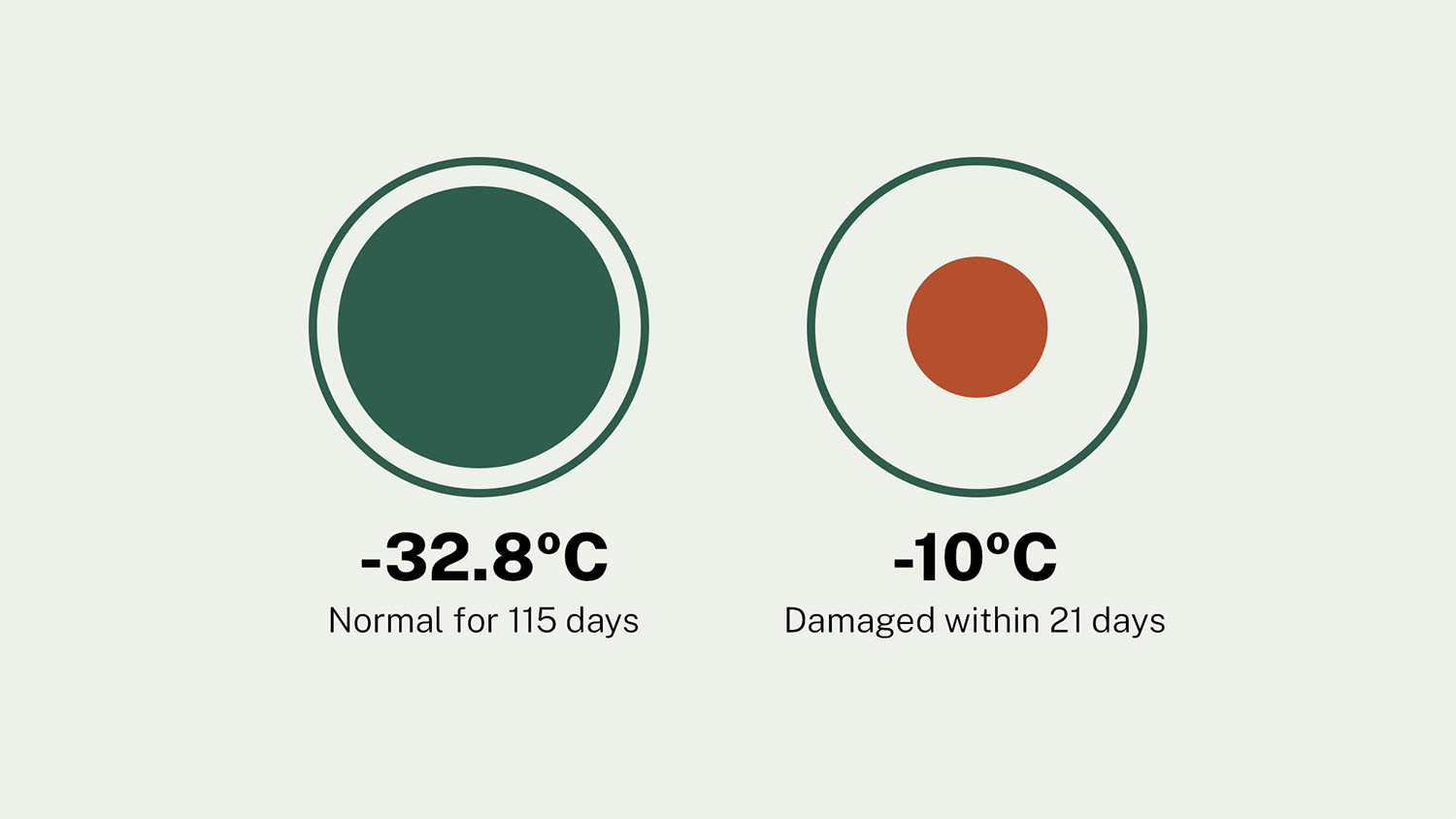
Freezer temperature is one of the biggest variables in how well frozen milk holds up: milk held at −32.8°C stayed normal for 115 days, while milk at only −10°C showed damage within 21 days.
What Happens to Raw Milk When You Freeze It
Some raw milk buyers and farms freeze milk to extend how long it keeps. That practice does work for extending shelf life, but freezing isn’t a neutral pause button. Ice crystals form inside the milk, and depending on how quickly it freezes, how it’s stored, and how it’s thawed, those crystals can cause real, measurable structural damage to milk’s fat and protein. For readers weighing freezing against other options, practical alternatives like kefir, cheese, and butter are covered separately; this article focuses specifically on what freezing itself actually does.
Key facts:
- Freezing temperature matters considerably: in early research on frozen homogenized milk, milk stored at −32.8°C remained normal for 115 days, while milk held at only −10°C developed an off-flavor within 21 days and visible separation by 89 days.
- Ice crystal formation, particularly at slower freezing rates, physically entraps and damages fat globules, destabilizing the fat emulsion and causing globules to coalesce once the milk thaws.
- A study comparing cold storage temperatures for milk fat globule membranes found that conditions just above freezing (−3°C, −0.5°C, and 4°C) preserved membrane structure well, with −3°C showing the best preservation, while actual freezing at −18°C caused clear ice-crystal-driven membrane rupture by comparison.
- Classic dairy science traces casein’s freeze instability to a specific mechanism: a 1954 study found concentrated milk seeded with crystalline lactose before freezing showed both extensive lactose crystallization and casein coagulation within just 5 days of frozen storage.
Ice Crystals Are the Root of the Problem
The core mechanical issue with freezing milk is simple: as water freezes into ice, it forms crystals, and those crystals physically damage the structures suspended in the surrounding liquid. Fat globules get trapped and squeezed by growing ice crystals, and that physical stress destabilizes the fat emulsion. Once the milk thaws, the damaged globules coalesce, merging into larger fat particles rather than staying as the small, evenly dispersed globules found in fresh milk.
How much damage occurs depends heavily on freezing speed and final temperature, because slower freezing produces larger ice crystals, and larger crystals do more mechanical damage. Early research on frozen homogenized milk illustrated this clearly: milk frozen and held at −32.8°C, a genuinely cold storage temperature that limits crystal growth, remained normal for 115 days. Milk held at a much less cold −10°C, by contrast, developed an off-flavor within just 21 days and showed visible separation by day 89. The freezer temperature isn’t a minor detail, it’s one of the biggest variables determining how well frozen milk holds up.
The Fat Globule Membrane Takes the Brunt of the Damage
Research specifically tracking the milk fat globule membrane, the structure that normally keeps milk fat properly dispersed and protected, found a clear line between temperatures that allow ice formation and temperatures that don’t. Storage at −3°C, −0.5°C, and 4°C, none of which are cold enough to freeze the milk, all preserved membrane structure reasonably well, with −3°C performing best among those tested. Actual freezing at −18°C, by contrast, produced clear evidence of ice-crystal-driven membrane rupture and particle aggregation. The dividing line isn’t simply “colder is worse,” it’s specifically whether ice crystals form at all.
This membrane damage connects directly to a separate, related issue covered in its own article on this site: milk’s native fat-digesting enzyme, lipoprotein lipase, is normally kept away from milk fat by an intact fat globule membrane. Slow freezing at −18°C is considered one of the most effective ways to trigger lipolysis specifically because it both crystallizes the fat and ruptures the membrane that would otherwise keep the lipase away from it, essentially removing the barrier that normally prevents rancidity from developing.
Thawing Method Matters Almost as Much as Freezing Method
It’s not just how milk gets frozen that determines the outcome, it’s also how it gets thawed. Rapid thawing accelerates both protein aggregation and fat globule coalescence, compounding whatever damage already occurred during freezing. Slow, controlled thawing, ideally at refrigerator temperatures rather than at room temperature or under warm water, is associated with meaningfully less additional structural disruption. In practice, this means the choices made after taking frozen milk out of the freezer matter almost as much as the choices made when it went in.
What Happens to Casein: A Classic, Well-Documented Mechanism
Freezing’s effect on milk’s casein proteins traces back to some of the most foundational research in dairy science, though it’s worth being precise about the specific context that research was conducted in. A 1954 study found that concentrated milk (roughly 35 percent total solids, a dairy-processing context rather than standard fluid milk) seeded with crystalline lactose before freezing showed both extensive lactose crystallization and casein coagulation within just 5 days of frozen storage. Careful examination in that study found that lactose crystallization consistently preceded the casein flocculation rather than the two happening simultaneously, establishing lactose crystal formation as the triggering event in a cascading destabilization process.
A related 1961 study refined this further, pinpointing a specific tipping point: once the alpha crystalline form accounted for 85 to 90 percent of the milk’s total lactose, the casein system broke down abruptly rather than gradually. That same study found that adding sucrose pushed this tipping point further out, apparently by slowing the rate of lactose crystallization itself, while adding sorbitol had no comparable protective effect. A 1964 paper added further detail, describing a quiet buildup phase that precedes a sudden, rapid collapse in protein stability, with the resulting precipitate identified as predominantly calcium caseinate.
One limitation is worth being direct about, though: this classic research was conducted on concentrated milk in an ice-cream-manufacturing and dairy-processing context, not on standard fluid milk at normal concentration. The underlying mechanism, lactose crystallization triggering casein destabilization, is real and well-established, but the specific 5-day timeline from the 1954 study shouldn’t be assumed to transfer directly to someone freezing a jug of ordinary fluid raw milk at home.
Frozen Storage Isn’t a “Set It and Forget It” Situation
Even once milk is properly frozen and stored, its quality isn’t locked in place. Moving frozen milk to a warmer storage temperature at any point, even temporarily, such as during a freezer malfunction or extended time in a car during transport, has been shown to measurably degrade its eventual thawed quality, even when the product may still look perfectly normal at the time. Temperature fluctuations during frozen storage promote a process called recrystallization, where existing ice crystals grow larger over repeated partial-thaw-and-refreeze cycles, worsening the same structural damage described throughout this article.
What This Research Does Not Show
The mechanisms described here are well documented: ice crystal formation damages fat globules and their membrane, freezing temperature and thawing method both measurably affect the degree of damage, and casein destabilization during freezing follows a specific, characterized chemical sequence involving lactose crystallization.
What this research does not show is a single, precise timeline for exactly how long any given batch of standard fluid raw milk can be safely frozen before quality noticeably declines. Specifically:
- The most detailed casein-destabilization research (the 1954, 1961, and 1964 studies) was conducted on concentrated milk at roughly 35 percent total solids, not standard fluid milk, and the specific timelines from that research shouldn’t be applied directly to fluid milk without accounting for that concentration difference.
- Much of the most detailed fat globule membrane structural work available was conducted on human milk and goat or sheep milk rather than bovine milk exclusively; species should be noted clearly wherever a specific study’s figures are cited.
- None of the sources reviewed here measured a food safety outcome tied to freezing raw milk specifically; the findings described are about physical and structural changes to fat and protein, not about pathogen survival or safety risk.
- The −32.8°C versus −10°C comparison used homogenized milk, not raw unhomogenized milk, and the presence or absence of homogenization could plausibly affect how fat globules respond to freezing in ways this specific study didn’t isolate.
Key Terms
- Ice crystal recrystallization: the process by which existing ice crystals grow larger during temperature fluctuations in frozen storage, worsening structural damage over time even without a full thaw occurring.
- Fat globule coalescence: the merging of separate, smaller fat globules into larger ones, commonly triggered by physical membrane damage such as that caused by ice crystal formation.
- Alpha-lactose crystallization: the formation of a specific crystalline form of milk’s sugar, lactose, during frozen storage, identified as the triggering event that precedes casein destabilization in concentrated milk.
- Calcium caseinate: the primary protein compound identified in the precipitate that forms when casein destabilizes during frozen storage.
- Milk fat globule membrane (MFGM): the protective structure surrounding fat droplets in milk, discussed in more detail in this site’s dedicated article on MFGM proteins, which is directly vulnerable to ice-crystal-driven rupture during freezing.
Frequently Asked Questions
Does freezing damage raw milk? Yes, to a measurable degree. Ice crystal formation physically damages fat globules and their protective membrane, and the degree of damage depends heavily on freezing temperature, freezing speed, and how the milk is later thawed.
What freezer temperature causes the least damage to milk? Colder is generally better up to a point: research on frozen homogenized milk found milk held at −32.8°C remained normal for 115 days, while milk held at only −10°C developed an off-flavor within 21 days, because colder temperatures produce smaller, less damaging ice crystals.
Does the way you thaw milk matter? Yes. Rapid thawing accelerates protein aggregation and fat globule coalescence, while slow, controlled thawing at refrigerator temperatures causes measurably less additional structural disruption.
Why does freezing sometimes cause milk protein to coagulate? Classic dairy research traces this to lactose crystallization during frozen storage, which precedes and appears to trigger casein destabilization. This mechanism was documented in concentrated milk used in dairy processing, not necessarily at the same speed in standard fluid milk.
Can you refreeze milk that has partially thawed? The research reviewed here doesn’t directly test refreezing, but it does show that temperature fluctuations during frozen storage promote ice crystal recrystallization, a process that worsens structural damage, suggesting repeated partial thawing and refreezing is likely to compound quality loss.