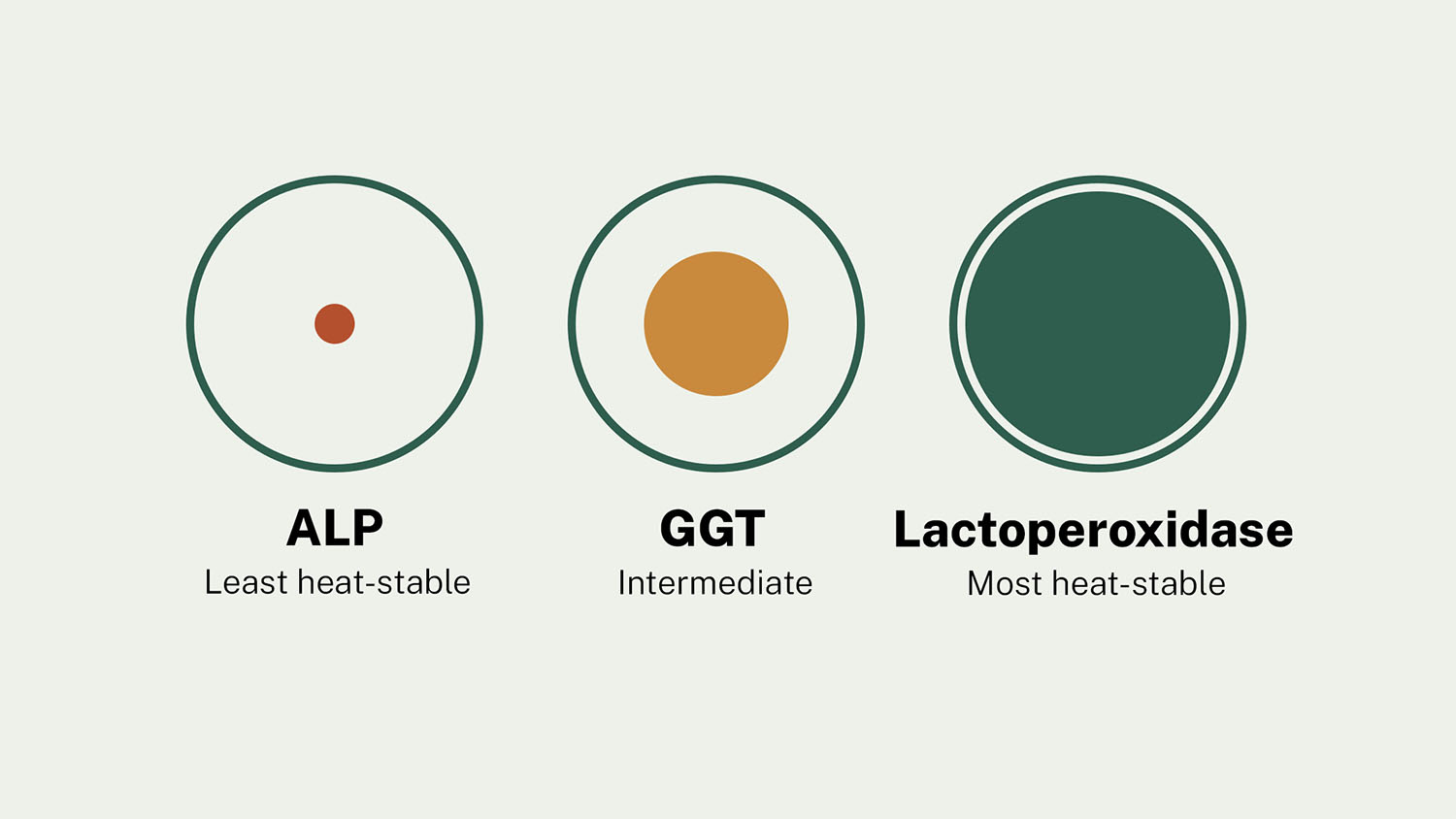
Milk's three classic marker enzymes show increasing heat stability in a specific order: alkaline phosphatase is nearly fully inactivated by standard pasteurization, GGT is partially reduced, and lactoperoxidase remains largely intact.
GGT: A Third Heat-Sensitivity Marker Enzyme in Milk
Alkaline phosphatase and lactoperoxidase aren’t the only indigenous milk enzymes whose heat sensitivity has been studied closely enough to matter for verifying pasteurization. A third enzyme, gamma-glutamyltransferase (GGT), sits at an intermediate point between the two, and its behavior under heat has been characterized in enough detail to distinguish specific temperature ranges that ALP alone can’t tell apart.
Key facts:
- Across milk’s three classic marker enzymes, heat stability increases in a specific, documented order: ALP is the least heat-stable, GGT is intermediate, and lactoperoxidase is the most heat-resistant.
- GGT is completely inactivated at 70°C held for 10 minutes, or at 80°C held for just 1 minute, according to a controlled heating study of raw cow’s milk that measured GGT alongside alkaline phosphatase and lactate dehydrogenase for comparison.
- Standard HTST pasteurization (72 to 75°C for 15 seconds) reduces GGT activity by roughly 80 percent, and residual activity in commercial pasteurized milk has been measured in the 1 to 20 percent range, consistent with treatment at the upper end of legally permitted pasteurization conditions.
- In raw milk, GGT activity has been reported as 8 to 10 percent higher than alkaline phosphatase or lactate dehydrogenase in one comparative study, though a separate study measuring cow, sheep, and goat milk found a considerably larger gap, 774 units per liter of ALP compared to 4,143 units per liter of GGT in raw cow’s milk, a discrepancy likely tied to differences in assay method and measurement units between studies rather than a contradiction in the underlying biology.
What GGT Actually Is
Gamma-glutamyltransferase is a membrane-bound enzyme naturally present in milk, and it isn’t unique to the dairy industry: the same enzyme family is measured in human blood tests as a marker of liver function. In milk specifically, GGT is distributed unevenly between fractions, with roughly 75 percent located in the skim milk portion and the remaining 25 percent associated with the cream fraction. Its natural biological role in the mammary gland involves amino acid transport, and GGT activity is notably concentrated in colostrum, running roughly three times higher than in mature milk produced later in lactation, consistent with colostrum’s broader role in supplying concentrated nutrition and immune components to newborn calves.
Species matters here too. Comparative studies measuring GGT activity across cow, sheep, and goat milk have found the enzyme is most active in cow’s milk, with sheep in the middle and goat milk showing the lowest activity of the three, a species-level baseline worth knowing before comparing any single heat-treatment result across different types of milk.
The Core Finding: Where GGT Sits Between ALP and Lactoperoxidase
A comparative heating study tested milk’s three classic marker enzymes side by side under identical isochronal heat conditions (temperatures from 35°C to 85°C, each held for 90 seconds) and established a clear, ordered ranking of heat resistance: alkaline phosphatase inactivates first, GGT inactivates at higher temperatures than ALP but lower than lactoperoxidase, and lactoperoxidase survives the longest. That ordering, ALP less heat-stable than GGT less heat-stable than lactoperoxidase, gives GGT a specific, useful role: because it sits at an intermediate point, GGT can help distinguish between milk heated within the standard pasteurization range and milk heated somewhat more intensively, a distinction ALP’s own on/off threshold can’t make on its own since ALP is already inactivated well before GGT is.
A separate, direct study of GGT’s own inactivation kinetics found the enzyme completely destroyed at 70°C held for 10 minutes, and even faster, at 80°C held for just 1 minute. Standard HTST pasteurization, 72 to 75°C for 15 seconds, reduces GGT activity by roughly 80 percent without fully eliminating it, which is the useful middle ground: enough heat sensitivity to respond meaningfully to standard pasteurization, but enough residual activity surviving that GGT levels can still distinguish standard treatment from more intensive heat.
Measuring Residual Activity in Real Commercial Milk
Kinetic modeling of GGT inactivation, based on first-order reaction kinetics with an activation energy of 457 kilojoules per mole, was checked directly against a set of 17 commercial milk samples, and the residual GGT activity measured in those real products, ranging from 1 to 20 percent of the raw-milk baseline, matched what the kinetic model predicted for milk heated at the upper limit of legally permitted pasteurization conditions. That agreement between a laboratory kinetic model and actual store-bought milk is a meaningful validation: it means GGT’s heat-inactivation behavior isn’t just a clean laboratory result, it holds up when applied to milk that’s gone through real commercial processing equipment and distribution.
This kind of residual-activity measurement is also where GGT’s practical value as a secondary marker becomes clearest. A milk sample that tests fully negative for ALP doesn’t tell a regulator much about whether that milk was pasteurized right at the standard threshold or heated considerably beyond it, since ALP is already gone in both cases. Measuring how much GGT activity remains, rather than simply whether it’s present or absent, adds a layer of resolution ALP’s simpler positive-or-negative test doesn’t provide on its own.
What This Research Does Not Show
The heat-inactivation data for GGT is well characterized: its position in the ALP-to-lactoperoxidase heat-stability spectrum is documented, its inactivation kinetics have been modeled and cross-checked against real commercial milk, and specific temperature-time combinations for its destruction are established.
What this research does not show is that GGT functions as a primary, industry-standard pasteurization-verification marker the way ALP does. Specifically:
- ALP remains the regulatory standard for confirming standard pasteurization was achieved in most jurisdictions discussed elsewhere in this cluster; GGT’s role in the sources reviewed here is as a well-studied intermediate marker useful for distinguishing heat intensities, not as a replacement for ALP testing.
- None of the sources here measured a nutritional or health outcome tied to GGT activity itself; GGT is not currently understood to have a documented protective or antimicrobial function in milk the way lactoperoxidase or alkaline phosphatase’s proposed roles have been studied.
- GGT is also used in an entirely separate clinical context, serum GGT testing in infants, where formula-fed infants show different GGT levels than breastfed infants because formula’s manufacturing process destroys the enzyme. That clinical application is a distinct research area from milk pasteurization verification and shouldn’t be conflated with the processing question this article addresses.
- The species comparison data (cow higher than sheep higher than goat) describes natural baseline differences in raw milk, not differences in how each species’ GGT responds to heat, a separate question not fully addressed by the sources reviewed here.
Key Terms
- Gamma-glutamyltransferase (GGT): a membrane-bound enzyme naturally present in milk, used in a different clinical context as a human liver-function marker, with heat sensitivity intermediate between alkaline phosphatase and lactoperoxidase.
- Isochronal heating: an experimental method that holds treatment time constant while varying temperature, used to directly compare heat sensitivity across different enzymes or conditions.
- First-order kinetics: a mathematical model describing how a reaction’s rate depends on the concentration of a single reactant, commonly used to model enzyme inactivation as a predictable function of temperature and time.
- Activation energy: the minimum energy required for a reaction, in this case enzyme inactivation, to proceed; a higher activation energy generally means the reaction is more temperature-sensitive.
- Colostrum: the concentrated first milk produced immediately after calving, nutritionally and immunologically distinct from mature milk, with GGT activity roughly three times higher than in milk produced later in lactation.
Frequently Asked Questions
Does pasteurization destroy GGT in milk? Substantially, but not completely under standard conditions. Standard HTST pasteurization reduces GGT activity by roughly 80 percent, and residual activity in real commercial milk has been measured between 1 and 20 percent of the raw-milk baseline, consistent with heat treatment at the upper end of permitted pasteurization intensity.
How does GGT’s heat sensitivity compare to alkaline phosphatase and lactoperoxidase? GGT sits in the middle. A direct comparative study found alkaline phosphatase inactivates at the lowest temperatures of the three, lactoperoxidase survives the highest temperatures, and GGT falls between them.
Is GGT used as an official pasteurization marker like alkaline phosphatase? Not as a primary regulatory standard. GGT is well studied as an intermediate heat-sensitivity marker useful for distinguishing standard pasteurization from more intensive heat treatment, but alkaline phosphatase remains the primary marker used in most regulatory testing.
Does GGT activity vary between raw milk from different species? Yes. Comparative studies have found GGT activity is highest in cow’s milk, intermediate in sheep’s milk, and lowest in goat’s milk, a natural baseline difference separate from how each species’ GGT responds to heat treatment.
Is GGT related to infant formula testing? GGT is used in a separate clinical context: serum GGT levels differ between breastfed and formula-fed infants, since formula’s manufacturing process destroys the enzyme. This is a distinct research area from milk pasteurization verification.