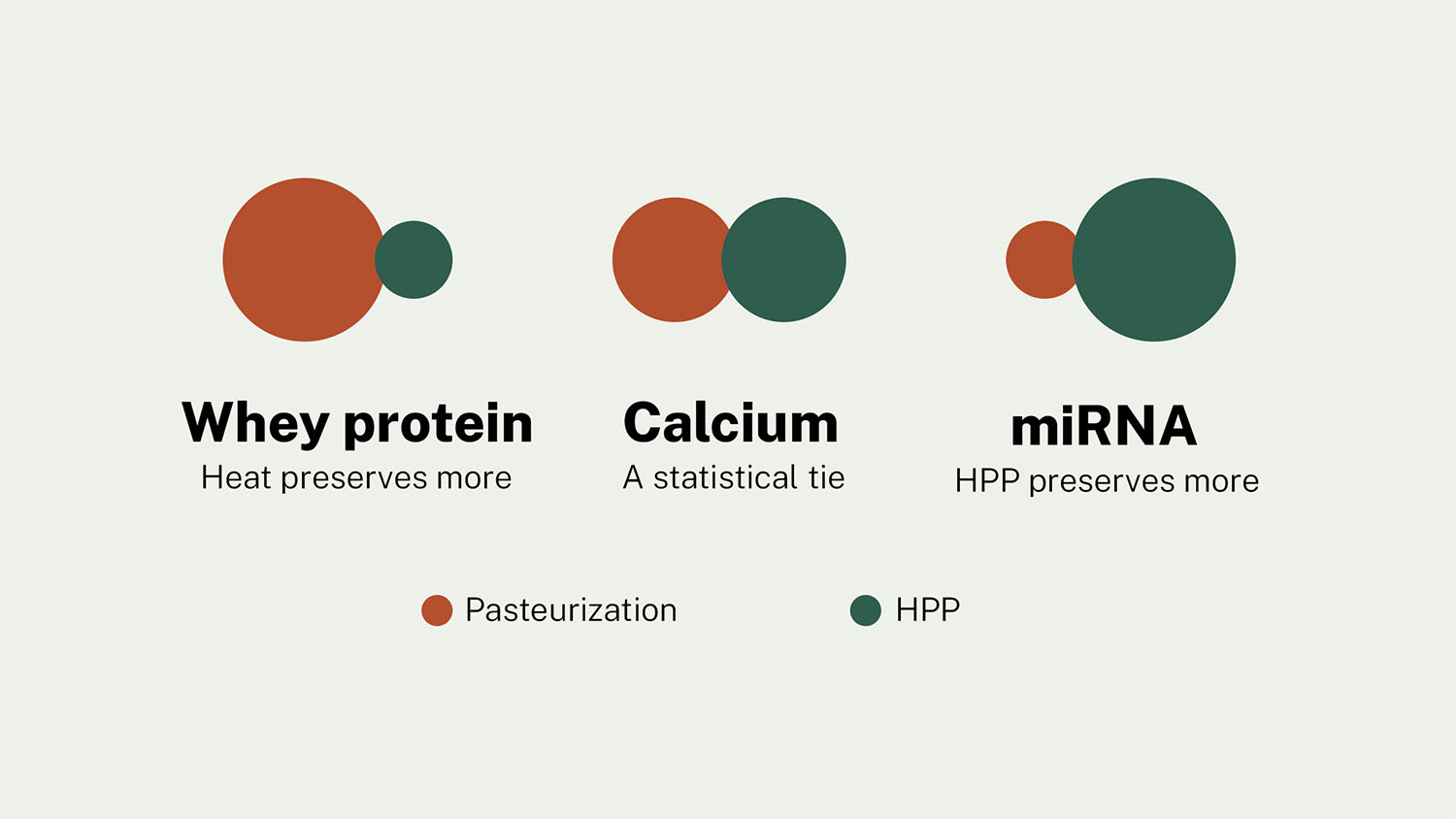
High-pressure processing and heat pasteurization affect milk differently depending on what's measured: heat preserves whey protein better, calcium bioavailability comes out equal, and HPP better preserves microRNA.
How High-Pressure Processing Differs From Pasteurization
Nearly everything in this content cluster examines a single variable: heat. But heat isn’t the only way to make milk safe to drink. High-pressure processing (HPP) uses intense mechanical pressure instead of temperature to inactivate pathogens, and where researchers have tested it directly against conventional heat pasteurization on the same milk components, the results consistently show a genuinely different effect profile, not simply a gentler or harsher version of the same thing.
Key facts:
- A direct comparison found HPP denatures a different set of whey proteins than heat does, primarily beta-lactoglobulin and IgG, while alpha-lactalbumin remains comparatively unaffected, a different pattern than standard HTST pasteurization’s heavier impact on lactoferrin, IgA, and IgM.
- In that same comparison, standard HTST pasteurization caused the least protein denaturation and the smallest immunogenicity shift among every treatment tested, including HPP, meaning HPP is not automatically the gentler option.
- A separate study found HPP produced significantly higher in vitro calcium bioaccessibility (98.4 percent) than conventional thermal treatment (91.3 percent), yet actual calcium bioavailability came out statistically equalregardless of which method was used.
- In human milk, HPP caused only a statistically insignificant decrease in miRNA sequencing reads, a sharp contrast to Holder pasteurization’s 82-fold reduction in whole milk and 302-fold reduction in the exosomal fractionmeasured in the same study.
What High-Pressure Processing Actually Is
HPP is a non-thermal pasteurization method that uses intense hydrostatic pressure, typically in the range of 300 to 600 megapascals, to inactivate microorganisms rather than relying on heat. The product is sealed and subjected to pressure from every direction uniformly, which disrupts the cell membranes and structures of bacteria without necessarily raising the product’s temperature the way conventional pasteurization does. It’s already used commercially for a range of foods, particularly juices and some ready-to-eat products, and has been studied directly as a milk-processing alternative in the research described throughout this article.
Because HPP and heat pasteurization disable microorganisms through entirely different physical mechanisms, pressure versus thermal energy, there’s no reason to assume they would affect milk’s other components identically. The research bears that out directly: depending on what’s being measured, HPP sometimes preserves more of a given component than heat does, and sometimes preserves less.
Whey Protein: A Different Denaturation Profile
A direct comparison testing HTST pasteurization against HPP at 400, 500, and 600 megapascals found that the two methods don’t just differ in degree, they denature different proteins. HPP’s effects concentrated on beta-lactoglobulin and IgG, with protein aggregation appearing at the highest pressure tested, while alpha-lactalbumin was comparatively unaffected by pressure treatment. That’s a distinct pattern from standard HTST pasteurization, which in separate research has been shown to hit lactoferrin, IgA, and IgM harder while leaving IgG comparatively intact.
The more important finding from this specific comparison, though, is what happened when the two methods were measured side by side on the same scale: of every treatment tested, standard HTST pasteurization came out as the one that disturbed native protein structure the least, and milk’s overall immune-response profile barely moved as a result. HPP told a different story, especially at higher pressures, where the shift in that same immune-response profile was more pronounced than anything heat produced. This is worth sitting with, because it directly contradicts an assumption that sometimes gets made by default, that a non-thermal process must automatically be gentler on milk’s proteins than heat. In this specific comparison, on this specific measure, it wasn’t.
Calcium: Higher Bioaccessibility Under HPP, But Equal Bioavailability
A study measuring calcium and phosphorus in milk-based beverages compared HPP against conventional thermal treatment and found a real, measurable difference in one specific test, that didn’t carry through to the outcome that actually matters for nutrition. In vitro calcium bioaccessibility, essentially how much calcium becomes soluble and available for absorption during simulated digestion, came out significantly higher after HPP (98.4 percent) than after thermal treatment (91.3 percent).
But when the researchers went a step further and measured actual calcium bioavailability using a human intestinal cell model, the difference disappeared. Bioavailability came out statistically equal across every processing method tested. This is a useful, concrete illustration of a distinction that comes up repeatedly in nutrition research: a laboratory test-tube measurement of solubility doesn’t always predict what a living system actually absorbs, and processing methods that look different on one metric can converge on the metric that matters most.
miRNA: One of the Clearer Cases Where HPP Preserves More
Not every comparison in this article shows HPP and heat landing in similar places, and human milk microRNA is the clearest counterexample. A study comparing processing methods for donor human milk found that HPP produced only a statistically insignificant decrease in miRNA sequencing reads. Holder pasteurization, the heat-based method standard in human milk banking, produced dramatically larger losses in the same comparative study: an 82-fold reduction in whole milk miRNA and a 302-fold reduction within the exosomal fraction specifically, a loss severe enough that researchers in that study could not perform further compositional analysis on the heat-treated samples at all.
This is the sharpest divergence between the two processing methods documented across the sources in this article. One caveat matters here, though: this specific comparison involved Holder pasteurization (62.5°C for 30 minutes), the gentler-temperature but longer-duration protocol used in human milk banking, not the standard HTST protocol used in commercial cow’s milk processing, so the magnitude of this particular gap shouldn’t be assumed to transfer directly to bovine milk pasteurized under different time-temperature conditions.
What This Research Does Not Show
The comparisons above are specific and well documented: HPP and heat pasteurization measurably differ in which whey proteins they denature, in calcium bioaccessibility (though not bioavailability), and substantially in human milk miRNA preservation.
What this research does not show is that HPP is uniformly gentler, or uniformly harsher, than heat pasteurization across milk’s components. Specifically:
- The whey protein comparison found the opposite of a simple “HPP is gentler” pattern: standard HTST pasteurization caused less denaturation and immunogenicity shift than HPP did in that specific study, directly undercutting an assumption that non-thermal automatically means less disruptive.
- None of the studies referenced here measured a clinical or nutritional outcome in people consuming HPP-treated versus heat-pasteurized milk; all of the findings are laboratory measurements of protein structure, mineral solubility and absorption models, or genetic material sequencing.
- The miRNA comparison, the starkest difference documented here, used Holder pasteurization rather than standard commercial HTST, and involved human milk rather than bovine milk, both of which limit how directly the specific magnitude of that finding generalizes. That study also worked from a small sample (three donor milk samples, with one later excluded from parts of the analysis), a limitation the study’s own peer reviewers specifically flagged; the direction of the finding is clear, but the precise fold-change figures should be read as an initial result rather than a settled, precise number.
- HPP is not currently a mainstream method for pasteurizing fluid cow’s milk commercially at scale; the research summarized here comes from comparative laboratory studies, not from widespread commercial production data.
Key Terms
- High-pressure processing (HPP): a non-thermal pasteurization method using intense hydrostatic pressure, typically 300 to 600 megapascals, to inactivate microorganisms without relying primarily on heat.
- Megapascal (MPa): the unit of pressure used to describe HPP treatment intensity; for reference, standard atmospheric pressure is about 0.1 MPa.
- Bioaccessibility: the proportion of a nutrient that becomes soluble and potentially available for absorption during simulated digestion, typically measured with in vitro methods.
- Bioavailability: the proportion of a nutrient actually absorbed and used by a living system, measured through cell-based or living-organism studies rather than test-tube solubility alone.
- Holder pasteurization: a heat treatment protocol (62.5°C for 30 minutes) standard in human milk banking, distinct from the higher-temperature, shorter-duration HTST protocol used in commercial cow’s milk processing.
Frequently Asked Questions
Is high-pressure processing gentler than heat pasteurization? Not uniformly. One direct comparison found standard HTST pasteurization caused less protein denaturation and a smaller immunogenicity shift than HPP did on the same milk, contradicting the assumption that a non-thermal method is automatically less disruptive than heat.
Does HPP preserve calcium better than heat pasteurization? It depends on what’s measured. HPP produced significantly higher in vitro calcium bioaccessibility than thermal treatment in one study, but actual calcium bioavailability, measured using a human intestinal cell model, came out statistically equal between the two methods.
Does HPP preserve milk’s microRNA better than pasteurization? In the clearest comparison available, yes, substantially. HPP caused only a statistically insignificant decrease in human milk miRNA reads, while Holder pasteurization caused an 82-fold decrease in whole milk and a 302-fold decrease in the exosomal fraction in the same study.
Is HPP used commercially to pasteurize milk? It’s an established commercial method for various foods, particularly juices, but it is not currently a mainstream method for pasteurizing fluid cow’s milk at scale. The research described here comes from direct comparative laboratory studies rather than widespread commercial production.
Which milk proteins does HPP affect most? HPP’s effects concentrate primarily on beta-lactoglobulin and IgG, with alpha-lactalbumin comparatively unaffected, a different pattern than standard heat pasteurization’s heavier impact on lactoferrin, IgA, and IgM.