How a Raw Milk Vending Machine Works
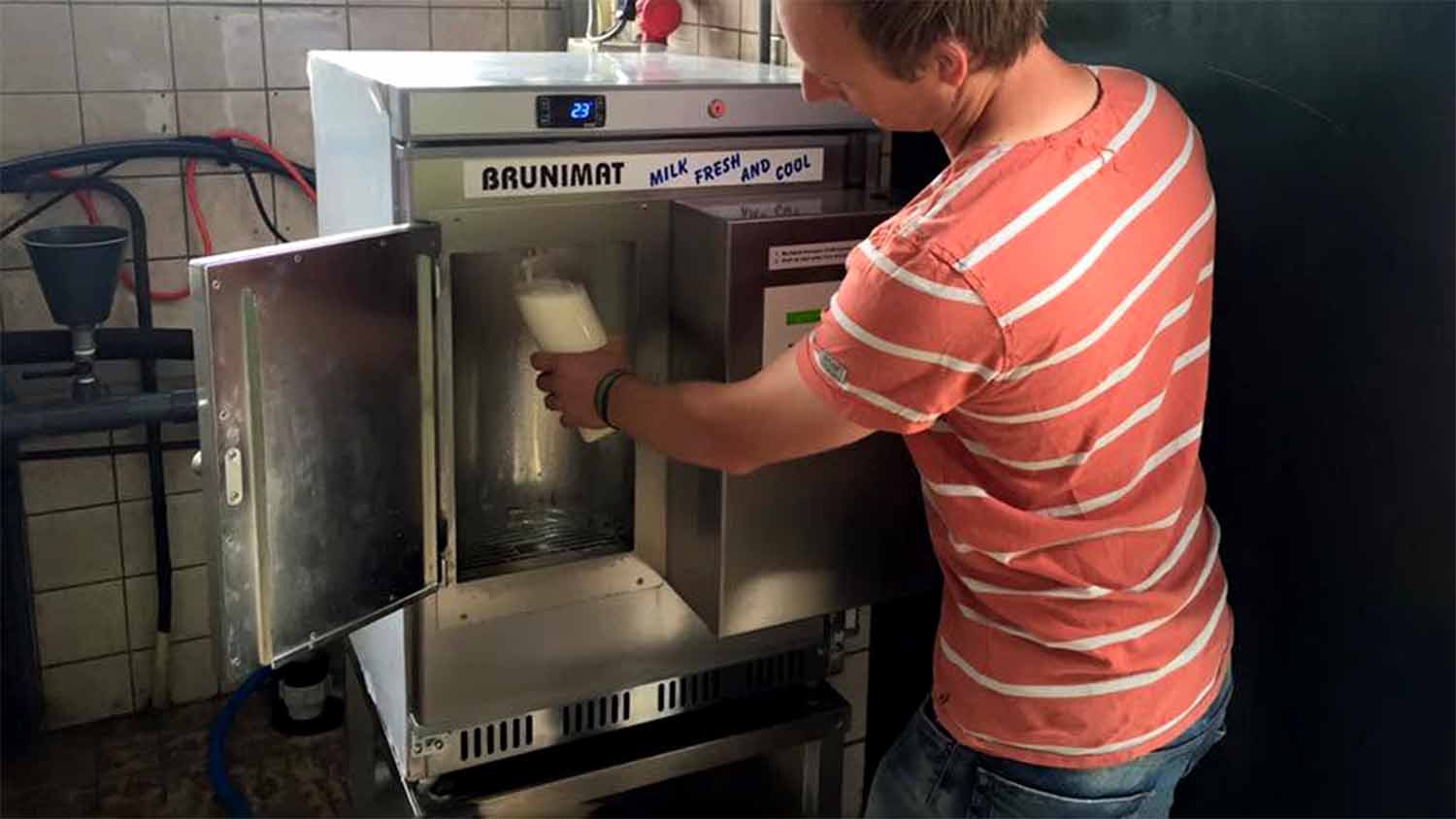
A raw milk vending machine is a refrigerated, self-service dispenser that delivers unpasteurized milk from a farm tank directly into a consumer’s container at the press of a button. The machine holds no packaged product. Milk flows from a sealed stainless steel tank through a metered pump into whatever the consumer presents: a glass bottle brought from home, a container purchased on-site, or a reusable jar. The entire system is designed around two requirements: keeping the milk at 1–4°C continuously, and sterilizing the dispensing nozzle between every use.
The Tank
The milk supply is held in a removable stainless steel tank mounted inside a dedicated refrigerating cell. DF Italia, the leading Italian manufacturer, builds its machines around tanks of 100 or 200 liters per unit, with modular systems reaching 1,800 liters or more across multiple tanks (DF Italia). Each tank includes a motorized agitator, a mechanical double paddle, that runs continuously to prevent cream from separating to the surface. Without agitation, fat globules rise within hours in unhomogenized milk, producing a layer of cream at the top and skimmed milk below; the paddle keeps the fat distributed evenly so every draw has consistent composition.
The refrigerating cell is insulated to hold 1–4°C regardless of ambient temperature, meeting the regulatory requirement of no more than 4°C in most European frameworks. Temperature is monitored continuously by sensors inside the cell, and the system logs any deviation. If the milk rises above the regulatory threshold, the machine automatically suspends dispensing and sends an alert to the operator’s phone via cellular telemetry.
Dispensing and Nozzle Sterilization
The consumer places their container under the dispensing nozzle, selects a quantity, and pays. Most machines offer two preset quantities, typically 500ml and 1 liter, with the amount controlled by a calibrated dosing pump that draws from the tank and pushes the milk through the outlet pipe. Some models allow continuous dispensing by holding a button, metering by volume. DF Italia specifically engineers the pump and nozzle for foam-free delivery: turbulent flow through the nozzle would agitate the milk on contact with air, producing foam and affecting the apparent quality of the draw. The machine also prints a receipt with operator-configurable information after each transaction.
After each dispense, the nozzle is sterilized before the next consumer uses the machine. DF Italia machines use a steam jet directed at the dosing area; the heat kills surface microorganisms on contact. Other manufacturers and models use an ultraviolet lamp that irradiates the nozzle between purchases. Both approaches address the same regulatory requirement: preventing cross-contamination between one consumer’s container and the next.
The dispensing pipe and connections are removable for cleaning. A built-in stainless steel waste tank collects residue milk from the pipe after each dispense, preventing stale milk from accumulating in the line.
Payment and Consumer Interface
Standard machines accept coins, with denominations and prices set by the operator. Most current models can be fitted with a card or contactless payment module. Some operators, particularly in France, offer rechargeable loyalty cards that reduce the per-liter cost for regular customers. The consumer interface is simple: select quantity, pay, fill. A bottle dispenser or vending slot for glass containers is often installed alongside the milk machine, allowing consumers who arrive without a container to purchase one on-site.
Remote Monitoring
The farmer does not need to be physically present at the machine to know its status. Current machines transmit operational data via cellular connection to a web application or smartphone app: milk temperature, fill level, sales volume, price settings, and alarm status. If the temperature rises, the machine sends an SMS alert directly to the operator’s phone. If the machine runs low, the app flags it. Inspectors with authority over the installation can be granted separate key card access to the machine’s interior at any time without operator involvement, a standard requirement under most European frameworks.
Daily Restocking and Tank Cleaning
The tank is refilled once a day, typically after the morning milking, and any milk remaining from the previous batch is removed before the new supply goes in. Under Italian regulation and most equivalent European frameworks, milk that has been in the machine for more than 24 hours cannot be dispensed to consumers; it must be returned to the farm and repurposed through heat treatment or conventional collection.
The tanks are removed from the machine entirely for cleaning. They are not cleaned in place. The farmer transports the empty tank to the dairy, cleans and sanitizes it using food-grade procedures, and returns it for the next filling. Removal gives full access to all surfaces, including the paddle shaft, internal welds, and outlet connections, without requiring work inside an installed machine.
Physical Formats and Installation
Machines range from compact single-tank units roughly the size of a domestic refrigerator to modular multi-tank installations several meters wide. DF Italia’s range runs from 100-liter starter units to multi-panel systems housing up to 1,800 liters across multiple tanks and dispensing stations. Brunimat, the Swiss manufacturer founded in 1994 and the first European producer of raw milk vending machines, produces machines exclusively in Switzerland across a similar capacity range.
Both manufacturers supply machines capable of dispensing cow, goat, sheep, and buffalo milk. The machines are not species-specific; regulatory frameworks in several countries, including France, explicitly authorize vending machines for small ruminants alongside bovines.
DF Italia also produces a companion fresh-produce dispenser, the DFresh, which can be installed alongside the milk unit to sell eggs, cheese, yogurt, and other farm products. Combined milk-and-produce installations are common in farm shop and market settings across Europe.
Installation requires only an electrical connection. Machines can be placed indoors or outdoors, at the farm gate, in a covered farm shop, at a market location, or, where regulations permit, at any off-farm commercial site. Outdoor installations are typically housed in a three-sided covered enclosure, wooden or metal, to protect the machine from weather while keeping it accessible around the clock. The machine’s refrigeration system maintains internal temperature within specification regardless of ambient conditions, but the enclosure reduces the thermal load and protects electronic components from rain and direct sun.
What the Machine Does Not Do
A raw milk vending machine performs no treatment on the milk. It does not heat it, filter it beyond the farm’s own straining process, or alter its composition in any way between the farm tank and the consumer’s bottle. The milk dispensed is exactly the milk the farmer produced: refrigerated to preserve quality and prevent bacterial growth, agitated to keep it consistent, and delivered through a sterilized nozzle into whatever container the consumer provides.
For a full list of raw milk vending machine locations across Europe, see the country directories: raw milk in Italy, raw milk in France, raw milk in Slovenia, raw milk in Switzerland, and raw milk in Austria. For a practical guide to finding and using machines while traveling, see How to Find a Raw Milk Vending Machine in Europe. For an overview of the regulatory frameworks that govern how machines are permitted and operated across each country, see Raw Milk Vending Machines in Europe.