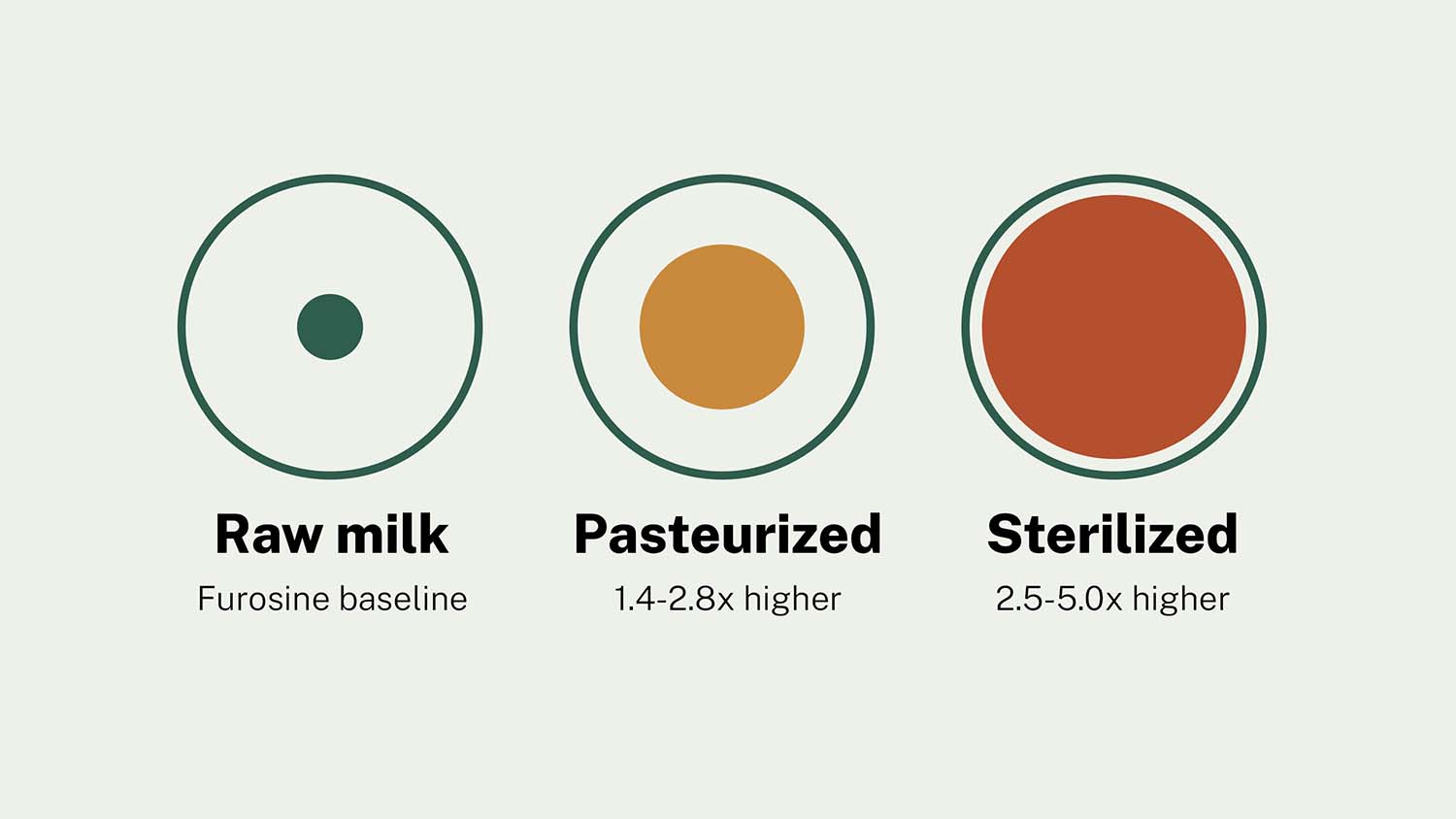
Furosine, the standard marker for Maillard reaction damage, rises 1.4 to 2.8 times above the raw milk baseline under pasteurization and 2.5 to 5.0 times higher under sterilization.
The Maillard Reaction in Milk: Furosine and Lysine Damage
Heat treatment doesn’t just denature milk proteins or shift mineral chemistry, it also triggers a specific, well-characterized chemical reaction between milk’s lactose and the amino acid lysine. This is the Maillard reaction, the same browning chemistry responsible for the crust on bread and the color of seared meat, and dairy scientists have built a precise chemical marker, furosine, to measure exactly how much of it occurs at different processing intensities. The resulting body of research is unusually well quantified, and it draws a clear line between what standard pasteurization does and what more intensive heat treatment does.
Key facts:
- A controlled comparative study measuring milk processed by four different methods found that furosine, the standard biomarker for early Maillard reaction damage, increased 1.4- to 2.8-fold under pasteurization (LTLT and HTST combined) and 2.5- to 5.0-fold under sterilization (UHT and in-bottle sterilization), relative to raw milk.
- The same study found that in-bottle sterilized milk showed a 32.8 percent decrease in total lysine and a 6.7 percent decrease in lactose, the two molecules that react with each other to form Maillard products in the first place.
- A separate review tracking furosine across processing intensities found levels rising from roughly 9.7 mg per 100 g of protein in raw milk to about 138 mg per 100 g of protein in UHT milk, a roughly fourteen-fold increase.
- China’s dairy regulations set separate maximum furosine limits for different product grades, 12 mg per 100 g of protein for premium pasteurized milk and 190 mg per 100 g of protein for premium UHT milk, reflecting how differently the two processes are expected to perform on this specific measure.
- Furosine is precise and reproducible enough that it is used industrially as a routine quality-control tool to distinguish pasteurized, extended-shelf-life (ESL), and UHT milk from one another, and even to estimate how long milk has been stored or transported.
What the Maillard Reaction Does to Milk Protein
The Maillard reaction begins when lactose, milk’s primary sugar, reacts with the amino acid lysine, an essential building block of milk protein, under heat. This reaction forms an intermediate compound called an Amadori product. When a milk sample is later subjected to acid hydrolysis in the lab, that Amadori product converts into a stable, measurable compound called furosine, which does not occur naturally in unheated milk and forms specifically as a marker of this reaction pathway. Because furosine’s formation depends directly on how much lysine and lactose reacted under heat, its concentration functions as a reliable proxy for how much Maillard damage a given batch of milk has undergone, and by extension, for how much of that lysine is no longer nutritionally available in its original form.
This reaction proceeds through recognized stages, moving from furosine as an early-stage marker toward intermediate compounds like 5-(hydroxymethyl)furfural (HMF) and 2-furaldehyde, and eventually to advanced glycation end products (AGEs) such as Nε-(carboxymethyl)lysine (CML) and Nε-(carboxyethyl)lysine (CEL) at the far end of the reaction pathway. Researchers can measure all of these stages independently, which is what makes it possible to compare processing methods with this level of precision.
Furosine as a Heat-Load Indicator
A 2021 study conducted specific quantitative comparisons across the full range of methods used in commercial dairy processing, treating milk with low-temperature long-time (LTLT) pasteurization, high-temperature short-time (HTST) pasteurization, ultra-high temperature (UHT) sterilization, and in-bottle sterilization (BS), and measuring Maillard reaction products at each stage. The results showed a clear, consistent pattern: milk run through either pasteurization method picked up 1.4 to 2.8 times as much furosine as raw milk, while the two sterilization methods pushed that multiplier nearly twice as high, to 2.5 to 5.0 times the raw-milk baseline. Every pasteurization treatment in the study landed below every sterilization treatment on this measure, with no overlap between the two groups, and sterilized milk’s readings came out well above raw, LTLT, or HTST milk on each Maillard compound the researchers tracked.
The same study measured actual depletion of the reactants themselves in the most intensively heated samples: in-bottle sterilized milk showed a 32.8 percent decrease in total lysine content and a 6.7 percent decrease in lactose content compared to raw milk. Notably, the researchers did not report a comparable, statistically significant lysine depletion figure for the pasteurization treatments specifically, reinforcing that this is fundamentally a matter of degree tied closely to heat intensity, not a binary raw-versus-processed distinction.
From Early to Advanced Maillard Products: HMF and AGEs
Beyond furosine, the same study tracked intermediate and advanced-stage Maillard compounds. For 5-(hydroxymethyl)furfural, UHT milk came in at roughly 4.7 times the raw-milk level, and in-bottle sterilized milk nearly doubled that again at 8.4 times; a related intermediate compound, 2-furaldehyde, sat below the detection threshold entirely in raw and LTLT-pasteurized milk, only becoming measurable once heat treatment intensified further. Further along the pathway, at the advanced-glycation stage, Nε-(carboxymethyl)lysine (CML) came out around 1.4 times the raw-milk level in UHT milk and 1.6 times in in-bottle sterilized milk, and across every heated sample tested, CML consistently outmeasured its chemical relative CEL by a factor of roughly 4.4 to 6.7.
The pattern across every single compound measured in this study points the same direction: pasteurization produces detectably more Maillard reaction products than raw milk, but consistently and substantially less than either UHT or in-bottle sterilization. The gap between pasteurization and sterilization is larger, by every metric tested, than the gap between raw milk and pasteurized milk.
How Much Does Furosine Actually Increase? Concrete Numbers
Individual published furosine values give a more concrete sense of scale than fold-changes alone. A 2019 review of chemical methods for monitoring the Maillard reaction in milk products cites HPLC-based measurements showing furosine rising from roughly 9.7 mg per 100 g of protein in raw milk to about 138 mg per 100 g of protein in UHT milk, and considerably higher still in commercial milk powders, which can reach 275 to 448 mg per 100 g of protein after one to two years of room-temperature storage. That storage effect illustrates an important point: furosine accumulation isn’t limited to the initial heat treatment. It continues to climb during subsequent storage, particularly at higher storage temperatures, which is part of why the compound is useful for estimating not just processing method but also a product’s storage history.
This variability is precise enough to underpin actual regulatory standards. China’s dairy quality regulations set separate maximum furosine thresholds for premium-grade product: 12 mg per 100 g of protein for premium pasteurized milk and 190 mg per 100 g of protein for premium UHT milk, an explicit regulatory acknowledgment that the two processes are expected to, and permitted to, produce meaningfully different amounts of Maillard reaction byproduct.
Furosine as an Industrial Quality Control Tool
Because furosine formation is so consistently tied to heat intensity and storage time, the dairy industry uses it as a practical diagnostic tool well beyond academic research. Analytical methods have been developed specifically to distinguish pasteurized milk from extended-shelf-life (ESL) and UHT milk based on furosine content alone, since the three categories reliably cluster into different measurable ranges. Furosine measurement has also been proposed as a way to estimate how far milk has traveled or how long it has been held before reaching a processing facility, since additional heat exposure or extended time at elevated ambient temperature both push furosine levels upward in a predictable direction. This practical application is a useful illustration of just how reliable and reproducible the underlying chemistry is: it’s precise enough to build a regulatory testing standard around, not merely a laboratory curiosity.
What This Research Does Not Show
The chemistry described above is thoroughly documented and precisely quantified: heat reliably triggers the Maillard reaction between milk’s lactose and lysine, the reaction’s byproducts are measurable with high specificity, and the magnitude of the effect scales consistently with processing intensity.
What this research does not show is a demonstrated human health consequence from the levels of Maillard reaction products found in standard pasteurized milk specifically. Specifically:
- None of the sources here measured a clinical or nutritional-status outcome in people consuming pasteurized milk; all of the findings are compositional chemistry measurements of the milk itself.
- The 32.8 percent lysine depletion figure applies to in-bottle sterilized milk, a substantially more intensive treatment than standard HTST pasteurization; the study did not report a comparably large lysine loss specific to pasteurization.
- Lysine is an essential amino acid, but milk is one of many dietary sources of it; none of the sources here quantify what a measured furosine increase in pasteurized milk translates to in terms of a person’s overall daily lysine intake or nutritional status.
- Advanced glycation end products (AGEs) like CML and CEL are sometimes discussed in broader nutrition literature in connection with inflammation and chronic disease risk, but no source cited here directly measured such an outcome tied specifically to the AGE levels found in pasteurized milk.
Key Terms
- Maillard reaction: a chemical reaction between a sugar (here, lactose) and an amino acid (here, lysine) under heat, producing browning and flavor compounds along with measurable nutritional changes.
- Furosine: a stable compound formed during acid hydrolysis of the Maillard reaction’s early-stage Amadori product, used as the standard biomarker for measuring heat-induced protein damage in milk.
- Advanced glycation end products (AGEs): later-stage Maillard reaction compounds, including CML and CEL, that form as heat treatment intensifies.
- Blocked lysine: lysine that has reacted through the Maillard pathway and is no longer available in its original nutritional form.
- Time-temperature integrator (TTI): a measurable compound, like furosine, whose concentration reflects the cumulative heat and time a food product has been exposed to, used to verify processing method and storage history.
Frequently Asked Questions
Does pasteurization cause the Maillard reaction in milk? Yes, to a measurable but comparatively modest degree. A controlled study found pasteurization increased furosine, the standard Maillard reaction marker, 1.4- to 2.8-fold over raw milk, substantially less than the 2.5- to 5.0-fold increase measured under UHT and in-bottle sterilization.
How much lysine does pasteurization destroy? The clearest documented lysine loss, a 32.8 percent decrease, was measured in in-bottle sterilized milk, a more intensive treatment than standard pasteurization. The same study did not report a comparably large lysine loss specific to standard HTST or LTLT pasteurization.
What is furosine used for? Furosine is both a research tool for measuring Maillard reaction damage and a practical industrial quality-control marker, used to distinguish pasteurized, extended-shelf-life, and UHT milk from each other, and to estimate a product’s storage history.
Is the Maillard reaction in milk regulated? Yes, in some jurisdictions. China’s dairy standards set specific maximum furosine limits by product grade, 12 mg per 100 g of protein for premium pasteurized milk and 190 mg per 100 g of protein for premium UHT milk, reflecting how differently the two processes are expected to perform on this measure.
Does furosine keep increasing after milk is processed? Yes. Furosine accumulation continues during storage, particularly at higher ambient temperatures, which is part of why it can be used to estimate not just how milk was processed but how long and under what conditions it has been stored since.