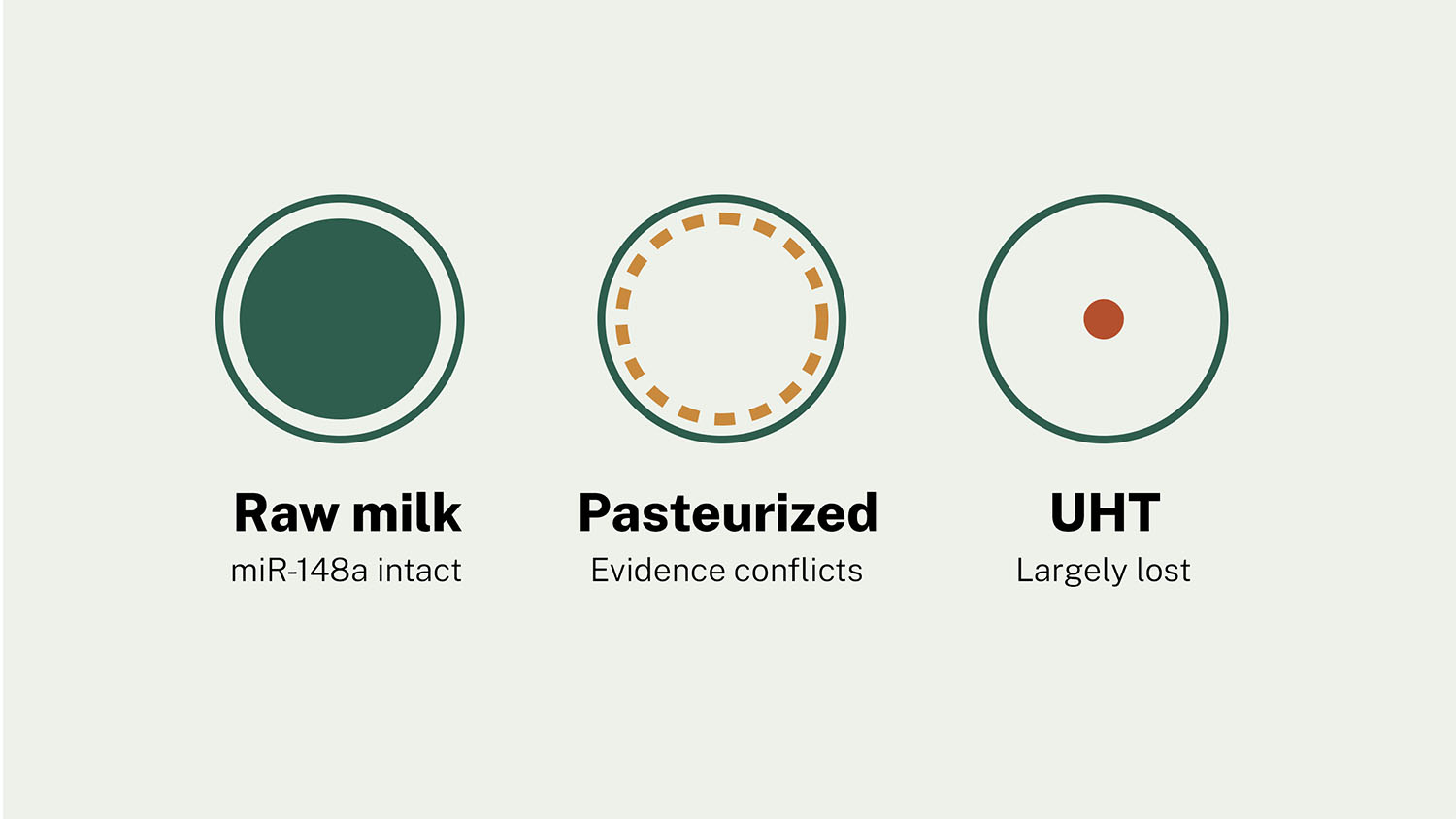
miR-148a, a milk exosome microRNA shown to protect against necrotizing enterocolitis in mouse studies, remains intact in raw milk, is contested under standard pasteurization, and is largely lost under UHT treatment.
Milk Exosomes and microRNA: Where the Research Disagrees
Milk carries tiny membrane-bound particles called exosomes, each loaded with microRNA (miRNA), short genetic fragments capable of influencing gene expression in cells that take them up. Whether pasteurization meaningfully disrupts this cargo is one of the more genuinely unsettled questions in dairy science, and unlike most topics in this cluster, the primary research does not point in one clean direction. Different labs, measuring different endpoints with different methods, have reported different answers, and a widely cited review has made claims that don’t fully hold up against the quantified data other researchers have published.
Key facts:
- One milk exosome miRNA, miR-148a, has documented, mechanistically specific protective effects against necrotizing enterocolitis in a mouse model, a serious intestinal disease affecting roughly 9 percent of extremely preterm infants, giving this research real stakes beyond an abstract nutrient-loss question.
- A controlled study measuring specific bovine milk miRNAs found that pasteurization combined with homogenization caused a 63 percent loss of miR-200c and a 67 percent loss of miR-29b (statistically significant in skim milk), while cold storage and somatic cell content had minor effects, under 2 percent loss.
- A separate study measuring total extracellular vesicle (EV) concentration found that all industrial processing treatments, including standard HTST pasteurization, caused more than a 60 percent decrease in EV concentration compared to raw milk, with gentler low-temperature heating preserving roughly three times more miRNA per particle than HTST or UHT.
- A third study measuring exosome particle counts specifically, rather than miRNA content, found that standard pasteurization had almost no effect on exosome counts, while high-temperature UHT treatment caused a significant loss of exosomes; the same study still found 25 differentially expressed miRNA species between pasteurized whole milk and raw milk fat.
- In donor human milk, which uses a different pasteurization protocol than commercial cow’s milk (Holder pasteurization, 62.5°C for 30 minutes rather than HTST’s 72°C for 15 seconds), one study found miRNA reads dropped 82-fold in whole milk and 302-fold in the exosomal fraction after processing, an effect severe enough that researchers could not perform further analysis on the pasteurized samples.
What Milk Exosomes and microRNA Are
Exosomes are small membrane-bound particles, roughly 40 to 120 nanometers across, released by cells and capable of carrying proteins, lipids, and genetic material like microRNA between cells. Milk exosomes originate from mammary gland epithelial cells and are present in the milk of all mammals studied, including cows and humans.
What these particles actually do is worth explaining before getting into whether pasteurization affects them. The clearest, most direct evidence comes from research on a single miRNA, miR-148a, isolated from human breast milk exosomes. A 2022 mouse study found that this miRNA directly suppresses a specific gene (Tp53) and reduces activation of NF-κB, a signaling pathway central to intestinal inflammation, and that delivering purified miR-148a alone produced a protective effect against necrotizing enterocolitis (NEC) comparable to giving whole breast milk exosomes. NEC is a serious intestinal disease that affects roughly 9 percent of extremely preterm infants and carries a mortality rate as high as 20 to 30 percent, which is part of why this specific mechanism has drawn substantial research interest independent of the broader, more speculative claims about milk exosomes discussed later in this article.
Beyond that specific example, milk exosomes and their miRNA cargo have been studied more generally for a role in intestinal barrier maturation and immune signaling in infants, and laboratory experiments have directly demonstrated that milk-derived miRNA can be taken up by human colon cells and rat intestinal cells through normal cellular uptake mechanisms. Once consumed, there is evidence that at least some milk-derived miRNA survives digestion, protected in part by the same membrane structure that defines an exosome in the first place, and reaches the bloodstream in measurable, if small, amounts. Milk-derived miRNA has also been detected in fermented dairy products like cheese, indicating it survives fermentation to at least some degree, though detection alone doesn’t establish that it retains full biological activity through that process.
Where the solid ground ends is worth being precise about, though. The NEC research above is specific, mechanistic, and grounded in a defined disease model. Broader claims that milk exosomes systemically reprogram gene expression across organs like the liver, brain, and adipose tissue in typical infant or adult development are considerably more speculative, and much of that broader literature traces back to the same small group of researchers, including the authors of the 2019 review discussed later in this article, whose interpretive reach this piece treats with caution throughout. The extent to which any of this produces meaningful biological effects in an adult human consuming ordinary dairy products, as opposed to an infant receiving fresh breast milk directly, remains actively debated in its own right, separate from the processing question this article focuses on.
The specific question this research addresses is narrower and more tractable: does pasteurization change how much of this exosome and miRNA content survives into the milk a consumer actually drinks? Several independent research groups have measured this directly, using different methods, and their results diverge in ways worth examining individually.
The Data Showing Pasteurization Reduces miRNA Content
Measured directly, standard pasteurization is associated with substantial, statistically significant losses of specific bovine milk miRNAs. A 2015 study that tracked two particular miRNA species through commercial-style processing found that pasteurization combined with homogenization, the standard combination used in commercial milk production, caused a 63 percent loss of miR-200c and a 67 percent loss of miR-29b, the latter statistically significant specifically in skim milk. By contrast, the same study found that cold storage and the milk’s natural somatic cell content had only minor effects on miRNA levels, under 2 percent loss, isolating processing itself as the dominant factor.
A 2021 study took a broader approach, measuring total EV concentration rather than individual miRNA species. It found that every industrial processing treatment tested, including standard HTST pasteurization, caused more than a 60 percent reduction in EV concentration relative to raw milk. The same study found that gentler low-temperature heat processing preserved roughly three times more total miRNA per particle than either HTST or UHT pasteurization, and that EV diameter shrank by 11 to 16 percent under low-temperature treatment relative to raw milk, indicating that heat affects both the amount and the physical structure of these particles.
The Data Showing Exosome Particles Are Relatively Preserved
A separate line of research, measuring a different endpoint, has reached a more reassuring conclusion about standard pasteurization specifically. A 2016 study designed to investigate the “farm milk effect” on childhood asthma compared native, pasteurized, and UHT-treated milk and found that high-temperature UHT treatment caused a significant loss of milk exosomes, while standard lower-heat pasteurization had almost no effect on exosome counts. This finding, that pasteurization preserves exosome particle counts even as UHT does not, is frequently cited as evidence that pasteurization leaves milk’s exosome content essentially intact.
But the same 2016 study did not stop at counting particles. It also profiled the miRNA content of those particles and reported differential expression of 25 miRNA species between pasteurized whole milk and raw milk fat samples, and differential expression of 52 miRNA species between pasteurized and UHT-treated milk. In other words, even in the study most often cited for showing pasteurization’s minimal impact, the specific cargo carried by those preserved particles was measurably different from what raw milk carries.
Reconciling the Apparent Disagreement
The tension between these findings resolves, at least partly, once the studies are read for what they actually measured rather than treated as competing answers to the same question. Exosome particle count, total EV concentration, and individual miRNA content are three distinct measurements, and a processing method can affect them differently. Pasteurization may leave the physical particles largely intact and countable while still altering, degrading, or unevenly depleting the genetic cargo those particles carry, which is broadly consistent with what the Howard, Colella, and Kirchner studies collectively show when read together rather than cited selectively.
Processing methodology also varies meaningfully between studies. The Howard et al. study examined pasteurization combined with homogenization, the combination typically used commercially, while the Kirchner et al. study appears to have examined pasteurization’s effect somewhat more in isolation. Since homogenization mechanically disrupts fat globules and can plausibly affect exosome-associated material differently than heat alone, studies that combine the two processes are not directly comparable to studies that isolate pasteurization specifically, and this methodological difference likely explains at least part of the divergence in reported outcomes.
What Happens at Higher Heat: UHT Processing
Where the research is far more consistent is at higher heat intensities. Multiple independent studies agree that UHT treatment causes substantially larger, more consistent losses than standard HTST pasteurization does. The 2021 EV concentration study found UHT among the treatments causing the largest reductions, and a separate comparative study testing UV light and UHT treatment against standard pasteurized milk found significant exosomal miRNA loss under both UV and UHT processing relative to pasteurized milk, though only UHT caused a significant drop in exosome particle count itself, UV radiation left particle counts statistically unaffected even as it reduced miRNA content. This pattern, that UHT does more consistent damage than HTST pasteurization across nearly every measure, is one of the more consistently reproduced findings across this body of research, even where the size of pasteurization’s own effect remains contested.
Human Milk Banking Tells a Starker Story
Donor human milk banks generally use a different pasteurization protocol entirely, Holder pasteurization at 62.5°C for 30 minutes, gentler in temperature but far longer in duration than the 72°C-for-15-seconds standard used in commercial cow’s milk processing. Research on this specific method paints a more dramatic picture of miRNA loss than most of the bovine HTST literature. A 2020 study sequencing human milk miRNA before and after processing found that Holder pasteurization reduced miRNA reads 82-fold in whole milk and 302-fold in the exosomal fraction, a loss severe enough that the researchers could not perform further compositional analysis on those samples at all. The same study found that high-pressure processing, a non-thermal alternative, caused only a statistically insignificant decrease in miRNA reads by comparison. A separate 2023 study on human milk found that while pasteurization didn’t measurably change EV particle size or number, it did significantly alter the miRNA cargo those particles carried and measurably reduced the resulting particles’ ability to modulate immune signaling in intestinal cell cultures.
This human milk data is a useful reminder that “pasteurization” is not one single, uniform treatment. Holder pasteurization’s much longer holding time at a lower temperature produces a different outcome than commercial HTST’s short, hot treatment, and findings from one cannot be assumed to transfer to the other.
A Widely Cited but Speculative Claim Worth Flagging
A frequently cited 2019 review article states plainly that pasteurization has no significant effect on milk exosome integrity and miRNA bioavailability. That claim is worth flagging directly, because it sits in tension with the quantified losses reported by Howard et al. and Colella et al. above, and the review itself is worth understanding for what kind of paper it is. It is explicitly framed as a hypothesis-generating review, not a study reporting new experimental data, and its central argument extends well beyond the pasteurization question to propose that regular consumption of pasteurized milk exosomes contributes to a wide range of chronic diseases, including obesity, type 2 diabetes, several cancers, osteoporosis, and Parkinson’s disease. Each of those specific disease claims rests on long chains of indirect, mechanistic inference connecting individual miRNAs to individual genes to individual pathways, rather than on direct clinical evidence that pasteurized milk consumption causes any of those conditions. Readers encountering this review elsewhere should treat its specific pasteurization claim as one contested position among several, not as a settled summary of the field, and should treat its broader disease-causation arguments as speculative hypotheses awaiting testing rather than established findings.
What This Research Does Not Show
The laboratory measurements described above are real and specific: certain miRNA species measurably decline under standard pasteurization, exosome particle counts are more resistant to HTST than to UHT, and human milk processed by Holder pasteurization loses the large majority of its miRNA content.
What this research does not show is a settled, single answer to “does pasteurization destroy milk exosomes,” or any demonstrated human health consequence either way. Specifically:
- No study cited here measured a clinical health outcome in people consuming pasteurized versus raw milk; all of the findings above are laboratory measurements of particle counts, concentrations, or genetic sequencing reads.
- The degree of miRNA loss reported varies substantially depending on which specific miRNA species is measured, whether homogenization is combined with pasteurization, and which milk fraction (whole milk, skim milk, or exosomal fraction specifically) is analyzed.
- Even where milk-derived miRNA is shown to survive processing and reach human plasma after consumption, as in some of the bioavailability research this field draws on, that finding establishes absorption, not a demonstrated downstream biological or health effect at typical dietary intake levels.
- Findings from human milk Holder pasteurization research do not automatically transfer to commercial bovine HTST pasteurization, since the two use substantially different time-temperature combinations.
Key Terms
- Exosome: a small membrane-bound particle, roughly 40 to 120 nanometers in diameter, released by cells and capable of carrying proteins, lipids, and genetic material between cells.
- microRNA (miRNA): a short non-coding RNA fragment capable of regulating gene expression in cells that take it up.
- Extracellular vesicle (EV): a broader category of cell-released particles that includes exosomes along with other vesicle types.
- Holder pasteurization: a gentler, longer heat treatment protocol (62.5°C for 30 minutes) commonly used in human milk banking, distinct from commercial HTST pasteurization.
- High-pressure processing (HPP): a non-thermal pasteurization alternative that uses mechanical pressure rather than heat, shown in some studies to better preserve miRNA content than thermal methods.
Frequently Asked Questions
What do milk exosomes and their microRNA actually do? The most concrete evidence involves a single miRNA, miR-148a, shown to protect against necrotizing enterocolitis in a mouse model by suppressing a specific gene and reducing inflammatory signaling. More broadly, milk exosomes are studied for a role in infant intestinal and immune development, and lab experiments confirm human cells can take up milk-derived miRNA directly. Broader claims about systemic effects across multiple organs are considerably more speculative.
Does pasteurization destroy milk exosomes? The research disagrees depending on what is measured. Exosome particle counts appear relatively preserved under standard HTST pasteurization in at least one study, while separate studies measuring total EV concentration and specific miRNA content found substantial, significant reductions under the same general processing category.
Is there a consensus in the scientific literature on this question? No. This is one of the more genuinely unsettled questions in current dairy and nutrition science, with different research groups reporting different magnitudes of effect depending on their specific methods and measured endpoints.
Does UHT milk lose more exosome content than pasteurized milk? Yes, this is one of the more consistent findings across multiple independent studies. UHT causes substantially larger, more reproducible losses of both exosome particles and miRNA content than standard HTST pasteurization.
Is a widely cited claim that “pasteurization has no effect on milk exosomes” accurate? That specific claim comes from a 2019 hypothesis-generating review article, and it conflicts with quantified data from other researchers showing significant miRNA losses under pasteurization. The review’s broader argument, that pasteurized milk exosomes contribute to chronic diseases like obesity and cancer, rests on speculative mechanistic inference rather than direct clinical evidence.
Does human milk lose more miRNA during pasteurization than cow’s milk? Research on Holder pasteurization, the method typically used in human milk banks, has found dramatic miRNA losses (up to several hundred-fold in some measurements). This protocol uses a longer holding time than commercial cow’s milk HTST pasteurization, so the two are not directly comparable.