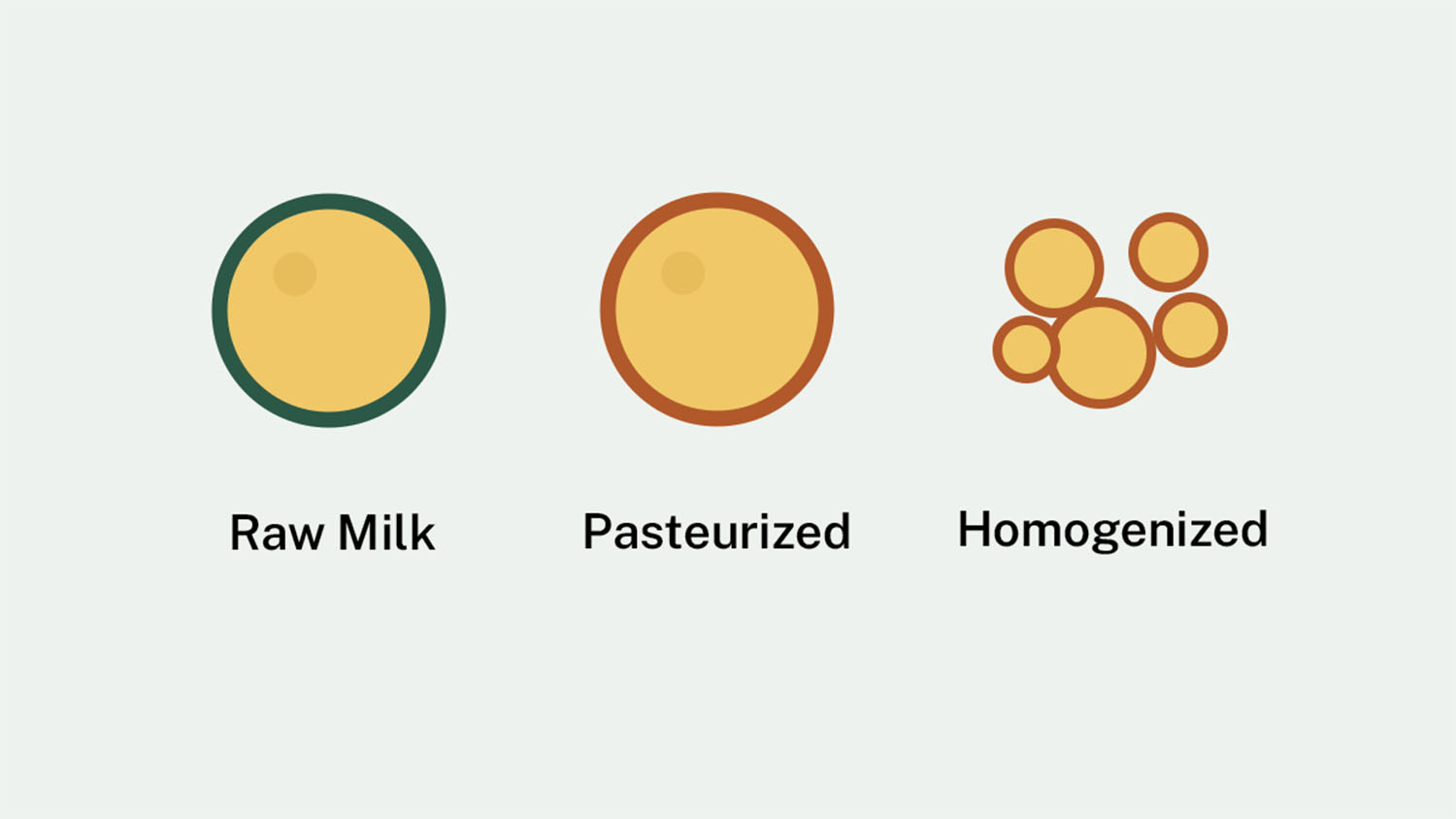
A simplified side-by-side comparison of raw, pasteurized, and homogenized milk fat globules, showing that homogenization reduces globule size and increases their number while pasteurization leaves globule size unchanged.
Milk Fat Globule Membrane: How Raw, Pasteurized, and Homogenized Milk Fat Differ
Every drop of milk carries its fat in microscopic packages called fat globules, and those globules are wrapped in a structure known as the milk fat globule membrane (MFGM). In raw milk, that membrane is still intact. In homogenized milk, it is mostly gone, replaced by a different coating made of milk proteins. That structural difference is well documented in dairy science, and it changes how the fat behaves, both in the carton and during digestion.
Key facts:
- The MFGM is a trilayer structure roughly 10 to 50 nanometers thick, making up only 2 to 6 percent of a fat globule’s total mass.
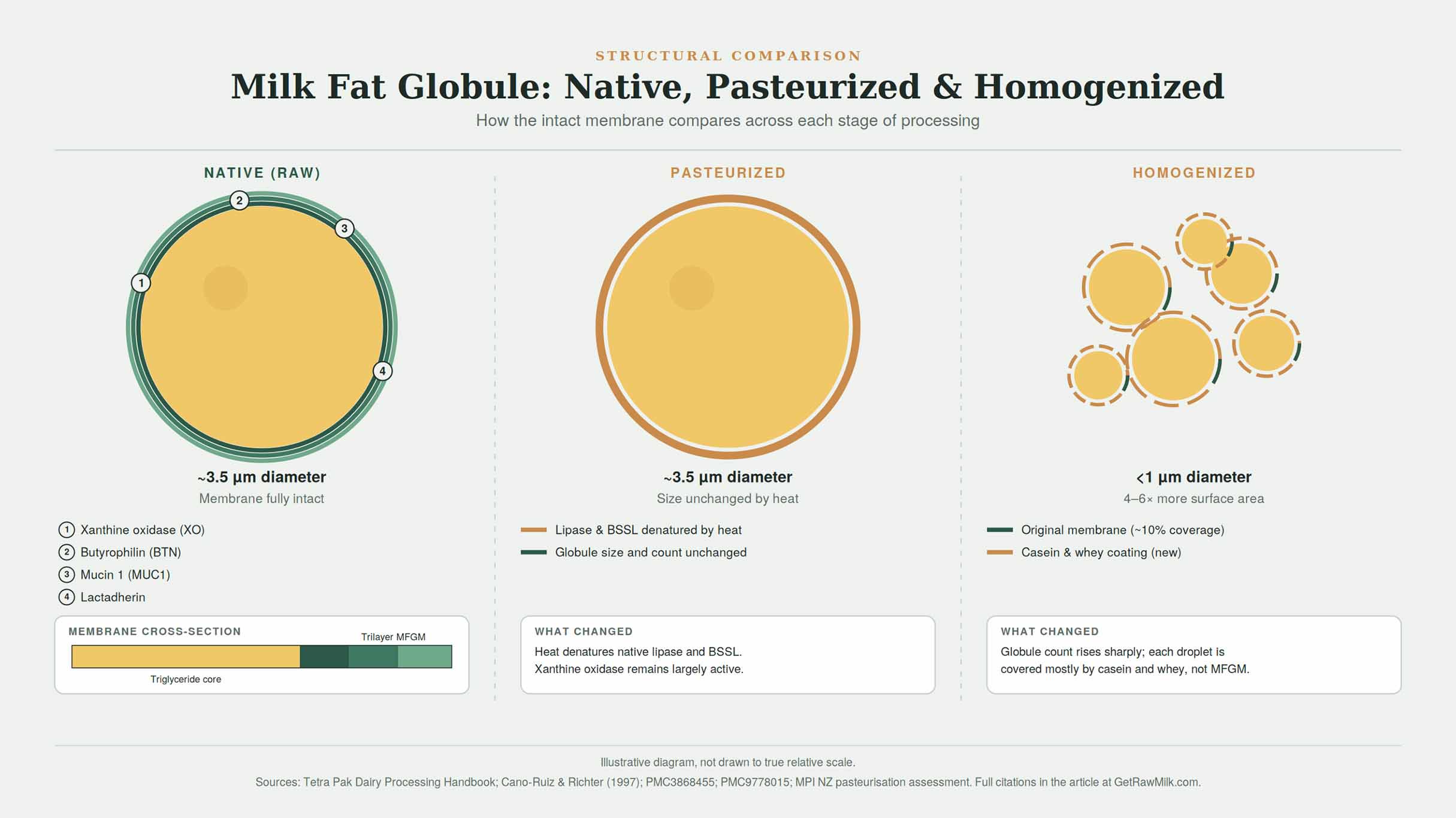
- Homogenization shrinks native fat globules from an average of 3.5 micrometers to below 1 micrometer, a four- to six-fold increase in surface area.
- The original membrane can cover only about 10 percent of that new surface area; casein and whey proteins cover the rest.
- Pasteurization does not shrink fat globules, but it denatures native enzymes including lipase and bile salt-stimulated lipase (BSSL), and can cause MFGM proteins to aggregate with other milk proteins.
- Camel and goat milk have the smallest native fat globules and the highest measured in vitro fat digestibility among commonly studied dairy species; buffalo milk has the largest globules and the lowest.
What Is the Milk Fat Globule Membrane?
The milk fat globule membrane (MFGM) is a three-layer membrane, derived from the mammary gland’s cell membrane, that encases each droplet of milk fat and keeps it emulsified. It is a trilayer structure roughly 10 to 50 nanometers thick that surrounds each droplet of fat as it is secreted. The membrane itself makes up only an estimated 2 to 6 percent of the total fat globule’s mass, while the core it encloses is composed predominantly of triacylglycerols (triglycerides). The membrane acts as a natural emulsifier, keeping fat dispersed in the watery part of milk while reducing interfacial tension and helping protect the fat from coalescence and oxidation.
The membrane itself is not simple packaging. Proteomic studies have identified more than 500 distinct MFGM proteins in bovine milk, though a much smaller set makes up the bulk of the structure. The most-studied major proteins include:
- Xanthine dehydrogenase/oxidase (XDH/XO), which accounts for roughly 12 to 13 percent of total MFGM protein and is the most heat-stable major MFGM enzyme
- Butyrophilin (BTN), a transmembrane glycoprotein suggested to act as a scaffold for the membrane’s assembly
- Mucin 1 (MUC1), a heavily glycosylated protein that forms part of the outer surface
- Lactadherin, also called PAS 6/7 or MFG-E8
- Cluster of differentiation 36 (CD36), adipophilin, and fatty acid-binding protein (FABP)
About 40 percent of MFGM proteins are glycosylated. The membrane also carries phospholipids, including phosphatidylcholine, phosphatidylethanolamine, and sphingomyelin, arranged in a lipid bilayer distinct from the triglyceride core they surround.
What Homogenization Does to Milk Fat Globules
Homogenization is a mechanical process that mechanically strips the native MFGM off fat globules and replaces it with a new coating of milk proteins. Milk is forced through a narrow valve at high pressure, and the resulting turbulence and cavitation shatter native fat globules into far smaller droplets.
The scale of that change is well measured by the Tetra Pak Dairy Processing Handbook and other dairy science references:
- Native bovine fat globules average about 3.5 micrometers in diameter, with a natural range of roughly 0.1 to 15 micrometers.
- Homogenization reduces the average globule size to below 1 micrometer.
- Splitting each globule into many smaller ones multiplies the total surface that needs covering, so the combined fat-to-plasma contact area ends up four to six times larger than in raw milk.
- The original membrane material is not enough to cover this new surface area. One estimate, from Cano-Ruiz and Richter’s 1997 analysis, places the original MFGM’s post-homogenization coverage at only around 10 percent of the new surface.
- Interfacial tension tracks this transition: raw milk measures roughly 1 to 2 mN/m, jumps sharply to about 15 mN/m the moment homogenization disrupts the native membrane, then drops back to 3 to 4 mN/m within moments as migrating proteins re-coat the exposed surface.
The remaining surface is covered by proteins migrating in from the milk itself, mostly casein micelles and whey proteins, which adsorb onto the exposed fat and form a new composite coating. This is a structurally different membrane than the one the fat globule was secreted with.
What Pasteurization Does to Milk Fat Globules
Pasteurization is a heat process that denatures native MFGM enzymes and proteins without mechanically breaking apart the fat globules the way homogenization does. Heat treatment denatures MFGM proteins and native milk enzymes, and it can cause those denatured proteins to aggregate with casein and whey proteins at the fat globule surface through disulfide and non-covalent bonds.
Some documented effects:
- Among the major MFGM enzymes, xanthine oxidase holds up best under heat, coming through standard pasteurization largely unchanged, while pasteurization inactivates enzymes such as native milk lipase and alkaline phosphatase.
- Bile salt-stimulated lipase (BSSL), a lipase that assists fat digestion, is denatured by standard pasteurization. In human milk specifically, one study using in vitro digestion models with preterm-infant models found that pasteurization reduced pre-lipolysis (the breakdown of fat that begins before digestion) and moderately decreased intestinal lipid uptake, though it did not eliminate digestive lipolysis carried out by the infant’s own enzymes. This finding is specific to human milk and preterm infant digestion models, not cow’s milk in adults.
- Heat treatment intensity matters: studies on caprine (goat) milk found that higher-intensity heat treatments caused greater reductions in MFGM protein abundance than gentler processing, with spray-drying causing comparatively less protein loss than direct heating.
Raw Milk Fat vs. Processed Milk Fat: A Structural Comparison
| Structural feature | Raw milk | Homogenized milk | Pasteurized milk |
|---|---|---|---|
| Fat globule size | Native range, ~0.1–15 µm (avg ~3.5 µm) | Reduced to below 1 µm | Unchanged from native size |
| Native MFGM coverage | Intact | Roughly 10% of new surface area | Largely intact but proteins denatured |
| Surface coating | Original membrane proteins and phospholipids | Mostly casein and whey proteins | Original proteins, partially denatured and aggregated |
| Native lipase (LPL) activity | Compartmentalized, inactive against fat | Activated once membrane is disrupted | Inactivated by heat |
| Xanthine oxidase activity | Active | Active (heat not applied) | Largely retained (most heat-stable MFGM enzyme) |
Why Doesn’t Raw Milk Go Rancid With Active Lipase Already Inside It?
Raw milk contains an active fat-digesting enzyme, lipoprotein lipase (LPL), but it cannot act on the fat because the intact membrane physically separates the enzyme from its target. LPL originates from the cow’s blood and leaks into milk through the mammary cell membrane. Under optimal conditions, bovine milk’s natural LPL content is potent enough to release free fatty acids within about 10 seconds.
That does not happen in intact raw milk, because of compartmentalization. The enzyme spends most of its time somewhere the fat can’t reach it: over 80 percent of LPL is bound to casein micelles, well away from the triglycerides sealed inside the intact membrane. LPL only becomes active against the fat once the membrane is damaged, whether by excessive agitation, pumping, cooling stress, or homogenization. This is also why homogenized raw milk must be pasteurized quickly: damaging the membrane without deactivating the enzyme allows rapid lipolysis and off-flavors to develop.
How Milk Fat Is Digested: Gastric and Intestinal Lipolysis
Fat digestion happens in two stages: gastric lipase begins breaking down triglycerides in the stomach, accounting for roughly 10 to 25 percent of total lipid digestion, and pancreatic lipase with bile salts complete the process in the small intestine. Regardless of processing, this two-stage path is commonly cited, with some sources citing a stomach-phase range up to 30 percent. In the small intestine, pancreatic lipase and bile salts break triglycerides down into free fatty acids and monoacylglycerols that are absorbed through the intestinal wall.
The MFGM’s condition affects this process because it governs how much surface area digestive enzymes can access, and how quickly. It’s worth noting that the specific rate at which individual MFGM proteins break down under gastric conditions is not entirely consistent across the literature: one study measuring gastric breakdown in milk-fed infants found mucin and lactadherin holding up well against stomach acid while butyrophilin disappeared quickly, whereas a separate simulated gastric digestion study of ruminant milk found butyrophilin to be comparatively more resistant than xanthine oxidase and lactadherin. This is likely a reflection of species and methodology differences (infant gastric aspirate versus simulated digestion), and is flagged here as an open question rather than a settled fact.
Which Milk Digests Fastest? Fat Globule Size by Species
Fat globule size varies by species, and smaller native globules are consistently associated with faster measured fat digestion in vitro. A 2014 study comparing goat, camel, cow, and buffalo milk found that smaller native globules corresponded to faster free fatty acid release, a finding corroborated in a subsequent comparative review.
| Milk source | Average native fat globule size | Relative in vitro fat digestibility |
|---|---|---|
| Camel | ~2.99 micrometers | Highest |
| Goat | ~3.49 micrometers | Highest (comparable to camel) |
| Cow | ~4.55 micrometers | Moderate |
| Buffalo | ~5.92 micrometers | Lowest |
Globule size figures from Nutritional Profile, Processing and Potential Products: A Comparative Review of Goat Milk.
By the point digestion was complete in the original 2014 study, there was no statistically significant difference between camel and goat milk in total fatty acids released, even though they started with somewhat different globule sizes. The consistent pattern across the dairy science literature is that smaller native globule size correlates with faster measured lipolysis in vitro.
What This Research Does Not Show
The structural facts above are well documented: raw milk fat globules carry an intact native membrane, homogenization and pasteurization each alter that membrane through different mechanisms, and globule structure measurably affects the rate of lipolysis in laboratory digestion models.
What the research does not show is a proven health outcome from drinking raw milk instead of processed milk.Specifically:
- None of the digestibility studies cited here compared inflammatory markers between raw and processed milk.
- None tested people with a diagnosed fat-metabolism condition.
- None measured real-world symptom differences between raw and processed dairy in adults.
- The digestibility research is largely in vitro (test-tube and simulated-digestion models) or conducted in animal models and infants, not adult human trials comparing raw and pasteurized cow’s milk fat tolerance.
A related but distinct body of clinical research exists on infant formula supplemented with isolated bovine MFGM (not raw milk itself). Randomized controlled trials in infants have found that adding bMFGM to formula produces modest shifts in gut microbiome composition, including increased abundance of Bifidobacterium and Akkermansia species in some studies, compared to standard formula. These trials measure an added MFGM ingredient against standard infant formula, not raw milk against pasteurized milk in the general population, and their outcomes should not be extrapolated to unrelated questions like fat sensitivity or systemic inflammation in adults.
Key Terms
- Milk fat globule membrane (MFGM): the three-layer membrane of proteins and phospholipids that encases each fat droplet in milk.
- Homogenization: a mechanical process that reduces fat globule size by forcing milk through a high-pressure valve, stripping most of the native membrane in the process.
- Pasteurization: a heat treatment that inactivates certain enzymes and pathogens without mechanically breaking apart fat globules.
- Lipolysis: the enzymatic breakdown of triglycerides into free fatty acids and glycerides.
- Lipoprotein lipase (LPL): the main native fat-digesting enzyme in milk, normally kept inactive by the intact MFGM.
- Bile salt-stimulated lipase (BSSL): a lipase found in milk that assists fat digestion and is sensitive to heat treatment.
Frequently Asked Questions
Does homogenization destroy the milk fat globule membrane? Homogenization does not chemically destroy the membrane, but it mechanically disrupts it. The dramatic increase in fat surface area during homogenization means the original membrane material can cover only a fraction of the new surface, roughly 10 percent by one estimate, with casein and whey proteins forming a new composite coating over the rest.
Does pasteurization affect milk fat digestion? Pasteurization does not destroy fat globules the way homogenization does, but the heat denatures certain native enzymes involved in fat digestion, including lipase and bile salt-stimulated lipase, and can cause MFGM proteins to aggregate with other milk proteins.
Is raw milk fat easier to digest than homogenized milk fat? Structural digestibility studies using in vitro models show that native fat globule size and membrane condition correlate with measurable differences in the rate of lipolysis. This is a documented structural and enzymatic difference, not a proven clinical health outcome, and no adult human trials directly compare raw and pasteurized cow’s milk fat tolerance.
What keeps raw milk from going rancid if the fat-digesting enzyme is already present? Lipoprotein lipase, the main native fat-digesting enzyme in milk, is largely bound to casein micelles while its target triglycerides remain sealed inside the intact fat globule membrane. The enzyme cannot act on the fat until that membrane is physically damaged, whether through agitation, pumping, or homogenization.
Which milk has the smallest natural fat globules? Among commonly compared dairy species, camel milk has been measured with the smallest average native fat globule size, followed closely by goat milk. Cow milk globules are larger, and buffalo milk has the largest average native fat globule size among the species studied.