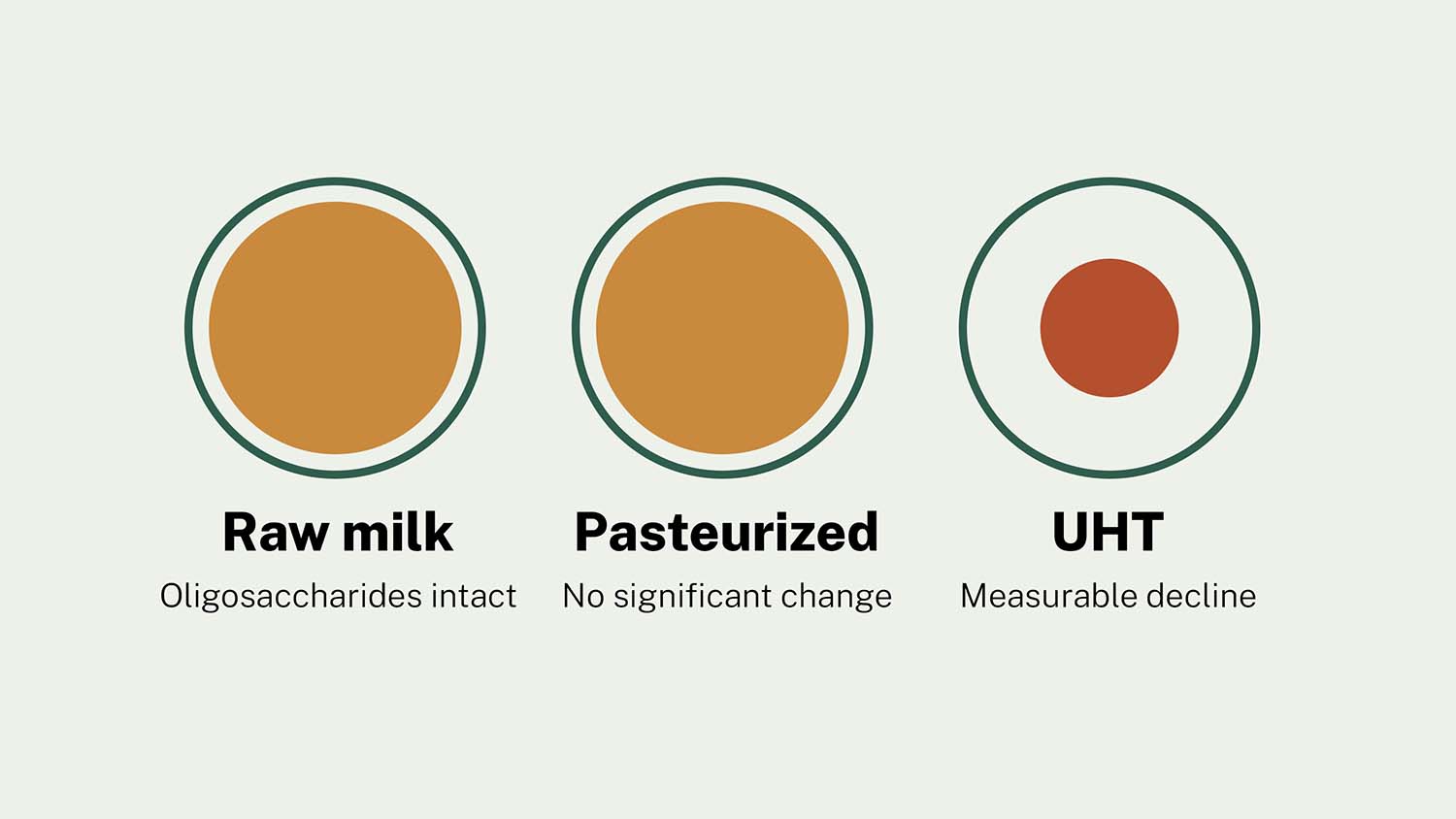
Milk oligosaccharide levels are identical between raw and standard pasteurized milk, with a measurable decline appearing only under UHT sterilization at 135°C.
Milk Oligosaccharides: The Compound That Survives Pasteurization
Most of this content cluster documents things pasteurization reduces, denatures, or measurably alters. Milk oligosaccharides are the exception, and the research behind that exception is unusually consistent. Across more than a decade of independent studies, using different heat treatments, different milk sources, and different labs, the finding keeps repeating: standard pasteurization temperatures leave these particular compounds essentially intact, in contrast to the vitamins, immunoglobulins, and other heat-sensitive components documented elsewhere in this cluster.
Key facts:
- A 2023 study analyzing milk oligosaccharides across seven mammal species, including cows, found that 65°C treatment, the standard industrial pasteurization temperature, had no significant effect on oligosaccharide concentration, while 135°C sterilization-range heating was associated with a measurable decline.
- A 2008 study on human donor milk reached the same conclusion using Holder pasteurization (62.5°C for 30 minutes): pasteurization did not affect the concentration or pattern of oligosaccharides analyzed.
- A 2022 comparative study testing both low-temperature long-time (LTLT) pasteurization and microwave-assisted heating found that oligosaccharide and fatty acid levels held essentially steady under both methods, while immunoglobulins and lactoferrin, measured in the same samples, showed clear processing-related losses.
- The most recent and comprehensive study identified here, published in 2025, measured a full panel of nutrients in matched raw and Holder-pasteurized human milk samples and concluded that Holder pasteurization has minimal to no impact on human milk oligosaccharides specifically, even as the same samples showed a roughly 35 percent drop in IgA and an over 80 percent drop in lactoferrin.
- A systematic review of 44 published studies on human milk composition changes after pasteurization concluded that the concentrations of the large majority of carbohydrates investigated, oligosaccharides included, did not change.
What Milk Oligosaccharides Are
Milk oligosaccharides are complex, unattached sugar structures dissolved in milk, distinct from lactose, the simple sugar most people associate with milk. In human milk, they are the third most abundant solid component after lactose and fat, and they are structurally and functionally similar across species, though concentrations differ substantially: bovine milk oligosaccharides (BMOs) are present at roughly a twentieth the concentration found in human milk oligosaccharides (HMOs). These compounds are largely indigestible by human enzymes in the small intestine, which is central to their biological role: they travel largely intact to the colon, where they function as a prebiotic food source for beneficial bacteria, particularly bifidobacteria species associated with infant gut health.
Because of this functional similarity to their human counterparts, bovine milk oligosaccharides have drawn separate research interest as a potential functional ingredient in their own right, including work on isolating and concentrating them from dairy byproducts like cheese whey for use in infant formula and other products.
The Core Finding: Oligosaccharides Resist Heat
A 2023 study set out specifically to compare milk oligosaccharide content and heat sensitivity across seven mammal species, developing a method sensitive enough to measure eleven distinct oligosaccharides simultaneously. After characterizing the natural oligosaccharide profiles of human, bovine, sheep, goat, yak, buffalo, and camel milk, the researchers then subjected dairy cow milk specifically to the two heat treatments most commonly used industrially: standard pasteurization at 65°C and UHT-range sterilization at 135°C. The result was a clear split: 65°C treatment had no significant effect on oligosaccharide concentration, while 135°C heating was associated with a measurable decline. The researchers concluded that high temperatures, not standard pasteurization, are the condition worth avoiding if preserving oligosaccharide content in a processed product is a priority.
This finding did not emerge from a single isolated study. It is one of several independent confirmations of the same basic pattern, tested across different labs, different specific processing protocols, and different milk sources.
Confirmed Across Independent Studies of Human Milk Banking
Human milk banking research, where Holder pasteurization is the standard treatment for donor milk, has produced the largest and most consistent body of evidence on this question. A 2008 study evaluating Holder pasteurization’s effect on oligosaccharides in preterm human milk found pasteurization did not affect either the total concentration or the specific pattern of individual oligosaccharides measured. A 2022 study broadened the comparison, testing LTLT pasteurization against microwave-assisted heating as an alternative processing method; oligosaccharides and fatty acids held steady under both treatments, while immunoglobulins and lactoferrin, tested in the same milk samples using the same protocol, showed clear, measurable losses that were smaller under microwave heating than under LTLT pasteurization.
A separate 2017 study took a different comparative approach, testing whether a lower-cost flash-heat pasteurization method (monitored using a phone-based sensing system called FoneAstra) performed differently than standard Holder pasteurization on oligosaccharide content, an important practical question for milk banks in lower-resource settings. It found no difference in total oligosaccharide concentration between the two pasteurization methods, reinforcing that this heat stability holds across meaningfully different pasteurization protocols, not just one specific standardized method.
The most recent study identified in this area, published in 2025 and using matched raw and Holder-pasteurized human milk sample pairs with methodologically rigorous outlier controls, again confirmed the pattern: pasteurization had minimal to no measurable impact on human milk oligosaccharides, even as the same milk samples, analyzed with the same rigor, showed roughly 35 percent losses in IgA and losses exceeding 80 percent in lactoferrin. That contrast within a single, well-controlled study is a useful illustration of how selectively pasteurization affects different milk components; oligosaccharides are not simply less-studied or overlooked in this research, they are specifically and repeatedly found to behave differently than the more heat-sensitive proteins measured in the same samples.
A Systematic Review Reaches the Same Conclusion
Beyond individual studies, a systematic review compiling findings across 44 separate published papers on human milk composition changes after pasteurization reached a summary conclusion consistent with the individual studies above: the concentrations of the large majority of carbohydrates investigated, including oligosaccharides and related glycan structures, did not change with pasteurization. The review did note one partial exception worth flagging for completeness: findings on simple glucose specifically were mixed across the reviewed literature, with different individual studies reporting increases, decreases, or no change, unlike the oligosaccharide findings, which were consistently null across studies.
What About More Intensive Heat?
The heat-stability finding described above is specific to standard pasteurization temperatures, not a claim that milk oligosaccharides are indestructible under any processing condition. The 2023 seven-species study found a measurable decline in oligosaccharide concentration at 135°C, the temperature range used for UHT sterilization, distinguishing it clearly from the 65°C pasteurization condition tested in the same study. This mirrors a pattern that shows up repeatedly across this content cluster: standard pasteurization and UHT/sterilization are frequently lumped together informally as “heat treatment,” but the research on specific compounds, oligosaccharides very much included, often draws a sharp line between the two.
Why Researchers Are Interested in Isolating These Compounds Separately
Because bovine milk naturally contains oligosaccharides at only about a twentieth the concentration found in human milk, researchers have worked on extracting and concentrating them from dairy processing byproducts, particularly cheese whey, for use as standalone functional ingredients. A crossover trial testing isolated bovine milk oligosaccharides in twelve healthy adults found the supplement was well tolerated at both low and high doses and showed potential to shift gut bacterial populations toward beneficial strains, without changing stool consistency from baseline. Separately, infant formula supplemented with bovine milk-derived oligosaccharides has been evaluated in randomized trials for growth and safety outcomes, part of a broader research effort to bring formula composition closer to human milk’s oligosaccharide profile. None of this isolation-and-supplementation research changes the core pasteurization finding above; it’s a separate but related research thread interested in these compounds for their own biological properties, independent of how they hold up under heat.
What This Research Does Not Show
The heat-stability finding here is unusually well replicated: multiple independent research groups, multiple pasteurization protocols, and a systematic review spanning 44 papers all converge on the same conclusion for standard pasteurization temperatures specifically.
What this research does not show is that oligosaccharide preservation alone makes raw or pasteurized milk meaningfully different in overall nutritional value, or that it offsets losses documented in other, more heat-sensitive components. Specifically:
- Most of the strongest evidence here comes from human milk and Holder pasteurization research, not commercial bovine HTST pasteurization specifically, though the one study that did test standard 65°C cow milk pasteurization directly found the same pattern.
- None of the studies cited here measured a clinical digestive, immune, or gut-microbiome outcome in people consuming pasteurized versus raw milk; the oligosaccharide findings are compositional measurements, and the downstream biological research on isolated bovine oligosaccharides used purified supplements, not whole milk.
- Oligosaccharide heat stability does not imply that other milk components are equally stable; the same studies cited here, run on the same milk samples, found substantial losses in unrelated components like lactoferrin and specific immunoglobulins.
- Bovine milk’s naturally low oligosaccharide concentration relative to human milk means that, heat stability aside, cow’s milk was never a major dietary source of these compounds to begin with; the interest in bovine milk oligosaccharides as a functional ingredient specifically involves concentrating and isolating them, not simply drinking milk as-is.
Key Terms
- Milk oligosaccharide (MO): a complex, largely indigestible sugar structure found in milk, distinct from lactose, that functions primarily as a prebiotic in the digestive tract.
- Human milk oligosaccharide (HMO): the specific term for oligosaccharides found in human milk, the third most abundant solid component after lactose and fat.
- Bovine milk oligosaccharide (BMO): the equivalent compound class found in cow’s milk, present at roughly a twentieth the concentration found in human milk.
- Holder pasteurization: a gentler, longer heat treatment protocol (62.5°C for 30 minutes) commonly used in human milk banking, distinct from commercial cow’s milk HTST pasteurization.
- Prebiotic: a substance that selectively feeds beneficial gut bacteria, without itself being digested by the host.
Frequently Asked Questions
Does pasteurization destroy milk oligosaccharides? No, not at standard pasteurization temperatures. Multiple independent studies, spanning human milk Holder pasteurization research and at least one direct test on cow’s milk at standard 65°C pasteurization, consistently found no significant reduction in oligosaccharide concentration.
Does this heat stability apply to UHT milk as well? No. A study testing both standard 65°C pasteurization and 135°C UHT-range sterilization on the same cow milk found oligosaccharide concentration held steady at 65°C but declined at 135°C.
Why are oligosaccharides more heat-stable than other milk components like immunoglobulins? Studies measuring both compound types in the same milk samples consistently find oligosaccharides unaffected by pasteurization even as immunoglobulins and lactoferrin, measured in parallel, show substantial losses, though none of the studies here directly investigate the biochemical reason for that difference.
Is cow’s milk a significant source of milk oligosaccharides? Less so than human milk. Bovine milk naturally contains oligosaccharides at roughly a twentieth the concentration found in human milk, which is part of why researchers interested in these compounds as a functional ingredient have focused on extracting and concentrating them from dairy processing byproducts rather than relying on milk’s natural content alone.
Are isolated bovine milk oligosaccharide supplements safe? A crossover trial in twelve healthy adults found isolated bovine milk oligosaccharides were well tolerated at both low and high doses, without adverse changes to stool consistency, though this research is separate from the pasteurization-stability question and involved a purified supplement rather than whole milk.