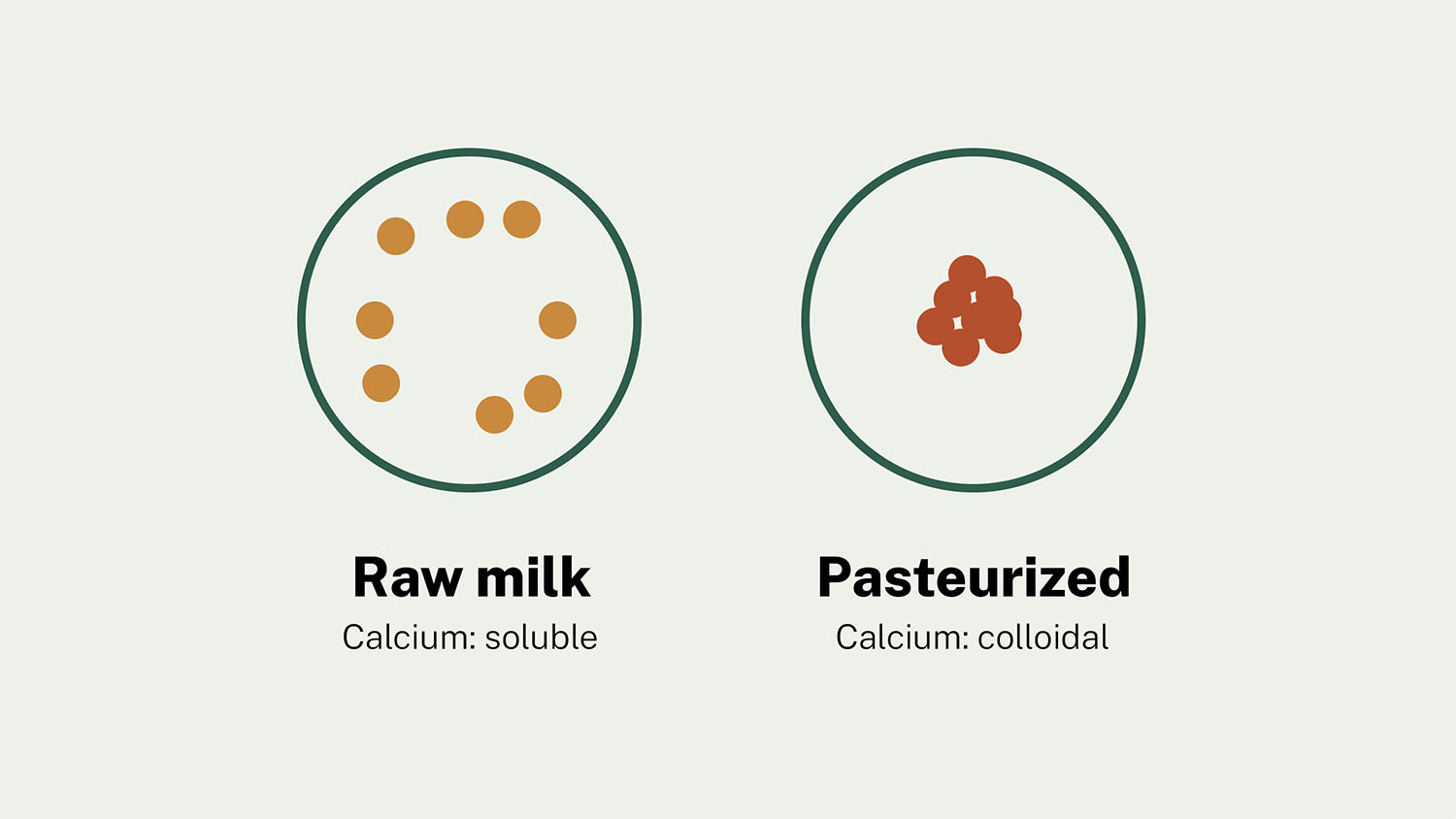
Heat shifts milk calcium from a soluble form, scattered in the milk serum, to a colloidal form bound to casein micelles, the same total amount of calcium in a different physical arrangement.
Pasteurization and Milk Calcium: Form Change vs. Bioavailability
Heat measurably changes where calcium sits within milk’s chemistry, shifting it between soluble and colloidal (protein-bound) forms. That chemical shift is well documented and easy to demonstrate in a lab. Whether it changes how much calcium a person’s body actually absorbs is a separate question, and it has been tested directly, more than once, with a notably consistent answer.
Key facts:
- Heating milk above roughly 60°C shifts calcium, magnesium, and phosphate from the soluble phase into the colloidal phase, where they associate with casein micelles as insoluble calcium phosphate.
- A controlled rat study using radioactive 47Ca tracing compared raw, HTST-pasteurized, and UHT milk for intestinal calcium absorption and femoral bone deposition, and found no significant effect attributable to heat treatment in any comparison.
- A separate comparison of thermal treatment against high-pressure processing found that in vitro calcium bioaccessibility was significantly higher after HPP (98.4%) than after thermal treatment (91.3%), yet actual calcium bioavailability was statistically equal across every processing method tested, a useful illustration of why solubility and absorption are not the same measurement.
- A 2021 comparative study using modern static in vitro digestion models found that milk processing did measurably affect bioaccessibility of calcium, magnesium, and zinc, with goat milk and its dairy products showing higher calcium and magnesium bioaccessibility than the equivalent cow milk products.
- At UHT and sterilization-range temperatures (130°C+), heat treatment can cleave the physical linkage between colloidal calcium phosphate and casein in ways not seen at standard 72°C pasteurization, making processing intensity, not simply “raw versus pasteurized,” the more relevant variable.
How Heat Changes Calcium’s Chemical Form in Milk
Calcium in raw milk already exists in two forms simultaneously: a soluble fraction dissolved in the milk serum, and a colloidal fraction bound to casein micelles as calcium phosphate. Heating disrupts the equilibrium between these two pools. As temperature rises past roughly 60°C, soluble calcium and soluble phosphate measurably decline within minutes, as the minerals transfer into the colloidal phase and form additional calcium phosphate deposits in and around the casein micelles. This is a well-established, repeatedly reproduced finding in dairy chemistry, not a contested one.
The mechanism has a secondary effect worth noting: as calcium and phosphate precipitate out of the soluble phase during heating, hydrogen ions are released, contributing to milk’s measurable drop in pH under intense heat treatment. A classic analysis of heat-induced changes in milk attributed this pH decline to three combined sources, in order of contribution: roughly 50 percent from organic acid production (principally formic acid) as lactose breaks down, about 20 percent from precipitation of calcium phosphate as tertiary phosphate, and the remaining 30 percent from hydrolysis of casein-bound phosphate followed by its own precipitation.
Importantly, this soluble-to-colloidal shift does not mean calcium is being destroyed, removed, or reduced in total quantity. It means the same total amount of calcium redistributes into a different physical form within the milk. Whether that redistribution matters for a person drinking the milk is a distinct, testable question, and it has its own separate body of research.
Does This Chemical Shift Reduce Calcium Bioavailability?
The most direct test of this question used live animals, radioactive tracing, and actual bone measurement, rather than inferring an answer from milk chemistry alone. A 1985 study published in the Journal of Food Science compared calcium bioavailability across raw milk, high-temperature short-time (HTST) pasteurized milk, and UHT-processed milk in rats. Using milk equilibrated with radioactive 47Ca as a tracer, researchers measured both intestinal calcium absorption, corrected and uncorrected for endogenous fecal excretion, and calcium deposition directly in femur bone. In a separate arm of the same study, femur calcium content was measured in rats whose only source of dietary calcium and phosphorus was one of the three milk types. None of these comparisons turned up a heat-related difference large enough to be statistically meaningful.
This finding lines up with the FDA’s own review of the topic, which points to the combined weight of in vitro and in vivo research as showing pasteurization doesn’t meaningfully change either how much of each mineral milk contains or how well the body absorbs it. Of everything reviewed, calcium gets singled out specifically as the mineral where raw and pasteurized milk are treated as nutritionally interchangeable. A related human study on preterm infants found a similar pattern outside of cow’s milk specifically: heat-treating human milk at 63°C for 30 minutes produced no measurable difference in the absorption and retention of calcium, phosphorus, or sodium compared to unheated human milk.
The Bioaccessibility vs. Bioavailability Distinction
One reason different studies on this topic can appear to disagree is that “bioaccessibility” and “bioavailability” are not interchangeable measurements, and conflating them produces misleading conclusions. Bioaccessibility refers to how much of a mineral becomes soluble and available for potential absorption during simulated digestion, typically measured in a test tube using an in vitro digestion model. Bioavailability refers to how much of that mineral actually crosses the intestinal barrier and becomes usable in a living organism, which requires an animal or human study to measure directly.
A study comparing thermal treatment against high-pressure processing (HPP) in milk-based beverages illustrates why this distinction matters. It found that in vitro calcium bioaccessibility was significantly higher after HPP (98.4 percent) than after conventional thermal treatment (91.3 percent), a real, measurable difference in the test tube. Yet when the researchers measured actual calcium bioavailability using a Caco-2 human intestinal cell model, calcium bioavailability came out statistically equal across every processing method tested. In other words, the two treatments produced different amounts of “available” calcium on paper, but the body’s actual absorption mechanism appeared to compensate, erasing the difference by the time calcium was positioned to cross into the bloodstream.
Newer In Vitro Research Complicates the Picture Somewhat
Not every study lines up neatly with the “no difference” conclusion, and it would be an overstatement to say the question is entirely closed. A 2021 comparative study using modern static in vitro digestion models, testing both a solubility method and a dialysis method, found that milk processing did measurably affect the bioaccessibility of calcium, magnesium, and zinc across raw milk, pasteurized milk, yogurt, and cheese. The same study found that goat milk and its dairy products generally showed higher calcium and magnesium bioaccessibility than the equivalent cow milk products, and that cheese specifically showed higher potential calcium and zinc absorption than milk or yogurt regardless of the digestion model used.
This study measured bioaccessibility rather than bioavailability, so it does not directly contradict the older in vivo bioavailability research described above; it measures an earlier stage in the same overall process. But it is a useful reminder that processing-related mineral effects are more actively studied and more nuanced than a single decades-old animal study can fully settle, particularly as newer in vitro digestion models like INFOGEST have become more standardized and widely used across the field.
What About Other Minerals? Zinc and Selenium
Calcium is not the only mineral this question has been tested on. A separate in vitro study measured the effect of milk processing on zinc and selenium specifically, finding that neither pasteurization (73°C for 15 seconds) nor sterilization (110°C for 10 minutes) affected the bioavailability of zinc or selenium in milk relative to untreated milk, using the same in vitro methodology.
Where the Chemical Shift Becomes Structurally Significant
The soluble-to-colloidal calcium shift described earlier is a matter of degree, and its structural consequences become considerably more pronounced at heat intensities well beyond standard pasteurization. Research on milk heated to UHT and sterilization-range temperatures (roughly 130°C and above) has documented an outright cleavage of the physical linkage between colloidal calcium phosphate and the casein proteins it is normally associated with, along with instability in the casein micelle structure itself and, in concentrated or UHT-processed products, eventual sedimentation of calcium phosphate deposits during storage. These structural effects are part of why UHT milk has different processing and stability characteristics than HTST-pasteurized milk, but they occur at temperatures well above the 72°C standard pasteurization threshold, and the bioavailability research described above was conducted using standard HTST pasteurization, not UHT or sterilization-range treatment.
What This Research Does Not Show
The calcium redistribution mechanism above is solid, uncontested dairy chemistry: heat shifts calcium from soluble to colloidal form, and this effect intensifies with higher processing temperatures.
What this research does not show is that standard HTST pasteurization meaningfully reduces how much calcium a person’s body actually absorbs from milk. Specifically:
- The strongest available evidence on this question is an animal study, not a human clinical trial; while its methodology (radioactive tracing plus direct bone measurement) is considered rigorous, it has not been replicated at scale in humans specifically for calcium.
- The 2021 in vitro study showing processing-related bioaccessibility differences did not measure actual bioavailability in a living organism, so it cannot be read as contradicting the older animal bioavailability findings; it addresses an earlier, related but distinct stage of digestion.
- None of the sources here measured a clinical outcome, such as bone density or fracture risk, tied specifically to raw versus pasteurized milk consumption in humans over time.
- Findings on standard HTST pasteurization do not extend to UHT or sterilization-range treatment, where the structural changes to calcium-casein bonding are measurably more severe.
Key Terms
- Colloidal calcium phosphate (CCP): the fraction of milk’s calcium and phosphate that is bound to casein micelles rather than dissolved freely in the milk serum.
- Bioaccessibility: the proportion of a nutrient that becomes soluble and potentially available for absorption during digestion, typically measured with in vitro (test-tube) methods.
- Bioavailability: the proportion of a nutrient that is actually absorbed and used by a living organism, measured through animal or human studies.
- Casein micelle: the complex protein-mineral structure in milk that houses the majority of milk’s protein and colloidal calcium phosphate.
- 47Ca tracing: a research method using a radioactive calcium isotope to directly track calcium absorption and deposition in living tissue.
Frequently Asked Questions
Does pasteurization reduce the amount of calcium in milk? No. Total calcium content is not reduced by pasteurization; heat changes the form calcium takes within the milk, shifting some from a soluble state to a colloidal, protein-bound state, without removing calcium from the product.
Does that chemical shift make calcium harder for the body to absorb? The most direct evidence, a controlled animal study using radioactive calcium tracing and bone measurement, found no significant difference in calcium absorption or bone deposition between raw, HTST-pasteurized, and UHT milk.
Why do some studies seem to disagree about this? Different studies measure different things. In vitro “bioaccessibility” studies measure how soluble a mineral becomes during simulated digestion, while in vivo “bioavailability” studies measure actual absorption in a living organism. A processing method can measurably change bioaccessibility without changing bioavailability, as shown directly in at least one comparative study.
Does this apply to UHT milk as well as standard pasteurized milk? Not entirely. The bioavailability research showing no significant difference was conducted using standard HTST pasteurization. At UHT and sterilization-range temperatures, the physical bond between colloidal calcium phosphate and casein can be structurally altered in ways not seen at standard pasteurization temperatures.
Are other milk minerals affected by pasteurization? Research on zinc and selenium specifically found no effect of pasteurization or sterilization on their bioavailability, using the same in vitro testing methodology applied to calcium.