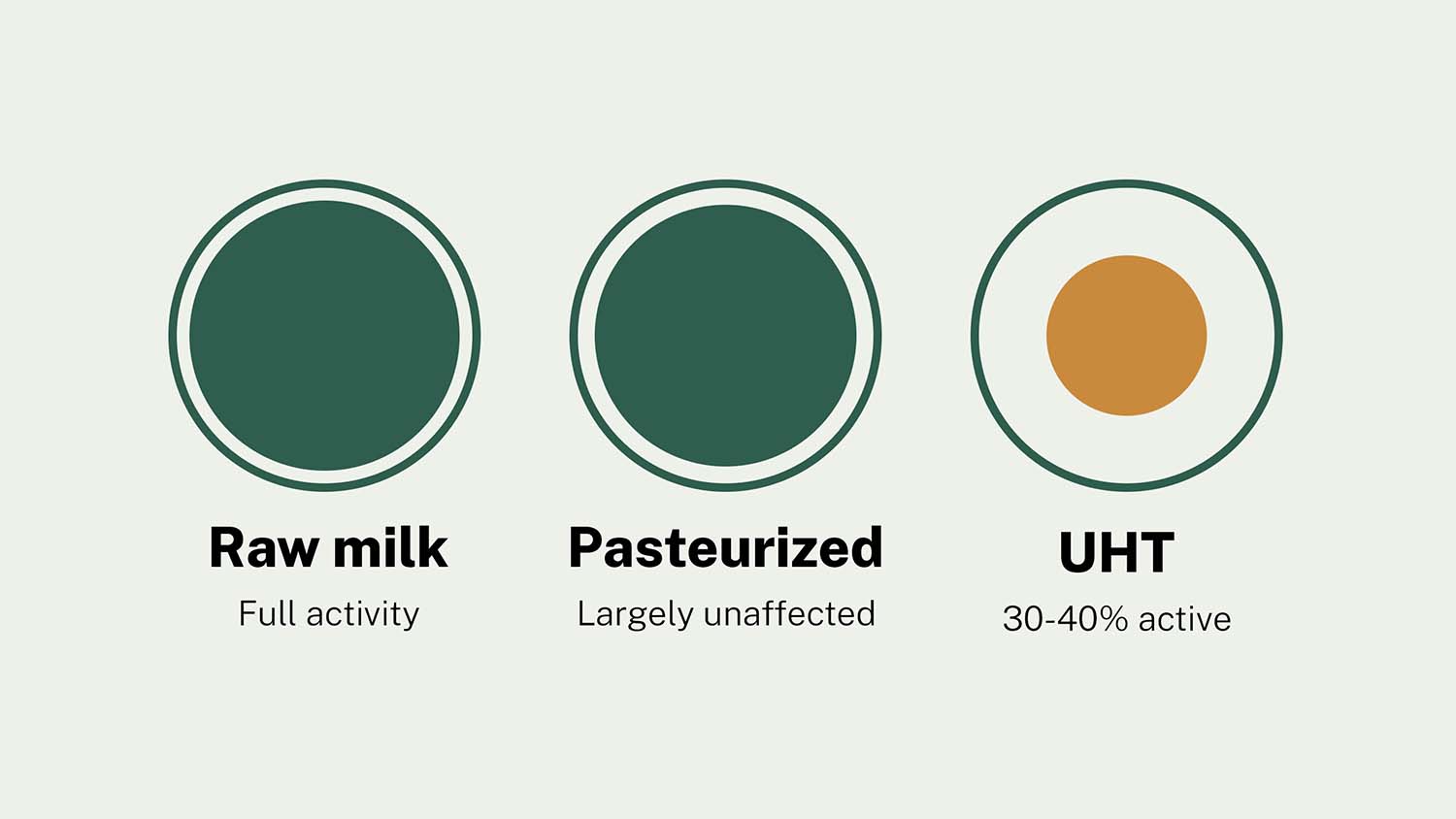
Plasmin, milk's main native protease, stays largely unaffected by standard pasteurization and retains 30 to 40 percent of its activity even after UHT sterilization, unlike most milk enzymes.
Plasmin: The Heat-Stable Milk Enzyme That Survives Pasteurization
Most of the enzymes discussed elsewhere in this science cluster share a common trait: heat knocks them out, to varying degrees, and that sensitivity is often exactly what makes them useful as pasteurization markers. Plasmin breaks that pattern. It is milk’s principal native protein-cutting enzyme, and it survives standard pasteurization largely untouched, then keeps a meaningful share of its activity even after UHT sterilization. A related enzyme, cathepsin D, tells a different story under the same heat, and the contrast between the two is one of the more specific, well-documented findings in this area of dairy science.
Key facts:
- Plasmin activity is largely unaffected by standard pasteurization, and 30 to 40 percent of its activity remains even after UHT treatment.
- A 2023 cross-species study measuring plasmin, cathepsin D, and elastase across bovine, ovine, and caprine milk found plasmin activity in caprine and ovine milk dropped 69 to 75 percent at 75°C for 15 seconds, while cathepsin D activity in spray-dried bovine milk increased 2.8-fold under the same general heat exposure.
- Plasmin’s heat resistance isn’t a property of the enzyme in isolation. Casein in the surrounding milk physically shields the unfolded protein from irreversible inactivation, which is a large part of why it survives heat that destroys other milk enzymes.
- An earlier bovine-specific study found non-specific milk protease activity dropped 44 percent in the casein fraction after 63°C for 30 minutes, while more intensive heat (85°C for 5 minutes) produced effects that varied by species and by milk fraction rather than a single uniform decline.
- Milk’s protease enzymes aren’t just pasteurization trivia. They contribute measurably to protein digestion, and research has linked bioactive peptides they generate to functions including gut mucosal development and immune signaling.
What Plasmin Actually Is
Plasmin is a heat-stable alkaline serine proteinase, meaning it cuts proteins apart using an alkaline-active enzymatic mechanism, and it is the dominant native protein-cutting enzyme in good-quality milk. It doesn’t originate in the mammary gland the way most milk proteins do. Plasmin is derived from blood, where its primary job is dissolving blood clots, and it makes its way into milk as part of a larger regulatory system that includes its inactive precursor form (plasminogen), activators that convert plasminogen into active plasmin, and inhibitors that keep the whole system in check.
Once in milk, plasmin has a fairly broad appetite for the casein proteins, particularly β-casein and αs-casein, cutting them into smaller fragments. This isn’t purely a processing curiosity: in cheesemaking specifically, that same proteolytic activity is one of the processes that helps develop flavor and texture during aging, even though the same activity is considered undesirable in pasteurized or UHT fluid milk, where it can cause unwanted gelation and reduced shelf stability over time.
The Core Finding: Plasmin Survives Heat That Destroys Other Enzymes
A foundational 1984 study in the Journal of Dairy Research established the basic fact this entire topic rests on: plasmin activity in skim milk was largely unaffected by standard pasteurization conditions, and 30 to 40 percent of its activity remained detectable even after full UHT processing. That’s a strikingly different survival profile than the enzymes covered elsewhere in this cluster, most of which lose the large majority of their activity well before reaching UHT-range heat.
The mechanism behind that resistance is itself worth understanding, because it isn’t simply that plasmin’s own molecular structure happens to be unusually tough. Research into the enzyme’s thermal behavior found that plasmin’s heat stability comes largely from an external source: casein in the surrounding milk physically protects the unfolded, heat-stressed enzyme from the kind of irreversible structural collapse that would otherwise destroy it. In other words, plasmin’s survival is partly a property of the milk matrix it sits in, not purely a property of the enzyme itself.
Cross-Species Confirmation, and a Sharp Contrast With Cathepsin D
A 2023 study published in Food Research International put plasmin’s heat resistance to a direct, controlled, cross-species test, and in the process documented a genuinely striking contrast with a second milk protease, cathepsin D.Researchers measured plasmin, cathepsin D, and elastase activity in bovine, ovine, and caprine milk under two heat treatments, 63°C for 30 minutes and 75°C for 15 seconds, and two drying methods, spray-drying and freeze-drying, comparing all of it against non-dried raw milk.
At the higher heat condition, plasmin activity in caprine and ovine milk dropped by 69 to 75 percent, a real, statistically significant loss. But cathepsin D moved in the opposite direction under related conditions: its activity in spray-dried bovine milk actually increased 2.8-fold. That divergence, one enzyme’s activity falling sharply while a related enzyme’s measured activity rises under a comparable processing step, is the kind of specific, quantified contrast that’s easy to miss if these two proteases get lumped together as a single category.
A separate 2021 study by an overlapping research team adds further texture to the plasmin side of this picture. Testing bovine, ovine, and caprine milk under both LTLT (63°C for 30 minutes) and a more intensive short treatment (85°C for 5 minutes), it measured a 44 percent drop in non-specific protease activity in the bovine casein fraction at the gentler condition, though that particular change did not reach statistical significance. Effects at the more intensive treatment depended heavily on both species and which milk fraction, whey or casein, was being measured: ovine whey protease activity dropped 49 percent under that treatment, while ovine casein protease activity actually rose 68 percent under the identical treatment, a reminder that “heat effect on milk protease activity” isn’t a single number even within one species.
What Cathepsin D Is, and Why It Behaves Differently
Cathepsin D is milk’s second major native proteinase, and it comes from an entirely different biological source than plasmin. Where plasmin arrives via blood, cathepsin D is a lysosomal enzyme originating from somatic cells, the white blood cells naturally present in milk as part of the body’s normal immune surveillance. Its substrate preferences are also more specific than plasmin’s broad casein-cutting activity: cathepsin D primarily targets β-casein and α-lactalbumin at defined cleavage sites, while native β-lactoglobulin largely resists it.
That somatic cell origin is worth being precise about, because it’s easy to conflate with a very different topic: somatic cell count (SCC) as a milk quality and udder health metric. Research in this area does show that cathepsin D and elastase activity run higher in milk from cows with mastitis or elevated somatic cell counts than in milk from healthy cows. That’s a real finding about the enzyme’s biological source, not a statement about pasteurization or heat treatment, and it shouldn’t be read as commentary on raw milk safety standards one way or the other. Plasmin, by contrast, is present in all milk regardless of somatic cell count, since it comes from blood rather than from somatic cells specifically.
Beyond Pasteurization Markers: What These Enzymes Actually Do
Stepping back from the heat-stability data for a moment, plasmin, cathepsin D, and related proteases aren’t just laboratory curiosities used to distinguish processing methods. The same 2023 cross-species study found that milk’s own endogenous proteases contributed more to protein breakdown during simulated gastric digestion than the digestive enzymes added in the experimental model, and protease activity generally increased further after digestion regardless of species. Separate research has connected the peptide fragments these enzymes generate to a range of documented bioactivities, including roles in mucosal development and immune signaling, positioning these proteases as functionally active participants in digestion rather than simply structural proteins along for the ride.
Plasmin’s activity also persists into processed dairy products in ways that matter practically. In reconstituted non-fat dry milk, plasmin activity and plasminogen activation were both measurable in milk powder spray-dried after low-heat treatment (72°C for 15 seconds), while powder made from milk heated more intensively (100°C for 30 seconds) showed no plasmin activity at all, a useful illustration of how the same heat-stability principle carries through into a very different product format than fluid milk.
What This Research Does Not Show
The heat-stability data above is well documented: plasmin survives standard pasteurization largely intact and retains a substantial share of its activity even after UHT treatment, a genuinely unusual profile among milk’s native enzymes.
What this research does not show is that plasmin’s survival, or cathepsin D’s somatic cell origin, has any bearing on milk safety or quality claims beyond what’s specifically measured here. Specifically:
- None of the studies cited here measured a human health or nutritional outcome tied to consuming plasmin-active milk; all of the findings are enzymatic activity measurements in milk itself or in simulated digestion models.
- Cathepsin D’s association with elevated somatic cell count in mastitic milk is a finding about milk quality and udder health, not a finding about pasteurization’s effects, and shouldn’t be extended into a broader claim about raw milk safety in either direction.
- The most detailed cross-species heat and drying comparison used ovine and caprine milk for its most dramatic percentage figures; the bovine-specific historical data available shows a real but differently structured pattern, decreasing in some fractions and increasing in others depending on heat intensity, and shouldn’t be assumed to mirror the ovine and caprine figures exactly.
- Plasmin’s role in cheese ripening flavor development is well established in dairy science, but that is a food-processing outcome, not evidence bearing on any consumer health question.
Key Terms
- Plasmin: milk’s principal native proteinase, derived from blood, that cuts casein proteins and is notably resistant to heat inactivation.
- Plasminogen: the inactive precursor form of plasmin, present in milk alongside activators that convert it to active plasmin and inhibitors that regulate the system.
- Cathepsin D: a second major milk proteinase, originating from somatic cells rather than blood, with more specific substrate preferences than plasmin and different heat behavior.
- Somatic cell count (SCC): a measure of white blood cell concentration in milk, used as a udder health and milk quality indicator, distinct from and not directly comparable to pasteurization heat-stability findings.
- Proteolysis: the breakdown of proteins into smaller peptide fragments, the general process both plasmin and cathepsin D carry out on milk’s casein proteins.
Frequently Asked Questions
Does pasteurization destroy plasmin in milk? No, not to any significant degree. Plasmin activity is largely unaffected by standard pasteurization conditions, and the enzyme retains 30 to 40 percent of its activity even after full UHT sterilization, a notably higher survival rate than most other milk enzymes.
Why is plasmin so heat-resistant compared to other milk enzymes? Its resistance comes largely from casein in the surrounding milk, which physically protects the unfolded, heat-stressed enzyme from irreversible structural collapse. The stability is partly a property of the milk matrix, not solely the enzyme’s own structure.
Does cathepsin D behave the same way under heat as plasmin? No. A cross-species study found plasmin activity dropped 69 to 75 percent in caprine and ovine milk under one heat treatment, while cathepsin D activity in spray-dried bovine milk actually increased 2.8-fold under related conditions, a clear divergence between the two enzymes.
Is cathepsin D related to somatic cell count in milk? Yes, cathepsin D originates from somatic cells and its activity runs higher in milk from cows with mastitis or elevated somatic cell counts. This is a finding about the enzyme’s biological source and milk quality, not a finding related to pasteurization or a basis for broader safety claims.
Do these enzymes do anything besides affect dairy processing? Yes. Milk’s native proteases contribute to protein digestion and generate peptide fragments linked to documented bioactivities, including roles in gut mucosal development and immune signaling, functions that extend beyond their use as processing or pasteurization indicators.