Cold-Storage Bacteria Leave Enzymes Pasteurization Can’t Touch
Refrigeration is supposed to be the thing that keeps milk safe between the farm and the glass. For one specific category of bacteria, cold is exactly where they thrive, and the enzymes they leave behind in milk are frequently tough enough to survive pasteurization, and even UHT sterilization, completely intact. Understanding what these bacteria are and what their enzymes actually do is a different kind of cold-storage question than most people think to ask.
Key facts:
- Psychrotrophic bacteria are defined by their ability to grow at 7°C or below, regardless of what temperature they actually prefer, and during refrigerated storage they come to dominate raw milk’s bacterial population.
- The extracellular proteases and lipases these bacteria produce can resist standard pasteurization (72°C for 15 seconds) and even UHT processing (138°C for 2 seconds or 149°C for 10 seconds).
- In a large-scale test of isolated bacterial strains, more than 70 percent of original protease activity survived heat treatment in 84 of 301 strains checked, and the same threshold held for lipase activity in 48 of 262 strains tested.
- Raw milk of very high starting quality can have a shelf life as long as 17 days under refrigeration before psychrotrophic organisms and their enzymes noticeably degrade its sensory quality.
What Psychrotrophic Bacteria Actually Are
Psychrotrophic bacteria are defined purely by a capability, not a preference: they’re able to grow at refrigeration temperatures of 7°C or below, even though most of them grow faster at warmer temperatures when given the choice. That distinction matters, because it means putting milk in the fridge doesn’t stop these organisms the way it stops most other bacteria, it just slows them down. In a clean farm environment, psychrotrophs might make up as little as 10 percent of the milk’s total bacterial population; in a dirtier one, that figure can climb to 75 percent. Either way, cold storage acts as a selective filter that favors them over time, since the bacteria that can’t tolerate cold get outcompeted while the psychrotrophs keep growing, however slowly.
A foundational study tracking four farms over ten months found that psychrotrophic populations increased within just 24 hours of refrigeration. The dominant genera identified across those farms included Pseudomonas, Acinetobacter, Lactococcus, Leuconostoc, and Microbacterium, and their enzymatic behavior wasn’t uniform: Pseudomonas and Acinetobacter were highly lipolytic (fat-degrading), Microbacterium was both highly lipolytic and proteolytic (protein-degrading), while the lactic acid bacteria genera showed only minor enzymatic activity by comparison. Roughly 20 percent of isolated strains in that study turned out to be entirely novel species, which is a useful reminder of how much is still being learned about exactly which organisms are living in refrigerated raw milk.
The Core Finding: Enzymes That Outlive the Bacteria That Made Them
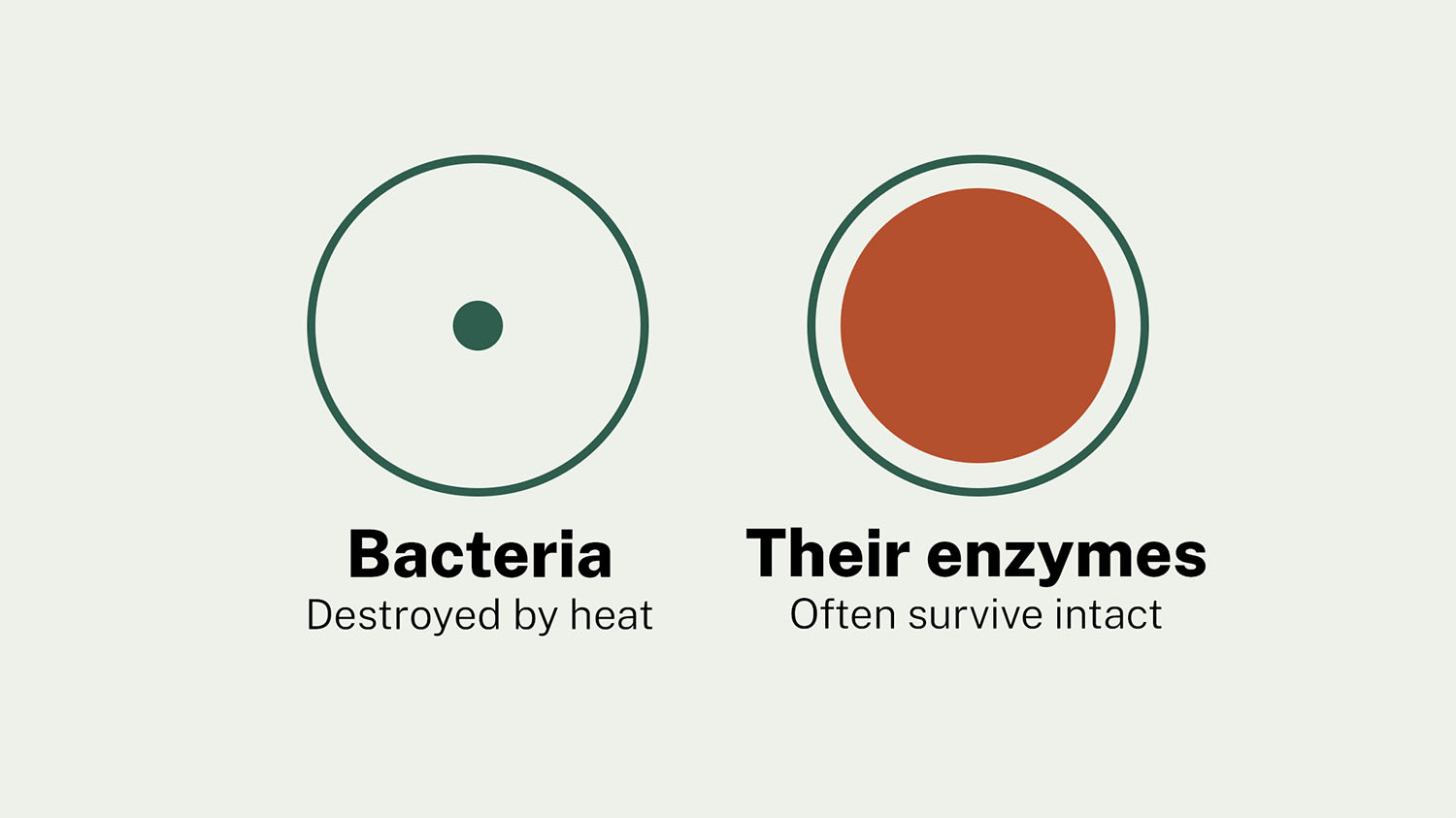
Here’s the part that makes psychrotrophs a genuinely distinct concern from ordinary bacterial contamination: pasteurization and even UHT sterilization reliably kill the bacteria themselves, but the extracellular enzymes those bacteria secreted while growing in cold storage often survive the same heat treatment intact. A review of the literature found these proteases and lipases can resist standard pasteurization (72°C for 15 seconds) and hold up even under UHT conditions (138°C for 2 seconds, or 149°C for 10 seconds), heat intensities that destroy essentially all vegetative bacterial cells.
The scale of this heat resistance has been measured directly. In one large test spanning hundreds of isolated bacterial strains, more than 70 percent of original protease activity survived heat treatment in 84 of the 301 strains checked, and the same threshold, over 70 percent surviving, held for lipase activity in 48 of the 262 strains tested for that trait. That’s not a marginal exception; it’s a substantial fraction of the psychrotrophic population capable of leaving behind enzymes that heat treatment simply doesn’t reach.
What These Enzymes Actually Do to Milk
The downstream effects of these heat-surviving enzymes are well documented in dairy science, and they’re specific. Proteases, which break down proteins, are linked to bitterness in milk and to a defect called “age gelation,” where UHT milk gradually thickens over its storage life and eventually forms a visible gel. Lipases, which break down fat, produce rancid, soapy off-flavors by hydrolyzing triglycerides into free fatty acids. Both defects are quality and flavor problems rather than food safety issues in the sources reviewed here; none of the research on these specific heat-stable enzymes frames them as a direct human health hazard. They’re a reason milk or dairy products might taste or feel wrong well into their shelf life, not a documented safety risk in their own right.
Storage Time Matters Even When the Cold Chain Never Breaks
It’s tempting to assume that as long as milk stays properly refrigerated the whole way through, psychrotrophic growth is a non-issue. The research doesn’t fully support that assumption. One study designed specifically to test this found that prolonged refrigerated storage, even with the cold chain maintained continuously and no temperature excursions, still allowed psychrotroph populations and their enzyme output to increase measurably over time. In other words, a properly maintained refrigerator slows the clock, but time itself is still working against milk quality in a way that temperature control alone doesn’t fully stop.
There are some non-thermal interventions that show partial promise for reducing this specific problem. High-pressure homogenization has been shown to reduce Pseudomonas-driven proteolysis by 29 percent at 100 megapascals and by 51 percent at 150 megapascals in standardized milk samples, suggesting that combining multiple mild interventions, an approach dairy scientists call “hurdle technology,” may accomplish more against these enzymes than any single method alone.
A Related Story: Somatic Cell Count and a Parallel Enzyme Source
Psychrotrophic bacteria aren’t the only source of heat-stable enzyme activity that builds up during refrigerated storage. Research on fluid milk shelf life found that elevated somatic cell count (SCC) in raw milk correlates with increased levels of both heat-stable protease and heat-stable lipase, specifically plasmin and lipoprotein lipase, two enzymes covered in their own dedicated articles elsewhere on this site. This is a genuinely separate mechanism from the bacterial story above; plasmin and lipoprotein lipase are native to milk itself rather than produced by bacteria, and their levels track with somatic cell count rather than with psychrotroph population size. The practical upshot is that refrigerated milk quality decline over time has at least two distinct, parallel contributors: enzymes secreted by cold-adapted bacteria, and native milk enzymes whose levels are tied to somatic cell count, working independently of each other.
What This Research Does Not Show
The data reviewed here is specific and well documented: psychrotrophic bacteria reliably come to dominate raw milk’s microbial population under refrigeration, a substantial share of their enzymes survive standard pasteurization and even UHT heat, and the resulting quality defects (bitterness, gelation, rancidity) are consistently described in the literature.
What this research does not show is that these specific heat-stable enzymes represent a food safety hazard, as opposed to a quality and flavor issue. Specifically:
- None of the sources cited here frame psychrotroph-derived proteases or lipases as a direct pathogen or toxin risk; the documented effects are sensory and textural (bitterness, gelation, rancidity), not safety-related.
- The 17-day shelf-life figure applies specifically to raw milk of very high starting quality with low initial spoilage-microorganism levels; it isn’t a general claim about how long any raw milk sample will last regardless of its initial bacterial load.
- The high-pressure homogenization mitigation data (29 to 51 percent reduction in proteolysis) comes from standardized laboratory milk samples, not a real-world commercial processing comparison, and shouldn’t be read as a guarantee of similar results at production scale.
- The SCC/plasmin/lipoprotein lipase cross-reference describes a correlation between milk quality metrics and enzyme levels; it is not evidence about SCC as a general safety indicator, a distinct and separate topic from what’s covered in these specific sources.
Key Terms
- Psychrotrophic bacteria: bacteria capable of growing at 7°C or below, regardless of their preferred growth temperature, which allows them to continue multiplying during standard refrigeration.
- Extracellular enzyme: an enzyme secreted by a bacterial cell into its surrounding environment, in this case milk, rather than remaining inside the cell; these enzymes can persist and remain active even after the bacteria that produced them are destroyed by heat.
- Age gelation: a quality defect in UHT milk in which the product gradually thickens and eventually forms a visible gel during storage, linked to heat-stable bacterial proteases.
- Hurdle technology: a food-processing approach that combines multiple separate, individually mild preservation methods (such as heat plus high pressure) rather than relying on a single intensive method to achieve the same protective effect.
- Somatic cell count (SCC): a measure of white blood cell concentration in milk, used as a udder health and milk quality indicator, correlated in this article with native enzyme levels rather than with bacterial enzyme production specifically.
Frequently Asked Questions
Does pasteurization destroy the enzymes produced by cold-storage bacteria? Not reliably. While pasteurization and even UHT sterilization kill the psychrotrophic bacteria themselves, a substantial share of the extracellular proteases and lipases those bacteria secrete during refrigerated storage survive the same heat treatment intact.
Is milk spoiled by psychrotroph enzymes unsafe to drink? The sources reviewed here describe these enzymes as a milk-quality and flavor issue, causing bitterness, gelation, or rancidity, not as a documented food safety hazard in their own right.
Does keeping milk properly refrigerated the whole time prevent this problem? Not entirely. Research specifically testing this found that psychrotroph populations and their enzyme output can still increase over extended storage even when the cold chain is maintained continuously without any temperature breaks.
How long can raw milk actually stay fresh in the refrigerator? Raw milk starting from very high quality, meaning low initial levels of spoilage microorganisms, has been documented to maintain acceptable sensory quality for as long as 17 days under refrigeration before psychrotrophic bacteria and their enzymes cause noticeable degradation.
Are bacterial enzymes the only source of heat-stable enzyme buildup in stored milk? No. Separate research found that elevated somatic cell count correlates with higher levels of two native milk enzymes, plasmin and lipoprotein lipase, both also heat-stable and both contributing to quality decline independently of any bacterial activity.