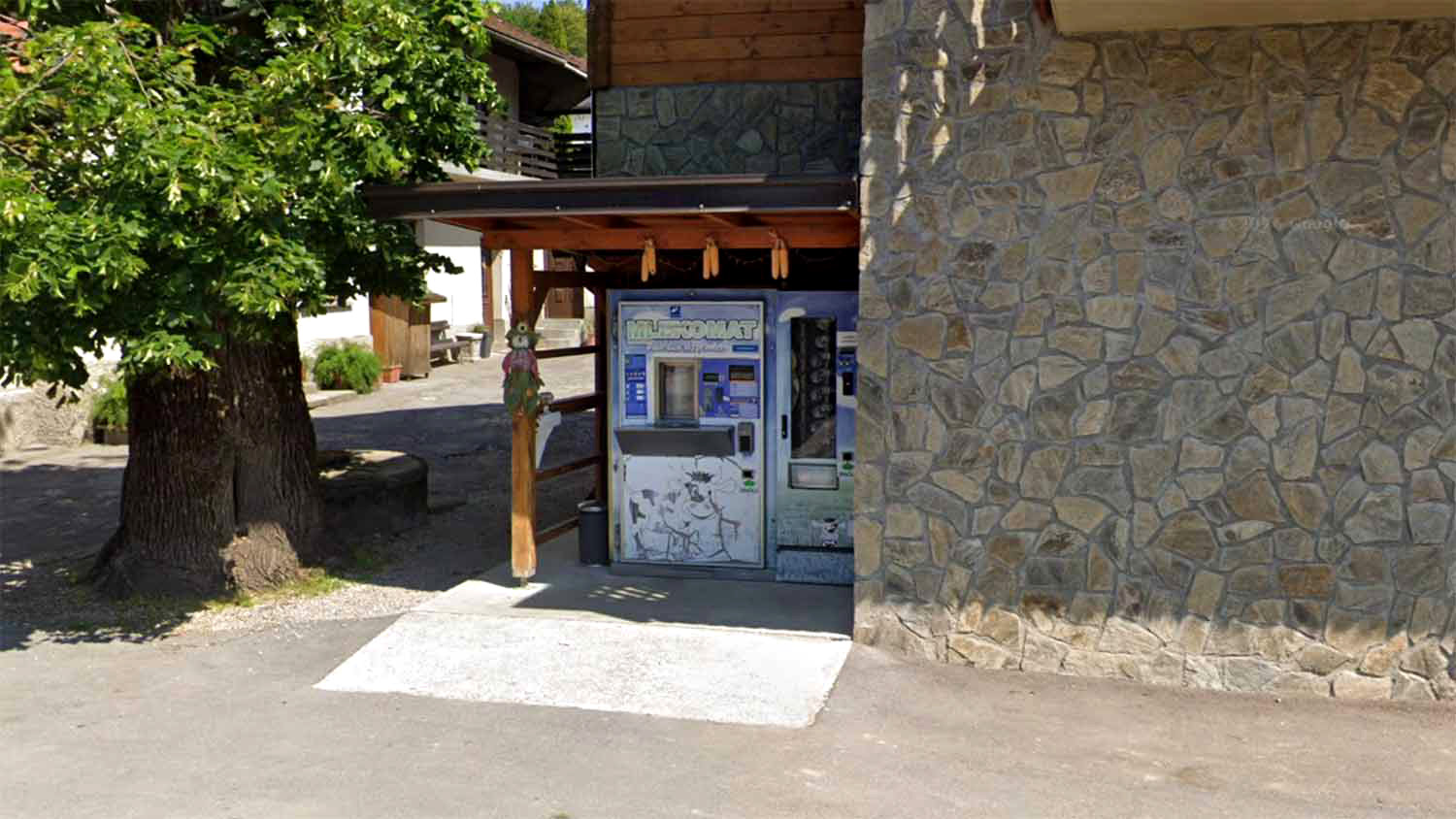
Mlekomat Dolnice, one of three active raw milk vending machines in Ljubljana, installed under a covered shelter in a residential village setting.
How Slovenia’s Dairy Farmers Cut Out the Middleman With Raw Milk Vending Machines
Slovenian dairy farmers receive roughly 30 cents on the euro when they sell milk through conventional merchant channels. When they sell the same milk through a mlekomat, a self-service raw milk vending machine, they receive the full €1.00 to €1.30 per liter directly from the consumer. That price differential drove the adoption of raw milk vending machines in Slovenia and has sustained the network through a decade and a half of operation.
What Is a Mlekomat
Mlekomat (plural: mlekomati) is the Slovenian term for a raw milk vending machine. The name derives from mleko (milk) and avtomat (automated machine). Each machine is owned and supplied by a single dairy farmer, who fills it daily with raw, unpasteurized milk and monitors it remotely. Consumers bring their own glass or plastic bottles, or purchase bottles on-site, and draw as much or as little milk as they need.
The machines operate 24 hours a day. A UV lamp disinfects the dispensing nozzle after each use. A built-in fan repels insects. Temperature is automatically checked every 20 minutes by the machine’s software, and the farmer is notified by SMS alert if the temperature threshold is exceeded or the machine requires attention. Milk sells for approximately €0.10 per deciliter, or €1.00 per liter, rising to around €1.30/liter as of late 2025 based on current Ljubljana listings. A new machine costs approximately €30,000 (Slovenia Times, 2024). Bottles are available on-site if needed.
Each machine is attributed to a specific farm. There is no pooling of milk from multiple farms.
The Economics That Built the Network
Slovenian dairy farmers faced the same structural problem as their counterparts across Europe: supermarket chains consolidated purchasing power over the milk supply chain, driving farm-gate prices to levels that made small and mid-size dairy operations difficult to sustain. Farmers selling through conventional merchant channels received approximately 30% of the final consumer price, with the remainder absorbed by collection, processing, distribution, and retail margins (Total Slovenia News, 2019). The scale of conventional-channel dependency remains significant: according to Slovenia’s national Statistical Office, dairy farms sold 92% of the country’s 625,000 tonnes of cow milk produced in 2022 to dairies and other middlemen (Slovenia Times, 2024).
The mlekomat offered a way around that structure. By selling directly to consumers, a farmer eliminates every intermediary and receives the full machine price. €1.00 per liter was the standard price for most of the network’s history, and at that rate a farmer operating a mlekomat earns more than three times the per-liter return they would receive through cooperative or merchant channels.
From First Machine to National Network
The first mlekomat arrived in Ljubljana in approximately 2009, though sources cite dates ranging from 2008 to 2010 depending on whether they reference the first machine or the first formal regulatory acknowledgment. Contemporary accounts place the first Ljubljana machine at Tržnica, the city’s main market, the same location where Mlekomat Tržnica operates today. The network expanded quickly through the early 2010s, spreading from Ljubljana to cities across Slovenia. By 2019, approximately 70 mlekomati were operating across the country (Total Slovenia News, 2019).
The Slovenian market is served by both of the dominant European manufacturers. Brunimat GmbH (St. Gallen, Switzerland, founded 1994) and DF Italia (Sandrigo, Italy, founded 2004) both list Slovenia among their export markets. Brunimat machines are produced exclusively in Switzerland; DF Italia machines in the Veneto. Both manufacturers produce machines that operate on the same core principle: single-farm attribution, continuous refrigeration, and UV disinfection of the dispensing nozzle between uses.
The machines were placed in a variety of settings beyond farm gates: markets, petrol stations, and other public locations with electrical connections. Each machine can be installed anywhere with power, provided the supplying farmer takes responsibility for daily restocking and hygiene compliance.
Regulatory Context
Slovenia operates its mlekomat network without a codified national legislative framework specifically governing raw milk vending machine sales. No equivalent to Italy’s Intesa Stato-Regioni or France’s Arrêté du 13 juillet 2012 exists. Instead, machines operate under general food safety responsibility principles: it is standard practice, not a legal requirement, that milk is held at 0–4°C and replaced every 24 hours (Godic Torkar et al., British Food Journal, 2017). The Slovenian National Institute of Public Health recommends that consumers heat-treat milk from vending machines before consumption, though the recommendation carries no legal enforcement mechanism.
A 2017 microbiological study by researchers at the National Institute of Public Health of the Republic of Slovenia and the Consumer Association of Slovenia examined 51 raw milk samples from 17 Slovenian vending machines across three seasons. Aerobic colony counts exceeded 100,000 CFU/mL in 39.2% of samples. Temperature compliance was the key operational gap: only 17.6% of samples were at the required 0–4°C at the time of sampling, with average temperatures of 5.3°C in May and 5.9°C in July, both above the standard threshold. The researchers found no correlation between milk temperature and external air temperature at the time of sampling (Godic Torkar et al., British Food Journal, Vol. 119 No. 2, pp. 377–389, 2017).
As of 2018, raw milk became available in some Slovenian shops as well, expanding access beyond vending machines for the first time.
Ljubljana
Three mlekomats are currently active in Ljubljana: Mlekomat Tržnica, Mlekomat Šmartinska c. 45, and Mlekomat Dolnice, all operating 24/7. The central market machine is supplied by a farm at the foot of Šmarna Gora (Slovenia Times, 2024). Current price is approximately €1.30/liter, with bottle vending machines available on-site. Ljubljana’s mlekomats were among the earliest in the country and drew international press coverage between approximately 2013 and 2019, including a February 2014 feature by Fulbright fellow Rebecca McCray for TakePart and subsequent coverage in Modern Farmer.
Current mlekomat locations and raw milk farms across Slovenia are at raw milk in Slovenia.
Italy’s raw milk vending machine network, which directly inspired the mlekomat model, is covered in Italy’s Raw Milk Vending Machines: The Distributori di Latte Crudo. For a broader overview of how raw milk vending machines operate across Europe, see Raw Milk Vending Machines in Europe.