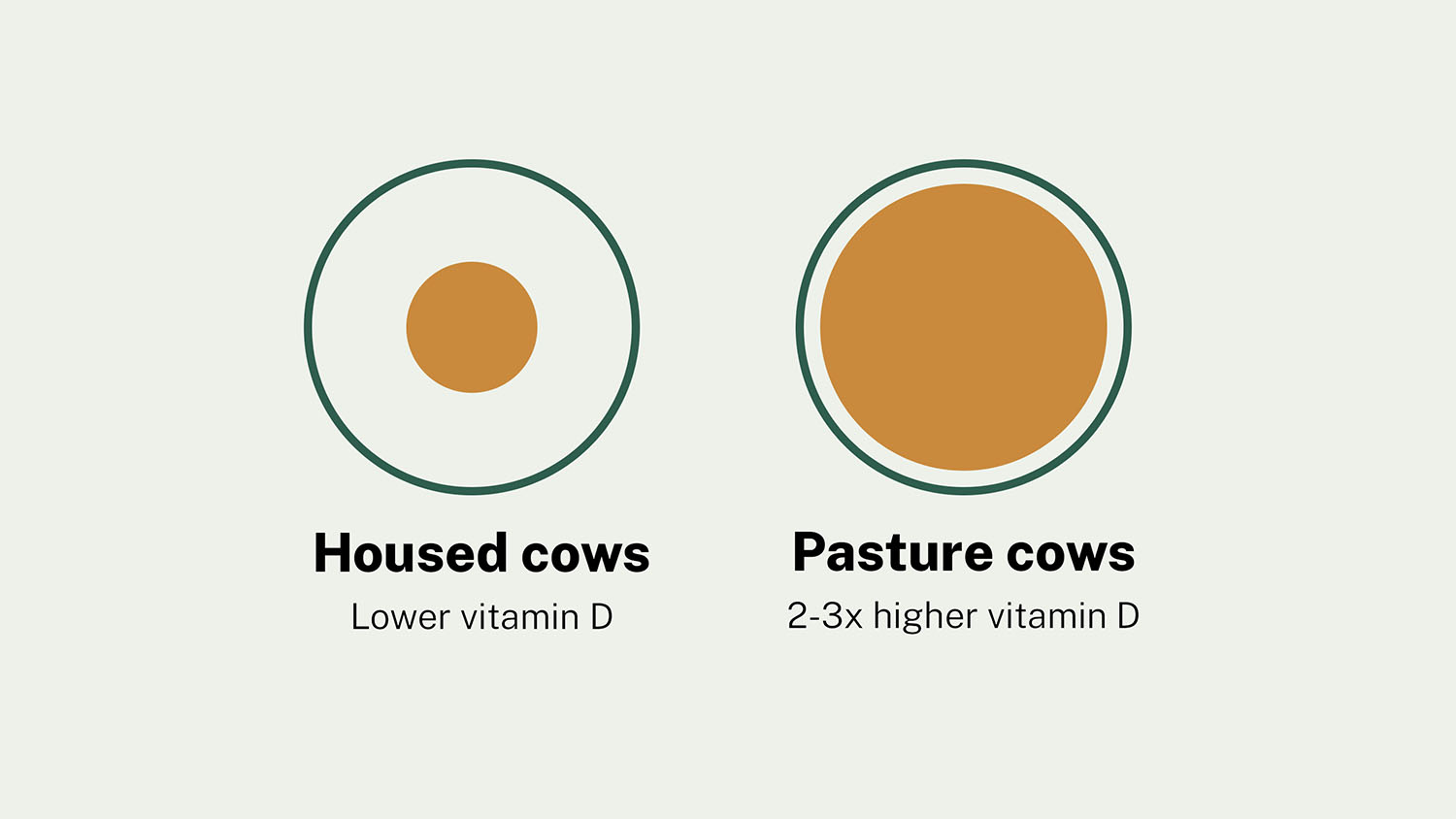
Cows on pasture produce milk with 2 to 3 times higher vitamin D content than the same cows kept housed indoors, a larger natural swing than anything pasteurization has been shown to cause.
Pastured Cows Make More Vitamin D, But That’s Not Where Yours Comes From
Milk has a reputation as a vitamin D food, but that reputation rests almost entirely on fortification, not on what a cow’s udder naturally puts into milk. Separating those two things matters for understanding what pasteurization actually does here: the processing question turns out to be a minor character in a story that’s really about deliberate, industrial-scale supplementation.
Key facts:
- Natural, unfortified milk contains only 0.34 to 0.84 IU of vitamin D per gram of fat, a level widely described as nutritionally insignificant on its own.
- A study measuring vitamin D3 directly in Italian raw and pasteurized cow’s milk found pasteurized samples were often higher in vitamin D3 than raw milk from individual farms, not because pasteurization adds vitamin D, but because commercially pasteurized milk is typically pooled from multiple farms to standardize fat content, averaging out the natural variability any single raw milk source shows.
- Cows on pasture show 2- to 3-fold higher vitamin D in their milk than the same cows kept housed indoors, a larger natural swing than anything pasteurization itself has been shown to cause.
- In countries with mandatory or widespread dairy fortification, fortified milk contributes 28 to 63 percent of total dietary vitamin D intake; in countries without that policy, milk’s contribution to vitamin D intake is far smaller.
Milk Was Never Much of a Vitamin D Source to Begin With
Before getting into what heat does to milk’s vitamin D, it’s worth being clear about how little is there in the first place. Unfortified milk contains somewhere between 0.34 and 0.84 IU of vitamin D per gram of milk fat, a range widely described in the fortification literature as not nutritionally significant on its own. This baseline fact matters more than almost anything else in this article: whatever pasteurization does or doesn’t do to that small amount, it was never a meaningful dietary source to start with, unlike the calcium or protein content covered elsewhere in this cluster.
The reason vitamin D shows up prominently on a modern milk carton’s nutrition label has almost nothing to do with what the cow produced naturally and almost everything to do with a separate industrial process, discussed in detail later in this article.
A Statistical Illusion, Not a Chemical Effect
Direct measurement of raw versus pasteurized cow’s milk turns up a result that’s easy to misread if you don’t look closely at the mechanism behind it. An Italian study using HPLC to measure vitamin D3 directly in paired raw and pasteurized high-quality cow’s milk found that pasteurized samples were, on average, often higher in vitamin D3 than the raw milk. Taken at face value, that could sound like pasteurization somehow increases vitamin D content. It doesn’t, and the study’s own authors explain why: commercially pasteurized milk in that market is typically pooled from multiple different farms specifically to standardize the final product’s fat content, without adding cream or skim milk to do so. Raw milk from any single farm, by contrast, reflects that one herd’s specific feeding, breed, and management conditions. The apparent “increase” is a blending artifact from how commercial milk gets assembled, not a chemical effect of heat treatment. The same study’s authors noted this was the first demonstration that raw milk sold as a premium product doesn’t necessarily contain more vitamin D3 than standard pasteurized milk, despite what a consumer buying a raw-milk-style label might reasonably expect.
Separately, research on donkey milk processing offers a cleaner look at heat’s direct chemical effect, without the farm-pooling confound present in the Italian cow’s milk study. A study measuring vitamin D2 and D3 before and after standard pasteurization (63°C for 30 minutes) in donkey milk found total vitamin D content wasn’t significantly different before and after processing, but vitamin D3 specifically showed poor thermal stability and a real, measurable reduction, while vitamin D2 held up better under the same heat. One complication is worth being direct about, though: the Italian cow’s milk study’s own authors describe vitamin D’s thermal stability as “still a controversial aspect” of the broader literature, noting that other published research has found vitamin D generally heat-stable, with pasteurization and sterilization not promoting its degradation. The donkey milk finding on vitamin D3 specifically is a real, measured result, but it sits inside a body of research that hasn’t fully converged on a single answer for how heat-sensitive vitamin D in milk actually is.
Why Milk’s Vitamin D Content Varies So Much Between Studies
A recurring theme across the research reviewed for this article is that vitamin D content in raw milk varies dramatically for reasons that have nothing to do with processing at all. The single largest factor identified is sun exposure: cows kept on pasture show vitamin D levels 2 to 3 times higher in their milk than the same cows kept housed indoors, since vitamin D synthesis in the animal itself depends heavily on sunlight exposure, mirroring the same basic biology that governs vitamin D synthesis in human skin. That’s a considerably larger swing than any processing-related effect discussed in this article.
Season and production system add further variation on top of that. Milk vitamin D3 content has been shown to vary significantly across seasons and between organic and conventional production systems, and even shows measurable differences tied to genetic variation between individual herds, specifically linked to a polymorphism in the gene for β-lactoglobulin, one of milk’s major whey proteins. Taken together, this is a useful reminder that when two studies report different raw-milk vitamin D baselines, the difference is often explained by which cows, which season, and which farming system produced the milk, not by any inconsistency in the underlying research.
The Real Story: Fortification, Not the Cow or the Processing Method
Whatever vitamin D content shows up on a typical commercial milk carton’s nutrition label almost certainly comes from deliberate fortification, added after milking and processing, rather than from the animal or the pasteurization process itself. In countries with mandatory or widespread dairy fortification programs, including Finland, Canada, and the United States, fortified milk products have been found to contribute 28 to 63 percent of a population’s total dietary vitamin D intake. In countries without comparable fortification policy, milk’s contribution to vitamin D intake drops to far smaller, sometimes negligible, levels. That’s a difference of policy and industrial practice, not biology.
Fortification’s stability once added is a genuinely mixed picture rather than a uniformly reassuring one. Three separate studies examining vitamin D3 added to pasteurized processed cheese reported no measurable loss over 9 months of storage, and a separate analysis found only 7 to 9 percent of added vitamin D3 was lost into the whey fraction during cheesemaking. But that same body of research also includes a contrasting result: a study fortifying Cheddar cheese specifically found a real reduction in vitamin D content over 7 months of ripening, with the degree of loss varying depending on how the vitamin D was added. The honest summary is that fortified vitamin D tends to hold up reasonably well in most tested products and storage conditions, but “no loss ever” would overstate what the research actually shows.
Whether that fortification actually improves people’s vitamin D status is a separate, legitimate question, and one that’s been studied directly. A 2025 systematic review and meta-analysis pooling 35 randomized controlled trials, covering nearly 5,000 participants, found that vitamin D-fortified dairy products measurably increased blood levels of 25-hydroxyvitamin D, the standard marker used to assess vitamin D status. Fortified milk and milk powder raised serum levels by roughly 17 to 18 nmol/L on average, and fortified yogurt performed even better, raising levels by roughly 26 nmol/L, both statistically significant results. That review represents the current best evidence that fortification programs translate into an actual physiological effect, not just a number added to a nutrition label.
What This Research Does Not Show
The data reviewed here is reasonably clear on the big picture: milk’s natural vitamin D content is small regardless of processing, natural variation from farming practices dwarfs any pasteurization effect that’s been measured, and the vitamin D consumers actually get from commercial milk overwhelmingly comes from fortification rather than the animal.
What this research does not show is a single, precise, universally applicable number for how much vitamin D pasteurization itself destroys, independent of the confounding factors described throughout this article.Specifically:
- The clearest raw-versus-pasteurized comparison available for cow’s milk was confounded by commercial milk-pooling practices, meaning it doesn’t isolate pasteurization’s own chemical effect on vitamin D the way a controlled paired sample from a single source would.
- The cleanest evidence for vitamin D3’s specific heat sensitivity comes from donkey milk pasteurized at 63°C for 30 minutes, a different species and a somewhat different protocol than standard bovine HTST pasteurization, and shouldn’t be assumed to produce an identical magnitude of effect in cow’s milk specifically.
- None of the sources reviewed here directly measured whether small changes in milk’s already-minor natural vitamin D content have any detectable effect on a person’s vitamin D status; given how small the baseline contribution is, this is a much lower-stakes question than the fortification-efficacy question addressed separately above.
- The meta-analysis on fortification efficacy addresses whether fortified dairy raises measured vitamin D status; it does not by itself establish an optimal fortification dose or settle every downstream question about fortification policy design.
Key Terms
- Cholecalciferol (vitamin D3): the primary natural form of vitamin D found in animal products including milk, distinct from vitamin D2, with different heat-stability behavior documented in some studies.
- 25-hydroxyvitamin D: the standard blood marker used in clinical and research settings to assess a person’s overall vitamin D status.
- Fortification: the deliberate addition of a nutrient, in this case vitamin D, to a food product after production, distinct from whatever level of that nutrient the food naturally contains.
- High-quality (HQ) milk: an Italian regulatory labeling category for milk meeting specific quality standards around breeder management, hygiene, and composition, though notably without any vitamin D-specific requirement.
- Milk pooling: the common commercial dairy practice of combining raw milk from multiple farms to standardize a final product’s fat content and other properties before processing.
Frequently Asked Questions
Does raw milk have more vitamin D than pasteurized milk? Not necessarily, and one direct comparison found the opposite on average, though not for the reason it might first appear. Pasteurized milk in that study was pooled from multiple farms to standardize fat content, which averaged out the natural variability seen in any single farm’s raw milk, rather than pasteurization itself increasing vitamin D content.
Does pasteurization destroy vitamin D in milk? The clearest evidence for a real, chemical heat effect comes from donkey milk research, where vitamin D3 specifically showed measurable thermal degradation after pasteurization while vitamin D2 held up better. The broader scientific literature on vitamin D’s heat stability hasn’t fully converged, though, with some other studies finding vitamin D generally heat-stable. A clean comparison for standard bovine HTST pasteurization specifically hasn’t been identified in the sources reviewed here.
Why does milk’s natural vitamin D content vary so much between sources? Mostly due to factors unrelated to processing. Cows on pasture show 2 to 3 times higher milk vitamin D than housed cows, and levels also vary by season, by organic versus conventional production system, and even by individual herd genetics.
Where does the vitamin D on a milk carton’s nutrition label actually come from? Almost entirely from deliberate fortification added after processing, not from the cow or the pasteurization method. In countries with widespread dairy fortification, fortified milk contributes 28 to 63 percent of total dietary vitamin D intake.
Does drinking fortified milk actually improve vitamin D status? Yes, according to the best current evidence. A 2025 systematic review and meta-analysis of 35 randomized controlled trials found vitamin D-fortified dairy products significantly raised blood levels of 25-hydroxyvitamin D, with fortified milk and milk powder raising levels by roughly 17 to 18 nmol/L on average and fortified yogurt by roughly 26 nmol/L.