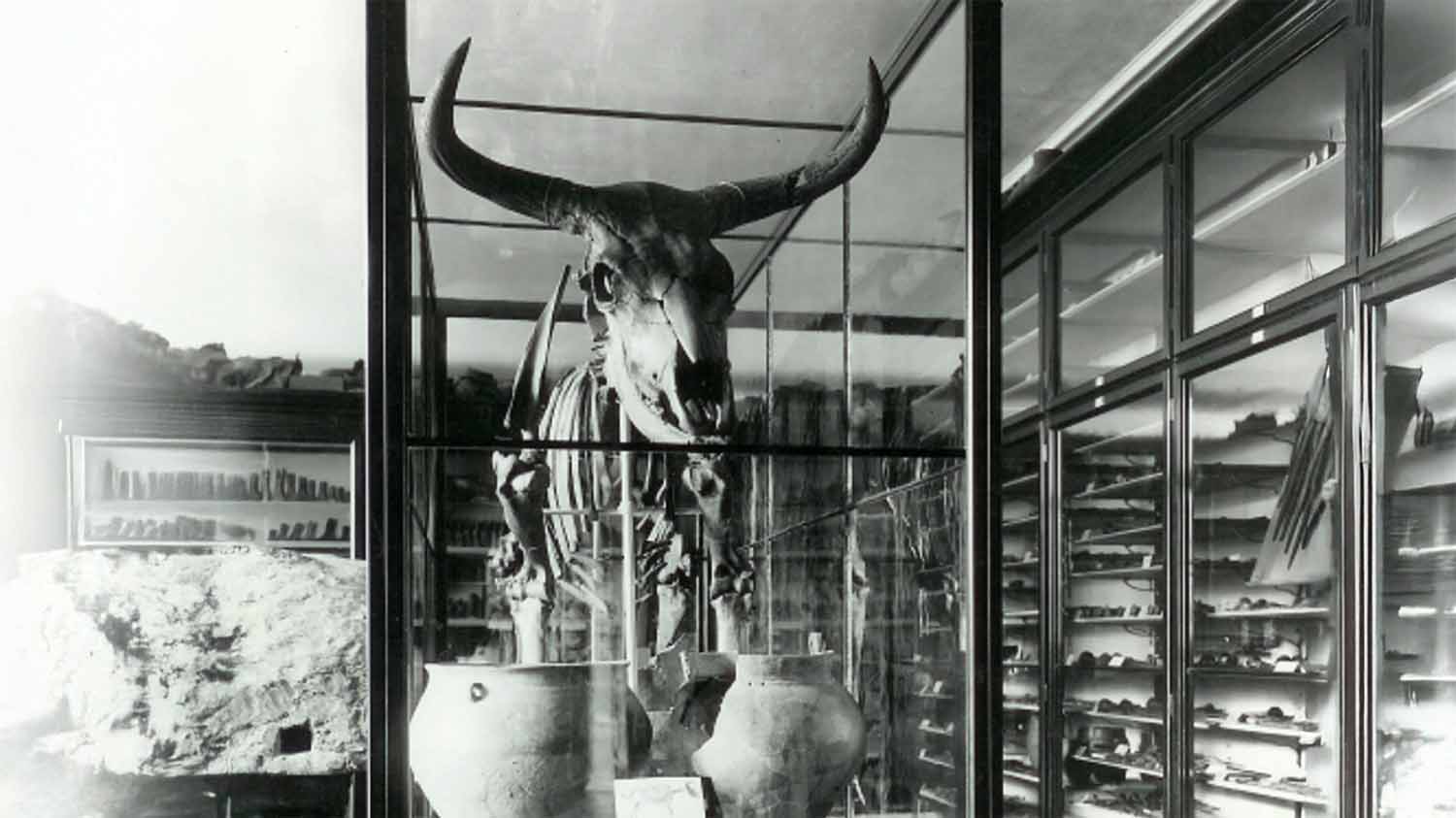
A mounted aurochs skeleton on display in a museum, its wide horns and full frame giving a sense of the animal's true scale.
What Ancient and Historical Writers Said About the Aurochs
The aurochs, wild ancestor of every domesticated cow alive today, went extinct in 1627, when the last individual, a cow, died in the royal forest of Jaktorów near Warsaw. Between the animal’s earliest appearance in the historical record and that final death, more than three thousand years passed, and across that span a surprisingly varied set of witnesses left something behind: gold cups, dedicated horns, secondhand hunting reports, a mounted taxidermy specimen, and at least one detailed field account of a dying herd. None of these sources agree on everything. Taken together, though, they form the closest thing available to a continuous written and artistic record of an animal that shaped the history of cattle, and by extension the history of dairy farming, before disappearing for good.
Quick facts: The earliest artistic evidence connected to aurochs hunting, the Vaphio Cups, dates to roughly 1500 BC. The earliest written account, by Julius Caesar, dates to about 53 BC. The most detailed eyewitness accounts, by Sigismund von Herberstein and Anton Schneeberger, date to the sixteenth century, within decades of the species’ extinction. At least ten named ancient and historical writers left some record of the aurochs before it disappeared. Across that roughly 3,100-year span, sources repeatedly return to two threads: what to do with the horns, and how easily the aurochs got confused with the European bison.
A rough timeline
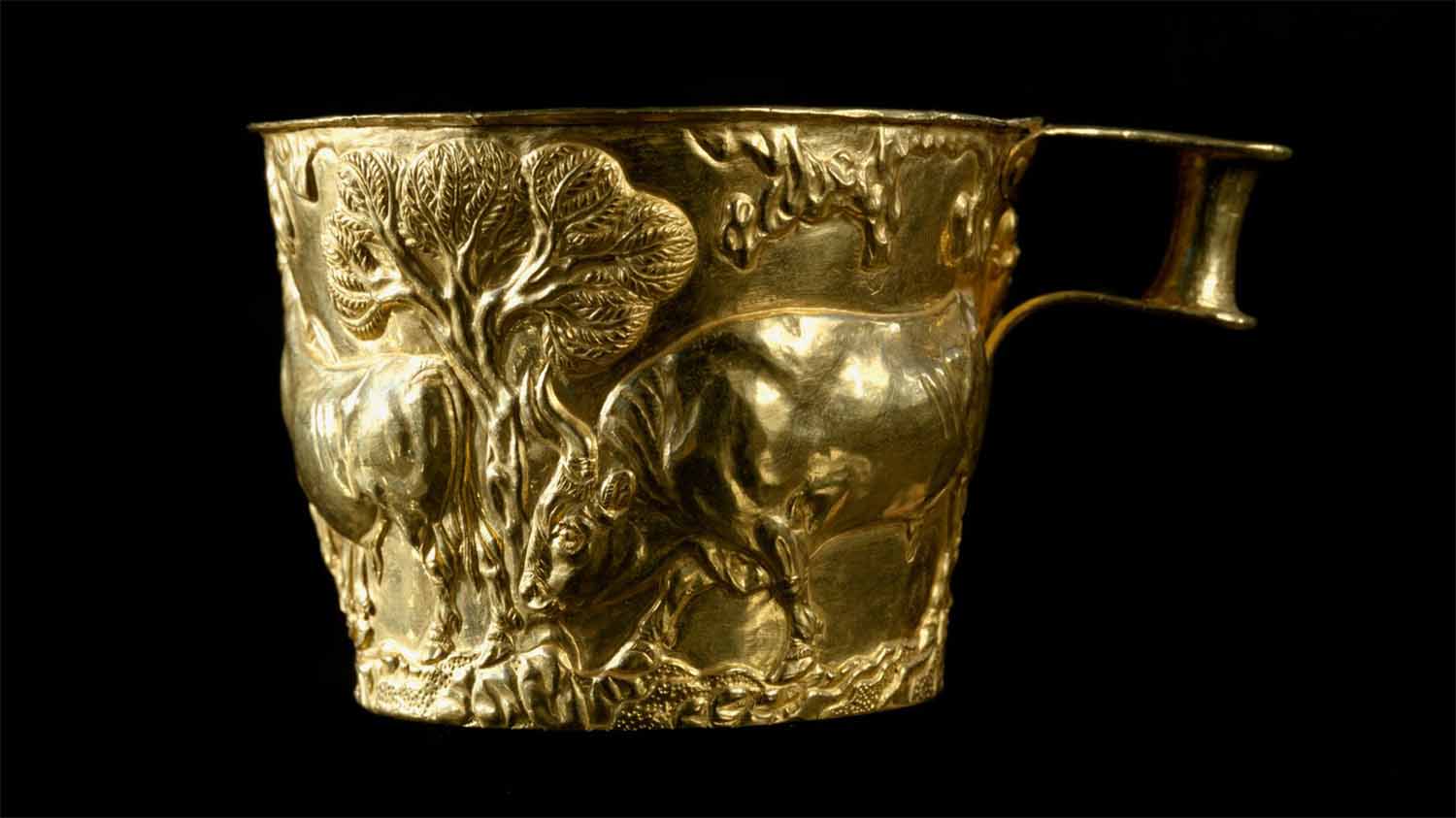
- ~1500 BC: The Vaphio Cups, Mycenaean gold vessels from a tomb near Sparta, depict wild-bull hunting and capture scenes generally identified with the aurochs.
- 221 to 179 BC: King Philip V of Macedon kills a wild bull on Mount Orbelus and dedicates its hide and horns, reportedly about 105 cm (41 in) long, to a temple of Heracles. At least two ancient poets commemorate the trophy.
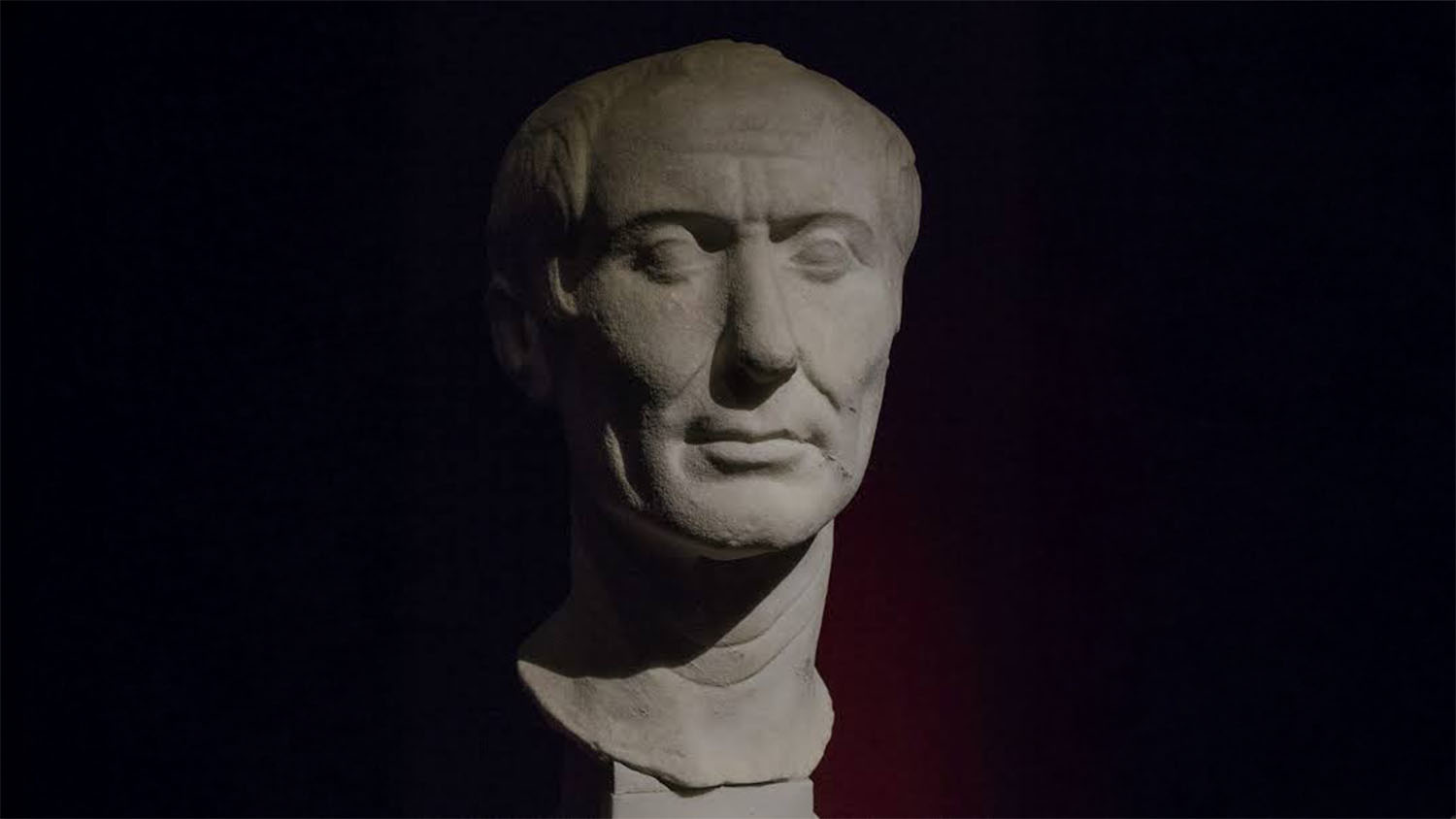
- 53 BC: Julius Caesar describes the aurochs (urus) in Book VI of De Bello Gallico, based on secondhand report from Germanic hunters, likely written that same winter.
- 1st century AD: Seneca the Younger lists the aurochs alongside tigers and the bison in his tragedy Phaedra. Later in the century, Pliny the Elder makes the aurochs-bison distinction explicit in his Natural History.
- ~630 AD: Isidore of Seville describes the aurochs of Germania in his encyclopedia Etymologiae, noting horns large enough to be made into vessels for royal tables, a detail later medieval writers would inflate considerably.
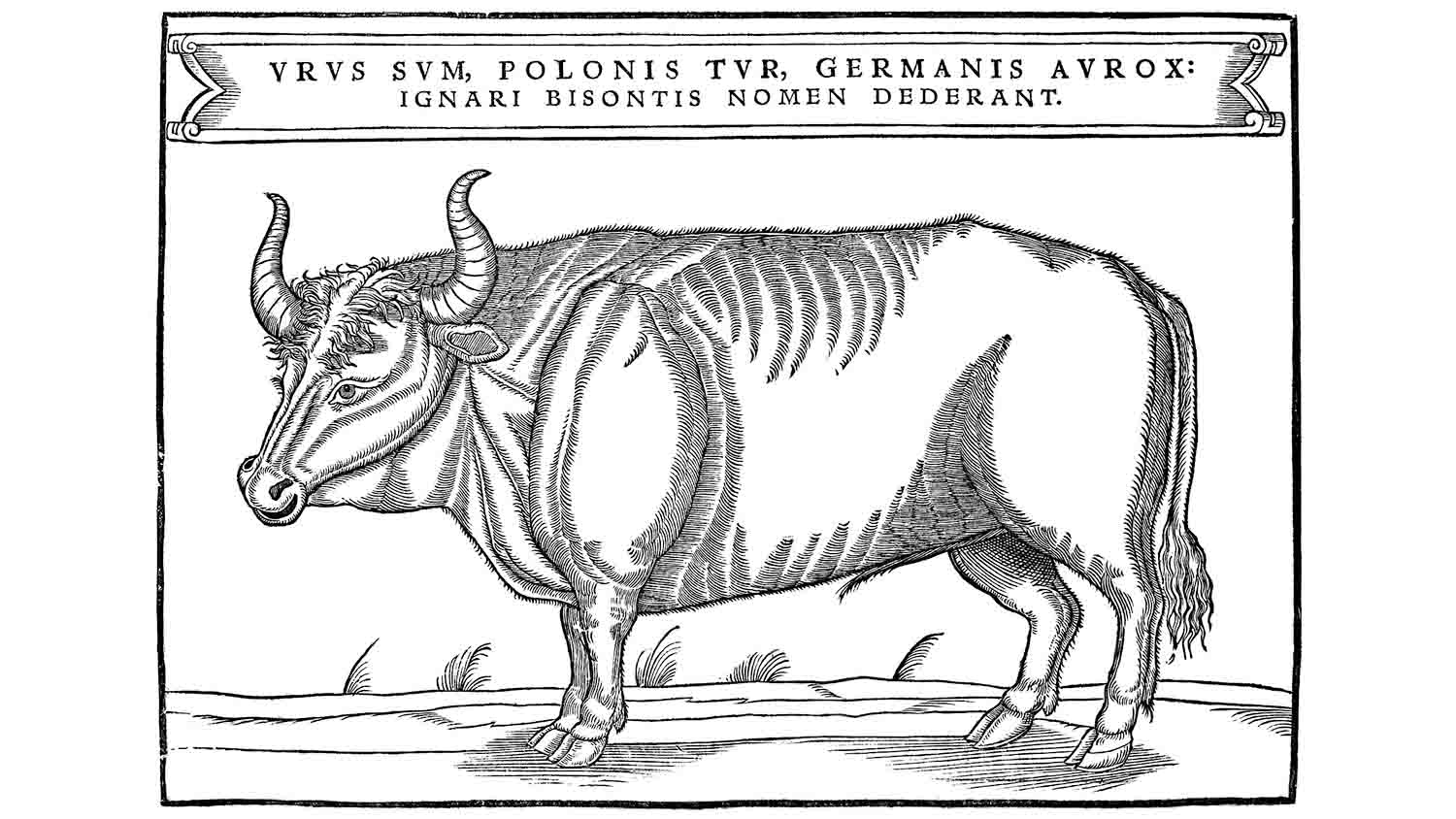
- 1549 to 1556: Sigismund von Herberstein publishes an account of the aurochs of Masovia, based on a specimen he received from the king of Poland around 1550, in his Rerum Moscoviticarum Commentarii.
- 1596: Paul Mucante, secretary to a papal cardinal, records a third eyewitness account of the Jaktorów aurochs in his travel diary.
- 1602: Anton Schneeberger’s letter to the scholar Conrad Gesner, describing the behavior of the last wild herd in detail, is published in Gesner’s Historia Animalium.
- 1627: The last aurochs, a cow, dies in the forest of Jaktorów. Polish gamekeepers had tracked the herd’s decline for decades: 38 animals in 1564, 24 in 1599, 4 in 1602, and a single surviving cow from 1620 onward.
Trophy, then witness: how the sources change character
The evidence splits fairly cleanly into two kinds, and the split lines up almost exactly with distance from the animal’s extinction. The earliest Greek and Roman material treats the aurochs as an object rather than a subject: something to kill, dedicate to a god, or drink wine from. The Vaphio Cups render a hunt in gold for a burial. Philip V of Macedon’s dedicated horns draw at least two epigrammatists’ attention, likely across different generations, precisely because the trophy itself, not a written description, stayed on public display. Seneca’s aurochs is a name on a list of dangerous game a goddess can master. None of these sources describe what the animal looked like doing anything other than fighting or dying.
Caesar’s account, written in 53 BC, sits at a hinge point. It is more descriptive than anything before it, giving size, coloring, temperament, and hunting method, but Caesar almost certainly never saw a living aurochs himself. The material likely reached him through Germanic hunters, and some classicists have even questioned whether the whole passage was inserted by a later editor. It is secondhand information dressed as firsthand authority, which makes it a genuinely transitional document: the first attempt at real natural history, built on the same kind of report that had produced trophy poems for centuries before it.
By the time Herberstein and Schneeberger were writing, more than 1,600 years later, the sources had changed again, though the label “eyewitness” oversimplifies what actually happened. Herberstein received the physical remains of an aurochs as a diplomatic gift and had them mounted for display, but whether his famous woodcut was drawn from that mount or from a living animal is disputed among the scholars who have studied the engraving’s anatomical details. Schneeberger, by contrast, appears to have watched a living population directly: mating season, calf coloration, a specific injured cow he did not expect to survive the winter. Between Herberstein’s physical trophy and Schneeberger’s field notes, the gap between object and observation finally closes, just a few decades before there was nothing left to observe.
Two threads that run through the whole record
Two details recur across every stage of this timeline, independent of era, language, or the writer’s relationship to the animal.
The first is what to do with the horns. Caesar describes Germanic hunters rimming aurochs horns in silver for use as drinking cups. Centuries earlier, according to the Greek Anthology, a hunter named Peucestes did the same thing near Doberus, keeping his kill’s horns as a personal wine cup rather than dedicating them to a god. Conrad Gesner, who received Schneeberger’s letter, reported examining aurochs horn-cup trophies still preserved in German treasuries in the sixteenth century, and a bishop named Johann von Manderscheid is recorded finding a similarly outsized horn mounted as a goblet and using it as the emblem of an entire drinking fraternity. From Macedon to Doberus to the treasuries Gesner personally inspected, the instinct to keep the horns as a standalone trophy, separate from the rest of the animal, shows up again and again across more than a thousand years and several different cultures.
The second is confusion with the European bison. The two animals were never the same species, but writers repeatedly struggled to keep them apart. The Greek and Roman bonasus, a fantastical creature with a horse’s mane that defended itself with burning dung, likely began as a garbled account of the bison rather than the aurochs, since classical writers otherwise describe the aurochs as smooth-coated. Pliny the Elder had to state the distinction explicitly. And Herberstein’s most pointed contribution may be a single line of Latin carved into his 1556 woodcut, stating flatly that only the ignorant call this animal a bison. That the correction was still necessary in the sixteenth century, more than 1,600 years after Caesar and nearly 1,500 years after Pliny had already made the same point, says something about how persistently the two animals blurred together whenever anyone was working from rumor instead of a trophy they could measure.
What this body of sources leaves out
For all its span, the historical record has real gaps. No source describes the aurochs’ full range across its lifetime, from Britain to India. Almost everything that survives comes from a narrow slice of its geography and its history: the Balkan foothills where Philip V hunted, the Hercynian Forest Caesar described secondhand, and the Masovian preserves where Herberstein, Schneeberger, and Mucante all wrote in the last century before extinction, when the species had already been pushed into its final strongholds. And the sources rarely agree on basic facts: Herberstein and Schneeberger describe glossy black bulls with a pale dorsal stripe, while Paul Mucante’s diary describes a grey one. Whether that is a genuine color variant or one writer’s error is impossible to settle from the text alone. What survives is real, but it was never a scientific survey. It is a few thousand years of people encountering, at most, the last scattered fragments of a species that had already been declining for millennia before anyone thought to write about it.