Louis Pasteur: Chemist and Pasteurizer of Beer and Wine
Louis Pasteur’s name appears on virtually every carton of milk sold in the modern world, but his career never touched dairy. He was a chemist and microbiologist whose work moved through crystals, fermentation, wine, beer, silkworms, anthrax, and rabies. The process bearing his name was not his invention but an application of his principles, made by others, decades after his most consequential work was done.
Early Life and Education
Louis Jean Pasteur was born on December 27, 1822, in Dole, a small town in the Jura region of eastern France. His father, Jean-Joseph Pasteur, was a tanner and a veteran of the Napoleonic Wars who had been awarded the Legion of Honor. The family later settled in Arbois, where Pasteur would eventually establish his home laboratory and where his house has been preserved as a museum.
As a student, Pasteur was unremarkable in most academic subjects but showed considerable talent in drawing and portraiture. His skills were good enough that his pastel portraits of family and neighbors were later catalogued by historians. It was his headmaster, not his grades, who recognized something more and encouraged him to prepare for the École Normale Supérieure in Paris, one of France’s most selective institutions of higher learning. He was admitted, completed a doctorate in physics and chemistry in 1847, and remained in Paris as a laboratory assistant while continuing his first major research project: the optical properties of tartrate crystals.
Tartrate Crystals and the Discovery of Stereochemistry
Pasteur’s early reputation rested not on fermentation or disease but on a meticulous piece of crystallographic work that founded an entire branch of chemistry. In 1847, he took up a puzzle posed by the German physicist Eilhard Mitscherlich: why did two chemically identical compounds, tartrate and paratartrate, behave differently when polarized light passed through them? Tartrate rotated the plane of light; paratartrate did not.
Examining crystal after crystal under a microscope, Pasteur discovered that paratartrate was not a single substance but a mixture of two mirror-image crystal forms. When he physically separated them and tested each in solution, one form rotated light clockwise and the other counterclockwise, and the mixture produced no rotation at all. The two forms were molecular mirror images of each other. This was the first demonstration of molecular chirality and the founding observation of stereochemistry, the study of how the three-dimensional arrangement of atoms affects chemical behavior.
Pasteur was twenty-five years old.
How Pasteur Proved Fermentation Is Biological
In 1854, Pasteur was appointed dean of the new Faculty of Sciences at the University of Lille. His move into fermentation research began there, prompted in part by a local industrialist whose beetroot-alcohol factory was producing inconsistent batches. The prevailing explanation for fermentation, championed by the chemist Justus von Liebig, held that it was a purely chemical process driven by the decomposition of organic matter. Pasteur’s microscope told him otherwise.
Examining fermenting liquids, he found living microorganisms, specifically yeasts, at work in every batch. Where the wrong organism was present, the fermentation went wrong. He coined the phrase that became his intellectual signature: fermentation is life without oxygen. By demonstrating that specific living organisms drove specific fermentation outcomes, he built the empirical case for the germ theory of disease. If a particular microbe caused wine to sour, perhaps a particular microbe caused cholera to spread.
How Pasteur Disproved Spontaneous Generation
Before the germ theory could stand, Pasteur had to address a doctrine that had persisted since antiquity: spontaneous generation, the idea that life could arise from non-living matter. The French Academy of Sciences had offered a prize to anyone who could settle the debate definitively. In 1859, the same year Darwin published On the Origin of Species, Pasteur set out to claim it.
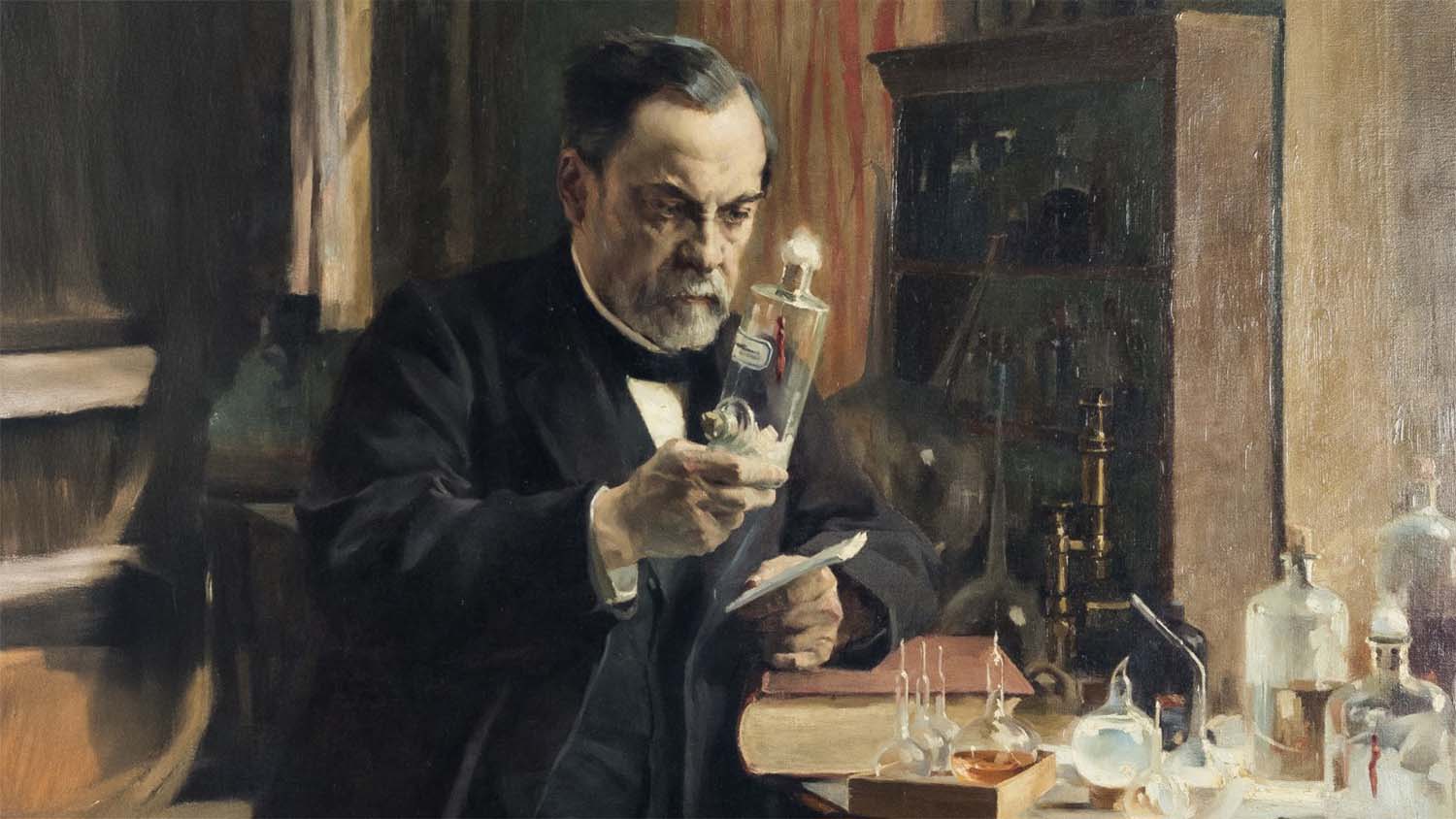
He designed a series of glass flasks with long necks drawn out and bent into an S-curve, now known as swan-neck flasks. Each flask was filled with nutrient broth and boiled to kill any existing organisms. The curved neck allowed air to enter freely but trapped airborne particles, including microbes, in the bend before they could reach the broth. Weeks passed. The broth remained clear. When Pasteur tilted the flask so that the trapped particles contacted the broth, microbial growth appeared within days.
Life did not generate spontaneously from the broth; it arrived from the environment. Several of those original sealed flasks, their contents still sterile after more than 160 years, are on display at the Musée Pasteur in Paris.
Pasteur and Wine: The 1865 Pasteurization Patent
Pasteur’s heat-treatment work began with wine, not beer or milk. In 1863, Emperor Napoleon III commissioned him to investigate why French wines exported to Britain frequently arrived spoiled, sour, cloudy, or undrinkably altered. The stakes were commercial and diplomatic: a trade treaty had just increased French wine exports to Britain, and the industry’s reputation was at risk.
Working from a makeshift laboratory in the vineyards of Arbois, equipped with little more than a mercury pressure tank, glass tubes, and a microscope, Pasteur set about examining spoiled wine sample by sample. His first finding was that each type of wine disease corresponded to a specific microbial contaminant: sourness to one organism, bitterness to another, ropiness to a third. Each was a biological process that could be targeted, not random chemical degradation.
He heated wine to between 55 and 60°C after fermentation, killing the contaminants while the wine stabilized for long-distance shipping without losing its bouquet. On April 11, 1865, he filed a patent “for a process for the preservation of wine.” The patent included the line: “Wine does not spoil if the microbes are killed beforehand.”
Louis Pasteur’s Research on Beer
If wine was a commercial problem, beer became a patriotic one. The Franco-Prussian War of 1870–1871 humiliated France. Pasteur’s only son had enlisted. The loss of Alsace-Lorraine stripped France of its major hop-growing and brewing region. German lager was flooding the French market. Pasteur, a fierce patriot who in 1871 returned an honorary medical degree awarded by the University of Bonn, channeled his anger into his laboratory.
He began his beer research at the Kuhn brewery in Chamalières, near Clermont-Ferrand, where he developed and patented an improved brewing method in June 1871. The method centered on a single principle: exclude atmospheric contamination at every stage of fermentation. Pasteur designed enclosed fermentation vessels that prevented airborne microbes from reaching the wort, and he proposed using a microscope to inspect yeast cultures before pitching them into a batch, discarding any showing signs of bacterial contamination.
His 1876 book Études sur la Bière (translated into English in 1879 as Studies on Fermentation: The Diseases of Beer, Their Causes, and the Means of Preventing Them) catalogued the contaminants in detail. Rod-shaped and spherical organisms, now understood to be lactic acid bacteria, produced sourness. Filamentous fungi and wild yeasts caused separate off-flavors and turbidity. In his own words: “Every unhealthy change in the quality of beer coincides with the development of microscopic germs which are alien to the pure ferment of the beer.” Heating beer to between 55 and 60°C for a short period killed the spoilage organisms and, according to his observations, could render a batch palatable for up to nine months.
He stipulated that beer produced by his method should be labeled in France as Bières de la revanche nationale, beers of national revenge. Applying the same heat-treatment principle he had developed for wine, he demonstrated that pasteurized beer kept indefinitely while untreated batches turned cloudy and undrinkable.
To see how large commercial breweries actually operated, he traveled to London in September 1871 with his son, staying at the Grosvenor Hotel near Victoria Station. The best-documented visit was on September 9, when he toured the Whitbread brewery on Chiswell Street. At first, Pasteur wrote, the English brewers “returned somewhat vague answers to our questions.” But within days of his visit, Whitbread’s directors had purchased a microscope and sourced fresh yeast cultures for their various beer lines. Whitbread later credited that visit as the origin of its scientific tradition; the brewery produced 100 bottles of “Louis Pasteur Ale” in 1995 to mark the centenary of his death.
Pasteur’s published findings reached Carlsberg in Copenhagen, where the Danish chemist Emil Christian Hansen took the work further than Pasteur had. Hansen developed a method for isolating pure single-strain yeast cultures, allowing breweries to pitch a known organism and eliminate the variability that had plagued fermentation since before recorded history. Carlsberg’s adoption of Hansen’s pure-yeast system in 1883 became the technical foundation of modern industrial lager brewing.
In the preface to Études sur la Bière, Pasteur wrote: “Our misfortunes inspired me with the idea of these researches. I undertook them immediately after the war of 1870, and have since continued them without interruption, with the determination of perfecting them, and thereby benefiting a branch of industry wherein we are undoubtedly surpassed by Germany.”
The Anthrax Vaccine and the Pouilly-le-Fort Trial
By the late 1870s, Pasteur had shifted his focus from fermentation to disease. His earlier work had established that microbes caused spoilage; the logical extension was that microbes caused illness. Testing this in animals, he discovered the principle of attenuation: weakening a pathogen by laboratory passage or chemical treatment rendered it capable of inducing immunity without causing disease. Edward Jenner had demonstrated vaccination empirically with smallpox in 1796; Pasteur was now giving it a mechanism that could be applied to any disease.
Anthrax was devastating French livestock. Pasteur produced an attenuated anthrax vaccine and, in a move characteristic of his flair for spectacle, accepted a public challenge from the Agricultural Society of Melun to prove it in the field. On May 5, 1881, at a farm in Pouilly-le-Fort, he vaccinated 24 sheep, one goat, and six cows in front of farmers, veterinarians, journalists, and skeptics. A control group of equal size received nothing. On May 31, both groups were injected with a culture of live, virulent anthrax bacteria. Two days later, the crowd returned. Every unvaccinated sheep was dead or dying. Every vaccinated animal was healthy. An 1881 paper in The Yale Journal of Biology and Medicine, translated from Pasteur’s original French report, describes the setup and outcome in his own words.
Rabies and Joseph Meister
In July 1885, a nine-year-old boy named Joseph Meister was brought to Pasteur’s Paris laboratory. The boy had been bitten fourteen times by a rabid dog two days earlier and was almost certainly going to die. Rabies had a fatality rate of essentially 100 percent once symptoms developed.
Pasteur had been working on an experimental rabies vaccine derived from the dried spinal cords of infected rabbits. It had worked in dogs. It had never been tried in a human. Pasteur was not a physician and had no legal authority to administer a medical treatment; his collaborator Dr. Jacques-Joseph Grancher administered the injections. Over ten days, Joseph received twelve doses of progressively more potent preparations. He survived. He did not develop rabies.
The CDC’s historical record of that treatment notes: “This was the beginning of the modern era of immunization.” News spread across Europe. People bitten by potentially rabid animals began traveling to Paris from as far as Russia and the United States. The donations that poured in from a grateful public funded the Institut Pasteur.
The Institut Pasteur
The Institut Pasteur was inaugurated on November 14, 1888, in a ceremony attended by French President Sadi Carnot. The building, funded by public subscription following the rabies success, housed a rabies vaccination department and five research laboratories under Pasteur’s closest colleagues: Grancher, Émile Duclaux, Émile Roux, Ilya Mechnikov, and Charles Chamberland. Pasteur himself moved into an apartment in the building and lived there until his death.
The Institut Pasteur went on to isolate the diphtheria antitoxin, identify the plague bacillus, and, in 1983, become the first institution to isolate HIV. It remains one of the leading biomedical research institutions in the world, with a global network spanning more than 30 countries.
Pasteur died on September 28, 1895, at Marnes-la-Coquette, outside Paris, surrounded by his family. He was 72. His body was interred in a vault beneath the institute. His last reported words: “Adopt a critical mind. By itself, it can neither encourage ideas nor stimulate anything great. But without it, everything is useless.”
Did Pasteur Pasteurize Milk?
The McGill University Office for Science and Society states the attribution plainly: “No, it wasn’t Louis Pasteur. Back in 1886, Franz von Soxhlet, a German agricultural chemist, was the first person to suggest that milk sold to the public be pasteurized.”
The Science History Institute notes that Pasteur’s process was “originally invented and patented in 1865 to fight the ‘diseases’ of wine… The process was later extended to all sorts of other spoilable substances, such as milk.”
Pasteur’s heat-treatment research targeted wine (1865) and beer (1871). His published work showed that controlled heating destroyed pathogenic microorganisms without destroying the product. The logical extension to milk was made by Franz von Soxhlet in Munich in 1886, in a paper published in the Münchener Medizinische Wochenschrift. Soxhlet had spent more than a decade studying the chemistry of milk, fractionating its proteins, describing lactose, and inventing the laboratory extractor that still bears his name. His 1886 paper proposed heating milk in sealed containers as a public health measure for infant feeding. He was building on Pasteur’s science. It was not Pasteur’s idea.
The American Milk Crisis and the Swill Milk Scandal
While Pasteur was working on wine in France, American cities were in the middle of a public health catastrophe that had nothing to do with fermentation science and everything to do with industrial corruption. The Swill Milk Scandal, exposed in a landmark 1858 series in Frank Leslie’s Illustrated Newspaper, revealed that New York City’s milk supply was coming largely from cows fed on distillery waste, producing a bluish, watery milk that was then adulterated with chalk, plaster of Paris, starch, and rotten eggs to pass as whole milk. The New York Academy of Medicine established a direct link between this milk and elevated infant mortality. The New York Times estimated that as many as 8,000 infants per yearwere dying from the contaminated supply.
Pasteur left no documented response to the American milk crisis, published nothing on it, and proposed no solution to it. The American response came from American figures working two and three decades after his wine patent: Nathan Straus, who built a private network of pasteurized milk depots across 36 cities; Abraham Jacobi, the physician who provided the clinical rationale for treating milk as a disease vector; and John D. Rockefeller, whose lobbying is credited with the first mandatory municipal pasteurization ordinance, passed in Chicago in 1908. The process carried Pasteur’s name into American law. Pasteur himself had been dead for thirteen years.
Why Pasteur’s Name Appears on Milk
“Pasteurized” is stamped on every carton, and the carton implies Pasteur invented what it describes. Legislative documents continue to repeat the error: a 2026 Colorado legislative memo claimed that Pasteur invented pasteurization for milk in 1863, conflating his wine patent with an application he never made. The Science History Institute’s 2009 history of pasteurization noted in its opening sentence that in 1907, a New York publication was still asking whether the city should “cook its milk,” forty-five years after Pasteur’s wine experiments, nearly twenty years after Soxhlet’s milk proposal, and well into the Nathan Straus era.
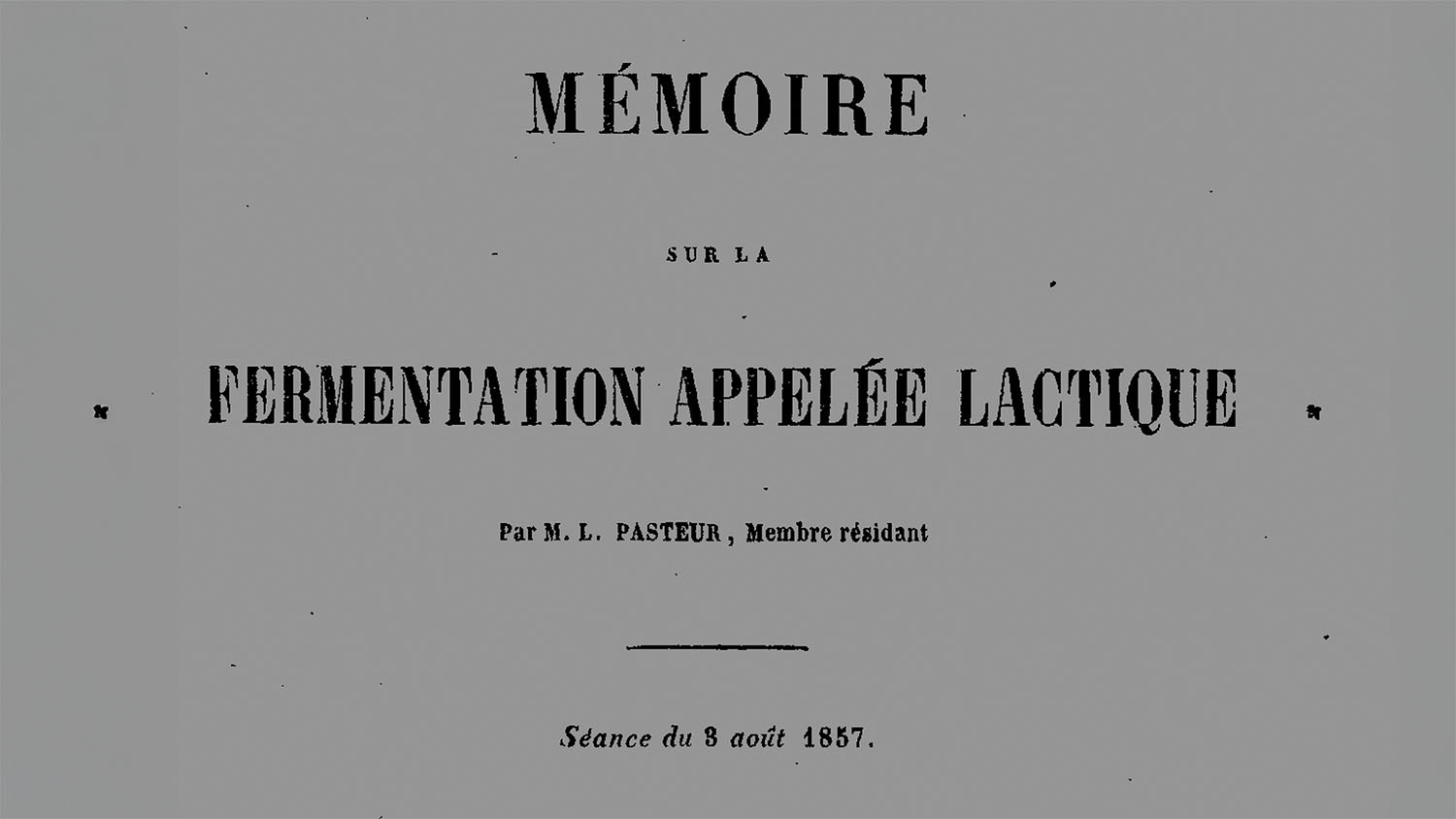
Pasteur never named the process himself. His 1865 wine patent describes “a process for the preservation of wine.” His 1876 beer book is titled Études sur la Bière, studies on beer. He did not attach his own name to the technique anywhere in his published work. The verb “pasteurize” entered the English language in 1881 and the noun “pasteurization” in 1885, both coined by others as an honorific, according to the Online Etymology Dictionary. The naming was not a deliberate act by any single person; as Pasteur’s wine and beer methods spread internationally, the scientific and commercial press needed a word and reached for the obvious one. The term was sixteen years old when it first appeared in English, and its noun form twenty years old, measured from his 1865 patent.
The word “pasteurization” was coined by admirers, applied first to wine and beer, extended to milk by a German chemist Pasteur never collaborated with, industrialized in America by a businessman and a physician working independently, and written into law by a city Pasteur never visited. His actual contribution was the science that made the chain of reasoning possible. Soxhlet drew the connection to milk. Straus, Jacobi, and Rockefeller built what followed.