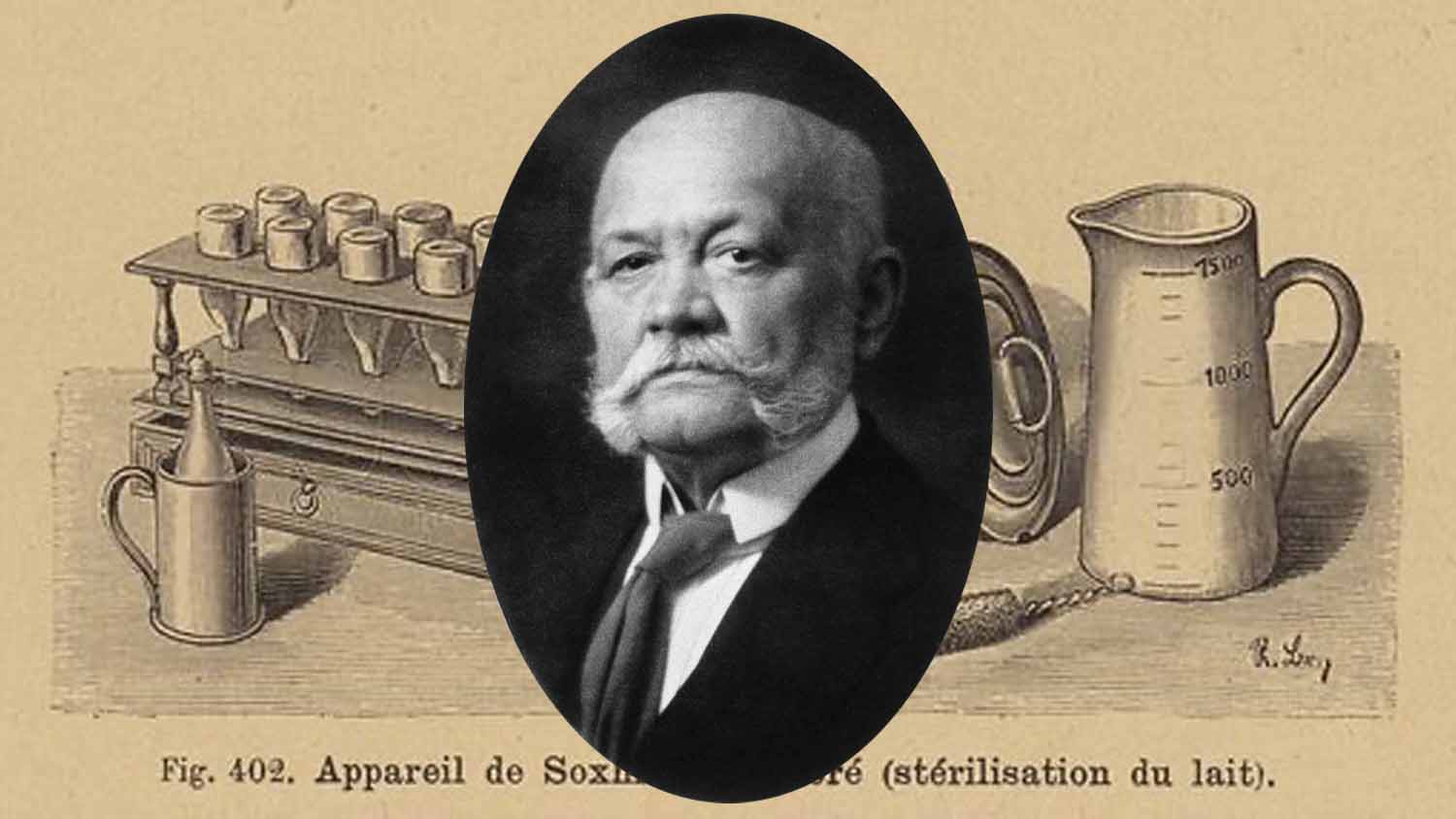
Franz von Soxhlet: Agricultural Chemist and Inventor of Milk Pasteurization
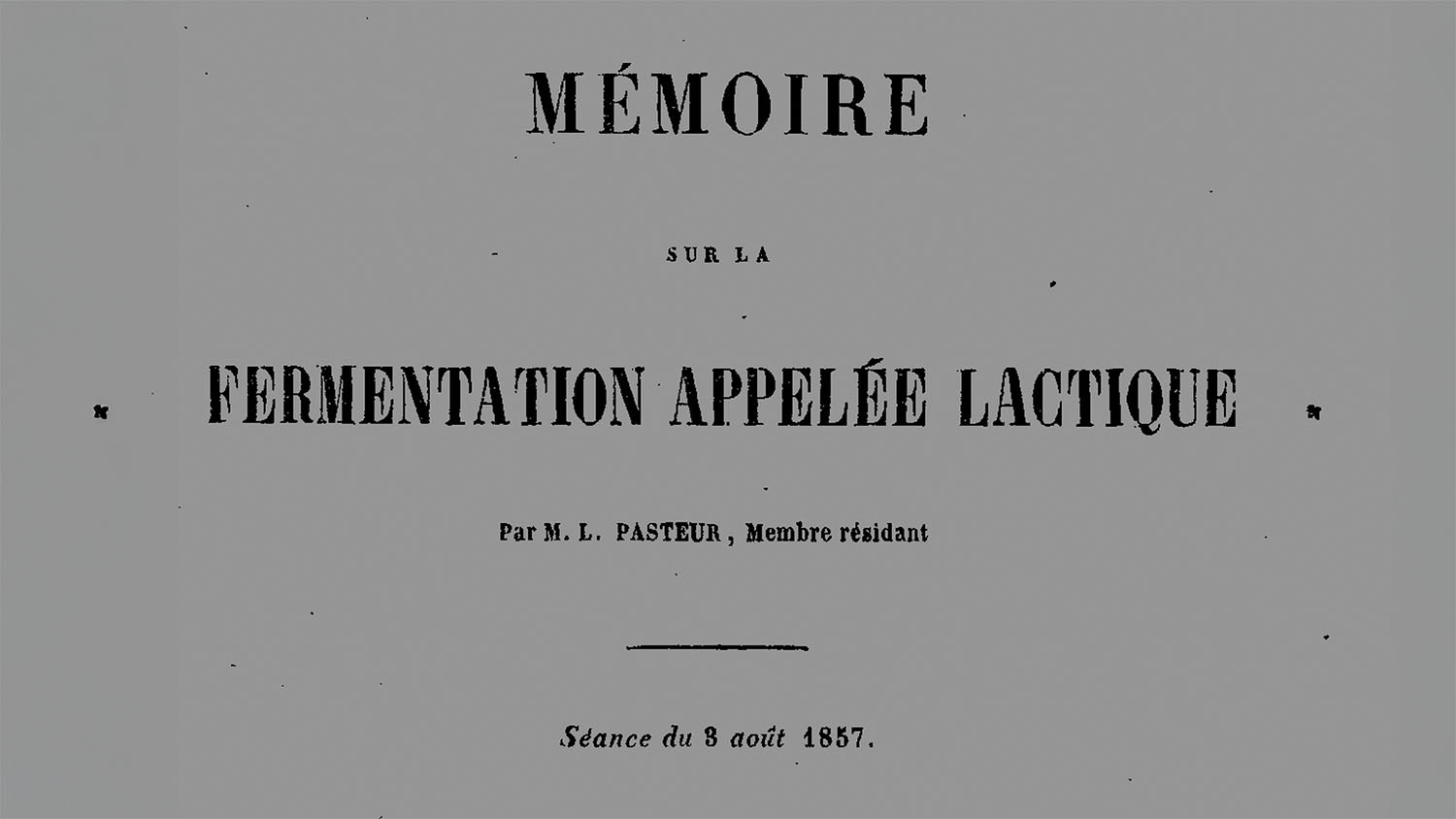
The name Louis Pasteur appears on almost every carton of milk sold in the modern world, at least by implication. The process is called pasteurization, and the assumption embedded in that name is that Pasteur applied his discovery to milk. He did not. Pasteur’s heat-treatment work in the 1860s targeted wine and beer, beverages whose spoilage had become an economic crisis for French producers. Milk was not his subject, and the misattribution still shows up in official government documents today.
The chemist who first proposed applying heat treatment to milk was a German agricultural scientist named Franz Ritter von Soxhlet, working in Munich in 1886. He arrived at that proposal through more than a decade of foundational research into the chemistry of milk itself, research that had already produced the first systematic fractionation of milk proteins, the first rigorous description of lactose, and a piece of laboratory glassware still found in chemistry labs around the world. His 1886 paper in the Münchener Medizinische Wochenschrift was the first time anyone in the scientific literature formally recommended that milk be heat-treated to protect infants from milk-borne disease.
A Belgian Family in Moravia
Franz Ritter von Soxhlet was born on January 12, 1848, in Brünn, the German name for what is now Brno in the Czech Republic, then part of the Austrian Empire. His father, Hubert Soxhlet, was a textile spinning industrialist and an immigrant from Dalhem, near Liège, in the former Duchy of Brabant. Belgian by family origin, German by education and adopted language, and Central European by geography, Franz grew up at a moment when both industrial and scientific practice in the region were changing fast.
The “Ritter von” in his full name is a Bavarian state honor conferred for distinguished service, not an inherited aristocratic title. He is generally referred to in scientific literature simply as Franz von Soxhlet, and occasionally in older sources as Frans von Soxhlet, the Flemish spelling of his first name reflecting his father’s origins near Liège.
The family migrated from Moravia to the German Confederation during Soxhlet’s youth. He went on to pursue chemistry at the University of Leipzig, one of the leading institutions in German-speaking Europe for the emerging discipline of agricultural and physiological chemistry. Justus von Liebig had defined the field a generation earlier, arguing that chemistry held the key to understanding nutrition, soil fertility, and animal physiology. Leipzig’s orientation toward applied chemistry made it a natural place for a student interested in how chemical analysis could serve agriculture and food production.
The Dissertation on Milk
Soxhlet completed his doctorate at Leipzig in 1872. The dissertation, titled Zur physiologischen Chemie der Milch (“On the Physiological Chemistry of Milk”), announces from the first moment of his scholarly career where his attention would remain for the next four decades.
The dissertation and the publications that accompanied it represented some of the earliest rigorous chemical work on what milk actually contains. Soxhlet was the first scientist to separate milk’s proteins into their distinct fractions: casein, albumin, globulin, and lactoprotein. This fractionation was not merely taxonomic. Understanding that these were distinct proteins with different chemical behavior was a prerequisite for later work on infant nutrition, on the effects of heat on milk, and on the differences between human and bovine milk. Soxhlet also provided the first systematic scientific description of lactose, the sugar present in milk, integrating earlier observations of its presence into a chemical framework that clarified its role in infant nutrition.
After finishing his PhD, Soxhlet became an assistant at the Institute of Agricultural and Animal Chemistry in Leipzig, and then in 1873 was appointed assistant at the agricultural chemical research station in Vienna. It was during these Vienna years that he began the work on milk fat extraction that would produce his most widely recognized invention.
The Extractor and the Fat Problem
By the mid-1870s, a practical problem dominated dairy chemistry: how to measure the fat content of milk accurately and repeatably. Fat content was the primary marker for adulteration detection, since watered-down milk had proportionally less fat, and it bore directly on assessments of nutritional quality. Existing extraction methods were inconsistent, prone to contamination, and difficult to reproduce between laboratories.
Soxhlet’s solution was an elegantly simple piece of glassware built around a constant-level siphon. A solid sample, absorbed into a porous thimble, sits in an extraction chamber above a round-bottom flask of solvent. When the flask is heated, solvent vapor rises to a condenser at the top of the apparatus and drips back down into the extraction chamber. When the liquid level in the chamber rises to a set height, the siphon automatically empties it back into the flask. The cycle repeats: solvent washes the sample, drains, and is recycled, requiring no additional solvent and no manual intervention. The self-regulating siphon was the key innovation, and the glassware itself was fabricated by a laboratory glassblower identified in historical accounts only as Herr Szombathy.
In 1879, Soxhlet published the design in Dingler’s Polytechnisches Journal under the title Die gewichtsanalytische Bestimmung des Milchfettes (“The Gravimetric Determination of Milk Fat”). That same year he joined the faculty of the Technical University of Munich as professor of animal physiology and dairy science. The device spread quickly across chemistry, biochemistry, food analysis, and eventually the petroleum and plastics industries. It is still in routine use more than 140 years later. Regulatory agencies including the AOAC cite the Soxhlet method as a standard reference technique for crude fat determination.
Soxhlet designed the extractor as a tool for milk analysis. The fact that it became a general-purpose laboratory instrument was incidental to his original purpose, which was to measure what was in milk.
Munich and the Infant Nutrition Question
From 1879 to 1913, Soxhlet held the chair of animal physiology and dairy science at the Technical University of Munich, simultaneously directing the Bavarian Agricultural Research Station associated with the school. He remained in Munich until his death. Infant nutrition was the thread running through nearly everything he published during those thirty-four years.
The problem was urgent. In European and American cities of the mid-nineteenth century, infant mortality rates were vastly higher than anything seen today. Gastroenteritis in infants, often called “summer diarrhea” or “the summer complaint” in English-language sources, killed tens of thousands of children annually. The illness followed the season because bacteria proliferated faster in warm weather, and the vehicle for those bacteria was increasingly cow’s milk. As urbanization pulled families away from the countryside, and as prevailing medical advice inadvertently discouraged breastfeeding by recommending rigid feeding schedules that reduced milk supply, more and more infants were fed cow’s milk from bottles. That milk traveled from farm to city in open, unrefrigerated containers, arriving already loaded with bacterial contamination.
Soxhlet understood this not as a social problem requiring political reform but as a chemical and microbiological problem requiring technical intervention. More than a decade of compositional work he had done on milk’s proteins, fats, and sugars gave him the analytical foundation to think carefully about how heat would affect each component, and whether milk could be made safer without losing its value as food.
The 1886 Proposal
In 1886, Soxhlet published a paper in the Münchener Medizinische Wochenschrift (the Munich Medical Weekly) under the title Über Kindermilch und Säuglings-Ernährung (“On Children’s Milk and Infant Nutrition”). The paper appeared in volume 33, at pages 253 and 276. Historians of food science and medicine generally identify it as the first time anyone in the scientific literature proposed applying Pasteur’s heat-treatment process to milk in order to protect infants from disease.
The focus on infants was not incidental. Soxhlet’s concern throughout his career had been with the milk reaching children who could not be breastfed, who were entirely dependent on cow’s milk as a nutritional substitute, and who were dying in large numbers because that milk was contaminated. The paper reasoned from that premise: if the bacteriological evidence showed that milk was transmitting the organisms responsible for infant diarrheal disease, and if heat treatment was already known to destroy those organisms in other liquids, then milk prepared for infants should be heat-treated.
Soxhlet’s contribution was to take Pasteur’s established method and make the case for applying it to milk, not as a laboratory curiosity but for the milk actually reaching infants through the commercial supply.
The 1891 Device
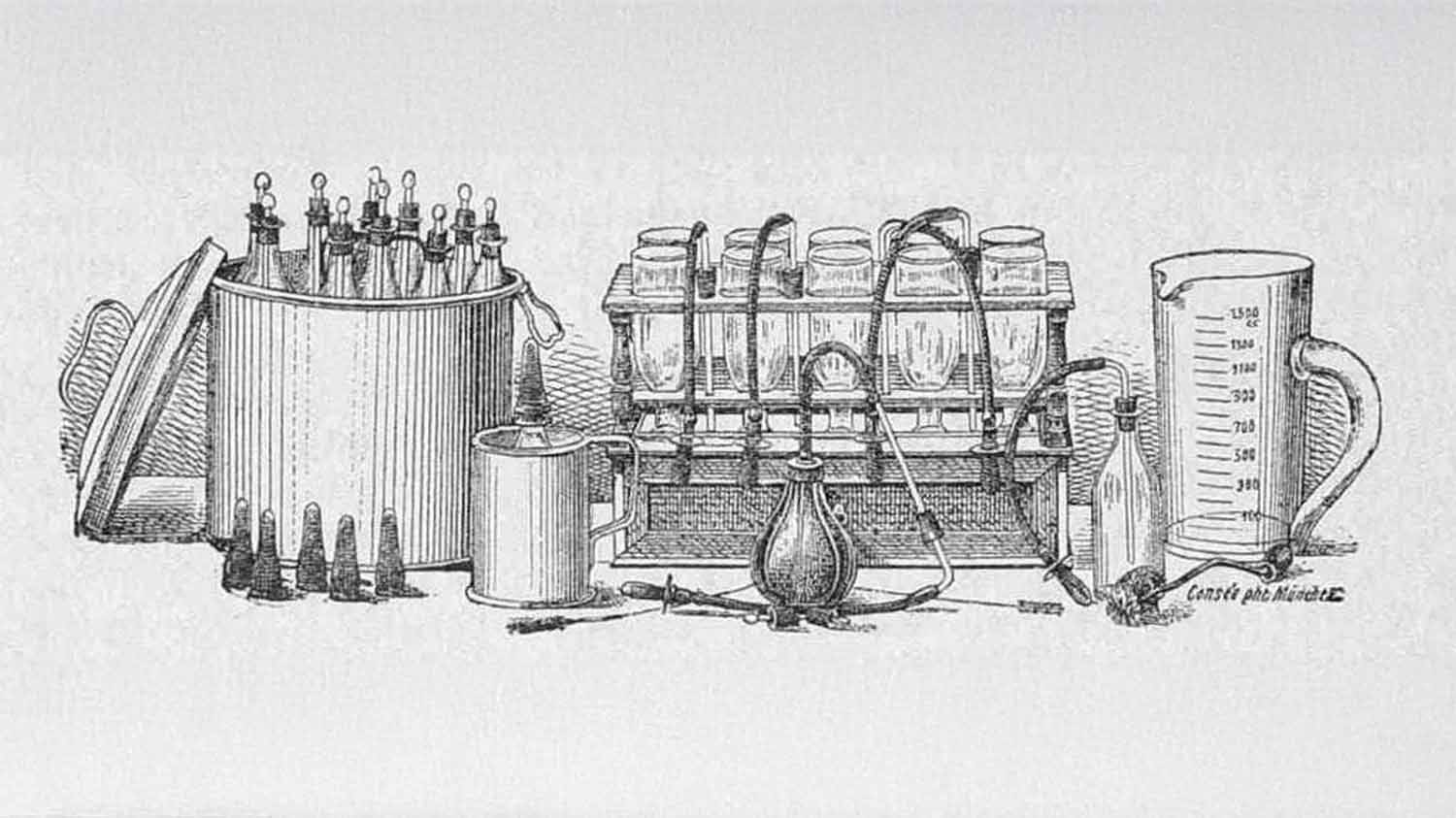
Five years after publishing his proposal, Soxhlet followed it with a practical invention. In 1891, he published Ein verbessertes Verfahren der Milchsterilisation (“An Improved Method of Milk Sterilization”), describing a simple household apparatus designed to pasteurize individual baby bottles.
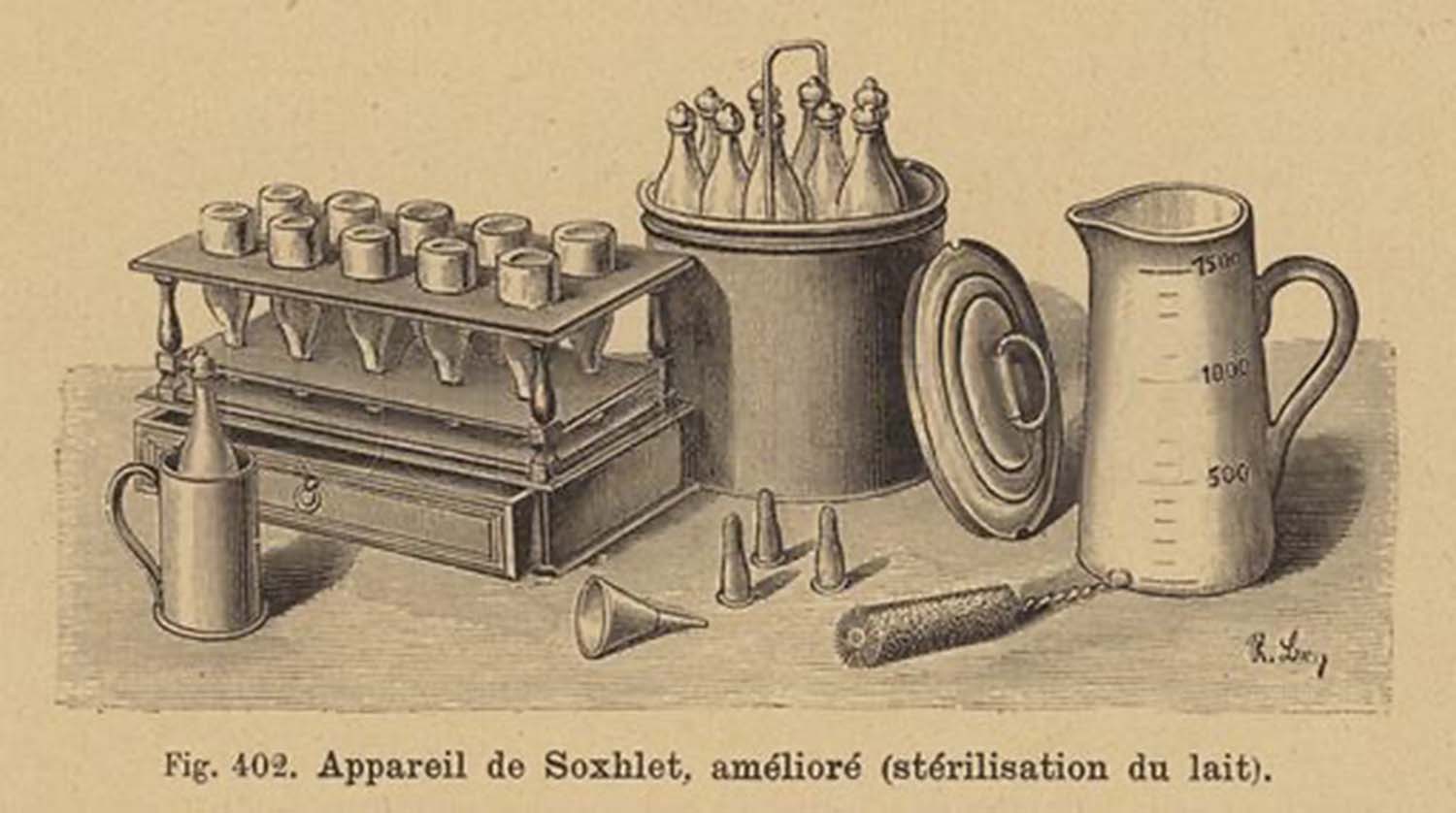
The device allowed a caregiver to heat multiple filled bottles simultaneously to a temperature sufficient to kill pathogenic organisms, hold that temperature for the appropriate time, and then seal the bottles for use. It was designed for domestic use rather than industrial application, which reflected Soxhlet’s consistent focus on the infant feeding problem rather than the commercial dairy supply at large. He was trying to put a workable solution in the hands of the people feeding infants, not waiting for institutions to act.
The invention made Soxhlet’s pasteurization proposal actionable at the household level, years before municipal or commercial pasteurization infrastructure existed anywhere. It also reinforced his standing as, in the phrase used by later German medical historians, the “reformer of infant nutrition.”
The Medical Degree at Halle
In 1893, Soxhlet published on the specific chemical differences between human and cow’s milk, an inquiry that bore directly on how bovine milk needed to be modified or prepared before it was suitable for infants. The following year, at the age of 46, he earned a medical degree from the University of Halle, his second doctorate. Pursuing formal medical credentials more than two decades into an established scientific career was an unusual move. He was not primarily a physician, but the questions he spent his career on bore directly on medical practice: how infants should be fed, what made milk safe or dangerous, how the chemical composition of a food related to its effects on the human body. A medical credential gave him standing to engage those questions in clinical and public health settings, not just agricultural chemistry ones.
His work around 1900 on the relationship between the calcium content of milk and the frequency of rickets in children illustrates this bridging role: the question was nutritional biochemistry, but the implications were pediatric.
What Soxhlet Built and What Others Built on It
Soxhlet’s contributions to milk science form a coherent body of work: the first rigorous chemical analysis of milk’s protein and sugar content; the invention of a standard method for measuring milk fat; the first published proposal to apply heat treatment to the milk supply for infant safety; a practical household device for implementing that proposal; comparative work on human versus bovine milk composition; and research on the nutritional role of milk minerals in child development. The same thread runs through all of it, from his 1872 dissertation to his retirement.
The proposal he made in 1886 did not become municipal policy quickly. Commercial pasteurization of milk expanded gradually in the following decades, driven by public health advocates, pediatricians, and dairy scientists who took Soxhlet’s foundational argument and pressed it through the political resistance of a dairy industry reluctant to adopt new processes. In the United States, Nathan Straus opened his first pasteurized milk depot in New York City in 1893 and spent the next two decades fighting for mandatory pasteurization. Abraham Jacobi, widely regarded as the father of American pediatrics, became an early advocate for heat-treating infant milk supplies. Henry Leber Coit took the opposite approach, arguing that rigorous production standards rather than heat treatment could yield milk safe enough to drink raw, and founded the certified milk movement in 1893. The debate between pasteurization and production-standard approaches to milk safety would persist well into the twentieth century.
In 1906, the American public health scientist Milton Rosenau established that pasteurizing milk at 60 degrees Celsius for twenty minutes killed pathogens without significantly degrading taste, addressing one of the persistent objections to commercial pasteurization and helping accelerate its adoption. Rosenau’s The Milk Question, published in 1913, synthesized the accumulated evidence for pasteurization’s role in reducing infant mortality and became a standard reference in the field.
Soxhlet retired from his professorship at Munich in 1913 after thirty-four years on the faculty. He lived another thirteen years, dying on May 5, 1926, at the age of 78. A brief memorial by Otto Rommel appeared in the Münchener Medizinische Wochenschrift that same year.
The Name on the Apparatus
Among working chemists today, the name Soxhlet is attached almost exclusively to the extractor, a piece of glassware that has been used in essentially unchanged form to extract fats from solid samples for nearly a century and a half. The connection to milk pasteurization is rarely made in chemistry curricula, and the connection to infant welfare almost never.
This is partly a function of how scientific credit accumulates over time. Apparatus named after their inventors survive in laboratory practice long after the original context of their invention is forgotten. The Soxhlet extractor was designed to answer a specific question about what was in milk. The pasteurization proposal came from the same man, working from the same body of knowledge, on the same underlying problem. The two are not separate contributions that happen to share a name; they are products of the same decades-long inquiry into milk’s chemistry and what that chemistry meant for the children drinking it.
Soxhlet did not become a public advocate pressing for pasteurization mandates. What he left was the science: the proteins separated, the sugar characterized, the fat measurable by a method still in use today, and the case for heat treatment made in print before anyone else made it.