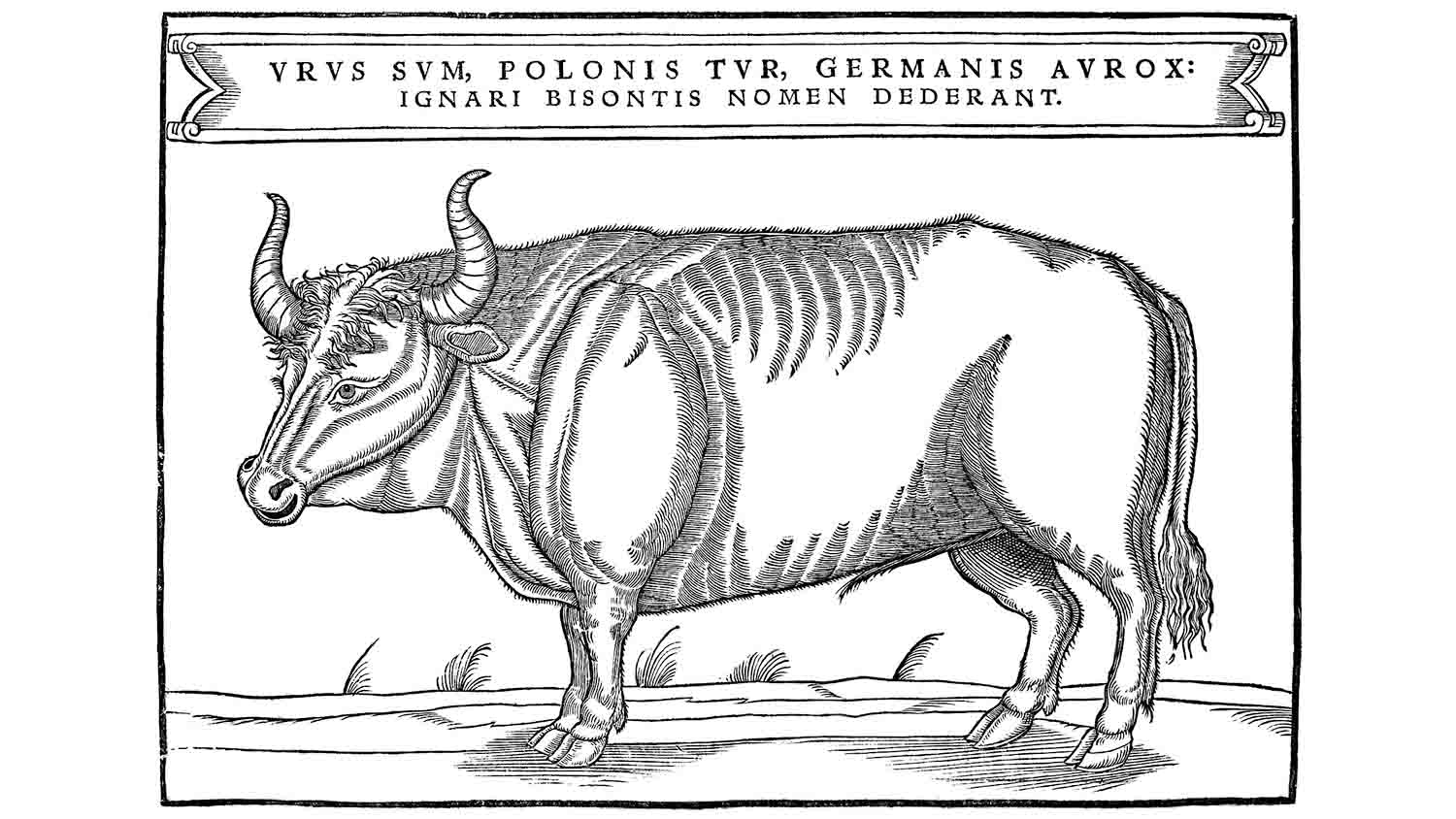
The 1556 woodcut of an aurochs from Herberstein's Rerum Moscoviticarum Commentarii, captioned in Latin: "I am the urus, called Tur by the Poles, Aurox by the Germans; the ignorant have given me the name of bison."
What Herberstein and Schneeberger Saw: The Last Eyewitness Accounts of the Aurochs
By the time Sigismund von Herberstein sat down to describe the aurochs, more than sixteen centuries had passed since Julius Caesar wrote his brief, largely secondhand account of the animal in Germania. Herberstein’s report is different in kind, though not quite as simple as it first appears. He personally received the physical remains of an aurochs as a diplomatic gift and had them mounted for display in his own home, and decades later a Swiss physician named Anton Schneeberger would visit the species’ last wild population and record its behavior in more detail than anyone before or since. Whether Herberstein ever saw a living aurochs himself is something historians still debate. Between the two writers, these accounts are the closest thing that survives to firsthand natural history of an animal that would be extinct within a lifetime of the second writer’s letter.
Quick facts: Herberstein’s account first appeared in his 1549 Rerum Moscoviticarum Commentarii and was expanded in the definitive 1556 Basel edition. It grew out of a 1550 diplomatic visit to Poland, during which King Sigismund Augustus gave Herberstein the body of an aurochs and Queen Mother Bona gave him two girdles of aurochs hide. Schneeberger’s letter to the Swiss scholar Conrad Gesner, published in 1602, is the most detailed surviving eyewitness account of aurochs behavior. By 1602, the last wild herd, in the Jaktorów forest near Warsaw, numbered only four animals. The last aurochs, a cow, died there in 1627.
A diplomat’s gift from the king of Poland
Herberstein was a Habsburg diplomat who carried out roughly 69 missions across Europe between 1515 and 1553, but he is remembered almost entirely for one book: Rerum Moscoviticarum Commentarii, the first detailed Western account of Muscovy, drawn from two extended embassies to Russia in 1517 and 1526. Tucked inside its geographic survey of Poland-Lithuania is a short passage on the aurochs of Masovia. In the 1851 English translation by R. H. Major, Herberstein writes:
“Masovia, which borders on Lithuania, is the only province which has in it the kind of buffalo which in the language of the country is called thur, but which we Germans may with propriety call urox. They are a sort of wild oxen, not unlike tame oxen, except that they are entirely black, with a line down the back having white blended with it. They are not very plentiful, and there are certain districts which are charged with the care of them; and it is only in some few preserves that they are kept.”
Herberstein then adds something no other classical or medieval source can offer: a description of an animal his own hunters had caught alive before it reached him.
“The King Sigismund Augustus, at the time I was ambassador at his court, made me a present of one which was just dropped, and which the hunters had taken, driven half-lifeless from the herd. It had the skin which covers the forehead cut away, which I suppose was done for some purpose, but from thoughtlessness I neglected to enquire why it was done. This is certain, that girdles made of the hide of the urox are much esteemed, and it is a vulgar opinion that parturition is assisted by wearing them.”
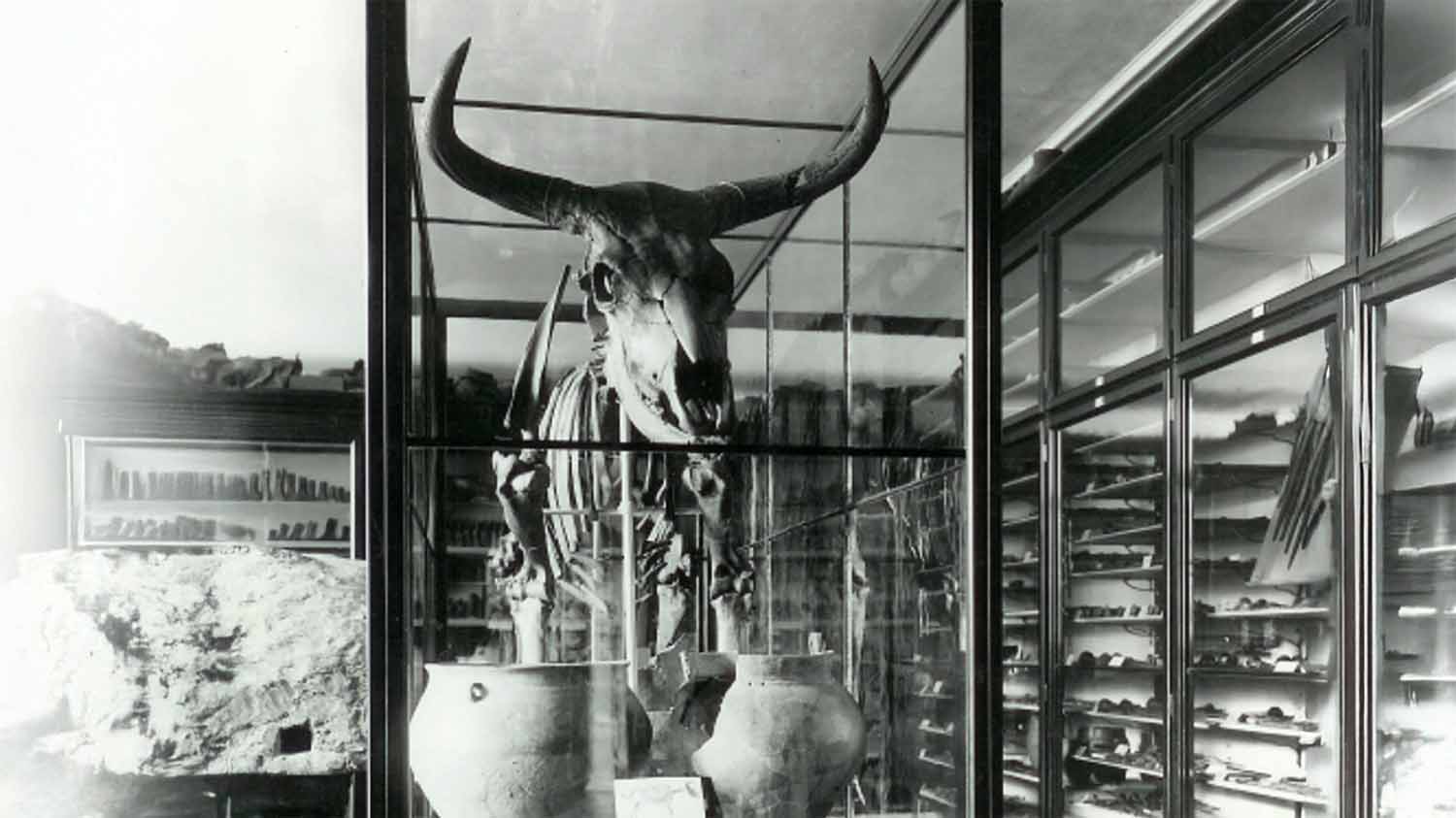
The visit behind this gift is dated by historian Alfred Nehring to 1550, when Herberstein traveled to Poland on business with King Sigismund Augustus and the Queen Mother, Bona Sforza. What the newborn calf became after capture is where the record gets more specific: according to Herberstein’s own account, the king’s gift arrived as a body, already prepared, missing the skin of its forehead, while Bona separately gave him two girdles cut from aurochs hide, one of which Herberstein kept and the other of which he presented to the wife of King Ferdinand I. The forehead skin, cut away before the animal reached him, likely relates to a documented Masovian practice of shearing the curly forelock hair from aurochs to weave into belts believed to ease childbirth, the very girdles Bona was giving away as gifts of rank. Herberstein took the specimen home to Vienna and had it mounted, alongside the hide of a wisent, or European bison, he had acquired on an earlier visit. Both stood on display in the entrance hall of his residence.
Was the famous illustration drawn from a living animal?
Herberstein’s credibility as a witness is more complicated than the gift story alone suggests, as Richard Lydekker laid out in detail in his 1912 study The Ox and Its Kindred. Wolfgang Lazius, who edited an early edition of the Commentariipublished at Basel, told Conrad Gesner that the aurochs and bison pictures in the book had been drawn from life. Gesner recorded that claim in his own Historia Animalium in 1554. But the nineteenth-century zoologist Alfred Nehring and, later, Theodor Noak studied the engravings themselves and reached the opposite conclusion. Noak pointed to specific anatomical tells: a visible cut in the hide over the aurochs’s shoulder, consistent with the piece removed from a hunting kill; a crack in the skin between the bison’s horns of exactly the kind that appears when a dried skin is stretched over a mount; and a horn angle on the bison so steep it distorts the animal’s proportions in a way no living bison’s body could produce. His conclusion was that both figures were drawn not from living animals in the Polish forest, but from the two stuffed, mounted specimens standing in Herberstein’s own entrance hall in Vienna.
If Noak is right, Herberstein’s famous portrait of the aurochs, the image most often reproduced today as the definitive likeness of the animal, may be a picture of a hunting trophy rather than a study from life. It does not make his written account less valuable. He had, at minimum, handled the actual hide, skull, and horns of an aurochs gifted by a king, more physical contact with the species than Julius Caesar or any other classical writer can claim. But it is a meaningfully different kind of evidence than an eyewitness sketch of a living herd, and it is worth holding the two apart. A Latin poem by Caspar Betius Transsylvanicus, written in 1552 and published in Vienna in 1558, independently describes the two mounted specimens standing in Herberstein’s hall, positioned so a viewer could compare the aurochs’s broader chest against the bison’s longer limbs. That detail supports the case that the mounts existed and were arranged for exactly this kind of visual study. The woodcut also gets at least one point demonstrably wrong: it shows the aurochs’s horns as solid black, while a fossil aurochs horn recovered from peat in Pomerania shows the animal’s horns were actually horn-colored with black tips only, the same pattern seen in Chillingham, Pembroke, and Spanish cattle today.
Correcting five centuries of confusion
Herberstein’s most consequential contribution may be a single sentence carved into a woodcut, generally attributed to the illustrator Jost Amman. His 1556 edition includes an illustration of the animal captioned, in Latin, “Urus sum, polonis Tur, germanis Aurox; ignari Bisontis nomen dederant,” or “I am the urus, called Tur by the Poles, Aurox by the Germans; the ignorant have given [me] the name of bison.” Aurochs and European bison (wisent) were confused constantly in medieval and early modern writing, sharing the vague Latin label bison or urus interchangeably despite being different species. Herberstein’s caption is a direct, deliberate correction, written by someone who had seen both animals and knew the difference mattered.
The last herd, counted by name
The population Herberstein and Schneeberger were describing lived under royal protection in the forest of Jaktorów, near Warsaw, watched over by gamekeepers who reported its numbers to the Polish crown. Those reports give the aurochs a documented decline that few extinct species have: in 1564 the herd stood at 38 animals, comprising 22 cows, 3 steers, and 5 calves in the main group, plus 8 solitary bulls living apart. By 1599 that number had fallen to 24. By 1602, the year Schneeberger’s letter was published, only 4 remained. By 1620 a single cow was the sole survivor. She died in 1627, and with her the aurochs ceased to exist as a wild animal.
Schneeberger’s letter to Conrad Gesner
Anton Schneeberger was a Swiss physician living in Kraków who corresponded with the scholar Conrad Gesner. His letter describing the Jaktorów aurochs was published in 1602, decades after Gesner’s own death in 1565, as part of a continuation of Gesner’s Historia Animalium. It is the single most detailed behavioral account of the species that survives.
Schneeberger recorded that mating took place in September and calves were born the following May, arriving a reddish or chestnut color before turning black within their first year, with a pale stripe forming down the spine; cows, he noted, kept the reddish-brown coloring into adulthood and were shorter-bodied than bulls. He described rutting bulls pawing the ground and throwing dust into the air, fights serious enough that some animals were reportedly found dead afterward, and a wild population that struck him as calm around people under ordinary circumstances. But an aurochs that felt threatened or teased was another matter: Schneeberger wrote that a provoked animal could toss a person into the air. He also recorded a specific, individual animal: a badly injured cow he had observed and did not expect to survive the coming winter, a detail so particular it reads less like natural-history convention and more like a field note.
A separate correspondent of Gesner’s, a Polish nobleman named Bonarus, added that aurochs bulls were known to mate with domesticated cows, something never observed between the wisent and cattle. Modern genetic evidence has since confirmed that aurochs and domestic cattle did interbreed and left lasting traces in European cattle populations, a detail two sixteenth-century letter writers had already worked out from watching the herd at Jaktorów.
A third witness, and a disagreement
Herberstein and Schneeberger were not the only sixteenth-century observers to record the Jaktorów aurochs. In 1596, Paul Mucante, private secretary to Cardinal Enrico Gaetano during a papal mission to Poland, kept a diary noting that the Polish king presented the cardinal with the carcass of an aurochs from a royal preserve. Mucante recorded that the meat, when eaten, tasted like ordinary beef, only drier and tougher, and that the cardinal later visited the preserve itself, a fenced forest roughly two miles from Warsaw, where bison were seen but no aurochs appeared that day. Mucante’s diary is useful in part because it disagrees with the others on one point: he described his aurochs as grey, not black with a pale stripe, a discrepancy modern researchers treat as a likely individual abnormality rather than evidence that Herberstein and Schneeberger were wrong about the species’ typical coloring.
Gesner himself, who received Schneeberger’s letter, had independent physical evidence to draw on. He reported examining aurochs skulls with unusually large horns kept in the treasuries at Worms and Mainz, the same kind of trophy horns Julius Caesar described German hunters mounting in silver for use as drinking cups some sixteen centuries earlier. A later sixteenth-century bishop, Johann von Manderscheid, is recorded as finding a similarly outsized horn mounted as a goblet in his own episcopal treasury and depositing it at Hohenbarr Castle as the emblem of a drinking fraternity known as the Bruderschaft des Hornes, the Confraternity of the Horn.
The last testimony before extinction
Caesar’s aurochs passage is valuable precisely because it is early. Herberstein’s and Schneeberger’s accounts are valuable for the opposite reason: they are late, close enough to extinction that the writers could describe individual animals by sight, disposition, and even injury, and close enough that a third witness, Mucante, could taste the meat and disagree with the others about a detail as basic as coat color. Where Caesar likely relied on Germanic hunters’ report of an animal he never saw at all, Herberstein handled the physical remains of one, a gift from a king he could name and date, even if the famous portrait drawn from those remains was more taxidermy study than field sketch. Schneeberger, for his part, watched a living herd that would be gone within his own generation. Later researchers cataloguing the aurochs’ decline treated Herberstein and Schneeberger as a matched pair: Herberstein for the animal’s physical form and the diplomatic record of its rarity, Schneeberger for its behavior in the wild. Together, and even in their points of disagreement, they form the last substantial testimony to an animal every domesticated cow descends from, recorded in the decades just before it disappeared. That testimony sits at the far end of a much longer story; a broader look at what ancient and historical writers said about the aurochs, including the Greek and Roman trophy culture that predates both Caesar and Herberstein by centuries, traces the fuller record from Bronze Age Greece through the species’ extinction.