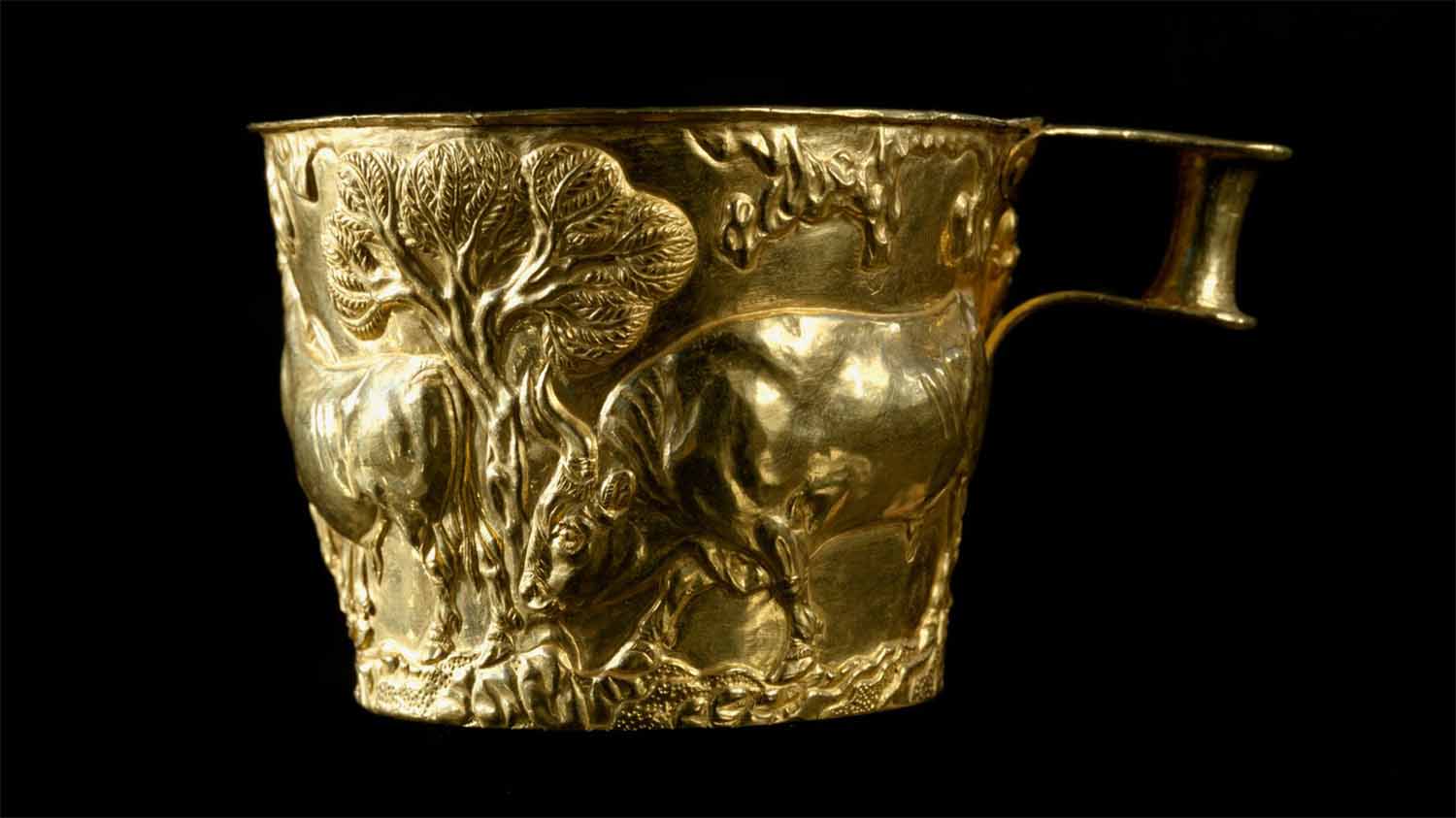
One of the two gold Vaphio Cups, Mycenaean goldwork dated to roughly the fifteenth century BC, showing a bull captured beneath a tree.
The Aurochs as Royal Trophy: Hunting Culture in Ancient Greece and Rome
Long before Julius Caesar wrote about the aurochs in Germania, the animal was already a mark of status across the ancient Mediterranean world, and the practice outlasted him by centuries. A Macedonian king killed one and dedicated its hide to a god. Bronze Age goldsmiths hammered its capture into drinking cups fine enough to be buried with the dead. A Roman emperor commemorated his predecessor’s own aurochs-horn offering more than a century and a half after Caesar’s death. A Roman playwright listed the animal alongside tigers as prey too dangerous for anyone but a goddess to hunt safely. None of these sources describe the aurochs with the technical detail Caesar or later eyewitnesses like Herberstein and Schneeberger would provide. What they describe instead is what the animal meant: proof of courage, a fit offering for a god, and, again and again, a set of horns worth keeping.
Quick facts: The Vaphio Cups, gold vessels from a Mycenaean tomb near Sparta dated to roughly 1500 BC, depict wild-bull hunting scenes and are among the oldest surviving artistic evidence of the practice. Around 200 BC, King Philip V of Macedon killed a wild bull on Mount Orbelus and dedicated its hide and horns, reportedly about 105 cm (41 in) long, to a temple of Heracles. At least two ancient poets, and possibly three, wrote separate epigrams commemorating that same trophy, suggesting it remained on public display for generations. In 106 AD, the emperor Trajan dedicated a gold-mounted aurochs horn to Zeus after his campaign against the Getae, an offering commemorated in verse by his successor, the emperor Hadrian. The Roman playwright Seneca listed the aurochs (uri) alongside tigers and bison as prey belonging to Diana in his tragedy Phaedra.
The Vaphio Cups: Bronze Age gold and the oldest hunting scenes
The earliest artistic evidence connected to wild-bull hunting in the Aegean world comes from a pair of gold cups recovered from a tholos tomb at Vaphio, near Sparta, excavated by Christos Tsountas in 1889 and dated to the fifteenth century BC. Both cups are now held at the National Archaeological Museum in Athens. One cup shows a bull being lured and roped in a relatively calm scene; the other shows a hunt gone wrong, a bull caught in a net while a second animal charges the hunters, one man thrown into the air. The animals depicted are commonly identified as aurochs, though the identification rests on their scale and build relative to the human figures rather than any feature that rules out a generic wild bull. Scholars have long debated whether one or both cups were made on Crete or the Greek mainland, since Minoan and Mycenaean bull-imagery share close stylistic ties. What survives is not a written account, but the cups establish that hunting a powerful wild bovine was already a subject worth rendering in gold, for a burial, more than a thousand years before Caesar picked up a pen.
A king’s kill on Mount Orbelus
The clearest ancient link between the aurochs specifically and elite status comes from Macedon. Sometime during his reign (221 to 179 BC), Philip V of Macedon killed a wild bull in the foothills of Mount Orbelus, in the region bordering ancient Paeonia, by driving a hunting spear through its forehead. He dedicated the animal’s hide and horns to Heracles, from whom the Macedonian royal house claimed descent. An epigram securely attributed to Antipater of Sidon, preserved in the Greek Anthology, commemorates the kill directly:
“The bull that formerly bellowed on the heights of Orbelus, the brute that laid Macedonia waste, Philip… has slain, piercing its forehead with his hunting-spear; and to you, Heracles, he has dedicated with its strong hide these horns, the defence of its monstrous head.”
Two more epigrams on the same dedication survive, and here the authorship gets genuinely uncertain. One gives the trophy’s dimensions directly:
“We hang in the porch, a gift of the king to Heracles, the skin and mighty horns, fourteen palms long, of a wild bull, which when it confronted Philip, glorying in its strength, his terrible spear brought to ground, on the spurs of Orbelus, the land of wild cattle.”
Fourteen palms works out to roughly 105 cm (41 in), a figure consistent with the largest known aurochs horn cores recovered by modern archaeology. Older sources print this poem, along with a third, under the name of Philippus of Thessalonica, a poet who lived more than a century after Philip V. The manuscripts themselves disagree: one tradition credits the poem to Simias, whose dates make that attribution impossible, while the standard modern scholarly edition of the Greek Anthology, by Gow and Page, assigns both remaining epigrams to a different poet entirely, Samius of Macedon. What is not in dispute is that at least two poets, writing at different points after the fact, thought this particular set of horns worth writing about. Temple dedications like this one were not taken down after the ceremony; this trophy stayed on public display long enough, and mattered enough, to draw more than one epigrammatist’s attention, quite possibly across different generations.
A second hunter, and a drinking horn
The Orbelus kill was not an isolated story from the region. A separate epigram, numbered 9.300 in the Greek Anthology and attributed to the poet Addaeus, also preserved in Norman Douglas’s survey of the collection, describes a warrior named Peucestes who met a wild bull on horseback near Doberus, in the same general part of the southern Balkans, and killed it by driving his spear into its temple. Rather than dedicating the trophy to a god, Addaeus records that Peucestes kept the horns for himself and drank wine from them afterward. Between the two stories, dedicated to a temple in one case and kept as a personal drinking vessel in the other, the region’s aurochs hunters treated the horns as the point of the exercise nearly as much as the kill itself, a pattern that shows up again centuries later in Julius Caesar’s account of Germanic hunters mounting aurochs horns in silver for use as cups.
An emperor’s trophy, three centuries later
The custom of dedicating an aurochs horn to a god did not end with Philip V. In 106 AD, during his campaign against the Getae along the lower Danube, the emperor Trajan dedicated a gold-mounted aurochs horn, together with two ornately worked cups, to Zeus of Mount Kasios at Antioch in Syria, drawn from the first spoils of that victory. The dedication was commemorated in a Greek epigram, securely attributed to Trajan’s own successor, the emperor Hadrian:
“To Casian Zeus did Trajan, the descendant of Aeneas, dedicate these ornaments, the king of men to the king of gods: two curiously fashioned cups and the horn of a urus mounted in shining gold, selected from his first booty when, tirelessly fighting, he had overthrown with his spear the insolent Getae.”
The ritual falls more than three centuries after Philip V’s hunt and in an entirely different corner of the ancient world; the Getae inhabited the lower Danube region of what is now Romania and Bulgaria, far from Macedon or Doberus. The underlying gesture, though, is identical: a ruler takes an aurochs horn as war trophy, has it worked in precious metal, and dedicates it to the chief god of his pantheon. That the poet recording it was himself a reigning Roman emperor, writing about his immediate predecessor, confirms that turning an aurochs horn into a formal offering was still recognized, elite behavior well into the second century AD, not a custom that had faded from memory after Caesar wrote about the Germanic version of it in Gaul.
Rome’s aurochs: prey fit for a goddess
Roman literature treats the aurochs less as a specific trophy story and more as a byword for dangerous, exotic prey. In his tragedy Phaedra, the philosopher and playwright Seneca the Younger has Hippolytus open the play with a hunting invocation to Diana, cataloguing the animals that fall within her power across the known world. The list includes Gaetulian lions, Cretan deer, and both of the great wild bovines of the northern forests:
“The striped tigers face thee, but the shaggy-backed bisons flee, and the wild ox with wide-spreading horns.”
The Latin for that last phrase, feri cornibus uri, uses the exact word Caesar would use for the aurochs a century earlier, and places it deliberately alongside bisontes, the bison, as a separate and equally formidable animal. Seneca never claims firsthand knowledge of either species; the passage is a literary catalog, not a hunting report. But the distinction matters. More than a century before Pliny the Elder made the same separation in his Natural History, a Roman playwright already treated the aurochs and the bison as two different animals worth naming individually among the world’s most dangerous game.
When the record gets it wrong
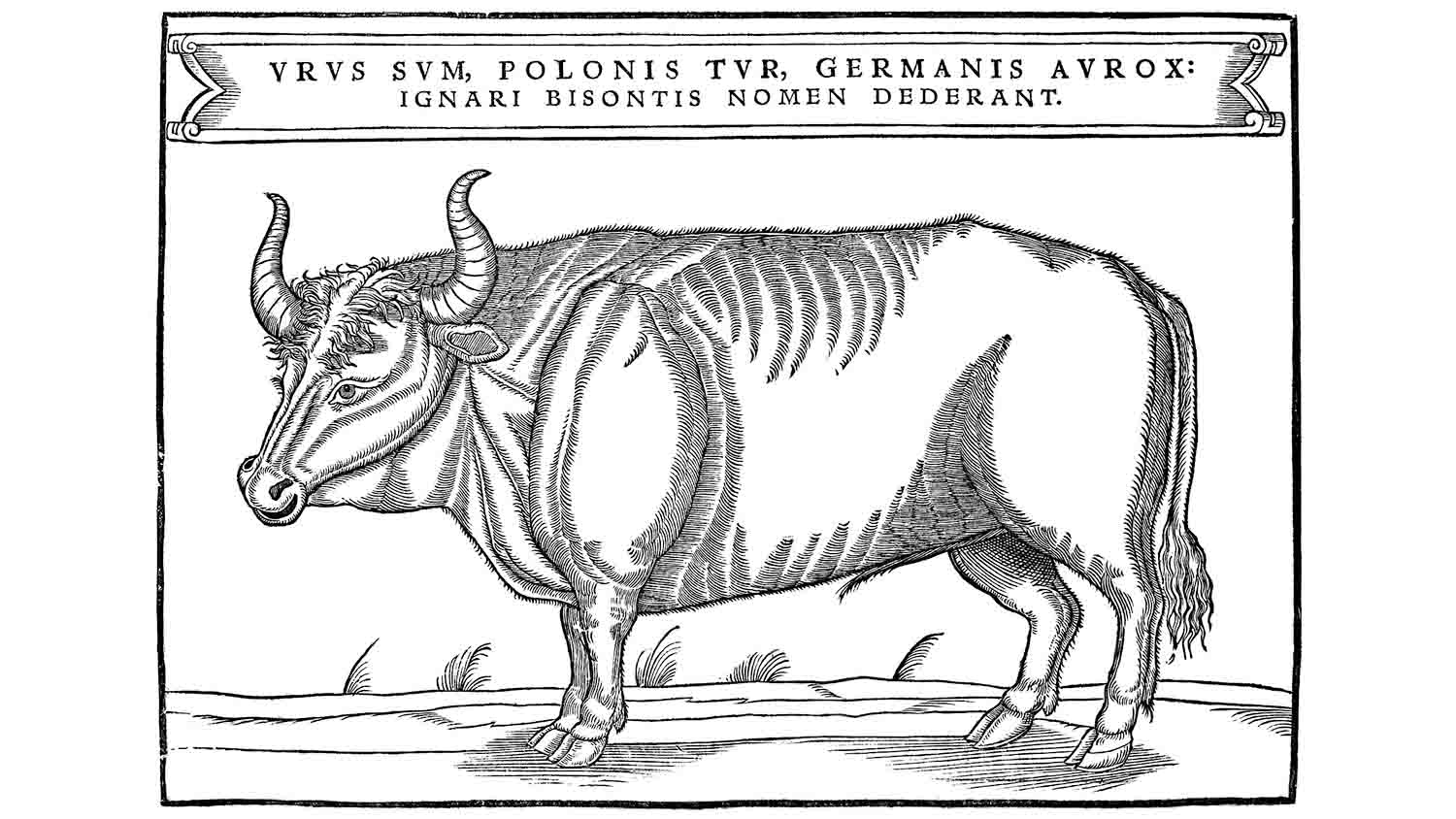
Not every classical account of the region’s wild cattle was this reliable. Aristotle, and later Pliny, both described an animal from the same general area, Paeonia, called the bonasus: bull-like, maned like a horse, with horns curved uselessly inward, and capable of driving off pursuers by spraying burning dung for hundreds of feet. Medieval bestiaries would later inflate this into the wholly fantastical bonnacon. Most modern scholars think the bonasus began as a garbled secondhand account of the European bison, whose shaggy mane and Balkan range fit far better than the aurochs, which classical writers consistently describe as smooth-coated. The bonasus is a useful corrective: it shows that when ancient writers were working from rumor rather than a trophy they could see and measure, the distinction between the aurochs and the bison broke down completely, the same confusion Herberstein would still be correcting in print more than a thousand years later.
What the trophies confirm
None of these Greek and Roman sources approach the aurochs the way Caesar, Herberstein, or Schneeberger did: as an animal to be described, measured, or watched. They approach it as an object, something to kill, dedicate, drink from, or list. But that difference in purpose is what makes them useful alongside the rest of the cluster. The Vaphio Cups show the aurochs, or an animal very like it, already carrying prestige a millennium before written history reaches it. Philip V’s dedication and the Peucestes drinking-horn story confirm, independently of Caesar, that turning aurochs horns into trophies and vessels was a real and geographically widespread practice, not a detail Caesar’s Germanic informants invented for his benefit. Trajan’s dedication, commemorated by Hadrian more than a century and a half after Caesar wrote his own account, shows the same instinct persisting at the very top of Roman society long after Gaul had been conquered. Seneca’s aurochs-and-bison pairing shows Rome maintaining the same species distinction Pliny would make explicit a century later. And the bonasus shows what happens to a record when nobody has an actual trophy to check the story against, the same gap Herberstein’s woodcut caption would still be closing fifteen centuries afterward. This trophy culture is one strand in a much longer story; a broader look at what ancient and historical writers said about the aurochs traces the fuller record from these earliest sources through the species’ 1627 extinction.