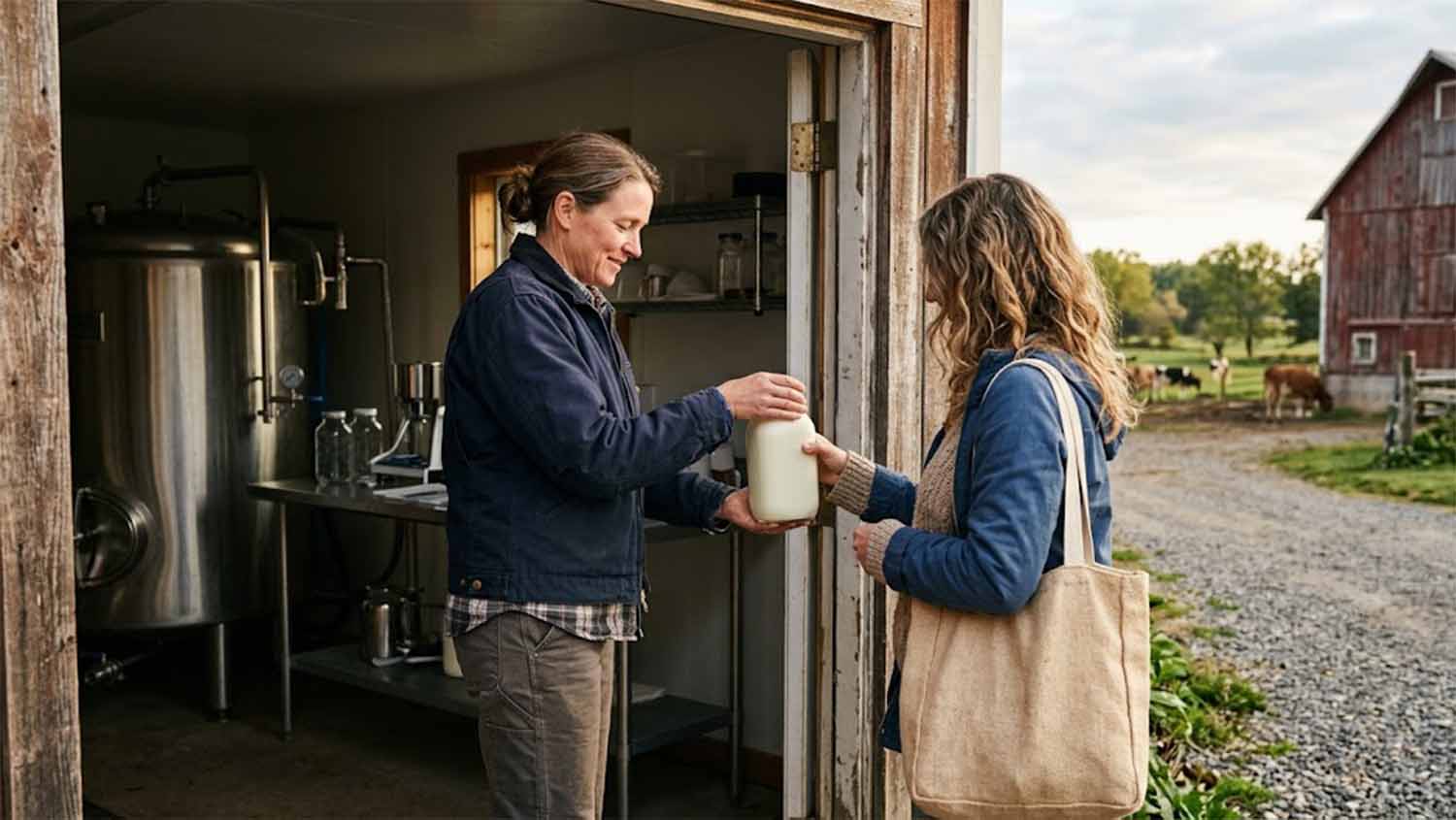
Beef sold direct from a farm can be traced to a single herd and a single animal. Ground beef sold at retail generally cannot, because federal law no longer requires an origin statement.
Where Does American Ground Beef Come From? What the Label Doesn’t Say
Most ground beef sold in American supermarkets is a blend. Lean trimmings, a large share of them imported, are mixed with fattier trimmings from domestic cattle to hit a target fat percentage: 80/20, 85/15, 73/27. The package tells you the ratio. In most cases it does not tell you the country.
That is not an oversight. It is what current federal labeling law allows, and understanding the rules makes it straightforward to find beef whose origin you can actually verify.
What a beef label can and cannot tell you
Two separate rules govern this, and they are often confused.
Mandatory country-of-origin labeling for beef was repealed in 2015. Section 759 of the Consolidated Appropriations Act, 2016 (Public Law 114-113, at 129 Stat. 2285) amended the Agricultural Marketing Act of 1946 by striking “beef,” and “ground beef,” from the covered commodity list at 7 U.S.C. 1638. Since then, retail beef and ground beef can be sold in the United States with no origin statement at all.
“Product of USA” is a voluntary claim with a strict definition. In the FSIS final rule Voluntary Labeling of FSIS-Regulated Products With U.S.-Origin Claims (89 FR 19470), USDA defined “Product of USA” and “Made in the USA” to mean the product is derived from animals born, raised, slaughtered, and processed in the United States. Establishments choosing to use the claim have had to meet those requirements under 9 CFR 412.3 since the compliance date of January 1, 2026.
This closed a real loophole. Before the rule, imported beef could carry a US-origin claim after minimal processing such as grinding or repackaging domestically. That is no longer permitted.
But the rule governs what the claim means, not whether it must appear. Putting it plainly:
| What the package says | What it tells you |
|---|---|
| “Product of USA” or “Made in the USA” | Born, raised, slaughtered and processed in the US. A verifiable claim. |
| A named country, e.g. “Product of Brazil” | That country of origin. |
| No origin statement at all | Nothing. Origin is not disclosed and is not required to be. |
The third row covers a great deal of retail ground beef. An unlabeled package is not a labeling failure, and it is not evidence of anything being wrong with the beef. It simply means the information was not required and was not given.
Whether that remains the case is now under formal review. An executive order signed on September 4, 2026, Supporting America’s Ranchers, directs the Secretary of Agriculture, in consultation with the Trade Representative, to review within 90 days “all statutory and regulatory authorities that may permit the establishment of mandatory country-of-origin labeling for beef products,” along with an economic analysis of its impacts. A review is not a rule, and none of the labeling requirements described above have changed.
Why imported beef ends up in American ground beef
This is a structural feature of how cattle are raised, not a recent development.
Grain-finished American cattle yield trimmings with a high fat content. Ground beef needs lean trim to blend against it. Grass-fed cattle from pasture-based systems abroad produce exactly that lean trim, and much of the American supply arrives from countries that raise cattle that way.
The February 2026 presidential proclamation on beef imports describes the mechanism directly: the United States imports “lean trimmings, which are blended with fattier domestic trimmings to produce ground beef products, such as hamburgers.” The same document records that the United States imported 4.64 billion pounds of beef in 2024, an increase of more than 24 percent over 2023.
The specific product at issue is boneless beef, classified under Harmonized Tariff Schedule numbers 0201.30.5091 and 0201.30.5097 (fresh or chilled) and 0202.30.5091 and 0202.30.5097 (frozen). It does not become a steak. It goes to grinders.
Which countries supply American beef
Beef imports run under a tariff-rate quota (TRQ): a set quantity enters each year at a low duty, and anything beyond it pays a much higher one. In the Harmonized Tariff Schedule, frozen boneless beef entering within the quota (subheading 0202.30.50) is dutiable at 4.4 cents per kilogram, while the same product outside it (0202.30.80) pays 26.4 percent of its value.
US Customs and Border Protection publishes the allocations. From Quota Bulletin QB 26-201, covering January 1 to December 31, 2026:
| Country | 2026 in-quota limit |
|---|---|
| Australia | 378,214,000 kg |
| New Zealand | 213,402,000 kg |
| Argentina | 20,000,000 kg |
| Uruguay | 20,000,000 kg |
| United Kingdom | 13,000,000 kg |
| Other countries or areas | 52,005,000 kg |
| Canada | No limit |
| Mexico | No limit |
Two features of that table explain most of what happens in practice.
First, Canada and Mexico have no quota at all, entering duty-free under USMCA. Together they are consistently among the largest suppliers.
Second, there is no line for Brazil. Brazil competes inside the shared “Other countries or areas” pool of 52,005,000 kg alongside Nicaragua, Paraguay and others. That pool is modest relative to demand, and it is administered first-come, first-served. Australian trade publication Beef Central reported that the pool filled within six days of the 2026 trading year opening. Brazilian beef arriving after that point pays the full 26.4 percent rate, and has continued to arrive in volume regardless.
This is why the identity of the quota matters more than the headline tariff. A change to out-of-quota duties is worth little to Australia or New Zealand, which have large country-specific allocations, and nothing to Canada or Mexico, which have none to exceed. It is worth a great deal to whoever is shipping out-of-quota.
What changed in 2026: two tariff proclamations
Two actions in 2026 have altered these mechanics.
February 2026: Argentina’s allocation quadrupled. A presidential proclamation, Ensuring Affordable Beef for the American Consumer, increased the aggregate in-quota quantity by 80,000 metric tons for calendar year 2026 and allocated all of it to Argentina. The increase applies only to lean beef trimmings under the four HTS numbers listed above, and is administered in four quarterly tranches of 20,000 metric tons each, opening February 13, April 1, July 1 and October 1. CBP published the tranche mechanics in Quota Bulletin QB 26-223, and has since issued bulletins for the second and third tranches. The legal authority is Section 404 of the Uruguay Round Agreements Act (19 U.S.C. 3601(b)), which permits temporary TRQ increases where the President determines supply will be inadequate to meet demand at reasonable prices.
August 2026: 300,000 metric tons, allocated entirely to the shared pool. On August 26, 2026 the President signed Proclamation 11059, Further Ensuring Affordable Beef for the American Consumer (91 FR 55989), increasing the 2026 in-quota quantity by a further 300,000 metric tons. As in February, it applies only to lean beef trimmings under the same four HTS numbers.
The decisive clause is the fourth: the additional quantity is “allocated in its entirety to ‘other countries or areas.’” That is the shared 52,005,000 kg pool described above, not the country-specific allocations. Australia, New Zealand, Argentina, Uruguay and the United Kingdom hold their own lines in the quota table and draw nothing from this increase; Canada and Mexico have no quota to exceed. The benefit falls to the countries shipping inside the shared pool, which had already exhausted it in the first week of January. Brazil is by some distance the largest of them.
CBP implemented the increase in Quota Bulletin QB 26-230. It runs in three 30-day tranches of 100,000 metric tons, opening September 1, October 1 and October 31, and closing when the quantity fills or on November 30, whichever comes first. Entries are first come, first served; anything exceeding a tranche limit is prorated and pays the high duty rather than rolling into the next tranche. Filers use a new tariff line, 9903.54.02, ahead of the ordinary Chapter 2 number.
The widely reported 25 percent discount is worth reading carefully in the text. The proclamation does not require it. It directs the Secretary of Agriculture and the Trade Representative to monitor whether trimmings entering under the increase are sold at 25 percent below the market price, and if they are not, to notify the President “so that I may determine whether to eliminate what remains of the increased in-quota quantity.” That is a discretionary remedy, not a binding commitment by any named party. The American Farm Bureau Federation’s analysis notes that additional lean trim influences ground beef supply more than prices for steaks, roasts and other retail cuts.
Why the EU stopped accepting Brazilian beef
Two days before the American window opened, a different one closed.
On September 3, 2026, the European Union suspended imports of Brazilian beef, poultry, eggs and honey. The decision followed a May 2026 vote by member state experts on an updated list of third countries authorised to export animal products to the bloc, implemented through Commission Implementing Regulation (EU) 2026/1189. Brazil was left off it.
The reason is narrower than it first sounds. EU rules bar antimicrobials used to promote growth or increase yield, and restrict those reserved for human medicine, and exporting countries must certify compliance across the production chain. Brazil did not provide the written guarantees for beef before the deadline. It did provide them for poultry and honey, where audits are continuing. This is a failure to satisfy a certification requirement, not a finding that any particular consignment is contaminated, and the distinction matters. Brazil remains eligible to ship beef to the United States throughout. (Euronews, RTE)
The sequence is a coincidence of calendars rather than cause and effect: the European vote was taken in May, and the American proclamation was signed in August. But the practical result is that in a single week the largest supplier inside the shared quota pool lost access to one major market and gained tariff-free access to another.
The company on both ends of the trade
The Wall Street Journal reported that Joesley Batista, who co-controls JBS, met the President at the White House on August 20, 2026 and pressed the case for dropping the tariff on Brazilian beef. The announcement came the following day. The reporting rests on unnamed sources, and Reuters noted it could not independently verify the account. A White House official said the decision “was the result of a long policy planning and coordination process involving domestic stakeholders” and “was not done as the result of any one conversation.” No impropriety has been established. (Reuters, via Yahoo Finance, NewsNation)
The detail matters because JBS sits on both ends of this trade. It is a Brazilian company, and through JBS USA it is one of the four processors handling the large majority of American beef, so it stands to buy the trimmings as well as sell them.
Two further matters are on the public record, and readers can weigh them for themselves.
In October 2020, J&F Investimentos, the Batista family holding company that controls JBS, pleaded guilty in United States federal court to conspiring to violate the Foreign Corrupt Practices Act, agreeing to pay a criminal monetary penalty of $256,497,026. The Batista brothers, J&F and JBS separately settled related Securities and Exchange Commission allegations, part of which concerned JBS’s acquisition of Pilgrim’s Pride.
Separately, Pilgrim’s Pride, the American poultry subsidiary of JBS, gave $5 million to the Trump-Vance inaugural committee, the single largest contribution that committee received and more than Amazon, Meta, Google and Apple’s chief executive gave combined. In May 2025 Senator Elizabeth Warren wrote to the company, saying she was “concerned Pilgrim’s Pride may have made its contribution to the inaugural fund to curry favor with the Trump administration,” and noting that the Securities and Exchange Commission had approved a New York Stock Exchange listing for JBS the previous month. The donation was lawful and disclosed, and no finding of impropriety has been made in connection with it or with the 2026 tariff decision.
How to buy beef you can trace
None of the above implies imported beef is unsafe. Imported lots are required to be presented for reinspection at the port of entry, and the countries supplying the United States operate under equivalence determinations recognised by USDA.
That requirement is a process, though, and processes can be missed. In August 2026, Corte Argentino USA LLC of Aventura, Florida recalled roughly 29,628 pounds of raw beef produced by the Argentine packer Frigorifico Gorina SAIC because the product had entered the country without the benefit of import reinspection. The beef was whole muscle cuts, produced in May 2026 and carrying use or freeze-by dates into September, and it had already reached distributors in Florida and Texas. The problem was procedural rather than a contamination finding, it was identified through routine FSIS inspection activity, and no illnesses were reported. (Fox Business, CBS News)
Read fairly, that episode cuts both ways: product did reach the market without the check it was supposed to receive, and the system that is supposed to notice caught it. The episode illustrates why origin knowledge matters, and it is a poor basis for treating imported beef as inherently unsafe.
The honest issue is therefore not danger. It is knowledge: a package with no origin statement cannot tell you what you are eating, and no amount of label-reading will change that.
The reliable alternative is to buy from a source that can answer directly. Questions worth asking:
- Where were the cattle born and raised, and were they ever moved between operations?
- What were they fed, particularly in the final months before harvest?
- Where were they processed, and is that facility local?
- Is the ground beef from one animal or a batch blend?
A farm selling its own beef can answer all four. Many raw milk dairies also raise cattle for meat and sell beef directly, which is a practical way to buy from a single named herd. The same farms frequently offer pastured pork and farm eggs alongside the dairy.
One thing that surprises first-time buyers: farms usually sell beef as a whole, half or quarter animal rather than by the pound. That is a consequence of federal law, not a preference. Under 21 U.S.C. 623(a), custom slaughter is exempt from federal inspection only when the meat is prepared exclusively for the owner of the animal and their household, guests and employees. Selling individual cuts to the public requires a federally inspected plant, a state program recognised as at least equal to it, or a state plant enrolled in USDA’s Cooperative Interstate Shipment program. Buying a share means you own the animal before it is processed, which is what keeps the transaction inside the exemption.
Several efforts to change that are live but none has changed the law. The PRIME Act (H.R. 4700 and S. 2409) would extend the exemption to custom-facility meat sold within a state. A narrower version, a capped state pilot program with mandatory labelling disclosing that the meat was not federally inspected, sits at section 12114 of the House-passed 2026 farm bill. And on September 4, 2026 the President signed two executive orders on the subject, following an August 28 social media post saying he was authorising documents to let farmers and ranchers process their own food.
Neither order changes who may sell meat without federal inspection. Promoting Fair Competition in Livestock Markets and Expanding Market Access for American Meat Producers directs stepped-up enforcement against packers, tells the Department of Agriculture to accelerate state entry into the Cooperative Interstate Shipment program, creates training and a guaranteed loan program for small processors, and commissions reports within 60 days on the statutory barriers that restrict state-inspected product. Supporting America’s Ranchers orders a broader review of regulations affecting ranchers. Both work within the existing inspection framework, and the fact that they ask what the statutory obstacles are is itself a recognition that the inspection requirement is set by statute and cannot be lifted by executive action alone.
Browse the grass-fed and pastured beef map to find farms, farm stores, drop points and retailers near you, or start with the raw milk farm directory if you want dairy from the same source.