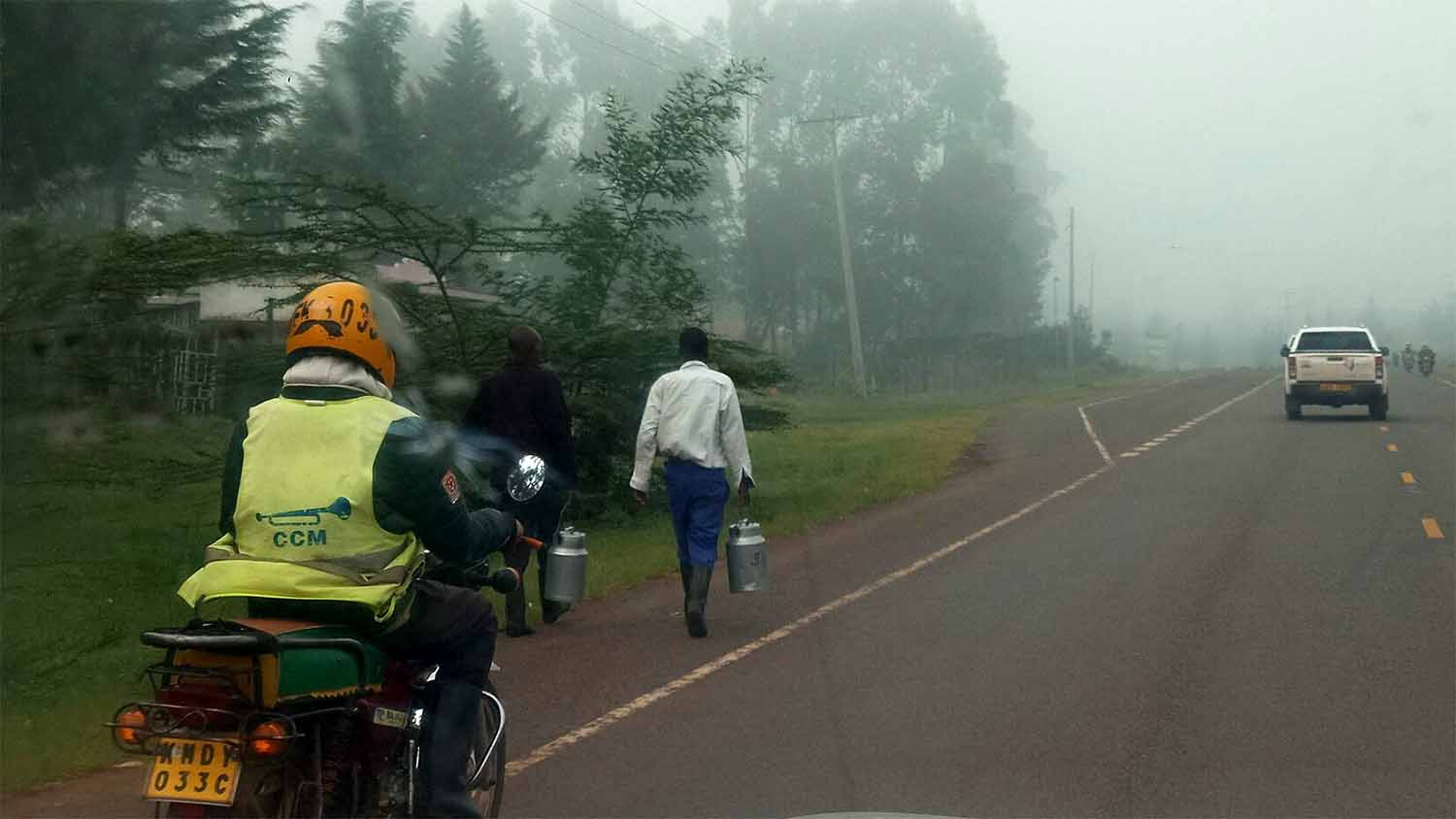
Milk carried by hand in aluminium cans along a rural Kenyan road, 2020. About 80 percent of Kenya's milk moves through informal channels, but since 2021 the law has allowed raw milk sales only from a farmer to an immediate rural neighbor, collected at the farm. Photo: MarkDenver Karubiu, via Wikimedia Commons, CC BY-SA 4.0. Cropped from the original.
Kenya’s 2026 Milk Shortage and the Raw Milk Hawking Crackdown
In May 2026, Kenya’s Agriculture Cabinet Secretary declared that “milk hawking must stop,” arguing that it “destroys the ability to create value-added dairy products.” By September, some supermarkets were capping how much milk each customer could buy, prices had risen by half or more in parts of Nairobi and Kiambu, and the same Cabinet Secretary was conceding that farmers had diverted milk to brokers because brokers paid more than cooperatives.
This is an update to earlier coverage of Kenya’s raw milk hawking ban, which traced the policy from 2013 through 2024. Since then Kenya has announced a nationwide crackdown, passed a new food safety coordination law, and run short of milk in the formal dairy channel. A viral post now claims more than 100 milk sellers are in remand, which no one has confirmed.
Key facts at a glance
| Question | Answer |
|---|---|
| Is raw milk legal in Kenya? | Only narrowly. A farmer may sell raw milk to an immediate neighbor in a rural area, collected at the farm, not for resale. All other raw milk sales, and all sales in urban centers and cities, are prohibited. |
| What law bans milk hawking? | Regulation 5 of the Dairy Industry (Dairy Produce Safety) Regulations, 2021 (Legal Notice 22 of 2021), made under the Dairy Industry Act, Cap. 336. |
| Why does Kenya restrict raw milk? | The official reason is public health. A 2022 study found “a lack of evidence on the incidence of milk-borne disease” in Kenya, traced the rules to a 1958 law passed partly to limit competition with settler dairies, and pointed to government links to major processors. |
| What is the penalty? | Up to KSh10,000, up to 12 months in prison, or both, under Regulation 10 of the same regulations. |
| When was the 2026 crackdown announced? | May 20, 2026, by Agriculture CS Mutahi Kagwe at Uhuru Park, Nairobi. |
| What caused the September 2026 milk shortage? | Officials cite drought and feed costs. The Agriculture CS also said farmers were selling to brokers who paid more than cooperatives. |
| How much did formal milk supply fall? | Deliveries to processors fell 3.7 percent, from 84.4 million litres in June to 81.3 million litres in July 2026. |
| How high did prices go? | KSh90 for 500ml in parts of Nairobi, and KSh110 per litre for fresh milk at one outlet in Pipeline, up from KSh60, per Kenyans.co.ke on September 16, 2026. |
| Are 100 raw milk sellers in prison? | Unverified. The claim comes from a single social media post citing unnamed sources. No Kenyan news report or court record of it could be found. |
| Did a new law change the penalties in 2026? | No. The Food and Feed Safety Control Co-ordination Act, 2026 amended the Dairy Industry Act on July 10, 2026, but it adds coordination and audit powers, not new penalties for selling milk. |
Timeline: Kenya’s raw milk crackdown and milk shortage, 2026
| Date | Event |
|---|---|
| May 20, 2026 | CS Mutahi Kagwe announces a nationwide crackdown on milk hawking and a KSh1.43 billion cooler program |
| June 23, 2026 | Food and Feed Safety Control Co-ordination Act, 2026 (Act No. 21 of 2026) receives assent |
| July 10, 2026 | Act No. 21 of 2026 commences and amends the Dairy Industry Act |
| July 2026 | Formal milk deliveries drop to 81.3 million litres, down from 84.4 million in June |
| September 1, 2026 | Kenya Dairy Board describes “temporary supply constraints instead of a complete milk shortage”; brands disappear from shelves nationwide |
| September 4, 2026 | Kagwe blames drought and brokers paying more than cooperatives; rationing reported in some supermarkets |
| September 16, 2026 | Kagwe tells the Senate the shortfall is about 5 percent and blames panic buying |
| September 21, 2026 | Viral post claims more than 100 raw milk sellers are in remand at Lang’ata and Kiambu prisons |
What the May 2026 crackdown announced
On May 20, 2026, Agriculture and Livestock Development CS Mutahi Kagwe announced a nationwide crackdown on brokers and hawkers distributing raw milk directly to families, speaking at the launch of bulk milk coolers for dairy cooperatives at Uhuru Park in Nairobi.
“Milk hawking must stop. It is dangerous, it is a health issue and it destroys the ability to create value-added dairy products,” Kagwe said, according to The Star. The rest of the government’s case was economic. As Dairy Business Middle East & Africa summarized it, “the dominance of brokers and hawkers has undermined dairy cooperatives, frustrated processors and denied farmers opportunities to benefit from value-added dairy products.”
The money went to the formal channel:
- 230 bulk milk coolers worth about KSh1.43 billion for dairy cooperatives, 95 of them already delivered at the time of the announcement
- Traceability records required of processors and cooperatives, “showing where milk is sourced from, how much individual farmers produce and how products move through the supply chain”
- Subsidized sexed semen, cut from KSh9,000 to about KSh1,000
- Local yellow maize and soya beans promoted to lower animal feed costs
None of the coverage cited a new statute, regulation or penalty. The crackdown was an enforcement push under rules in force since 2021, paired with an effort to route milk through cooperative coolers and on to processors.
Is raw milk legal in Kenya? What the law says
Selling raw milk in Kenya is mostly illegal. The only permitted sale is from a farmer to an immediate neighbor in a rural area, with the milk collected at the farm and not resold. Hawking, meaning the sale of raw milk away from the farm by vendors who buy from farmers and carry it to customers by bicycle, motorbike or on foot, or sell it on the street, is prohibited, as is any raw milk sale in an urban center or city.
The operative rule is not in the Dairy Industry Act itself. It is Regulation 5 of the Dairy Industry (Dairy Produce Safety) Regulations, 2021, Legal Notice 22 of 2021. The raw milk provisions read:
(1) Primary producers may sell milk to his or her immediate neighbor provided that— (a) the milk is obtained from a healthy animal and is, to the best of the knowledge of the seller, free from a disease, antibiotic residue, contaminant, adulterant or preservative and meets the relevant Standard for raw milk; (b) the buyer collects the milk from where the milk is produced using a clean, hygienic food grade, container; (c) the seller expressly communicates to the buyer that the milk is raw and the buyer commits to ensure that it is safe for domestic consumption. (d) the milk shall not be resold; (2) No persons shall engage in hawking of dairy produce except as provided for in this regulation. (3) Paragraph 5(1) does not apply to sale of milk in urban centers and cities where urban centers and cities are as defined by the relevant legislation.
In practice:
- Legal: a farmer selling raw milk to an immediate neighbor, in a rural area, with the neighbor collecting it at the farm in their own clean container, told plainly that it is raw, and not reselling it.
- Not legal: carrying raw milk to customers, selling it on the street or door to door, reselling milk bought from a farmer, or any raw milk sale inside an urban center or city.
The companion Dairy Industry (Registration, Licensing, Cess and Levy) Regulations, 2021 (Legal Notice 16 of 2021) exempts “a primary producer who produces milk and sells to a neighbor for domestic consumption” from registering as a producer at all. Dairy businesses such as milk bars, milk dispensers, cooling plants and processors need a Kenya Dairy Board regulatory permit and a county licence.
Milk ATMs do not offer a raw milk route either. The same regulations define a dispenser as “a vending machine that dispenses processed dairy produce to consumers.”
Does Kenya’s raw milk ban protect public health or processors?
Kenya justifies its raw milk rules on public health grounds, but the research record points to economic motives. The most detailed recent study, “Kenya’s informal milk markets and the regulation–reality gap”, published in Development Policy Review in 2022 by researchers from IIED and the International Livestock Research Institute, found that “the case for regulation has been underpinned by food-safety issues (though there is a lack of evidence on the incidence of milk-borne disease in the country)” and “by concerns about the informal sector posing ‘unfair competition’ to the formal sector.”
The rules began as protection for settler dairies. The Dairy Industry Act was passed in 1958 “partly in response to pressure from white settlers to control the sector and to limit the competition they faced from the indigenous population,” the authors write. “The intention was to keep raw milk out of urban areas so that consumers would purchase pasteurized milk from the formal sector.” They describe the 2021 regulations as looking “remarkably similar to those passed in colonial times.”
The government has a stake in the formal channel. The study points to “government links to, and ownership of, major processors and the ability for government representatives operating on the ground to extract bribes from those who fail to comply with pasteurization or licensing requirements,” which it says “further incentivizes government to proceed with policies and practices that criminalize the informal sector.” Licences, it adds, “are an important, independent source of revenue for all licensing agencies.”
The formal channel is where fees are collected. Under the 2021 licensing regulations:
- Permit holders collect a consumer safety levy of 40 cents per kilogram of milk processed, or 1 percent of its cost, whichever is higher, and remit it to the Kenya Dairy Board monthly.
- Counties may charge cess of up to 0.5 percent of the farm-gate price, collected by the aggregator or the Board.
- Processors pay KSh50,000 a year for a regulatory permit above 20,000 litres a day, or KSh25,000 below it.
A farmer selling raw milk to a neighbor pays none of these.
Safety does not split along formal and informal lines. The research the authors review found that:
- In one Kenyan study, “over 60% of processed milk samples did not meet the specifications for pasteurized milk.”
- “An important determinant of milk safety in Kenya is not whether milk has been pasteurized or not, but the distance and length of the trading chain.” Most samples from short market chains and rural households met raw milk specifications.
- Studies comparing formal and informal milk chains in Kenya “show no significant differences in quality or safety between chains.”
In the study’s own consumer survey, “all of the consumers stated that they boil milk before consumption.” Only nine of 42 consumers recalled any illness they linked to informal milk, and all nine switched vendors as a result.
The informal market pays farmers and feeds households. Consumers in the survey paid KSh60 for informal milk in late 2018, against an average of KSh100 for pasteurized milk, and half named freshness as their main reason for buying it. Informal markets “tend to pay higher prices to producers,” the authors note, and an earlier estimate they cite puts raw milk sold through mobile vendors at 20 full-time jobs per 1,000 litres handled daily, against 12.5 in formal processing. Around 80 percent of milk sold in Kenya moves through informal markets. The authors conclude that “efforts by government to force the gap to close could be counterproductive for food safety, nutrition, and livelihoods.”
Penalties for selling raw milk in Kenya
The maximum penalty for hawking raw milk in Kenya is a fine of KSh10,000, imprisonment for up to 12 months, or both, under Regulation 10 of the 2021 Dairy Produce Safety Regulations. No offence in the 2021 dairy regulations carries a fine above KSh10,000.
| Offence | Regulation | Maximum penalty |
|---|---|---|
| Hawking or selling dairy produce outside Regulation 5 | LN 22/2021, reg. 10 | KSh10,000, 12 months, or both |
| Selling dairy produce that does not meet the standard | LN 22/2021, reg. 26 | KSh10,000, 12 months, or both |
| Selling contrary to a regulatory permit, first offence | LN 16/2021, reg. 22 | KSh5,000, 12 months, or both |
| Selling contrary to a regulatory permit, repeat offence | LN 16/2021, reg. 22 | KSh10,000, two years, or both |
| Failing to register as a primary producer | LN 16/2021, reg. 5 | KSh2,000, one month, or both |
| Any licensing offence without a specific penalty | LN 16/2021, reg. 27 | KSh10,000, one year, or both |
Did the 2026 food safety law change the raw milk rules?
No. Kenya Law shows the Dairy Industry Act as amended on July 10, 2026 by the Food and Feed Safety Control Co-ordination Act, 2026 (Act No. 21 of 2026), which received assent on June 23, 2026 and commenced on July 10, 2026. The amendment does not touch the raw milk rules or their penalties.
What the Act does:
- Creates a Food and Feed Safety Controller, an office that coordinates and audits the agencies responsible for food safety
- Adds section 17A to the Dairy Industry Act, letting the Kenya Dairy Board ask the Controller for advice where its functions overlap or conflict with another agency’s, and requiring the Controller to audit the Board’s food safety controls
- Assigns county governments food safety duties, including to “license and exercise official control of persons who conduct food business and feed business”
- Requires a multi-annual control plan developed with the counties
The county role matters on the ground. A raw milk seller in Nairobi or Kiambu can face county bylaws and county enforcement officers as well as the Kenya Dairy Board.
Why is there a milk shortage in Kenya?
The Kenya Dairy Board and the Agriculture Ministry blame drought, reduced pasture and high feed costs for Kenya’s 2026 milk shortage. Agriculture CS Mutahi Kagwe also said farmers were selling to brokers who paid more than cooperatives, and that panic buying worsened shortages on supermarket shelves. The official explanations shifted over three weeks.
September 1: seasonal weather. The Kenya Dairy Board described “temporary supply constraints instead of a complete milk shortage,” per the Daily Nation, blaming dry and cold weather in the main dairy regions. Citizen Digital reported formal deliveries to processors down 3.7 percent from June to July. The chairman of the Kericho Dairy Cooperative Union said collections were “below 60 per cent.” A Nairobi supermarket manager said Tuzo had gone from KSh62 or 63 to KSh65 to 68 per 500ml. The Daily Nation reported Brookside, Mt Kenya, New KCC and Tuzo missing from shelves from Nairobi and Lodwar to Mombasa, Nyeri and Homa Bay, and formal milk intake for the first half of 2026 down 0.6 percent, to 513.32 million litres from 516.34 million.
September 4: drought and brokers. Kagwe named two causes, reported by The Eastleigh Voice. One was drought cutting pasture. The other: “A lot of milk that normally goes to processing plants is now being given to brokers because brokers are offering a higher price than the milk processing companies through the cooperatives.” He told cooperatives to get higher prices from processors and “pass the advantages that you are getting in monetary terms back to the farmer,” warning that otherwise “there’s a shortage of milk in supermarkets, but out there in the villages, there is still milk being sold in small bottles and so forth.”
The same day, The Star reported KDB chairman Genesio Mugo urging consumers not to stockpile and saying there was no cause for alarm, while repeating the board’s warning against unpasteurized milk from unregulated traders. Livestock PS Jonathan Mueke said, “The real issue is fodder pressure due to lack of rain.” The government said it would allow duty-free imports of 500,000 tonnes of yellow maize for animal feed.
September 16: a 5 percent shortfall and panic buying. Before the Senate, Kagwe said “there is a slight shortage of milk, but it is not exaggerated. It’s only about 5 per cent less than the usual production,” with processing down about 5.18 percent, according to The Star. “People who would normally have one or two packets of milk in their houses have now got six or so because of the fear that there is not going to be milk,” he said.
Kenya milk prices, September 2026
| Location | Product | Before | September 2026 | Source |
|---|---|---|---|---|
| Nairobi | Packet, per a shopper | KSh60 | KSh75 | Daily Nation |
| Roysambu and Lower Kabete, Nairobi | 500ml packet | not reported | KSh90 | Kenyans.co.ke |
| Pipeline, Nairobi | Fresh milk, per litre, one outlet | KSh60 | KSh110 | Kenyans.co.ke |
| Kiambu | 500ml packet | KSh52 | KSh80 | Kenyans.co.ke |
| Meru | 500ml packet | KSh57 | KSh75 | Kenyans.co.ke |
| Coast | 500ml packet | KSh60 | KSh75 | Daily Nation |
| Nyeri, Kirinyaga, Embu | 500ml packet | KSh44 | KSh48 | Daily Nation |
| North Rift | 500ml packet | KSh50 to 52 | KSh53 to 60 | Daily Nation |
| Homa Bay | Carton of 12 x 500ml, wholesale | KSh620 | KSh750 | Daily Nation |
Kenyans.co.ke also reported that milk ATM operators’ daily supplies fell from 2,000 litres to 500.
On the farm side, Kagwe told the Senate that some companies were paying farmers KSh55 to 60 per litre, above the government minimum. He cited a Kenya Dairy Board study putting the cost of producing a litre at KSh39.50 for zero grazing, KSh37.30 for semi-zero grazing and KSh24.50 for open grazing, an average of KSh36.20, with average profits of about KSh9.90 per litre.
Why farmers are choosing brokers over cooperatives
No official has linked the shortage to the hawking crackdown. The government’s own statements, read in order, still show the tension:
- In May, the goal was to pull milk away from brokers and hawkers and into cooperative coolers and processors.
- By September, the Agriculture CS was describing farmers doing the opposite, choosing brokers because they paid better than cooperatives.
- The shortage showed up in the formal channel the crackdown was meant to strengthen, while milk kept selling “in small bottles” in the villages.
- Kagwe’s proposed fix was price: cooperatives passing higher prices to farmers and paying on time.
This fits a long pattern. In 2024, officials described hawking as something that took hold when farmers went unpaid for two to three months, as covered in the earlier article on Kenya’s hawking ban. Enforcement does not change what a cooperative pays.
Are raw milk sellers in prison in Kenya? The viral claim
A viral post claims more than 100 raw milk sellers are in remand in Kenya, but no news outlet or court record has confirmed it.
On September 21, 2026, X user @koxmusaInc_ posted that the Kenya Dairy Board was “carrying out a crackdown on people selling raw milk directly to consumers” on the streets, that “from my sources there are more than 100 people currently in remand” at Lang’ata and Kiambu prisons, and that getting out costs KSh30,000. “Right now selling raw milk on the streets nikama kuuza bangi,” the post said, meaning it is now like selling cannabis. It drew more than 27,000 views.
What can be confirmed:
- The crackdown is real. It was announced in May 2026 and restated by the Kenya Dairy Board in September.
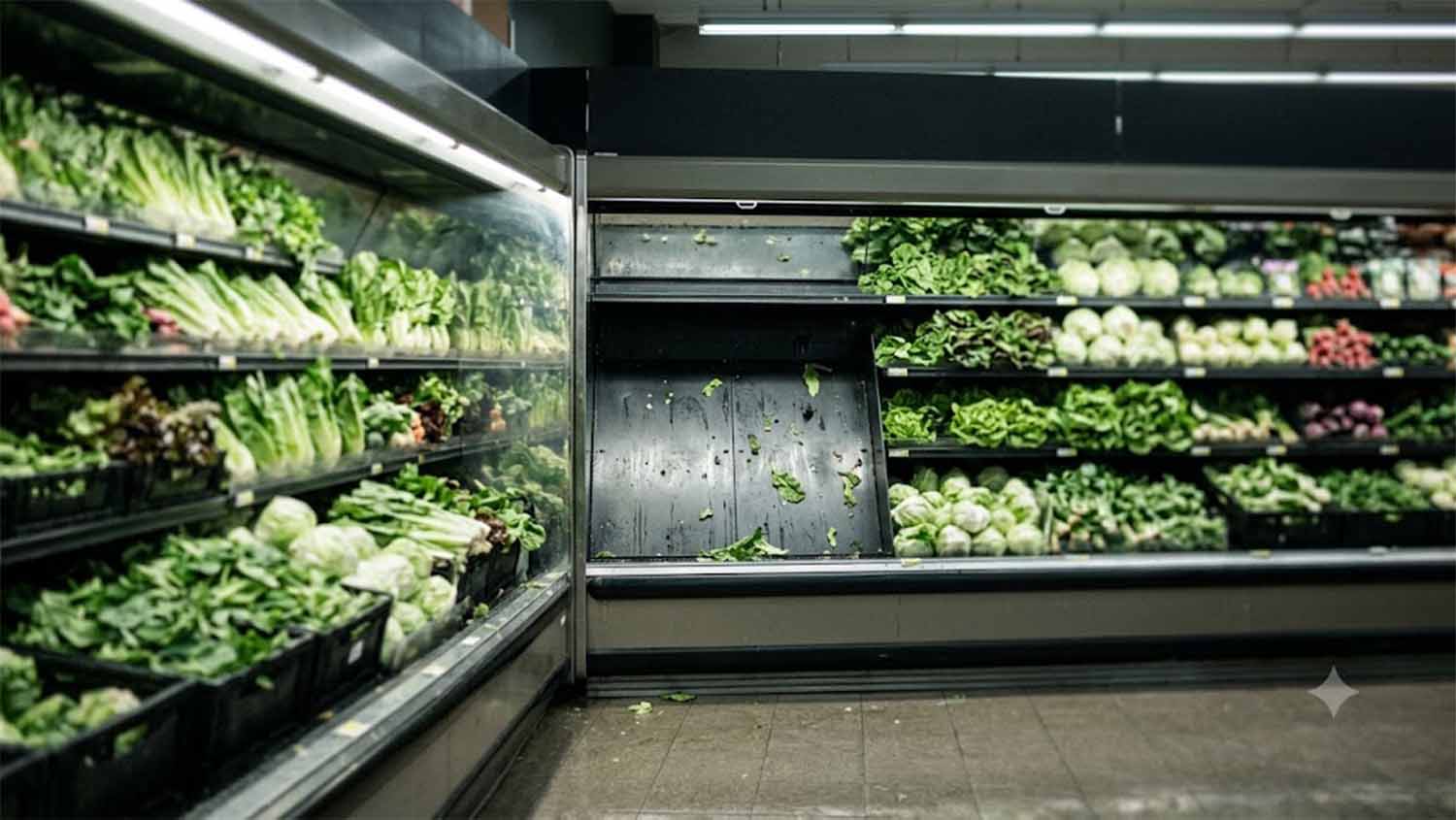
- The shortage is real. The photos attached to the post show near-empty supermarket shelves with a purchase limit sign, consistent with the documented shortage.
What cannot be confirmed:
- The arrests. No report could be found in the Daily Nation, The Standard, The Star, Citizen Digital, KBC, Kenyans.co.ke or Taifa Leo of mass arrests, remand or bond linked to the crackdown. The only source is the poster’s unnamed contacts.
- The KSh30,000 figure. It is three times the maximum fine for any single offence in the 2021 dairy regulations. If people are paying that amount, it is more likely cash bail, which magistrates set case by case, a combination of charges, or penalties under county bylaws or other laws. None of those has been reported.
If accurate, 100 people held in remand over offences capped at a KSh10,000 fine would be significant. At the time of publication, the claim is unsubstantiated. This article will be updated if that changes.
Where raw milk is still legal to buy in Kenya
The legal route is the farm gate. In a rural area, a household may buy raw milk directly from a farmer who is its immediate neighbor, collecting it at the farm in its own clean, food-grade container. The farmer must say the milk is raw, and the buyer may not resell it. The farmer does not need to register with the Kenya Dairy Board for these sales.
For the full legal picture and how Kenya compares with its neighbors, see the Kenya raw milk laws page. For other countries, browse the raw milk laws map.