The American Academy of Pediatrics renewed its call for a nationwide raw milk ban as states continue to expand access.
AAP’s Raw Milk Hysteria Misses the Real Emergency
On October 5, 2026, the American Academy of Pediatrics published a policy statement in Pediatrics calling for a nationwide ban on the sale and distribution of raw milk, along with fresh, soft and soft-ripened raw milk cheeses.
Advising families is a pediatric association’s job. Recommending that pregnant people, infants and children avoid raw milk is stricter than many families would choose, but it is advice, and parents can weigh it. The statement goes further:
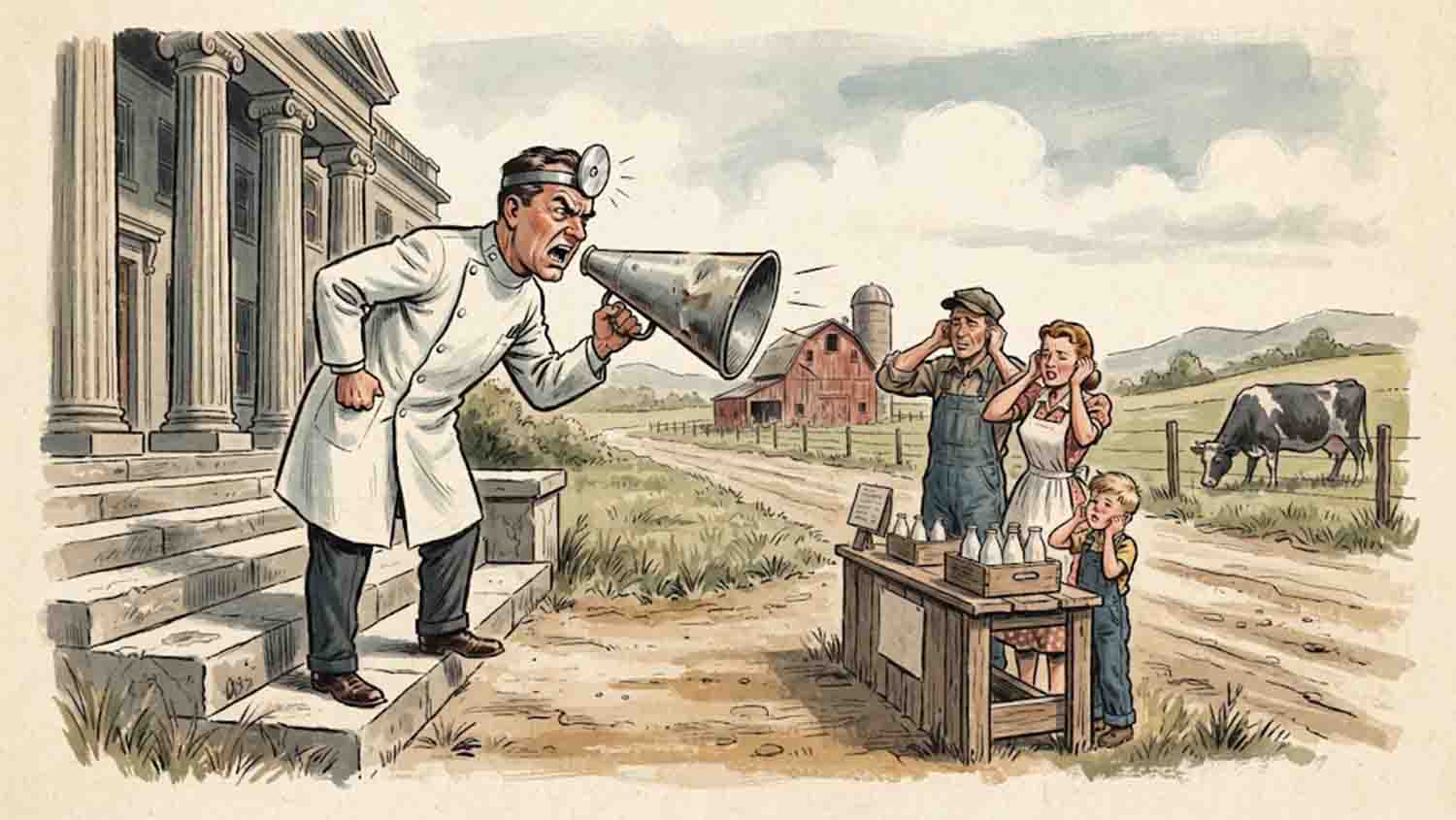
“The AAP also encourages pediatricians to contact their state representatives to support a ban on sale of unpasteurized milk and milk products. Meanwhile, pediatricians can work with local public health officials to advocate for restrictions surrounding raw milk sale (such as warning labels) and community education on the risks of unpasteurized milk consumption. In states where unpasteurized milk sale is currently outlawed, bills proposing to legalize its sale should be opposed.”
That moves from the exam room to the statehouse, and the statement adds a push for “social media and school-based campaigns.” The ban it endorses would end legal access for every household in the country, in a nation where about 11 million adults drink raw milk according to FDA survey data. Set against the AAP’s own figures and the recent record of public trust, the call costs public health more than it protects.
Raw milk illness by the AAP’s own numbers
The statement opens by noting that six major pathogens cause an estimated 9.9 million domestically acquired foodborne illnesses in the United States each year, along with about 53,000 hospitalizations and nearly 900 deaths. Those are modeled estimates that include illness never reported or diagnosed. The comparable figure for raw milk comes from a 2017 study the AAP itself cites, which estimated outbreak illness from raw milk and cheese after adjusting for underreporting.
| Annual, United States | All foodborne illness (CDC estimate) | Raw milk and cheese (Costard estimate) | Raw milk and cheese, high-end overestimate (all sporadic cases counted) |
|---|---|---|---|
| People exposed | about 330 million (all Americans) | about 11 million (adult drinkers only) | about 11 million (adult drinkers only) |
| Illnesses | 9.9 million | about 730 | about 19,000 |
| Illness rate per person exposed | about 3% | about 0.007% | about 0.2% |
| Hospitalizations | about 53,000 | about 21 | not estimated |
The third column is a deliberate overestimate. It applies a Minnesota finding that sporadic illnesses among raw milk drinkers outnumbered outbreak cases about 25 to 1, a generous allowance since those illnesses could not be confirmed as coming from milk. Even then, raw milk accounts for about one foodborne illness in 500. The drinker count comes from FDA surveys of adults, while the illness counts include children, so the true rate per drinker is lower than the table shows. Put another way, about 3 in 100 Americans get sick each year from these pathogens through all foods combined, while the estimated risk from raw milk is about 7 in 100,000 drinkers a year, or about 2 in 1,000 at the deliberate high end. Confirmed outbreak counts tell the same story: the AAP’s own figures show 675 raw milk outbreak illnesses, 98 hospitalizations and 2 deaths over the six years from 2013 to 2018.
The fear behind pasteurization laws was once well founded. In the era of New York’s swill milk scandal and The Jungle, milk came from crowded city dairies with no refrigeration or herd testing, and it spread typhoid, tuberculosis and diphtheria. Reformers answered with pasteurization and also with certified milk, a strict standard for clean raw milk founded by Newark pediatrician Henry Leber Coit. In 1938, milk accounted for 25% of all disease outbreaks traced to food and water, according to FDA’s Pasteurized Milk Ordinance. When raw milk drinking began climbing again in the 2000s, it was reasonable to worry those numbers would return. Two decades later, they have not. From 1998 to 2018, as legal access spread, raw milk accounted for 0.9% of reported foodborne outbreaks in CDC data. Licensed raw milk today comes from tested herds, is chilled immediately and is sampled for pathogens, and the outbreak record reflects that.
Per consumer, the Costard estimate works out to about 1 in 13,000 to 1 in 15,000 a year, below leafy greens and chicken even with the sporadic allowance, and the study behind the AAP’s state comparisons acknowledges that it “did not control for true population at risk.” Raw milk carries a real but small risk.
Hyperbole doing the work
Because the numbers are small, the case for a ban leans on framing. The pattern is old: a 1945 Coronet magazine article, “Raw Milk Can Kill You,” was built around a story that never happened, and within three years Michigan became the first state to ban raw milk sales.
- The 840x figure. The most repeated raw milk statistic is a per-serving ratio against pasteurized dairy, which had no reported Salmonella or E. coli illnesses in the study period. The same study puts raw dairy outbreak illness at about 730 a year. A June 2026 Medical Daily article called it “a landmark CDC analysis” (it was written by private consultants) and “the scientific basis for federal and state regulations requiring pasteurization” (the federal interstate ban predates it by 30 years).
- Bird flu. The statement concedes that “no human cases from unpasteurized milk consumption have been identified to date.” Its lead author still told the Washington Post the risk is “quite concerning.”
Stories of sick children carry much of the emotional weight in coverage. They are real, and every one matters, which is exactly why policy should rest on rates rather than images. A ProPublica investigation into a toddler’s E. coli infection documents a farm that was unlicensed, sold milk labeled as pet food, and was beyond inspectors’ reach because state law bars them from entering unlicensed properties. The state’s licensed farms are inspected and required to test for pathogens. A ban would leave only the first kind of farm.
Punching down: how other outbreaks are handled
Other foods cause far larger outbreaks without anyone proposing to ban them. In 2024, Listeria in Boar’s Head deli meat from a single Virginia plant caused 61 illnesses, 60 hospitalizations and 10 deaths across 19 states. Inspectors had logged dozens of violations at the plant. The company closed it and kept selling deli meat. In 2026, Cyclospora in iceberg lettuce from Taylor Farms de Mexico caused 12,883 illnesses in 21 states, at least 570 hospitalizations and 2 deaths, according to CDC’s final update. That one outbreak caused nearly five times as many illnesses as every raw milk outbreak CDC recorded from 1998 to 2018 combined. The lettuce was recalled. Nobody called for a ban on salad, and nobody asked pediatricians to lobby against deli counters. Across comparable CDC datasets, produce outbreaks were linked to 72 deaths from 1998 to 2013 and raw milk outbreaks to 3 deaths from 1998 to 2018.
Raw milk is singled out because its producers and buyers are small. Large processors and the produce industry are treated as food systems to be fixed. Small farms and the families who buy from them are treated as a problem to be eliminated. Even Leana Wen, a former Baltimore health commissioner and prominent pandemic-era voice who calls the raw milk movement dangerous, warned that a broad crusade against it would alienate the public and erode trust.
Trust is the scarce resource
Public confidence in medicine and science fell sharply after 2020. A 50-state survey published in JAMA Network Open found that the share of US adults reporting a lot of trust in physicians and hospitals dropped from 71.5% in April 2020 to 40.1% in January 2024, and the authors framed the study around “the increasing politicization of public health policies during the COVID-19 pandemic.” Pew Research Center found confidence in scientists fell from 87% to 73% over a similar period, recovering only to 76% in 2024.
The erosion started earlier. In 2000, the AAP’s Committee on Nutrition, one of the two committees behind the raw milk statement, advised delaying peanuts until age three; the lead investigator of the LEAP trial later said such avoidance advice “may have contributed to the rise in the peanut and other food allergies.” Guidance delivered with certainty and later reversed teaches the public to weigh the tone of a warning against the size of the problem.
Trust is weakest where raw milk is most popular. The JAMA study found lower trust among rural residents, and FDA research found raw milk drinkers are more likely to be young and rural. A ban campaign run through their pediatricians targets the people public health has already lost the most ground with.
Losing the argument in statehouses
This is not the AAP’s first attempt. Its 2014 policy statement endorsed the same nationwide ban, including the same fresh, soft and soft-ripened cheeses, and asked pediatricians to “contact their state representatives to support a ban.” The academy reaffirmed that statement in June 2025, and the Washington Post covered the new one as a renewed call. The intervening years went the other way. The new statement’s count of legal states is “as of 2019.” Since then, Georgia and Iowa legalized sales in 2023, and West Virginia, Louisiana and Delaware followed in 2024. Alaska, Arkansas, North Dakota, Oklahoma and Utah expanded access, with Utah now allowing raw milk in grocery stores statewide. That is ten states in seven years, red and blue, moving toward licensed access. The full picture is on the raw milk laws map.
The United States would also be an outlier among its peers. France, where Louis Pasteur did his work and which never banned raw milk, sells lait cru at the farm gate, from vending machines and in organic and specialty grocers under a licensing and testing framework. Italy, Switzerland and Austria and England all allow regulated sales. A nationwide ban would put the US alongside Canada and Scotland instead, choosing prohibition where comparable food-safety systems chose regulation.
Legislatures and voters weighed the warnings and decided. Answering that with a louder version of the same demand is the kind of overreach that has cost public health so much trust.
Alarm runs in both directions. Some commentators and advocates build audiences, and raise money, on the claim that raw milk is under attack, even as access expands state by state. Most of what gets described as an attack is ordinary oversight: licensing rules, inspections and recalls, the same scrutiny every food business faces. A nationwide ban call from a national medical association is the rare development that fits the siege story, and it hands those voices their next fundraising pitch. Overstatement on one side feeds overstatement on the other.
The proportionate alternative
The AAP’s own statement already points to one: it suggests pediatricians support “restrictions surrounding raw milk sale (such as warning labels)” and community education. Labels, testing and licensing respect consumer choice and keep farms open to inspectors. A prohibition campaign does neither, and it spends trust public health does not have on a problem that, even with generous allowances for unreported cases, accounts for about 0.2% of foodborne illness.
Rebuilding trust means matching the strength of a warning to the size of the risk and saving political capital for problems that need it. A raw milk ban fails that test.