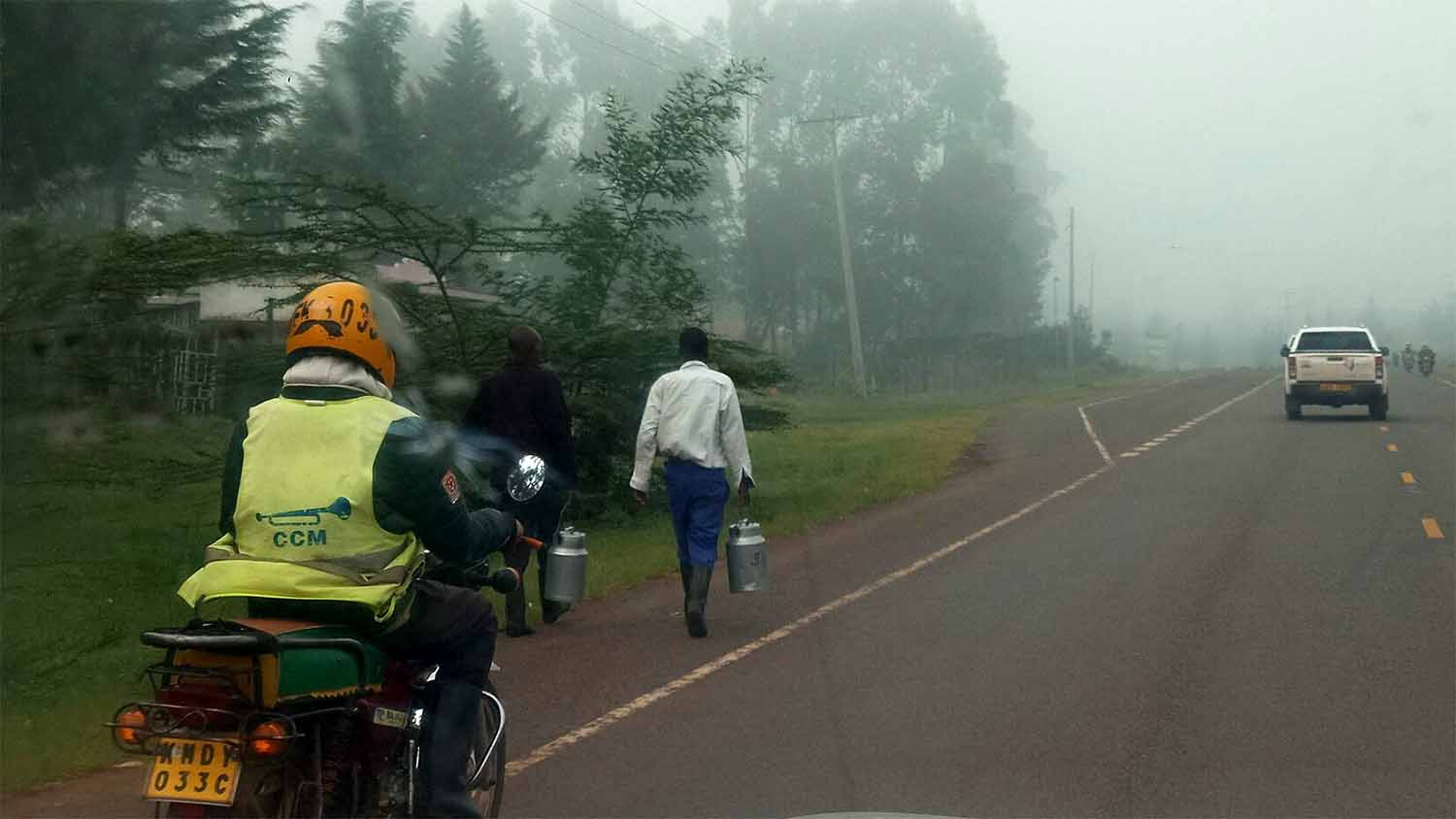
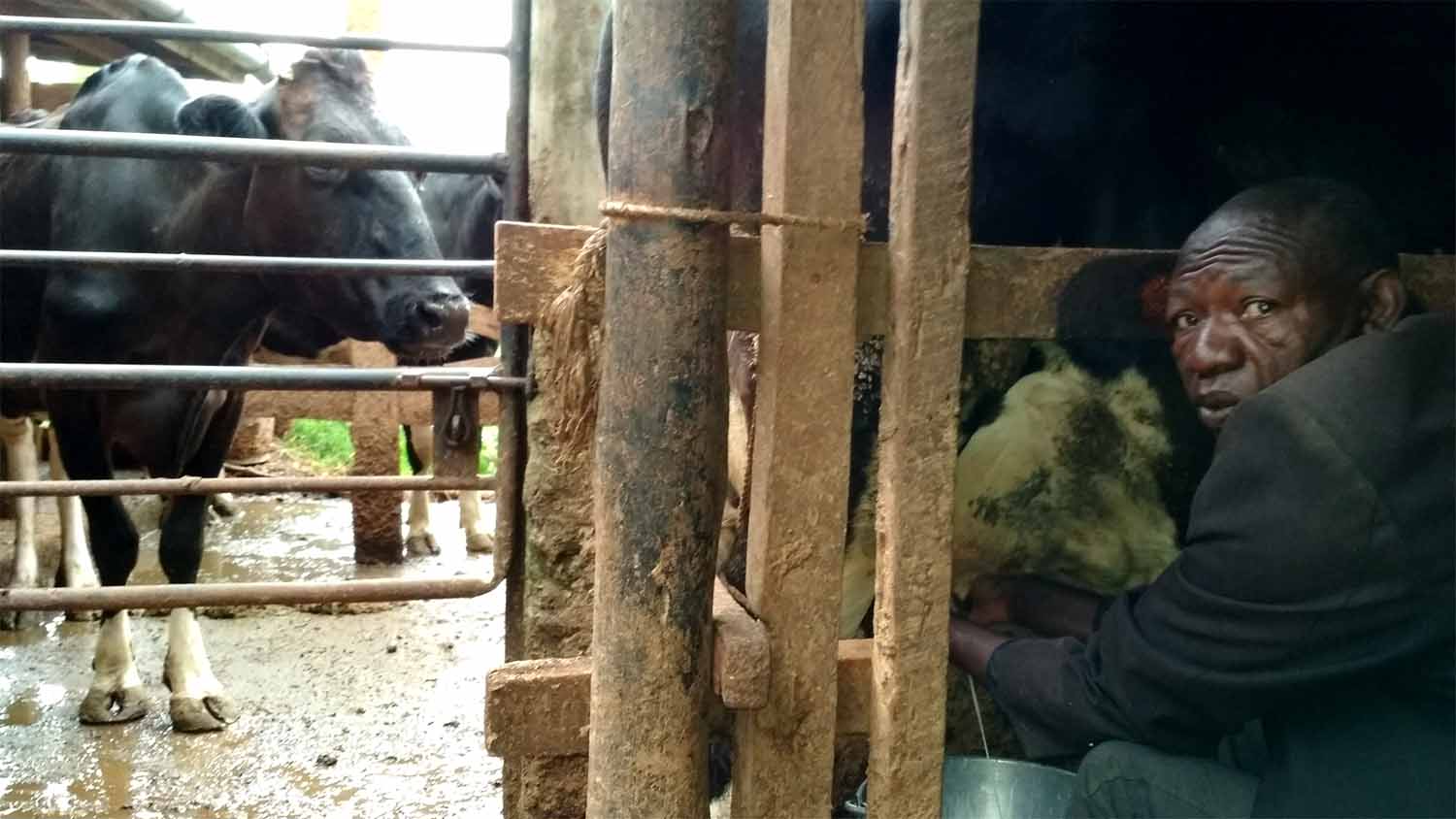
Hand-milking on a smallholding in Murang'a County, Kenya, 2017. Dairy farmers in the county reported delayed cooperative payments in September 2026 and sold to private buyers instead, and in October asked the government to cut animal feed taxes. Photo: Maina Pat Mbae, via Wikimedia Commons, CC BY-SA 4.0. Cropped from the original.
Kenya’s Milk Shortage Deepens as Farmers Bypass Cooperatives
Kenya spent May 2026 promising to end milk hawking. By October, the government was conceding that farmers were steering milk away from cooperatives because informal buyers paid better, the state processor was at the centre of privatisation claims, and the President was proposing buffalo and camels.
This follows on from Kenya’s 2026 milk shortage and the raw milk hawking crackdown, published in September. Everything below happened after that, with one exception: a set of official market-share figures that were public all along and that explain more than any of the claims now circulating on social media.
Key facts at a glance
| Question | Answer |
|---|---|
| How bad is the shortage now? | Deliveries to processors fell from 84.4 million litres in June to about 81 million in July and 75 million in August. Agriculture CS Mutahi Kagwe put the decline at about 5.8 percent in early October. |
| What are Kenyans paying? | In the South Rift a 500ml packet reached KSh100, up from KSh50 to 55. A litre of raw milk reached KSh100, up from KSh50 to 60. |
| Why is milk leaving the formal channel? | The Livestock PS says some cooperatives underpay farmers, and that farmers “have chosen to take their produce to the informal sector, which offers them better prices.” |
| How much milk do cooperatives say they lost? | Some South Rift cooperatives reported raw milk deliveries down by up to 50 percent as vendors bought directly from farmers. |
| Who controls processed milk in Kenya? | Kenya Dairy Board data cited by the Competition Authority gives Brookside 40 percent of processed milk and 45 percent of milk-related products such as butter, cheese and yoghurt. |
| How big is the informal market? | Of about 5 billion litres produced a year, roughly 2.3 billion is sold through milk bars and direct raw milk sales, against about 500 million litres sold as processed milk and products. |
| What has the government proposed? | Milk imports from Uganda, duty-free yellow maize for feed, a warning to consumers against buying at the farm, and trials of buffalo and improved camel breeds. |
| Is Brookside causing the shortage? | No evidence supports that claim. It is being pushed by a coordinated set of social media posts, one of which uses an altered news screenshot. |
| Is raw milk legal in Kenya? | Only from a farmer to an immediate rural neighbor, collected at the farm and not resold. |
What changed after September
| Date | Event |
|---|---|
| September 11, 2026 | Kenya Dairy Board says August deliveries fell to 75 million litres and warns the shortage will last another month |
| September 21, 2026 | Daily Nation reports the Livestock PS blaming low cooperative payments, and South Rift cooperatives recording deliveries down up to 50 percent |
| October 8, 2026 | President Ruto proposes buffalo farming and improved camel breeds to diversify milk supply |
| October 11, 2026 | Nyandarua Senator John Methu links the shortage to claims of a New KCC privatisation plan |
| October 13, 2026 | Murang’a farmers call for a law barring processors from buying directly from individual farmers |
| October 15, 2026 | Kagwe warns consumers against bypassing shops to buy milk at the farm |
Why is Kenya’s milk shortage getting worse?
Official figures show the formal channel still contracting. The Kenya Dairy Board reported deliveries to processors of 84.4 million litres in June, about 81 million in July and 75 million in August, a fall of more than 9 million litres in three months, according to Citizen Digital. KDB chairman Genesio Mugo said several processors had temporarily closed while waiting for rain, and that imports could not easily fill the gap because supply in Rwanda and Uganda was also low.
Drought and feed costs remain the official explanation. In the South Rift, a bale of Boma Rhodes grass reached KSh280 to 300, and a Narok farmer told the Daily Nation that “local streams and water sources have dried up, there is a sharp decline in water volumes in rivers and pasture has been depleted both in stores and fields.”
What has changed is that drought is no longer the whole story in the government’s own telling.
The government says farmers are choosing informal buyers
Principal Secretary for Livestock Development Jonathan Mueke, quoted in a Daily Nation report published on September 21, said drought was not the only factor and pointed at what cooperatives pay:
The cooperative societies that are paid high prices by the processors should pay farmers well so as to spur production. Some of the cooperatives, unfortunately, underpay the dairy farmers for their supplies, thus discouraging those involved in the sector.
He went further:
Some of the farmers have chosen to take their produce to the informal sector, which offers them better prices.
The same report found cooperatives in Bomet, Kericho and Narok recording drops in raw milk deliveries of up to 50 percent as vendors sourced fresh milk directly from farmers, and said some farmers were considering quitting dairy altogether over poor prices and high production costs. Consumers, meanwhile, were going to milk cooling plants in person and prepaying to secure supply.
That is the same diagnosis Kagwe offered in September, when he said milk was going to brokers “because brokers are offering a higher price than the milk processing companies through the cooperatives.” A cabinet secretary and a principal secretary have now described the informal trade as the better-paying option for farmers, five months after the state set out to shut that trade down.
Farmers have drawn their own conclusion about where the leak is. At a cooler launch in Gatanga on October 13, dairy farmers asked for cuts to animal feed taxes and stronger cooperative laws, and John Waweru, head of the cooperative dairy sector, called for legislation requiring processors to buy through cooperatives rather than directly from individual farmers, per Dairy Business Middle East & Africa. In Murang’a, farmers had reported delayed cooperative payments in September and sold to private buyers instead. The government announced a KSh465 billion National Feed Strategy in July, to run over ten years.
Kenya milk prices, September and October 2026
| Place | Product | Before | Latest | Source |
|---|---|---|---|---|
| South Rift (Bomet, Kericho, Narok) | 500ml processed packet | KSh50 to 55 | KSh100 | Daily Nation |
| South Rift | 250ml packet | KSh25 to 30 | KSh50 to 60 | Daily Nation |
| Bomet town | Raw milk, per litre | KSh50 to 60 | KSh100 | Daily Nation |
| National, collection points | Farm-gate median, per litre | KSh72.50 in August | KSh81.25 in September | Pulse |
| National spot check, October 9 (The Star) | Raw milk, per litre | not stated | above KSh90 | Pulse |
| National spot check, October 9 (The Star) | Packaged brands | not stated | about KSh135 | Pulse |
| Urban markets | Camel milk, per litre | not stated | KSh180 to 200 | The Star |
Raw milk and processed milk have converged at the till in the worst-hit areas. In Bomet both were quoted at KSh100.
Who controls Kenya’s processed milk market?
The clearest answer is in a July 2024 determination by the Competition Authority of Kenya, which sets out Kenya Dairy Board figures.
For processed milk:
| Processor | Share |
|---|---|
| Brookside Dairy | 40% |
| New Kenya Co-operative Creameries | 25% |
| Sameer Agriculture & Livestock | 14% |
| Githunguri Dairy Co-operative | 12% |
| Musty Distribution | 3% |
| Pascha-Uplands Premium Dairies & Foods | 1.7% |
| Dodla Dairy Kenya | 0.9% |
| Others | 3.4% |
For milk-related products, which the determination defines as “foods made from milk such as butter, cheese, ice cream, yogurt, and condensed and dried milk,” Brookside holds 45 percent, ahead of Sameer at 18 percent, Githunguri at 8 percent and New KCC at 6 percent.
The same document sizes the two halves of the trade. Kenya produces about 5 billion litres of milk a year. About 2.3 billion litres is sold through milk bars and direct sales of raw milk, while about 500 million litres is sold as processed milk and products. Around 40 percent of milk produced does not reach formal markets at all.
Those two facts sit directly against the stated reason for the hawking crackdown. Kagwe said in May that hawking “destroys the ability to create value-added dairy products.” Value-added dairy is the market where a single company holds 45 percent, and that company is Brookside, in which Danone bought a 40 percent stake in 2014 from the Kenyatta family, which retained the balance alongside a minority investor.
Imports, buffalo and camels
With domestic supply falling, the state has reached outward and sideways.
Trade CS Lee Kinyanjui said in September that Kenya could not meet its own demand and was “actually importing milk from neighbouring countries like Uganda,” per Citizen Digital. Processors pushed back on one import route: the Kenya Dairy Processors Association urged the government not to import powdered milk, with chairman Kenneth Gitonga predicting the country would “move from a shortage to a glut.”
At the Agriculture and Food Transformation Summit on October 8, President William Ruto proposed new species. “I had told the Livestock PS to bring in good breeds of camels and buffaloes,” he said, according to The Star. “I hear buffaloes also produce a lot of milk. If others are milking them, why can’t we do the same?” He noted camel milk sells for KSh180 to almost KSh200 a litre in town, about triple the price of cow milk. Kagwe had already declared the domesticated water buffalo a food animal under the Meat Control Act in Gazette Notice No. 977 of January 31, 2025, though that notice does not by itself establish a buffalo dairy industry or approve imports for milk production.
Alongside that came a warning in the other direction. Kagwe cautioned consumers against bypassing shops to buy directly from farms, since that diverts milk away from processors, as Pulse reported on October 15. A household buying milk from a farmer it neighbors is doing something Kenyan regulations expressly allow.
The New KCC privatisation claim
The state-owned processor has become the other flashpoint. Nyandarua Senator John Methu said in a television interview on October 11 that the shortage could be linked to a plan to privatise New Kenya Co-operative Creameries, reported by The Kenya Times.
“There is a milk shortage in the country, but Kenyans need to look deeper and ask what is really happening at New KCC,” he said, adding: “We cannot sit back and watch a strategic institution like New KCC being taken away from farmers through the back door.”
The report notes that the government has rejected any link between privatisation and the shortage, and Methu offered no documents. New KCC holds 25 percent of the processed milk market on the Kenya Dairy Board figures above, so its ownership is a live question for farmers whatever the cause of the current shortage.
Is Brookside causing the milk shortage?
Since mid-October a set of posts under the hashtag #MilkShortageScam has claimed that Brookside is buying up raw milk at prices rivals cannot match, exporting it, and manufacturing the shortage. Several of those posts were published within about an hour of each other by different small accounts, carrying identical tag lines, and most had view counts in the low tens.
Nothing in the public record supports the central claim, and two of the specific claims can be checked and fail.
A claim that one firm controls 70 percent of farmers’ raw milk. The Competition Authority figures above put Brookside at 40 percent of processed milk, and processed milk accounts for roughly 500 million litres of the roughly 5 billion litres Kenya produces. That places the company in the low single digits as a share of all raw milk produced, not 70 percent.
An altered news screenshot. One post circulated an image of a Kenya Times article headlined “Milk Shortage Mystery Takes New Twist as Whistleblower Accuses Brookside of Causing Crisis,” bylined Wiltord Otieno and dated October 15, 2026. The Kenya Times published a real article by that journalist on October 12 headlined “Mystery of Milk Shortage Takes New Twist as New KCC Privatization Claims Emerge.” The two share the byline, the layout and the stated four minute reading time. The published article is about Senator Methu and New KCC, and it does not mention Brookside anywhere. A search of the Kenya Times site for “Brookside” on October 16 returned nothing published in October.
Two further images circulating in the same set, presented as a BBC report and a Citizen Digital report naming Brookside, could not be located on either outlet.
The campaign is worth noting precisely because the documented position needs no embellishment. Official Kenyan regulatory filings already show one company holding 40 to 45 percent of the formal market, a formal market that handles under a fifth of the country’s milk, and two government officials saying farmers get paid better outside it.
What this means for farm-direct sales
Kenya’s rules did not change during the shortage. Under Regulation 5 of the Dairy Industry (Dairy Produce Safety) Regulations, 2021, a farmer may sell raw milk to an immediate neighbor in a rural area, with the buyer collecting it at the farm in a clean food-grade container, told that the milk is raw, and not reselling it. Hawking and all raw milk sales in urban centers and cities remain prohibited, with penalties capped at KSh10,000, 12 months in prison, or both.
What changed is the pressure on that narrow opening from both sides. The Agriculture CS is asking consumers not to buy at the farm. Cooperative leaders are asking for a law that would bar processors from buying from individual farmers. And farmers, by the government’s own account, keep selling to whoever pays most.
The full legal picture for Kenya, and how it compares with its neighbors, is on the Kenya raw milk laws page. Other countries are on the raw milk laws map.