“Raw Milk Can Kill You”: The 1945 Coronet Article That Shaped American Pasteurization Policy
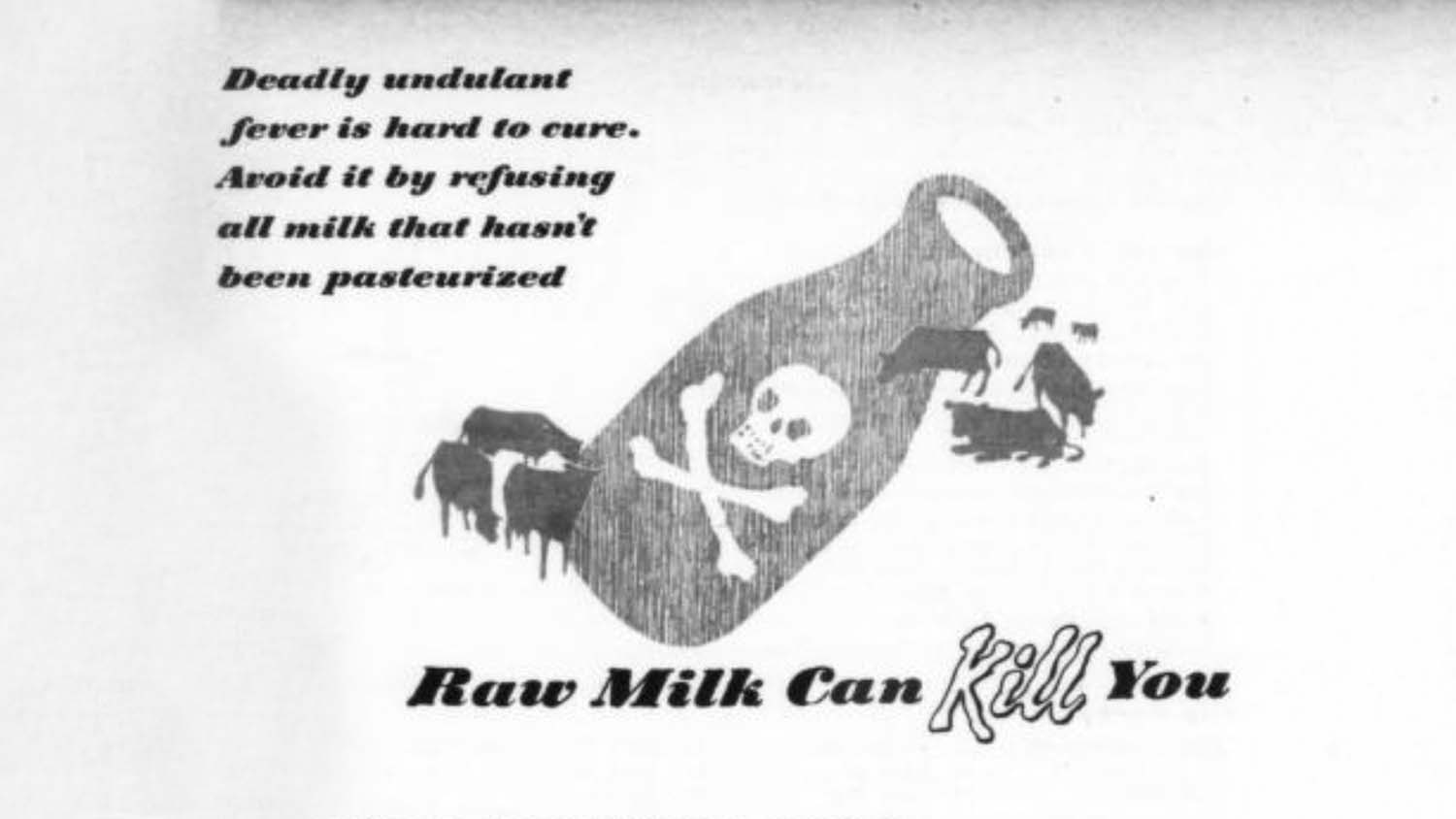
In May 1945, a five-page article appeared in Coronet magazine under a skull-and-crossbones illustration of a milk bottle. The headline, “Raw Milk Can Kill You,” was borrowed from a slogan that Nathan Straus, the New York department store magnate who had spent three decades campaigning for milk pasteurization, had used to frame his public health crusade. The byline read: Lieutenant Commander Harold J. Harris, USNR (MC). The article ran in a mass-circulation magazine that reached an estimated three million American households at the height of World War II. A year later, Reader’s Digestcondensed and redistributed it to millions more. Within three years, Michigan became the first state to ban the sale of raw milk for human consumption. The Coronet piece did not cause that outcome on its own, but it was one of the most widely read and frequently cited documents in the postwar campaign to mandate pasteurization nationwide. The story at its center, it later emerged, had never happened.
Understanding what the article said, what it got right, what it fabricated, and what legislative consequences followed is not a footnote in the history of American food policy. It is one of the clearest examples of how popular journalism, wartime authority, and genuine public health concern combined to produce a regulatory outcome that foreclosed the development of a safe, inspected raw milk supply for a generation.
Coronet Magazine and Its Wartime Reach
Coronet was not a fringe publication. Founded in October 1936 by David A. Smart and Arnold Gingrich, the same partnership that had launched Esquire in 1933, it was designed as a digest-format general-interest monthly directly inspired by Reader’s Digest but carrying original articles alongside condensations. Smart left the Esquire masthead specifically to run Coronet. Gingrich, who had built Esquire‘s literary reputation by publishing Hemingway, Fitzgerald, and Dos Passos, served as executive editor. The magazine published from Chicago at 919 North Michigan Avenue under the corporate umbrella of Esquire, Inc.
By the mid-1940s, Coronet had built its circulation to several million. Its editorial mix was eclectic: the same May 1945 issue that carried Harris’s raw milk article also ran Sidney Carroll’s account of the Japanese-American 100th Infantry Battalion in Italy, H.V. Kaltenborn’s audience with Pope Pius XII, and a long feature on the origins of Mother’s Day. The magazine positioned itself as serious popular reading, willing to commission reported articles on public health controversies, and its audience was literate, middle-class, and largely suburban. That was exactly the demographic making consumer decisions about what kind of milk to buy and what policies to support.
The wartime context mattered enormously. Harris was writing as a commissioned officer in the U.S. Naval Reserve Medical Corps, a credential that carried substantial moral weight in 1945 when military authority was at its cultural zenith. His byline was not simply “Harold J. Harris” but “Lieutenant Commander Harold J. Harris, USNR (MC).” Every reader of that masthead understood the implicit argument: a military doctor was telling them something medically urgent. The magazine’s editors reinforced this with a pull-quote epigraph printed in italic type at the article’s opening: “Deadly undulant fever is hard to cure. Avoid it by refusing all milk that hasn’t been pasteurized.”
The full text of the May 1945 issue, including the Harris article on pages 84 through 88, is archived at the Internet Archive.
Harold J. Harris: The Author
Harold J. Harris held medical credentials. The Darlington rebuttal published in 1947 identifies him consistently as “Harold J. Harris, M.D.,” and his Naval Reserve designation USNR (MC) confirms his Medical Corps affiliation. He was not a journalist posing as an authority. He was a medical professional writing for a popular audience at a moment when such crossover writing was common and encouraged.
What makes Harris an unusual figure in the history of this controversy is his subsequent career. Fourteen years after the Coronet article, he published a piece of rigorous literary scholarship: “Orwell’s Essays and 1984,” which appeared in Twentieth Century Literature, Vol. 4, No. 4, in January 1959. That essay argues carefully that George Orwell used his personal essays as raw-material notebooks for the sensory and political world of Nineteen Eighty-Four, and it reveals a man with serious intellectual range. The same person who wrote a fictional outbreak story for a mass-market magazine was also producing sustained literary analysis in a peer-reviewed academic journal. That duality does not resolve the question of why he fabricated the Crossroads epidemic, but it complicates any easy portrait of a propagandist. Harris appears to have been a thoughtful writer who made a consequential editorial decision in 1945, presenting an illustrative fiction as reportage, and that decision had reverberations far beyond anything a carefully hedged hypothetical would have produced.
What the Article Said
The Coronet article opens with a fictional Midwestern town Harris calls “Crossroads, U.S.A.,” placed, he writes, “in one of those states in the Midwest,” about twenty-five miles from a large city. The town is described as the kind of place where farmers and merchants and teachers drive in on Saturdays to shop, eat at the hotel, and catch a movie. It is, deliberately, Anytown.
A general practitioner named Dr. Anderson begins receiving calls. Mrs. Gahagen’s daughter Frances has a fever. The next day Old Man Hartman, the village clerk, dies of high fever; his heart simply gave out. The same day brings four more calls: a farmer named Stilwell, another farmer named Jansen whose wife and two children are sick, Mrs. Henry the bank manager’s wife, and a clerk from the hardware store. Anderson phones his only competitor, young Dr. Jacobs. “I don’t like it a bit,” Anderson says. “It looks to me as though we’ve got something on our hands.” Jacobs agrees it doesn’t seem like any of the usual things.
Within days the epidemic spreads rapidly. The state board of health is called. The source is traced to the Thorkelsson farm, described as “a fine, well-cared-for place,” where investigators find a cow infected with the hog strain of undulant fever and several hogs with the same disease. The Thorkelsson boys had been delivering milk warm from the udder every morning. It was, Harris writes, good “fresh” milk with no pasteurization to spoil the flavor.
Harris states the toll directly: the disease struck one out of every four persons in Crossroads; despite the efforts of two doctors and the state health department, one out of every four patients died. This yields a case fatality rate of 25 percent and a population mortality of roughly 6.25 percent, numbers that would have been extraordinary for brucellosis by any clinical standard of the era.
The article then shifts from the Crossroads narrative to a series of what Harris presents as factual case studies and epidemiological claims.
The New York physician. About five years prior to 1945, a New York City physician fell ill with brucellosis. His colleagues did what they could; within a few days he died. Tests showed a rare variety transmitted by goats. An investigating colleague, acting “like an amateur Sherlock Holmes,” inspected the dead man’s kitchen and found pasteurized milk in the refrigerator, no goat milk, but a freshly cut head of imported Italian cheese. The cheese was made from goat’s milk; a culture showed it was, in Harris’s phrase, “dripping with the germs of the goat brand of undulant fever.”
The Montreal typhoid epidemic. Harris writes: “Ten years ago Montreal, a favorite American vacation spot, had an epidemic of 4,000 cases of typhoid — 400 persons died — all from a single Montreal dairy which sold raw milk.”
The Kansas City survey. Surveys indicate about 10 percent of the population may be infected with undulant fever. Harris cites a study of more than 7,000 school children in which 9 percent were found to have the disease; among children from families owning their own cows, the rate jumped to 18 percent.
The advertising executive. A young advertising man with a racking cough, lost weight, and extreme nervousness was sent to a tuberculosis sanatorium after his X-rays proved negative but his symptoms matched TB closely enough. Not until exhaustive examinations were completed did doctors find he had undulant fever, probably acquired years before.
The farm wife. Maria, a New England farm wife whose husband kept dairy cattle, whose family drank the herd’s milk unpasteurized. Maria was chronically ill, not enough to be bedridden, “but she barely managed to drag herself from one household chore to another.” A culture sent to the state laboratory showed the same germs that had attacked her husband’s dairy herd.
The Washington woman. A young woman presenting in acute mental distress, obviously suffering from anxiety neurosis, nervous and depressed and losing weight. It took her doctor a year to find that undulant fever had caused the symptoms rather than a psychosis.
Harris then addresses the disease’s biology, its masquerading quality, and the military’s response. He writes that the U.S. Army and Navy, in all war theaters abroad, banned fresh milk regardless of supply, with American servicemen in mess halls receiving only diluted powdered milk or condensed milk. In England, he notes, a debate was raging about whether to pasteurize, with many Englishmen taking “the negative view, holding that the process is ‘unproved’ and destroys the taste of milk.”
A sidebar box attributed to “The Editors” contextualizes the article’s headline:
“The only effective way to fight the alarmingly common undulant fever is by pasteurization of milk and milk products. Nathan Straus, who coined the slogan ‘Raw Milk Can Kill,’ successfully waged a one-man battle for pasteurization in New York City. So far eighty-six cities, by popular demand, require milk pasteurization; it is not required in any state. In 182 other cities all dairies voluntarily pasteurize the milk; while in thirty-seven cities all but ‘certified’ milk is pasteurized by ordinance…”
The article closes with the military frame: the Army and Navy consider raw milk a threat not only from undulant fever but from tuberculosis, scarlet fever, typhoid, strep throat, dysentery, and a dozen other ailments. Harris’s final sentence: “Beware of ‘fresh’ milk — at home or abroad. It can turn out to be a poison cocktail — just as lethal as strychnine and ten times more inviting.”
The Nathan Straus Attribution
The Coronet editors’ attribution of the slogan “Raw Milk Can Kill” to Nathan Straus is one of the article’s most historically significant details. Straus had died in January 1931, fourteen years before the article’s publication, but in 1945 there were still many Americans who remembered him directly. The attribution in a three-million-circulation magazine carries the weight of contemporaneous popular memory rather than retrospective interpretation.
Straus had spent nearly four decades building a private network of 297 pasteurized milk depots across 36 American cities, absorbing the full cost of pasteurization, bottling, laboratory testing, and distribution from his commercial income, and producing the mortality data that eventually persuaded city after city to adopt mandatory pasteurization ordinances. His New York City campaign was the most visible: his depot at the Third Street Recreation Pier opened in 1893, selling pasteurized milk to immigrant families for a cent a glass. The data he accumulated, including a drop in child mortality at the Roosevelt Island orphan asylum from 44 percent to 20 percent in a single year following the introduction of pasteurized milk, became the evidentiary foundation for the pasteurization movement.
The slogan itself was a compression of that decades-long argument into a form suitable for mass communication. By the time Harris borrowed it for his Coronet headline in 1945, it had already completed a transition from philanthropist’s advocacy to popular truth. The editors’ sidebar credited its origin but did not need to explain it; the slogan was already legible to readers as authoritative common sense.
What the Article Got Right
Before examining what Harris fabricated, the article’s accurate elements deserve acknowledgment, because the brucellosis threat of the 1940s was genuine.
Brucellosis, caused by the bacterium Brucella abortus in cattle, Brucella melitensis in goats and sheep, and Brucella suisin hogs, was a significant occupational and foodborne pathogen in the United States through the mid-twentieth century. As Harris correctly described, it was a disease of genuine diagnostic difficulty: its symptoms overlapped substantially with tuberculosis, anxiety disorders, and neurological conditions, and it could persist for years with intermittent flare-ups.
The disease’s proper name derives from Sir David Bruce of the British Army Medical Corps, who identified the causative organism in 1887 on Malta, where British troops had been sickened for decades by what they called “Malta fever.” The connection between Brucella melitensis and goat milk was established by Themistocles Zammit in 1905. The connection between bovine brucellosis and raw cow milk was well-established by the 1920s and 1930s.
U.S. Public Health Service data for the period 1923 through 1944, covering 21 years of national surveillance, recorded 32 outbreaks of milk-borne undulant fever in the entire United States, Alaska, and Hawaii, comprising 256 cases and 3 deaths. The average outbreak involved 8 cases. These were real events involving real illness. Harris’s basic claim, that raw milk could transmit brucellosis, was epidemiologically sound.
His description of the military policy was also accurate. The Army and Navy did prohibit the consumption of fresh milk in overseas war theaters, specifically because of undulant fever, tuberculosis, and other milk-borne diseases. American servicemen overseas received powdered or condensed milk exclusively. This was genuine policy based on genuine risk assessments by military medical authorities.
The disease’s masquerading quality was clinically real. Alice Evans, the bacteriologist Harris names in the article, was genuinely responsible for identifying the connection between Brucella species in cows and goats and demonstrating their disease-causing potential in humans, work for which she faced years of institutional resistance. The scientific research worker Harris describes, suffering from brucellosis while physicians told her she had a psychosis, was Evans herself, a detail that can be confirmed through Evans’s published memoirs and correspondence.
What the Article Fabricated
The Crossroads epidemic was entirely invented.
This was established not by a hostile investigation but by the inquiry of a Johns Hopkins bacteriologist, J. Howard Brown, who corresponded with Harris directly after the article’s publication. Brown’s research into milk-borne disease records led him to question the Crossroads account, and Harris acknowledged the truth in their correspondence. Jean Bullitt Darlington, writing in 1947 for The Rural New Yorker (Lee Foundation for Nutritional Research, Reprint No. 28), cited Brown’s finding directly, quoting his documentation of Harris’s admission:
“Correspondence with the author of this article reveals that the outbreak at ‘Crossroads, U.S.A., in one of those States in the Midwest,’ was fictitious, representing no actual occurrence, and, presumably was described merely to illustrate what the author thought might happen.”
Harris’s defense, that the account was illustrative of what he thought might happen, collapses under examination of his own prior and subsequent statements. In a March 1941 article he had stated that mortality in acute brucellosis cases “was formerly about two percent, but this has been greatly lowered by modern methods.” In a paper read before the Maine Veterinary Medical Association on April 17, 1946, one year after the Coronet article, Harris said the proportion of deaths from acute illness varied “from two to three percent, rarely higher in epidemic form” and could be made “almost, if not quite, zero.” Yet the Crossroads account, published between those two dates, depicted a 25 percent mortality rate: one in four patients dying. Harris knew, when he wrote that number, that it bore no relationship to the clinical reality he was simultaneously describing in professional settings.
The additional “factual” cases in the article were similarly fictitious or unverifiable.
The Montreal typhoid claim. Harris wrote that ten years before 1945, Montreal had suffered a typhoid epidemic of 4,000 cases and 400 deaths from a single dairy that sold raw milk. The Montreal typhoid epidemic he was referencing actually occurred in 1927, eighteen years before the article, not ten. More critically, the official investigation conducted by the Quebec Ministry of Health determined that the epidemic was traced to pasteurized milk from the Montreal Dairy Company and its associated National Dairy Company, which distributed milk pasteurized at the Montreal Dairy plant. The investigation found that a typhoid carrier who was foreman of the pasteurizing room, and his successor who was an incipient typhoid case, had contaminated the milk during and after pasteurization. An extensive study of the possibility that infected raw milk caused the epidemic, the Ministry’s report stated, “failed to reveal any such opportunity.” The epidemic Harris cited as evidence against raw milk was, in documented fact, an epidemic caused by pasteurized milk.
The New York physician. Darlington investigated this case through the New York City Department of Health. The Department’s response, confirming a prior interview with Dr. Greenberg of that office, stated: “There is no record in the files of this Department of any such case.” The story of the physician who died of goat-cheese brucellosis was, like Crossroads, unverifiable and apparently invented.
The Kansas City survey. The survey Harris cited, covering 9 percent of 7,122 school children found to have brucellosis, was real, having been conducted in Kansas City, Kansas, in April and May 1937 by four physicians. Harris’s characterization of the results, however, was materially misleading. The survey tested children for skin sensitivity to brucellergin, not for active disease. The authors stated explicitly: “We wish to make it clear that evidence of infection does not mean disease.” Bacteriologist I.F. Huddleson had further written that when human beings are exposed to Brucella, a large percentage “fail to show any clinical evidence of the disease, but do develop specific serum antibodies and skin sensitivity,” a state indicating active immunity rather than illness. A positive brucellergin skin test in a healthy child was evidence of immunity, not infection. Harris presented it to Coronet readers as evidence of rampant disease.
The Reader’s Digest Amplification
The Coronet article’s reach multiplied substantially in August 1946, when Reader’s Digest ran a condensed version of an article by Holman Harvey originally published in The Progressive (Madison, Wisconsin) on July 15, 1946. Harvey’s article in The Progressive had drawn extensively on the Coronet piece, and the Digest condensation carried those claims to a readership substantially larger than Coronet’s.
The amplification introduced new distortions. Harvey’s version in The Progressive inflated the Montreal figures: where Harris had written of 4,000 cases and 400 deaths, Harvey wrote of “5,100 persons attacked, killing 500.” The Digest, in condensing Harvey’s article, quietly dropped the Montreal claim entirely, apparently recognizing it as unsupportable, while retaining much of the article’s anti-raw-milk framework.
This is the media chain through which the Crossroads story and its supporting false statistics traveled into American popular consciousness: Coronet in May 1945, then The Progressive in July 1946, then Reader’s Digest in August 1946, each step reaching a new and often larger audience, each step introducing modifications that made the underlying claims harder to trace and correct. By late 1946, the fabricated epidemic had become part of the ambient factual landscape of American public health discourse, cited without attribution, repeated without verification, and treated as common knowledge.
Darlington’s 1947 rebuttal documented the chain of errors systematically. Coronet and Ladies’ Home Journal both refused, despite requests, to publish responses presenting the other side of the raw milk controversy. The Progressiveoffered only a letter to the editor limited to 600 words, an offer refused as inadequate given the circulation Reader’s Digest had provided to Harvey’s claims. Reader’s Digest stated it would be willing to consider material presenting the other side, but no comparable article appeared.
The Certified Milk Alternative Harris Dismissed
The Coronet article mentions certified milk almost in passing, noting that in some cities all milk except certified milk was pasteurized by ordinance, without engaging with the certified milk movement’s arguments or its track record.
The certified milk movement, founded in 1893 by Newark pediatrician Henry Leber Coit, had established a rigorous system of veterinary inspection, bacterial count standards, and continuous farm oversight to produce safe raw milk under controlled conditions. Coit’s position, shared by a significant fraction of American physicians through the 1940s, was that pasteurization treated the symptom of a contaminated milk supply rather than its cause, and that the energy devoted to heat treatment would be better spent eliminating contamination at the farm. Certified milk sold at a premium that limited its reach, but it demonstrated, in the cities where it operated, that raw milk produced under sustained oversight could meet high bacteriological standards.
Presenting pasteurization as the only available remedy for the dangers of raw milk was a rhetorical choice, not a scientific inevitability. The alternative of rigorous production standards for raw milk was a live option in American public health debate in 1945. By the time the Reader’s Digest condensation circulated in 1946, the space for that debate was narrowing rapidly, and Harris’s piece, along with the media amplification that followed it, contributed to that narrowing by presenting the question as already settled.
The Legislative Consequence
Michigan’s 1948 ban on the sale of raw milk was the first statewide prohibition in American history. It did not emerge from a vacuum. The postwar period was one of broad confidence in industrial food processing, of wartime hygiene habits carried into peacetime, and of a dairy industry with significant economic incentives to support pasteurization mandates that raised the capital cost of milk production and squeezed smaller, non-pasteurizing dairies out of the market.
The Coronet article contributed to this environment by normalizing the assumption that raw milk was inherently dangerous, that the Crossroads scenario could “happen almost anywhere in America,” and that the only responsible policy was universal mandatory pasteurization. Other states followed Michigan with varying speed, and the federal interstate ban on raw fluid milk sales, codified through FDA regulations, eventually made it illegal to transport raw milk across state lines for human consumption. That federal prohibition remains in effect today, with raw milk legality governed state by state.
What was foreclosed in this process was not merely the market for raw milk but the institutional development of rigorous safety standards for its production. The certified milk movement, which had been building those standards since 1893, did not survive the postwar wave of pasteurization mandates. Where certified dairies had been demonstrating that raw milk could be produced safely under continuous inspection and bacterial count monitoring, mandatory pasteurization removed the regulatory incentive to maintain those standards. The question of how to produce safe raw milk was effectively declared moot, replaced by the question of how to pasteurize all milk regardless of its production conditions.
This outcome was not the inevitable product of the science. It was, in part, the product of a media campaign that included fabricated epidemics, misattributed outbreaks, and misrepresented surveys, none of which were corrected in publications with anything close to the circulation that had distributed the original claims. The swill milk scandals of the nineteenth century had made raw milk a target for reformers with genuine cause; by 1945, the narrative had hardened into something less discriminating, treating all raw milk as equivalent regardless of how it was produced or from what herds it came.
What Actually Happened to Brucellosis
The brucellosis threat Harris described in 1945 was real. The disease’s subsequent history in the United States is a story of successful eradication through a program that had nothing to do with pasteurization and everything to do with the approach Harris and his contemporaries had sidestepped: eliminating the disease at its source.
The USDA’s Brucellosis Eradication Program, launched in 1934 and intensified after World War II, worked by testing cattle herds, quarantining infected animals, mandating vaccination with the Strain 19 vaccine, and compensating farmers for destroyed animals. The program was systematic, federally coordinated, and sustained over decades. By 1956, the national cattle herd infection rate had fallen from a peak estimated at 11.5 percent in the 1930s to below 1 percent. By 1992, the U.S. had achieved “Class Free” status, meaning brucellosis had been effectively eliminated from the commercial cattle population. Texas was the last state to reach brucellosis-free status, in 2008, due to proximity to infected wildlife populations near Yellowstone. The national commercial herd has remained essentially free of the disease since the 1990s.
This eradication was accomplished through animal health measures, not pasteurization. Pasteurization killed brucella organisms in milk after the fact; the eradication program killed the organisms in the herds that produced the milk. The distinction matters historically because source-based control was precisely the approach Henry Leber Coit and other opponents of mandatory pasteurization had argued for in the 1890s and early 1900s, applied here to a different pathogen by different methods, but reflecting the same underlying logic.
The implication for contemporary raw milk policy is not that raw milk carries no risk. Other pathogens remain legitimate public health concerns in raw milk produced under inadequate conditions. But the specific threat Harris dramatized in 1945 no longer exists in the same form. A reader of the Coronet article in 1945 lived in a country where roughly 10 percent of dairy cattle carried Brucella abortus. A consumer of raw milk in a state with functioning raw milk regulationstoday lives in a country where that pathogen has been eliminated from the commercial herd. The two eras are not comparable.
The Article’s Lasting Rhetorical Legacy
The Coronet article’s most durable contribution was not its specific claims, most of which were corrected or challenged within two years of publication, but its rhetorical template. The combination of a gripping fictional scenario, the medical authority of a uniformed officer, the attribution to a respected philanthropic figure like Nathan Straus, and amplification through mass-circulation media established a framework for anti-raw-milk communication that subsequent decades would replicate without necessarily returning to the original source.
The fictional Crossroads epidemic was not the first use of illustrative narrative in public health communication, and it was not the last. What distinguished it was its consequence: published in a magazine that declined to print corrections or counterarguments, amplified by Reader’s Digest before any rebuttal could reach comparable circulation, and cited in policy contexts by people who had no reason to know its factual foundation had been challenged.
The challenge, when it came, was thorough. Darlington’s 1947 analysis drew on official government records, direct correspondence with the New York City Department of Health, and documented correspondence with Harris himself through J. Howard Brown, and it dismantled every major factual claim in the article. But it circulated in The Rural New Yorker and as a Lee Foundation reprint, publications that reached farmers and food reformers rather than the millions of Reader’s Digest subscribers who had absorbed Harvey’s version of the story the previous year.
The disparity in reach between the original claim and its documented refutation is the central lesson of the Coronet affair. It is not a lesson unique to this episode; it appears throughout the history of public health communication, on every side of contested questions. The raw milk case is among the clearest examples because the primary documentation is thorough and the evidentiary chain is traceable from start to finish.
What the Article Means for the Raw Milk Debate
The historical record of the Coronet article does not prove that raw milk is safe, and it would be a misreading of the evidence to use it for that purpose. Brucellosis was a genuine threat in 1945. Other milk-borne pathogens, including Salmonella, Listeria, Campylobacter, and E. coli O157:H7, remain genuine concerns in raw milk produced under inadequate conditions. The existence of fabrications in one 1945 magazine article does not resolve the contemporary safety debate.
What the historical record does establish is more specific and more consequential: the regulatory framework that governs raw milk in the United States today was built, in significant part, on a foundation that included fabricated evidence. The Crossroads epidemic never happened. The Montreal epidemic attributed to raw milk was caused by pasteurized milk. The Kansas City survey was misrepresented to readers. And the author who knew these things, or should have known them, was writing not for a scientific journal but for a three-million-circulation popular magazine that refused to publish a rebuttal.
The question of whether to permit the sale of raw milk, and under what conditions, is a legitimate policy question on which thoughtful people disagree based on current risk data, current production standards, and current regulatory capacity. It deserves to be debated on current evidence. The Coronet article is not current evidence. It is a historical artifact whose factual failings were documented within its own era, and whose influence on American food law outlasted by decades any honest accounting of what it actually said and whether it was true.
Understanding that history is not an argument for or against any particular regulatory outcome. It is a precondition for an honest conversation about one, and the United States has never quite managed to have that conversation, in part because it began with a story about a town that did not exist.