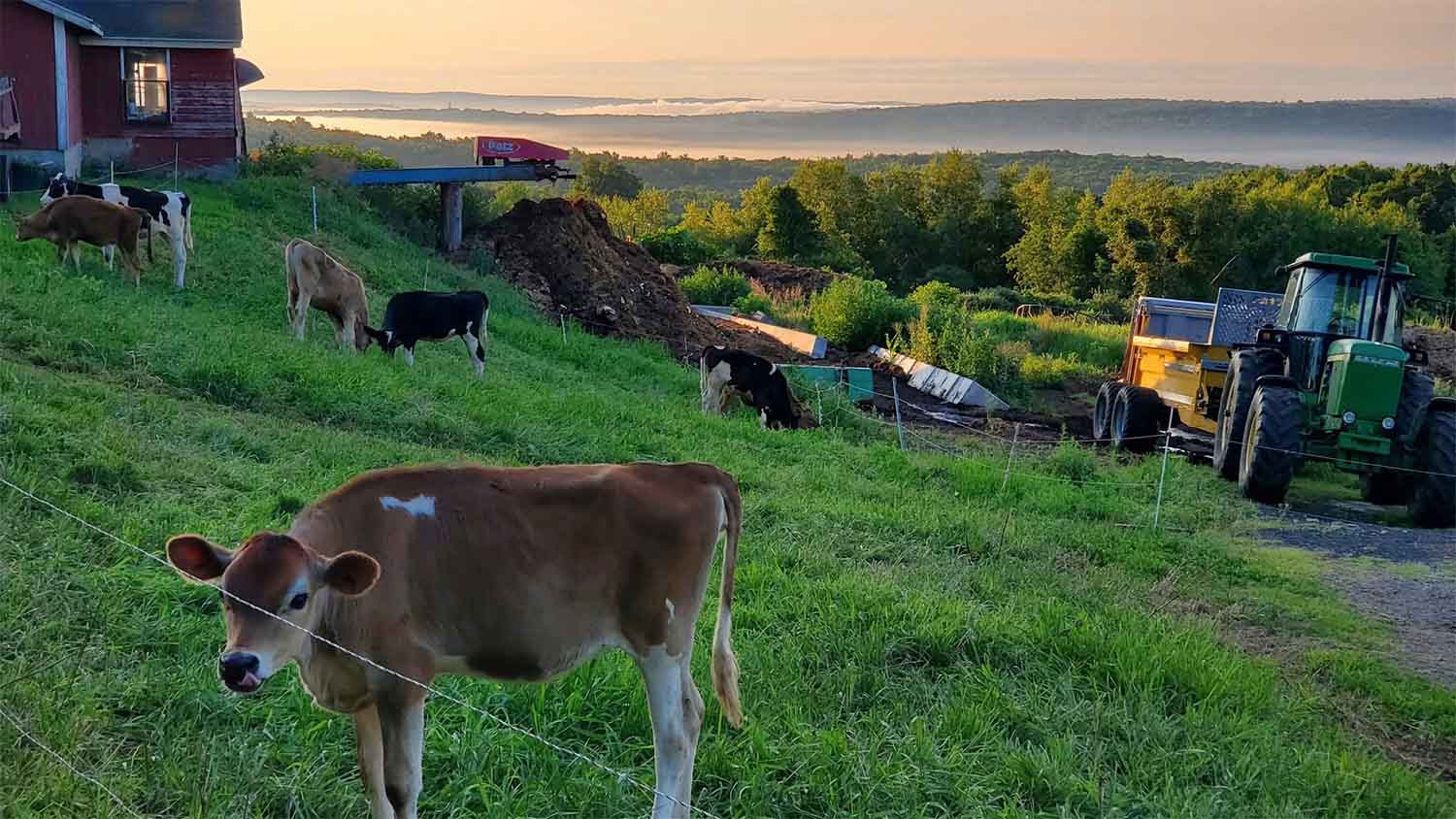
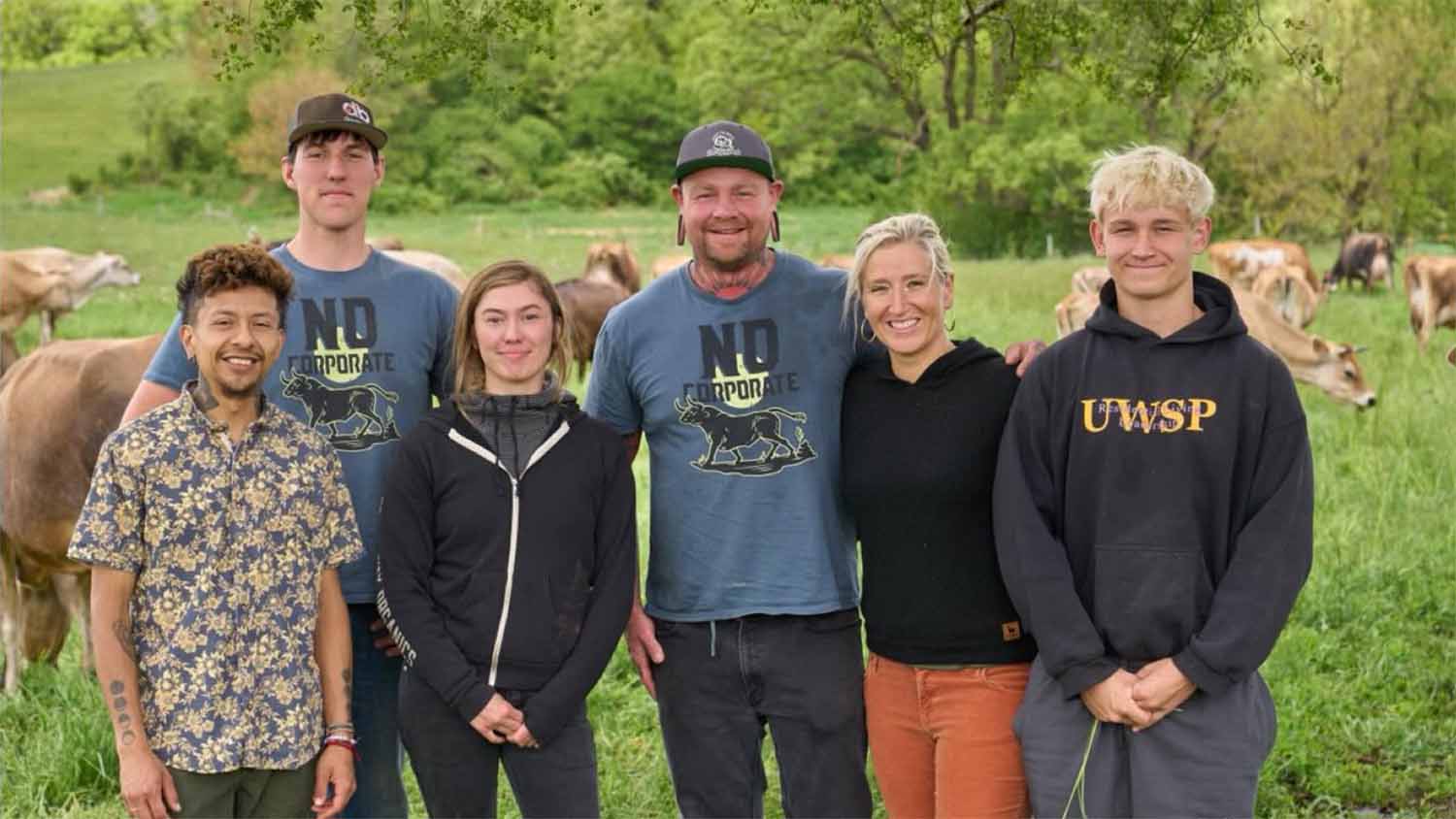
The Grassway Organics team in pasture with the farm's Jersey herd in East Troy, Wisconsin.
Grassway Organics and the End of Wisconsin’s Raw Milk Truce
When a Sauk County jury acquitted Vernon Hershberger in 2013, many raw milk supporters in Wisconsin treated it as a turning point. It was not one. A jury verdict changes no laws and binds no future case, and Wisconsin’s raw milk rules came out of the trial exactly as they went in. What the verdict did create was an assumption that the state would think twice before going after another raw milk farm. Farms built businesses on that assumption, but it was never solid ground.
Grassway Organics, a RAWMI-listed dairy in East Troy, is now finding out how thin that ground was. The Wisconsin Department of Agriculture, Trade and Consumer Protection (DATCP) suspended the farm’s milk producer license in April 2026 and proposed a $10,000 forfeiture plus $50 for every day it keeps operating. In early October, farmer Chaz Self told customers that a Walworth County judge had granted the farm a temporary restraining order, so Grassway’s owners are still receiving milk while the case moves forward.
Grassway Organics case status
| Question | Answer |
|---|---|
| Parties | Grassway Organics (Chaz and Megan Self) v. DATCP and Secretary Randy Romanski |
| State’s claim | Grassway’s member-owners are consumers, so providing them raw milk is an illegal sale |
| Farm’s position | Members hold a bona fide ownership interest, a status Wisconsin law expressly allows to receive raw milk |
| Special order | March 18, 2026 |
| License suspended | April 21, 2026, with a proposed $10,000 forfeiture plus $50 per day |
| Lawsuit and TRO motion filed | September 28, 2026 |
| TRO | Granted by a Walworth County judge, according to Self |
| Hearing on the merits | May 24 to 26, 2027 |
DATCP has declined to discuss the case, citing pending litigation. In a statement to Wisconsin Public Radio, the department said “commercial sales of raw milk are illegal and DATCP expects everyone to follow pertinent law and rules in Wisconsin.”
The Hershberger verdict never changed the law
Hershberger, an Amish farmer from Loganville, supplied raw milk to members of a private food club. State agents raided his farm in 2010, and prosecutors charged him with operating without a milk producer license, a retail food establishment license and a dairy plant license, plus violating a DATCP hold order. In May 2013, the jury acquitted him on all three licensing counts and convicted him only of breaking the hold order, a story covered in Vernon Hershberger’s Food Rights Trial and a later visit to his farm.
The verdict showed how hard it is to win a criminal raw milk case in front of a Wisconsin jury. It did not show that the activity was legal, and the courts made that plain the following year. In Farm-to-Consumer Legal Defense Fund v. DATCP (2014), the Wisconsin Court of Appeals upheld the state’s rules against two raw milk arrangements. One of them was the original Grassway Organics, founded in 2005 by Wayne and Kay Craig in New Holstein. Members of the GrassWay Organics Association paid to receive ownership interests in the farm store, which owned the herd. The circuit court found the arrangement was created “for the sole purpose of producing and selling unpasteurized milk,” and the appeals court agreed that the members had no valid ownership interest and counted as consumers.
The legislature has come close to filling the gap. In April 2010, SB 434, which would have let Grade A dairy farms sell raw milk directly to consumers on the farm, passed the Senate 25 to 8 and the Assembly 60 to 35. Governor Jim Doyle vetoed it, and an override attempt failed. Support has grown since: in December 2022, delegates to the Wisconsin Farm Bureau Federation, the state’s largest general farm organization, voted to support raw milk sales from farms that meet Grade A requirements and national standards. The next bill, SB 781, would have created a licensed raw milk sales path, but it failed to pass when the session ended in April 2024. Wisconsin has been left with a jury that would not convict, a court that would not budge and a statute that never changed.
Is raw milk legal in Wisconsin?
Wisconsin does not allow retail raw milk sales, but it does not ban raw milk either. Under Wisconsin law, raw milk can reach people through a short list of exemptions. Wis. Stat. § 97.24 allows “incidental sales of milk directly to consumers at the dairy farm where the milk is produced,” and DATCP’s rule, ATCP 65.52, allows unpasteurized milk to be distributed to:
- the licensed milk producer who runs the dairy
- “an individual who has a bona fide ownership interest in the dairy farm and milking operation,” when the producer is a legal entity rather than an individual or married couple
- family members and nonpaying household guests of the producer or a bona fide owner, at home
- employees of the dairy farm
The bona fide ownership exemption is the heart of the Grassway case. DATCP’s own raw milk guidance says that “a person who merely makes a sham investment in order to obtain raw milk is not a bona fide owner,” and that cow shares and herd shares do not qualify. Neither the statute nor the rule defines what a bona fide ownership interest is, and Grassway argues that the rule has not changed since the farm was first licensed.
How Grassway’s ownership model works
Chaz and Megan Self bought Grassway from the Craigs in 2016, allowing the couple to retire, and later moved the farm from New Holstein to Friemoth Road in the Town of Troy. They run a grass-fed dairy with A2A2 Jersey cows.
Rather than selling raw milk to the public, Grassway offers people the chance to buy into the farm. “I’m not advertising that I sell raw milk,” Self told WPR. “I have created a program that allows people to buy into my farm as a bona fide owner.” Owners pick up their milk at the farm or at pickup points in Wisconsin and northern Illinois.
The Selfs built the model to avoid the problems that sank the Craigs. Grassway holds its own state milk producer license, first issued in 2020. The farm has been listed by the Raw Milk Institute, which sets testing and risk management standards for raw milk producers, since 2020, and carries what it describes as the first raw milk product liability policy for a Wisconsin dairy.
Self says regulators were part of the process from the start. He told WPR he spent six months working with attorneys from raw milk advocacy groups and talking to regulators before launching the ownership program. The Farm-to-Consumer Legal Defense Fund, which supports the farm, says DATCP spent at least six years working with Grassway on this cooperative model.
Why DATCP suspended Grassway’s license
According to WPR, the trouble began when Self had to reapply for his license in November 2025, after his contractor, the California raw dairy Organic Pastures, changed its name to Raw Farm. Months of questions from DATCP followed. “Almost monthly, DATCP was asking questions: ‘How are you doing this? How are you doing this?'” Self said. On March 18, 2026, the department issued a special order demanding changes to the farm’s business practices, and on April 21 it suspended the license.
DATCP’s position is that buying a share of the farm only to pick up raw milk is a sham, not real ownership, which makes the milk an illegal sale. Grassway argues its owners hold genuine ownership under an exemption the state accepted for six years. The farm also argues DATCP is enforcing its own findings before any judge has heard the case. The lawsuit filed on September 28 asked the court to pause the shutdown until a hearing on the merits, now scheduled for May 24 to 26, 2027.
No jury in the Grassway case
The route the state chose matters. Hershberger faced criminal charges, so a jury of local citizens decided his fate. Grassway is contesting its license suspension through the state’s administrative process, where a judge decides the case and there is no jury. The protection that came out of the Hershberger trial was never written into law, and it does not carry into this one. The 2027 hearing will turn on how a judge reads “bona fide ownership interest,” and on whether six years of working with DATCP counts for anything once the department changes its position.
How to support Grassway Organics
Self says the case will cost about $150,000 in legal fees to reach the May 2027 hearing. The farm is raising money through its GoFundMe campaign, and the Farm-to-Consumer Legal Defense Fund also accepts donations earmarked for Grassway. Self posts case updates on YouTube and Instagram (@graze_and_gainz).
Grassway continues to operate under the restraining order. Whatever the hearing decides, the lasting fix is the one Hershberger’s acquittal never delivered: a statute that says plainly how Wisconsin farms can provide raw milk. Wisconsinites looking for raw milk can find farms on the raw milk map.