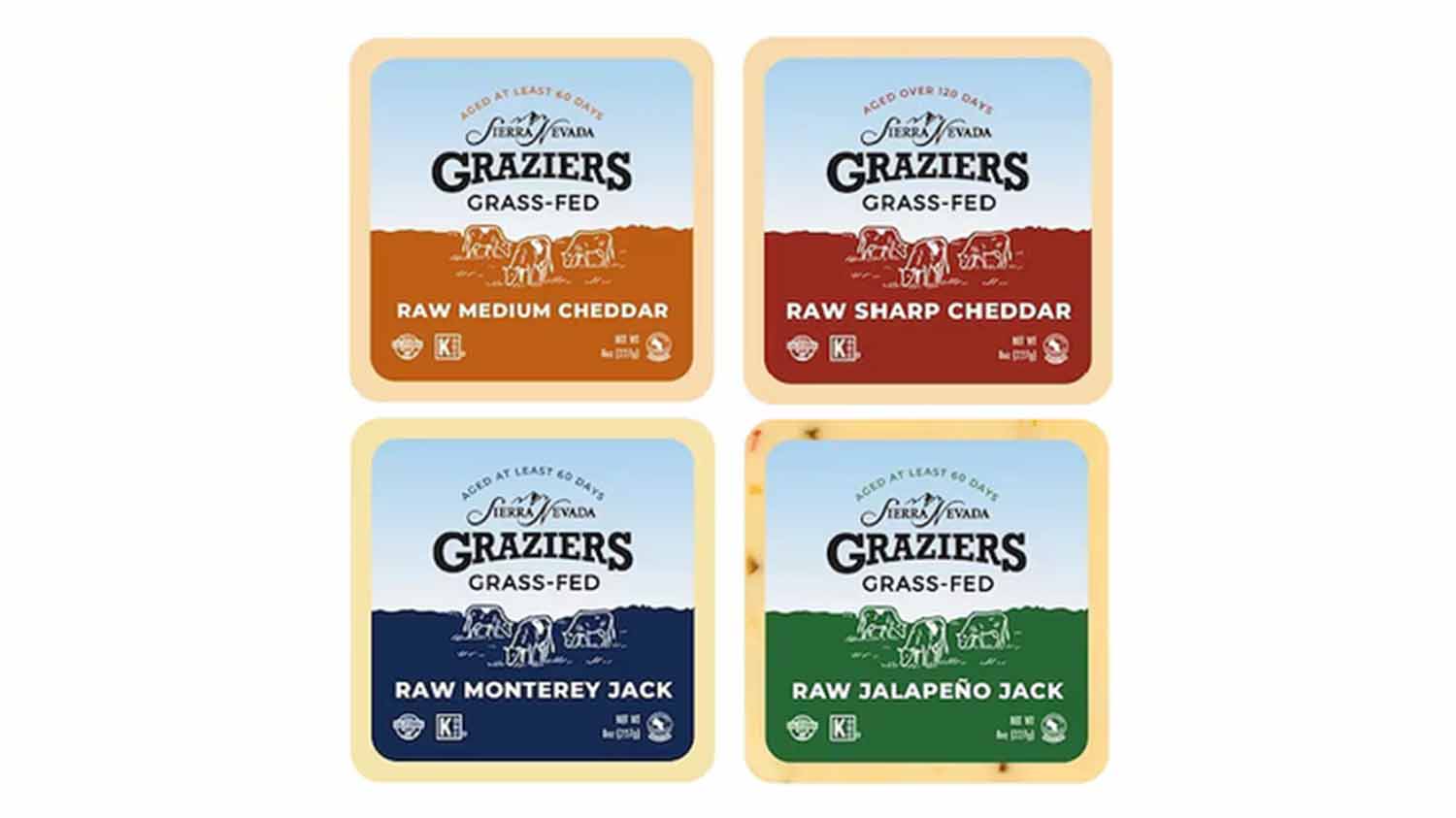
The four recalled Graziers varieties. Each label says raw and lists the aging period, but none mentions that the milk is heated to 135°F before cheesemaking, according to a retailer listing.
Graziers Raw Milk Cheese Recall: E. coli Outbreak, Milk Reportedly Heated to 135°F
Sierra Nevada Cheese Company of Willows, California, has recalled every variety of its Graziers raw milk cheese after federal and state investigators linked it to an outbreak of Shiga toxin-producing E. coli O26:H11. Thirteen people in nine states are sick, eight have been hospitalized, and more than half are children age 5 or younger.
The cheese is sold as raw milk cheese. According to an online retailer’s product listing, the milk behind it is heated to 135°F before the cheese is made.
Graziers E. coli outbreak at a glance
| Question | Answer |
|---|---|
| Pathogen | Shiga toxin-producing E. coli O26:H11 |
| Illnesses | 13 in 9 states: California (3), Nevada (3), and one each in Colorado, Georgia, Kentucky, Michigan, Oregon, Tennessee and Utah |
| Severity | 8 hospitalized, 3 with hemolytic uremic syndrome (HUS), no deaths reported |
| Ages | 1 to 58, median age 5; more than half are 5 or younger |
| Illness onset | July 7 to August 26, 2026 |
| Product | Graziers raw milk cheese, all varieties |
| Recall date | September 24, 2026, the same day the FDA contacted the company |
| Distribution | Nationwide, including online sales |
| Investigation status | Ongoing; the source of contamination has not been identified |
The CDC’s outbreak notice and the FDA’s outbreak investigation both published on September 25. The case count by state comes from San Diego County’s health warning, which reports that two of California’s three cases are San Diego County children under 5. County Public Health Officer Dr. Sayone Thihalolipavan credited the county’s epidemiology team, “whose swift detection helped bring this recall to light,” NBC 7 San Diego reported.
How investigators linked the outbreak to Graziers cheese
The CDC’s investigation details rest on two lines of evidence. Of the nine sick people interviewed, all nine reported eating Graziers raw milk cheese. By comparison, 4.9 percent of respondents to CDC’s FoodNet Population Survey report eating unpasteurized cheese. Whole genome sequencing found that bacteria from the sick people’s samples are “closely related genetically,” which points to a common source.
Neither agency has reported whether any samples of the cheese itself tested positive.
Which Graziers cheeses were recalled
All four Graziers raw milk cheese varieties are covered: medium cheddar, sharp cheddar, jalapeño jack and Monterey jack. Retail packages are 8 ounces and 16 ounces, and food service customers and wholesalers received 5 pound loaves.
The company’s product page for Graziers medium cheddar now carries the notice “Sierra Nevada Cheese Company is voluntarily recalling all Graziers Raw Milk Cheeses. DO NOT CONSUME.” The FDA says buyers may return the cheese to the place of purchase for a refund.
What Sierra Nevada Cheese Company said
In a statement posted to social media and reported by Good Morning America, Sierra Nevada said the reported illnesses were associated with its medium cheddar. It is recalling all Graziers raw milk cheese “out of an abundance of caution as the investigation has not narrowed down a specific lot or date code.”
“We are incredibly grateful for the trust and support of our customers and community, and we appreciate your understanding as we take this precautionary step,” the company said.
Graziers milk is reportedly heated to 135°F before cheesemaking
“Raw milk cheese” is often understood to mean cheese made from milk that was never heated beyond the warmth of the cow.
Azure Standard’s listing for Graziers medium cheddar states in its product details: “The Raw milk is heated to 135°.” It gives no unit, but Fahrenheit is the only reading that fits cheesemaking. The listing does not say how long the milk is held at that temperature, or when the step began.
Sierra Nevada’s own product page lists the ingredients as “Certified Graziers Raw Cultured Whole Milk, Sea Salt, Vegetarian Enzyme” and says nothing about heat. Its recall statement does not mention the heat step either.
A dairy cow’s normal body temperature runs 100.4 to 102.8°F, according to the Merck Veterinary Manual. Traditional raw milk cheddar stays close to that: Shelburne Farms in Vermont heats its curds “to just above 100°F,” the peak of its published process. Heating milk to 135°F is a separate heat treatment. It sits at the bottom of the range for thermization, the sub-pasteurization heat treatment that EU rules set at 57 to 68°C (about 135 to 154°F) for at least 15 seconds, as a 2023 study in the journal Foods summarizes it.
What the 135°F heat step does and does not explain
Federal law allows it. Under 7 CFR 58.439, cheese labeled “heat treated,” “unpasteurized” or “raw milk” may be made from milk that is “raw or heated at temperatures below pasteurization,” as long as the cheese is cured at least 60 days at 35°F or above.
135°F is also well short of pasteurization. The lowest temperature in the time and temperature combinations listed in 21 CFR 1240.61 is 145°F, held for 30 minutes. The next is 161°F for 15 seconds, the high temperature, short time standard.
The heat step fits two explanations, and the evidence released so far does not favor either:
- The heat reduced bacteria but did not eliminate them. Heat below pasteurization temperatures still kills bacteria, and thermization consistently lowers total bacterial counts, according to the Foods study. How much it kills depends on how long the milk is held at temperature, the same trade-off built into the federal pasteurization list, where a lower temperature requires a longer hold. With no hold time disclosed, there is no way to tell from public information how large a reduction the Graziers step achieves.
- Contamination entered after heating. Cheese can pick up bacteria during culturing, pressing, aging, cutting or packaging, and in that case the heat step would not have been the relevant control.
The FDA says its “investigation is ongoing to determine the source of contamination.”
Sierra Nevada’s 2025 Bella Capra recall
On August 27, 2025, the California Department of Food and Agriculture announced a statewide recall and quarantine order for Sierra Nevada Bella Capra Raw Milk Goat Cheddar after Listeria monocytogenes was found in a routine sample collected at the manufacturing facility. That recall covered a single lot, code 90423255, and no illnesses were reported.
What to do with recalled Graziers cheese
The CDC and FDA say not to eat any recalled Graziers cheese, to throw it away or return it, and to check freezers as well as refrigerators. The FDA also advises cleaning and sanitizing any surfaces and containers that touched the cheese.
The CDC advises calling a healthcare provider for diarrhea with a fever above 102°F, diarrhea lasting more than two days, bloody diarrhea, vomiting that prevents keeping liquids down, or signs of dehydration.
Is raw cheese really raw?
Graziers is not the only cheese sold as raw that is made from heated milk. Is raw cheese really raw? covers how warm cheesemaking really gets, where federal law draws the line, how Europe defines raw milk differently, and what to ask a cheesemaker before buying.
To buy from a producer directly and ask those questions in person, find raw milk cheese near you.