Pure Milk Is Better Than Purified Milk: The Milk Question, 1912
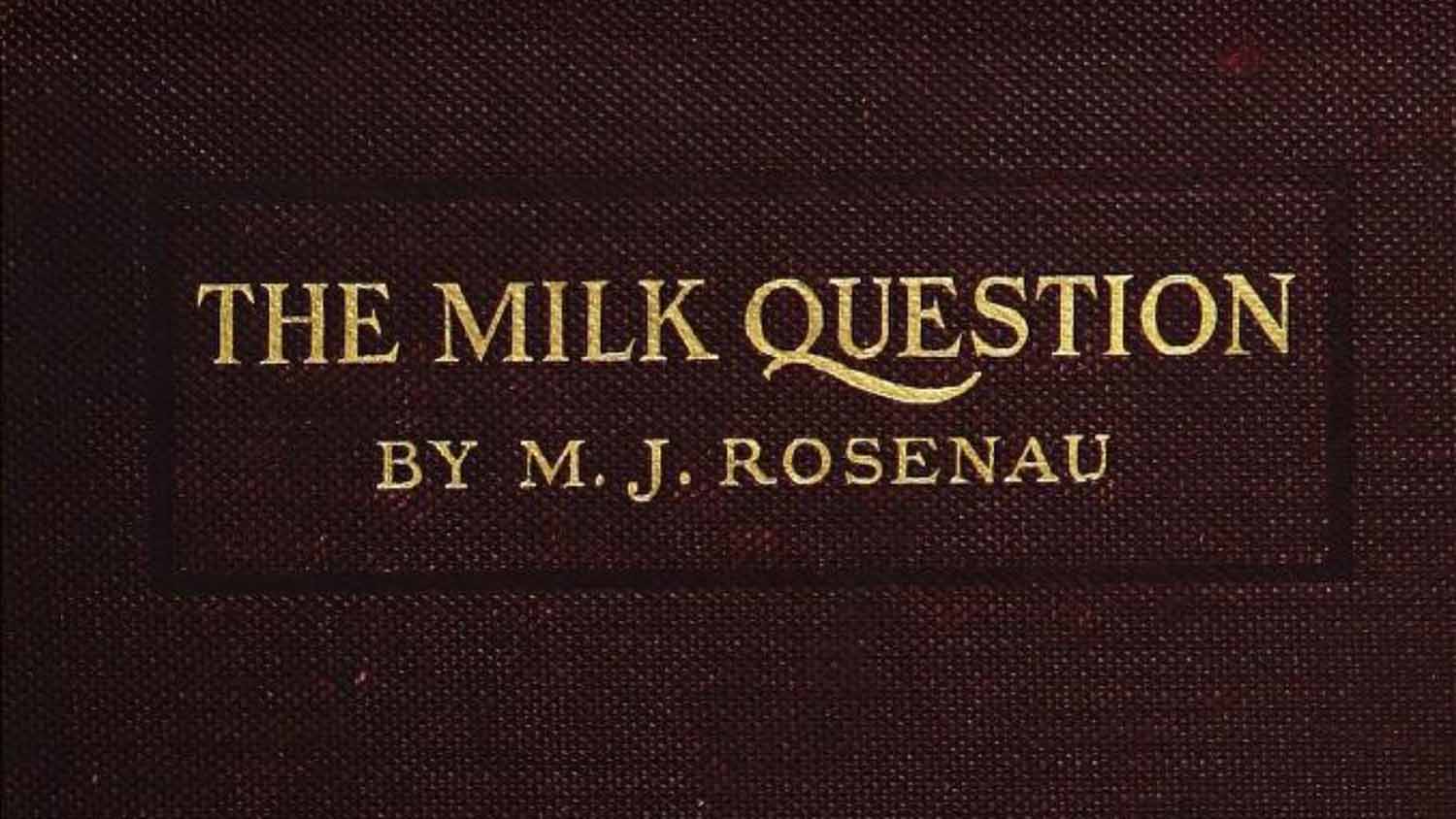
In November 1912, Houghton Mifflin published a book that would become the most comprehensive single document ever written about the safety, politics, and science of milk in America. Its author was Milton J. Rosenau, Professor of Preventive Medicine and Hygiene at Harvard Medical School, former director of the U.S. Hygienic Laboratory, and the scientist who had solved the taste problem standing in the way of nationwide pasteurization. Its title was The Milk Question.
The book went through six editions between 1912 and 1935. It was reviewed in Nature in 1913 and cited in the medical literature for decades. The pasteurization chapter, organized around three consecutive section headings, contains Rosenau’s explicit argument that pasteurized milk is not synonymous with good milk, and that clean production is superior to heat treatment as a goal.
The full text is in the public domain and can be read at the Internet Archive: archive.org/details/cu31924002934861.
Rosenau and Low-Temperature Pasteurization
Milton Joseph Rosenau was born in Philadelphia on January 1, 1869, to Nathan Rosenau and Mathilde Blitz, German Jewish immigrants. He received his medical degree from the University of Pennsylvania in 1889 and joined the United States Marine Hospital Service in 1890. Over the next decade he served as a quarantine officer in San Francisco (1895-1898) and in Cuba (1898), then was named director of the Marine Hospital Service’s Hygienic Laboratory in 1899, a position he held for ten years.
The Hygienic Laboratory was the federal government’s primary biomedical research institution, the forerunner of what would become the National Institutes of Health. Rosenau transformed it from a small operation into a functioning research institution with separate divisions in bacteriology, chemistry, pathology, pharmacology, zoology, and biology. He published on yellow fever, malaria, typhoid, poliomyelitis, disinfectants, anaphylaxis, and vaccine quality. But the subject he returned to most persistently, across his entire career, was milk.
By 1900, pasteurization had been technically possible for decades. Louis Pasteur had demonstrated the principle of heating liquids to kill microorganisms in 1864. Franz von Soxhlet, the German chemist who first fractioned milk proteins into casein, albumin, globulin, and lactoprotein and who first identified lactose as the sugar in milk, had proposed applying pasteurization specifically to milk in 1886. The obstacle to widespread adoption in the United States was not scientific but sensory: the high temperatures then in use produced a cooked flavor that consumers rejected.
Rosenau’s contribution was to solve this problem. Working at the Hygienic Laboratory, he established that low-temperature, slow pasteurization at 140 degrees F (60 degrees C) held for 20 minutes was sufficient to kill pathogenic bacteria without producing the cooked taste. He published this finding as Hygienic Laboratory Bulletin 42, “Thermal Death Points of Pathogenic Micro-Organisms in Milk,” in 1908. The CDC’s Morbidity and Mortality Weekly Report, in a 1999 profile of Rosenau, places the research itself in 1906, suggesting the experimental work preceded publication by roughly two years. Between 1890 and 1927, at least 31 different time-and-temperature combinations were proposed for pasteurization; Rosenau’s 60-degree/20-minute recommendation was one of the foundational reference points that ultimately shaped policy.
In 1909, Rosenau resigned from the Hygienic Laboratory and joined Harvard Medical School as Professor of Preventive Medicine and Hygiene. He co-founded the Harvard and MIT School for Health Officers in 1913 and directed Harvard’s epidemiology program from the founding of its School of Public Health in 1922 until 1935, when he moved to the University of North Carolina to help establish its public health school, serving as its dean until his death in 1946.
When he delivered the N.W. Harris Lectures at Northwestern University in 1912, the lectures that became The Milk Question, he was at the peak of his institutional authority: the former director of the federal government’s primary research laboratory, now at Harvard, who had personally established the technical parameters for the pasteurization method he was also publicly advocating.
He dedicated the book to Nathan Straus.
Why He Wrote It
The N.W. Harris Lectures were founded in 1906 by Norman Wait Harris of Chicago “to stimulate scientific research of the highest type and to bring the results of such research before the students and friends of Northwestern University, and through them to the world.” Rosenau was selected to deliver the 1912 lectures, and he chose milk as his subject.
He opened by asking why there was a “milk question” at all, why milk, unlike bread, grain, fruit, or vegetables, had become politically contested, publicly regulated, and the subject of ongoing scientific and civic debate. His answer came down to three factors.
The first was that milk was a necessary article of diet. Cow’s milk had become, in his assessment, indispensable to Western children and important to adults.
The second was that milk was uniquely difficult to handle safely. “It requires scrupulous care from pasture to pail, and from pail to palate,” he wrote. It was the most perishable of standard foods, spoiling faster than fresh fruit or berries, and the most vulnerable to contamination at every stage of production, transport, and delivery.
The third was the one that concentrated the danger: milk was almost always consumed raw. Rosenau estimated that roughly ninety percent of all food consumed by Americans was cooked before eating. In his framing, cooking destroyed pathogens and was the most important hygienic safeguard in human history. Milk was “the only important nitrogenous animal food commonly used without cooking.”
A 1909 Public Health Service study had catalogued 500 outbreaks of milkborne disease in the United States between 1880 and 1907. That figure was the backdrop against which Rosenau was writing.
What the Book Covered
The Milk Question ran to 309 pages across eight chapters and was written, as the Nature reviewer noted in 1913, “in simple language” designed “for the educated public generally.” The reviewer also noted that Rosenau had unusually done something most sanitary reformers failed to do: approach the milk question from the producer’s point of view as well as the public health regulator’s.
The table of contents alone communicates the scope of the project. Chapter I established the general framework and the economic context. Rosenau opened by noting that in 1910 there were more than 22.7 million milch cows in the United States, valued in aggregate at approximately one billion dollars, making the dairy industry among the largest in the country. Chapter II covered milk as a food: the physiology of lactation, milk composition and variation, the chemical constituents, enzymes, colostrum, and the differences between cow’s milk and human milk.
Chapter III addressed what he called “dirty milk”: the bacteriology of contamination, where bacteria came from, what kinds were present, what bacterial counts meant, and how legal standards had developed. He included data on leucocytes, the germicidal properties of fresh milk, and the biology of how milk spoils.
Chapter IV covered diseases transmitted through infected milk in systematic detail: tuberculosis (and the distinction between human and bovine tuberculosis), typhoid fever, scarlet fever, diphtheria, septic sore throat, milk sickness, foot-and-mouth disease, mastitis, and Malta fever. He reproduced typhoid outbreak maps, including a diagram showing the relation of milk routes to typhoid cases in Stamford, Connecticut in 1895, and tabulated milk-borne disease statistics from Greater Boston: 72 cases of diphtheria in 1907, 717 cases of scarlet fever in 1908, 400 cases of typhoid in 1909, 842 cases of scarlet fever in 1910, and 2,064 cases of amygdalitis in 1911, for a running total of more than 4,000 cases over five years from a single city’s milk supply.
Chapter V covered the production and inspection infrastructure: raw milk, certified milk, Dr. North’s plan, inspection methods, the score-card system, federal and state oversight, and the milk license.
Chapter VI was the pasteurization chapter, and the one where Rosenau’s position was most precisely articulated.
Chapter VII addressed infant mortality, and Chapter VIII moved from farm to consumer: the economics of dairy farming, milking technology, the middleman, household care of milk, grades and classification, milk standards, and an extensive treatment of milk products including cream, ice cream, butter, skim milk, buttermilk, condensed milk, and powdered milk. The final sections covered milk bottles, transportation, labeling, legislation, scientific research priorities, and what Rosenau called “the solution of the milk problem.”
The Certified Milk Section
Henry Leber Coit had founded the first Medical Milk Commission in Essex County, New Jersey in 1893, and by the time Rosenau was writing, the certified milk movement had spread across dozens of American cities. Rosenau devoted substantial space to it in Chapter V.
He was respectful of what certified milk represented. The certification system demanded tuberculin-tested herds, veterinary inspection, medical examination of dairy workers, strict bacterial count limits, and rigorous handling protocols at every stage from barn to bottle.
The first farm to operate under a Medical Milk Commission certificate was Fairfield Farm in Caldwell, New Jersey, which began producing certified milk in 1893 under Coit’s original Essex County commission. By the time The Milk Questionappeared nearly twenty years later, the model Fairfield had pioneered had been adopted by commissions in cities from Boston to San Francisco.
Rosenau acknowledged the certified milk model as proof that rigorous production standards were achievable, while noting that its cost placed it out of reach for the urban populations most affected by contaminated milk supply.
The Infant Mortality Chapter
Chapter VII is where the statistical stakes of The Milk Question become most visible. Rosenau drew on data from infants’ milk depots, the subsidized distribution programs Nathan Straus had pioneered in New York beginning in 1893 and that had since spread to dozens of American cities, to document the relationship between milk quality, feeding method, and infant survival.
The central concern was bottle-fed infants. Breast-fed infants, as Rosenau documented through mortality charts comparing the two groups, survived the summer months at substantially higher rates than artificially fed infants. The gap widened in summer, when ambient temperatures accelerated bacterial growth in milk and contaminated supply had the most acute consequences. Rosenau reproduced a chart showing the relative mortality of breast-fed and bottle-fed infants across the summer months.
Straus’s depot programs distributed pasteurized milk at subsidized prices. Rosenau’s analysis of the depot data showed reductions in infant mortality in cities where programs operated, which he attributed to the improved quality of the milk supplied relative to what those families would otherwise have had access to. He framed this not as evidence that pasteurized milk was inherently superior to clean raw milk, but as a consequence of clean raw milk being unavailable at scale for urban working-class populations in 1912.
The role of Abraham Jacobi, widely regarded as the father of American pediatrics, sits just behind this chapter. Jacobi had advocated for heating infant milk as early as the 1870s and his clinical influence helped establish the intellectual framework within which Straus’s depot model operated. Rosenau’s infant mortality analysis built on decades of pediatric argument that Jacobi had pioneered.
“Pure Milk Is Better Than Purified Milk”
Chapter VI, the pasteurization chapter, is where Rosenau’s position on the limits of pasteurization is most precisely stated. He was unambiguous that pasteurization was necessary as a public health measure given the conditions that prevailed, calling it the most important single preventive measure in the field of sanitation after water purification.
Rosenau organized Chapter VI around a sequence of claims, each given its own section heading. Two of them, placed consecutively, read: “Pasteurized Milk Not Necessarily Good Milk” and “Pure Milk Is Better Than Purified Milk.” A third heading followed: “Preventive Measures Are Better Than Corrective.”
These section headings reflected the structure of Rosenau’s argument. Pasteurized milk, in his framing, simply meant heated milk, not a synonym for clean milk, good milk, or pure milk. Heating milk that had been produced under poor conditions, stored improperly, or allowed to accumulate high bacterial counts before treatment produced milk that was safer than untreated contaminated milk, but still degraded milk. Pasteurization corrected the problem of contamination after the fact rather than preventing it in the first place.
Rosenau stated that clean production was the superior goal and pasteurization a practical measure for the conditions prevailing in 1912.
Six Editions Over Twenty-Three Years
The Milk Question ran through six editions between 1912 and 1935.
The first edition appeared in November 1912, published by Houghton Mifflin as part of the N.W. Harris Lecture series. Within months it was being reviewed internationally: Nature published its assessment in July 1913, the same month a British edition appeared through Constable and Co. in London. The Nature reviewer, R.T. Hewlett, noted that while the book “embodies American views and practice, a great deal of it is applicable to our conditions,” meaning the British milk question, and praised Rosenau for understanding the producer’s perspective as well as the regulator’s.
By 1936, the CDC would later note, pasteurized certified milk had become the standard in most large American cities, though over half of all milk consumed in the United States was still raw at that point. The Milk Question remained in print as a reference text through that transition.
Context in the Founding Period
The Milk Question serves as a primary synthesis of the debates that shaped American dairy policy between the 1880s and the 1930s. Nathan Straus, whose depot system Rosenau dedicated the book to, appears throughout the infant mortality chapter. Henry Leber Coit and the certified milk movement he founded occupy a substantial portion of Chapter V. Franz von Soxhlet, whose 1886 proposal to pasteurize milk preceded Rosenau’s low-temperature research, is part of the historical foundation the book draws on. Abraham Jacobi, whose advocacy for heating infant milk dated to the 1870s, is part of the intellectual lineage behind Rosenau’s infant mortality analysis. The book is available in full through the Internet Archive at archive.org/details/cu31924002934861.